
I first attended WiccanFest at 18 years old. It was a fixture of my life for all my 20s and early 30s.
For a variety of reasons, I stopped attending, for fifteen years.
I sometimes feel like a misfit in the pagan world. I’m straight, middle-class, neuro-typical, able-bodied, and middle-aged, in a community that is, compared to the over-culture in which we live, disproportionally more queer, more neuro-diverse, and more ‘woke’.
Not only that. People come to the pagan world because it accepts those who say they’ve had ghost sightings, spirit possessions, omens, prophetic visions, visitations from gods or ancestral spirits, and so on. Those things don’t happen to me.
I sometimes have the sense of being watched; I sometimes have the feeling that someone’s listening to the things I say into the darkness… but that’s really all.
This year, with the encouragement of several friends, I returned to my first festival.
What is a nerdy and introverted academic doing at a place like this?
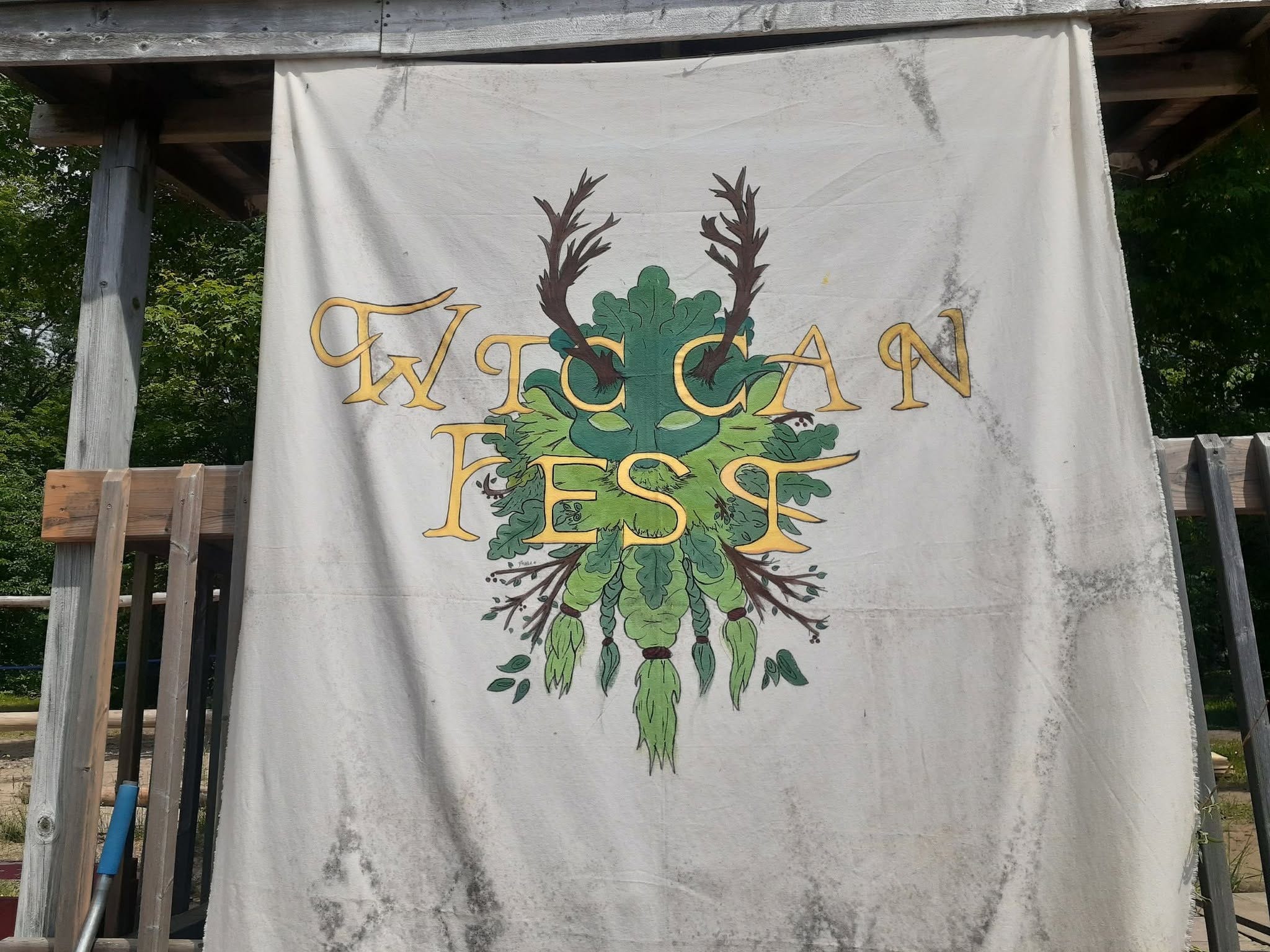
[The banner at the festival fire pit. My own photo.]
I’m following three things which I think form the core of the modern pagan experience.
And it’s not the ritual, not magic-making, and not the psychic-supernatural encounter.
But if not those things, what remains?
First: the fire pit.
I think back to my late teens, and my first attendance at Wiccan Fest. It’s dusk. There are tiki-torches lighting a narrow path from the main gathering field, through a thick and swampy area skirting the edge of a pond, and past the bridge to Toad Island. As I process down the trail, the sounds of drums grows louder. Soon it is joined by voices: some in excited conversation, some of them singing a round.
The trail opens to a gravel pit. I get my first glimpse of the fire at its centre, between perhaps a hundred people gathered round it. There’s an outer circle of observers, friends, and revellers. They’re talking, sharing food and drink, and getting to know each other. I shake hands with a few of them who I know. Others come to hug me. I find a way through that outer circle to the middle one: the drummers. That’s where I like to settle: me and my little orange djembe, with perhaps twenty better drummers to my left and right. I look around for the natural leaders: those who can call a tune and move others to follow it; the human metronomes who keep everyone on time; and the improvisers and jazz-blasters who keep it weird and wild.
The inner circle is made of dancers. Every age, every state of health or ill-health, every gender, every identity, all moving and spinning clockwise around the common fire. Some dressed in fun witchy outfits, some in the same clothes they’d wear to work, some in only the skin they were born in. Some moving slow and self-conscious, while others exuberant and entranced. Yet everyone so comfortable in their own skin. Everyone so accepting of each other’s expressions. The sand thrumming with their steps. The presumption of friendship with strangers. The sparks from the fire rising to join the stars in the sky.
There is nothing else quite like it, in my experience of life. I’ve attended pagan events in six out of ten Canadian provinces, three American states, and four European nations. And from what I have seen, nobody does a fire pit like we do at pagan festivals in Ontario.
For who I was, as a younger man, drawn to the fire pit for the first time, more than thirty years ago: it was an excellent place to learn what human bodies look like, in all their wild diversity of sizes, shapes, colours, abilities. What a wonderful place to learn what human bodies can do: how we can move, make music, touch, sing, scream, and play the drum, for hours upon hours at at time.
(Also, what a good place to learn about what bodies can not do, such as consume more alcohol than is reasonable, or chase people who do not want to be chased. But that’s another story.)
This leads to a second thing which I think we find at the core of the modern pagan experience: the sense of the mythic.
The sense that we are, always and everywhere, surrounded by an Otherworld.
The sense that there might be a realm of animism supervening upon and within the embodied world. The sense that there might be pantheons of gods watching over us, guiding us sometimes, or sending difficult lessons. The sense that the land here knows who we are, and loves us. And the sense that we are involved in relationships with them: we are all implicated with each other, entangled, entwined, embedded with each other.
I sometimes think it isn’t necessary to hold any religious or supernatural beliefs in order to grasp the sense of the mythic. For it is as much a function of rhetoric, as it is a function of perception: we talk as if that sense of the mythic informs our perceptions of the world, and we explore life-lessons and moral teachings that emerge from that way of talking. A friend at this year’s fest said that a certain amount of suspension-of-disbelief can be involved in ritual: not to say that we’re faking it, but rather to say ‘what if?’
The sense of the mythic is one of the things that drew me to the pagan world, thirty-plus years ago. The sense that the world is much larger than it may seem, and that its hidden fields can be discovered in practices like tarot card reading or ecstatic-trance dancing.
I wanted to believe that, back then.
The sense that by drumming and dancing around the fire, we could save the world.
I wanted to believe that, too.
Which leads to a third core experience of modern paganism: rebellion.
Magic, whatever you believe it to be, is the weapon of the oppressed. It’s what remains to those who have no other form of power: economic, political, social. Is the ‘energy’ of magic real and effective? Or is it only rhetoric? In either case, it must be empowering. People are drawn to the archetype of the witch because witches have power. They are agents of change; they make things happen.
This year’s fest included a performance by Aphrodite Unbound, who have a really wonderful protest song whose chorus could be a motto of the entire movement: We Will Not Be Tamed!
The pagan world belongs to everyone. Yet it is especially crafted and prepared for those who are excluded. It is the circle for the misfits, the nonconformists, the marginalized, the rejected, the unwanted, the broken, the hurting. Even the mad. It is especially prepared for those who refuse to be tamed by landlords, bosses, parents and families, preachers and priests, school teachers and college profs (gods help me, I’m a college prof!), the whole network of patriarchy, the whole process of disenchantment, or any other form of authority. It gives those forces a great big middle finger, and then runs off to the woods to build fire pits.
It says to everyone who comes to that fire: I hear you, I see you. Welcome, and enter! You are wanted here, just as you are. You belong here. You are loved here.
Which returns my meditation back to my place in the pagan world. How do I feel about attending the fire pit at Wiccanfest, for the first time in fifteen years?
It is rather like asking what should I make of the person I became, here in my early 50s, as compared to the person I wanted to be, back in my 20s, attending the festival for the first time.
I grew into a different kind of life, in those last fifteen years. A more solitary life; a more melancholic life. As mentioned, I’m not in any meaningful way marginalized or oppressed. I still don’t feel “energy” like many of my pagan friends say they do. And my history in the pagan world has not always been so happy. There are people who I’d rather avoid; there are people who’d rather avoid me. Such things still haunted my mind, during my time there.
But for the first time in fifteen years, I played my little orange djembe round that fire, surrounded by people who were glad to see me. Some of them, who I’ve known and loved for decades.
These days: that’s all the magic I need.
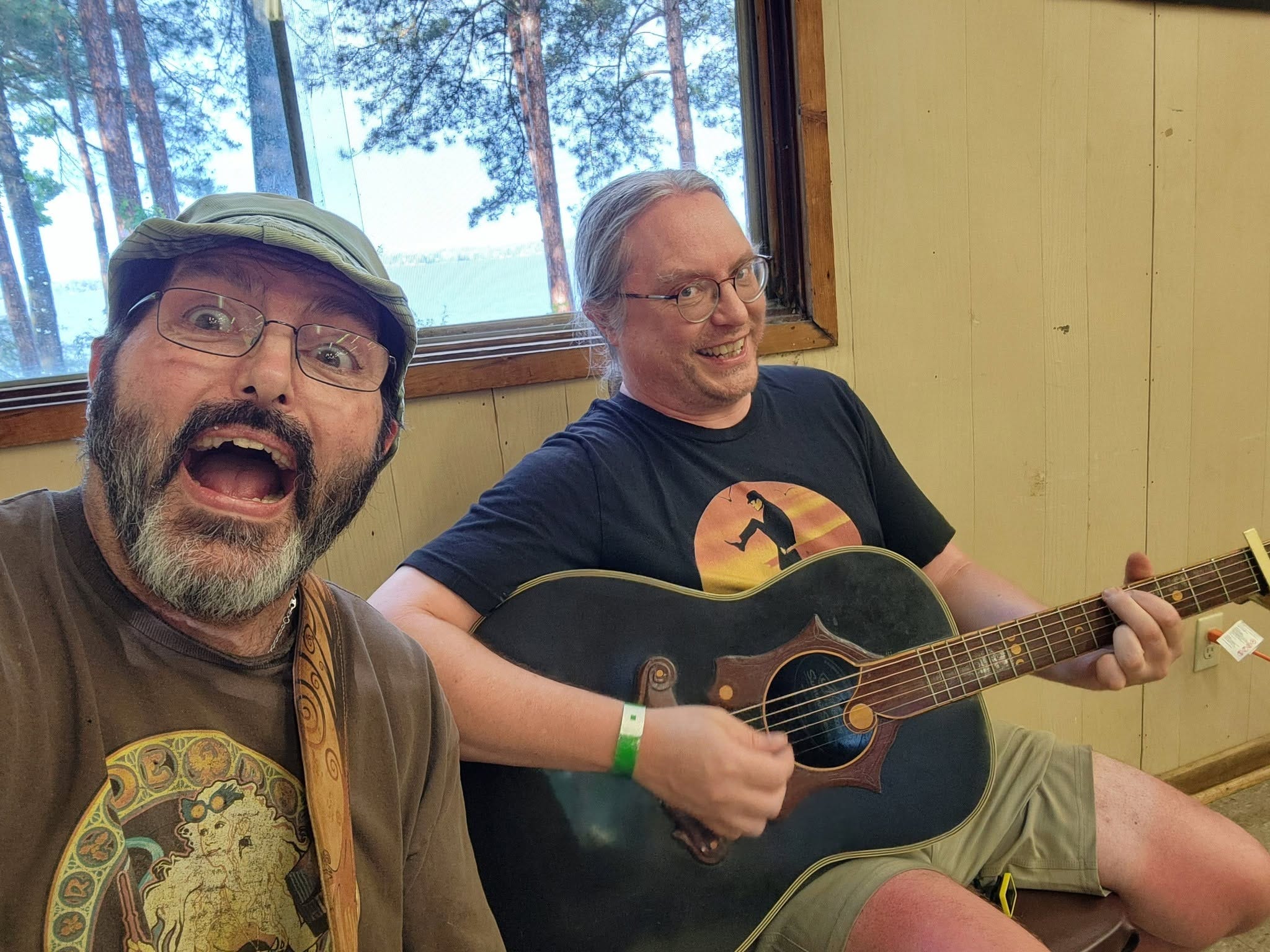
[Me on the right with the guitar and the sunburned legs. My dearest brother Greg Currie, on the left. We’re playing music in the dining hall. Photo by Greg.]
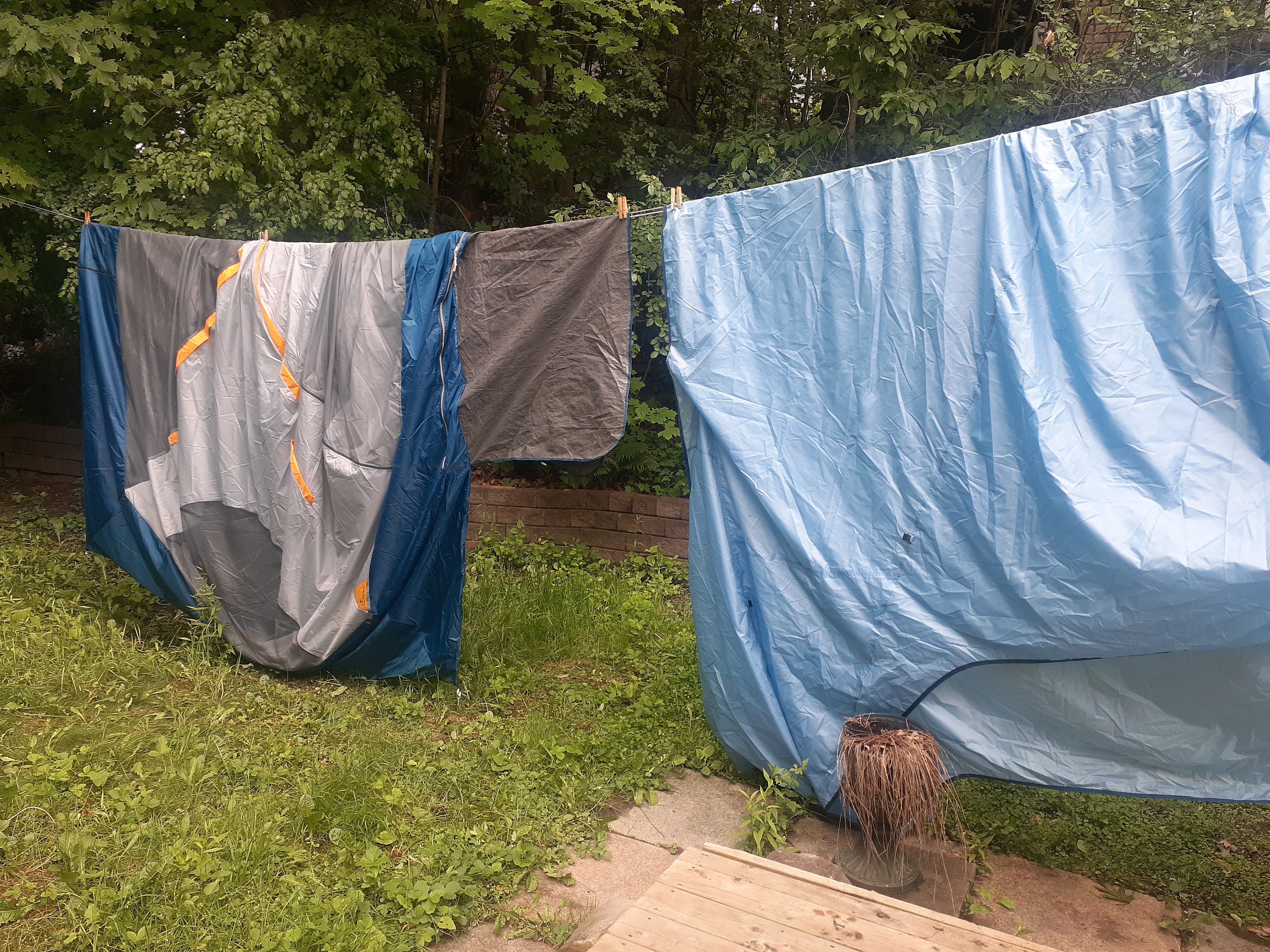
[And on my first day back home, I hung up my tent and rain-fly on my laundry line to dry!]
No posts
Comments
Nothing yet. Say the first thing.
Sign in to join the conversation.