
We all dwell in a system of ecological conditions; the human being is always and necessarily an organic, embodied, biological being, embedded in food webs and ecological processes; the human organism is “a transformation-station for energy” (to use Aldo Leopold’s words). This dimension of the human being depends upon the surrounding ecology for air, water, food, warmth, and other means of life. Its foundation both lies in the earth and flows from the sun. The ethical, epistemic, and metaphysical significance of humanity’s being-ecological, as I shall call it from here on, is precisely what environmental philosophy aims to understand.
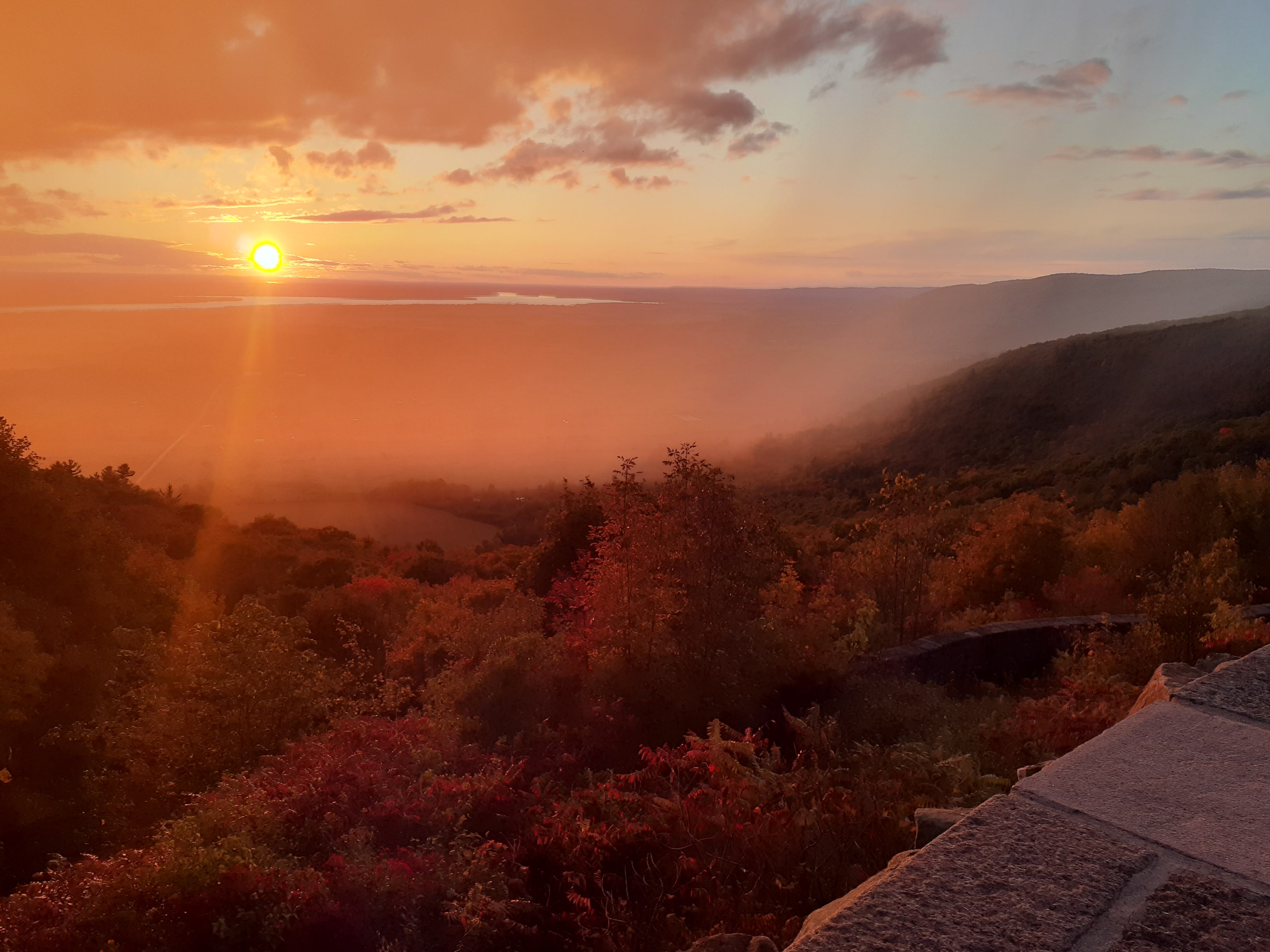
[Image: Sunset at Champlain Lookout, Gatineau Park, 2024. My own photo.]
Yet there are more forms of humanity’s being-something than our being-ecological. The human being is also a subjectivity, an unmoved mover for at least some of her actions, a causa-sui for at least some of her consciousness: in sum, a free being. This is the human being who reasons and knows, who values things and pursues them, who “surges up in the world” (to use Sartre’s phrase), who defines herself and defines the meaning of her life. This is the human being conditioned by freedom; the human being-free. This condition of the human reality has the most prestige in Western culture and civilization today.
[Image: Air force acrobatics jets flying over my house, 2024.]
There is a tension between our being-ecological and our being-free. It is the tension between the being who is a member and plain citizen of the biotic community (to paraphrase Leopold again), and the being who realises herself through reasoning, knowing, valuing, choosing, associating, feeling, identifying, and doing.
In Western culture at least since the Enlightenment, we have placed our being-free at the centre of our lives. We place freedom at the foundation of human dignity, moral standing, personal identity, political sovereignty, civil rights, and even Christian salvation.
To state it in a single proposition: being-free is the essence of the human spirit. Let us consider the word ‘spirit’ here not as anything theological, not as a kind of ghost which puppeteers the body or travels to some Otherworld after death. Let us not even consider it as a kind of object. Rather, let us consider it in the older, more primal and more pagan sense of enacted virtues, especially heroism and courage, curiosity and wonder, self-expression and revelation. Your spirit is your will to knowledge, to power, to self-creation, to freedom, and to meaning.
The field that draws this spirit closest to our being-free, and at the same time furthest away from our being-ecological, is architecture, the art of building and configuring the physical dimensions of human dwelling. Austrian architect and designer Hans Hollein made this point in a 1968 manifesto called Absolute Architecture, where he announced that ‘everything is architecture’:
Architecture is a spiritual order, realized through building. Architecture – an idea built into infinite space, manifesting man’s spiritual energy and power, the material form and expression of his destiny, of his life… All building is religious.
By saying ‘religious’, Hollein does not mean any particular religious denomination. Rather, he means the will to express ourselves, and to realize ourselves in what we express. Architecture does this with stone, metal, mortar, concrete, and glass: materials that can keep their shapes and functions for longer than a human lifetime and so appear to push back against the terror of time and death.
Yet architecture is also removed from our being-ecological because every work of architecture must occupy a plot of territory on the Earth which, after the work is done, becomes a human space and no longer a wilderness. Here’s renowned architect Le Corbusier on that point:
Primitive man has brought his chariot to a stop: he decides that here shall be his native soil. He chooses a glade, he cuts down the trees which are too close; he levels the earth around; he opens up the road which will carry him to the river or to those of his tribe whom he has just left… The road is as straight as he can manage with his implements, his arms and his time. The pegs of his tent describe a square, hexagon, or octagon. The palisade forms a rectangle whose four angles are equal. The door of this hut is on the axis of the enclosure… It is the spirit indeed of the Temple of Luxor. There is no such thing as primitive man; there are primitive resources. The idea is constant, in full sway from the beginning.
So architecture, according to Le Corbusier, pushes back, not only against the frontiers of time and death, but also against the frontiers of nature and wilderness. This pushing-back is one way the human spirit works itself out; it’s one of the ways we realize ourselves as being-free.
Philosopher Karsten Harries, a specialist in the philosophy of art and architecture, summarized both Hollein and Le Corbusier in a single elegant proposition: “to build is to appropriate and humanize nature”.
Monuments, in particular, according to Harries, “celebrate the time-transcending greatness of the human Spirit as a source of continuing meaning.” But any building is a kind of monument in that sense: any building that we raise up, with the intention that it should last, is an act of defiance against the impermanence of things, and thus “an act of spiritual self-assertion”.
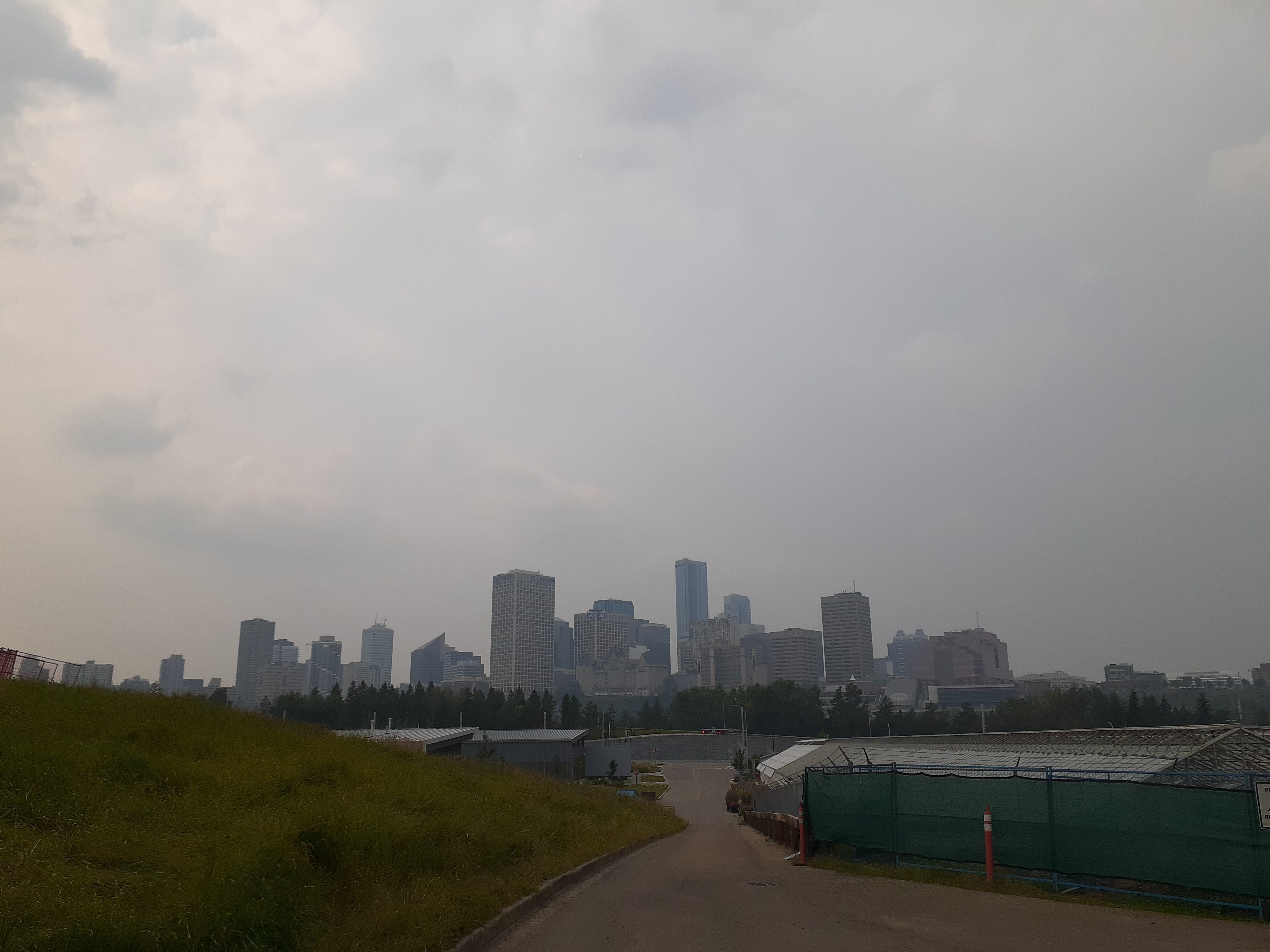
[Image: city of Edmonton, Canada, in 2024. My own photo again.]
Apart from a few non-mainstream worldviews that say otherwise, discussions of the human spirit in Western philosophy tend to go as I have described here. They tend not to dwell with our being-ecological.
Notice The Tension:
Our being-ecological, though possessing its own kind of dignity, places us in a trophic structure of symbiote and predator and prey, one species among many, always vulnerable to natural hazards no matter what we do, and subject to evolutionary forces which have no driver and no design.
Our being-free attempts to lift us out of that trophic structure. And if not to set us on top of it, our being-free aims to liberate us from it, and place us as far as possible beyond it and apart from it.
Our being-free is an expression of the human spirit. Our being-ecological is an expression of the Earth, its ecosystems and organic functions, and the process of natural selection, of evolution.
Our being-free says we’re special. Our being-ecological says we’re not.
Thus our being-ecological and our being-free are radically different in meaning. Yet both are constitutive of the human being taken as a whole. You see the tension here!
Yet both of these forms of human being are threatened by the climate crisis, although in different ways.
Our being-ecological, having been disrupted by industrial resource extraction and poisoned by consumer and industrial waste-outputs, is now weaponized against us.
And our being-free faces a kind of Kantian self-contradiction. For while the climate crisis is, I shall say charitably, no one’s deliberate intention, nonetheless it was brought about by an aggregate of free choices made by free beings whose freedom is now diminished precisely because of those freely-made choices. Our being-free is diminished in precise proportion to the damage that the crisis inflicts on our being-ecological, and in proportion to the willed ignorance that our being-free adopts concerning its own responsibility for the crisis.
My aim is to consider what to do about the tension. I want to understand who we are as human beings, what we have become, what we might become, and what we should become, as we face and respond to the Earth, our oasis in the desert of the cosmos, and our home.
[An expanded and fully footnoted version of this text appears as a chapter in my book, The Circle Of Life Is Broken (Moon Books, 2022.) Click here to buy it on Amazon, or click here for more info.]
No posts
Comments
Nothing yet. Say the first thing.
Sign in to join the conversation.