
Welcome to Awakening Minds—a place for open and discerning minds with a metaphysical leaning. Other ways I can support you:
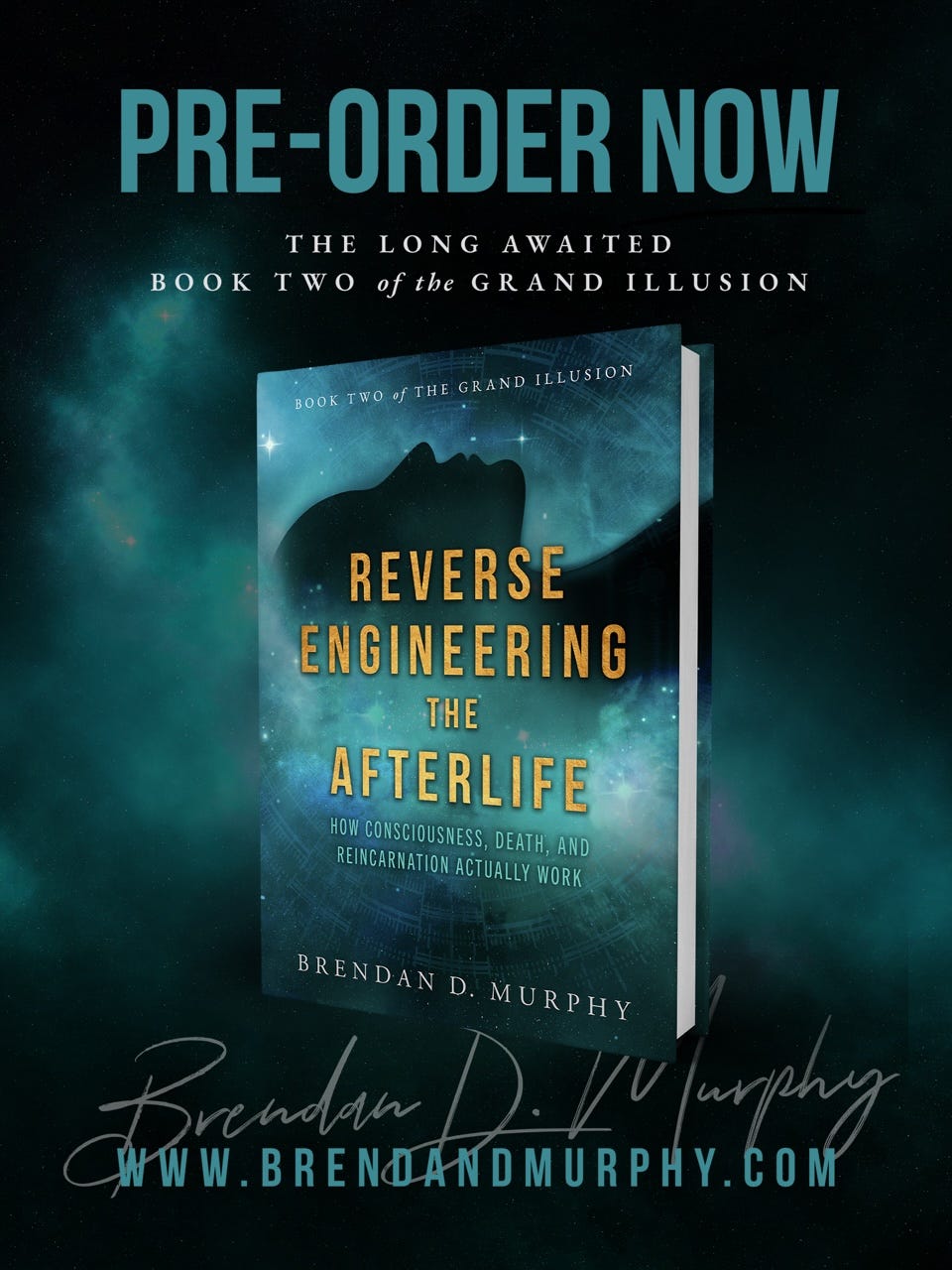
Be first in line to access the groundbreaking Book 2 of THE GRAND ILLUSION series
Experience the “revolutionary healing science expanding the boundaries of being.” (NEXUS mag) > EVOLVE YOURSELF biofield activations.
Read THE GRAND ILLUSION: A SYNTHESIS OF SCIENCE & SPIRITUALITY - Book 1 📘 10,000 hours of life-changing research—distilled
Grab a paid subscription for full access (includes starting Chat threads, access to all audio versions 🎧 + comments on all pieces). Paid members get direct access to me and priority conversation in Chat.
This Isn’t It
I want to let you in on something.
The “panoramic life review” is not the skeleton key to understanding the afterlife or survival of consciousness.
Do you think a single unified model of the afterlife is even possible—or does the diversity of cross-cultural experience make that a fool’s errand? 🤔
I guess I must be a fool… *Grin*
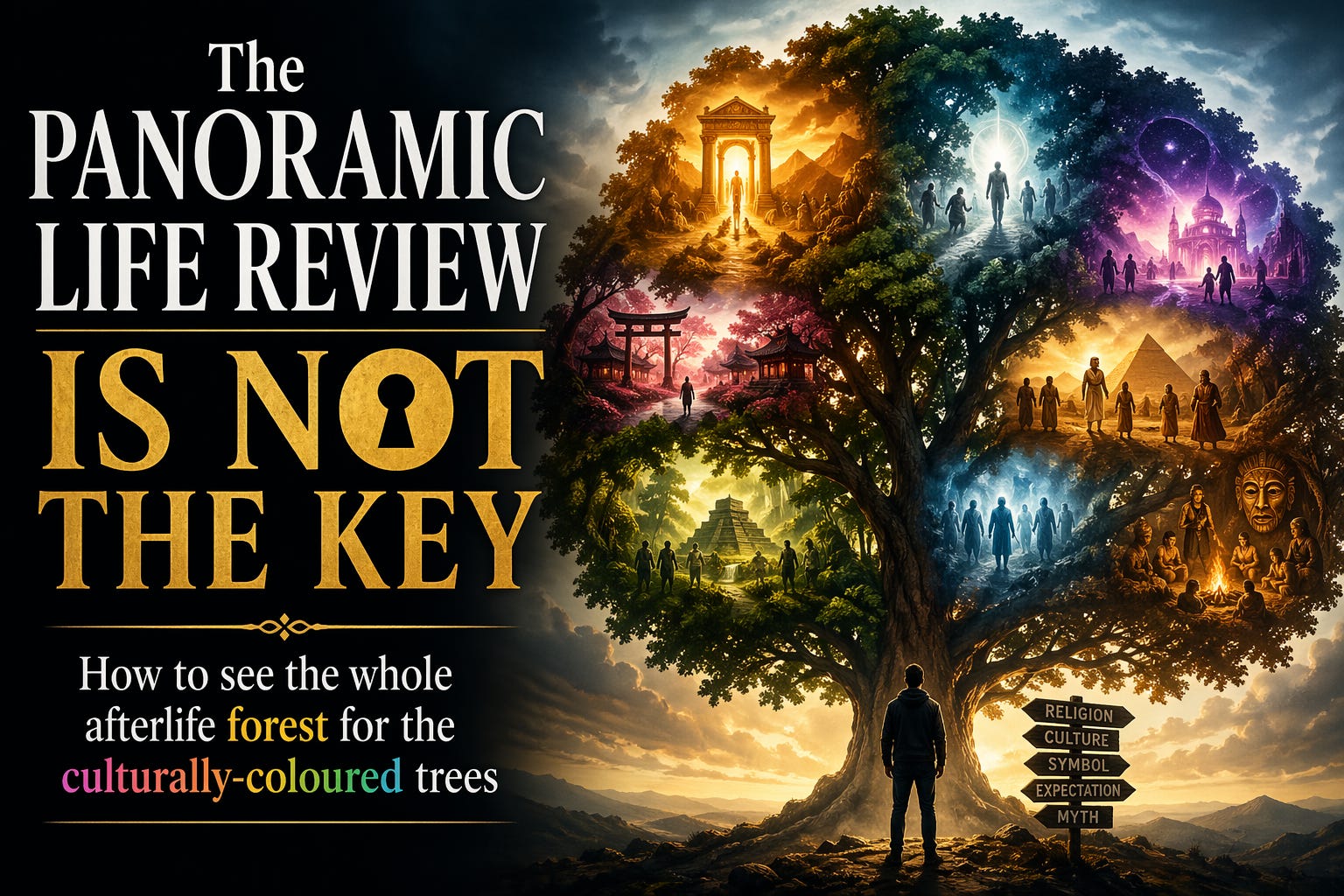
This may be neither here nor there to you, but some people have fixated on this single puzzle piece—the life review—to the detriment of a broader view of a transpersonal and cross-cultural system that displays culturally-influenced inflections; idiosyncrasies stemming from culture-bound time and place.
NDEs exemplify that dynamic through what researchers call cultural embeddedness. In other words, people tend to have their NDEs (and other altered state experiences) shaped by their life experience, cultural memes, religious beliefs, etc.
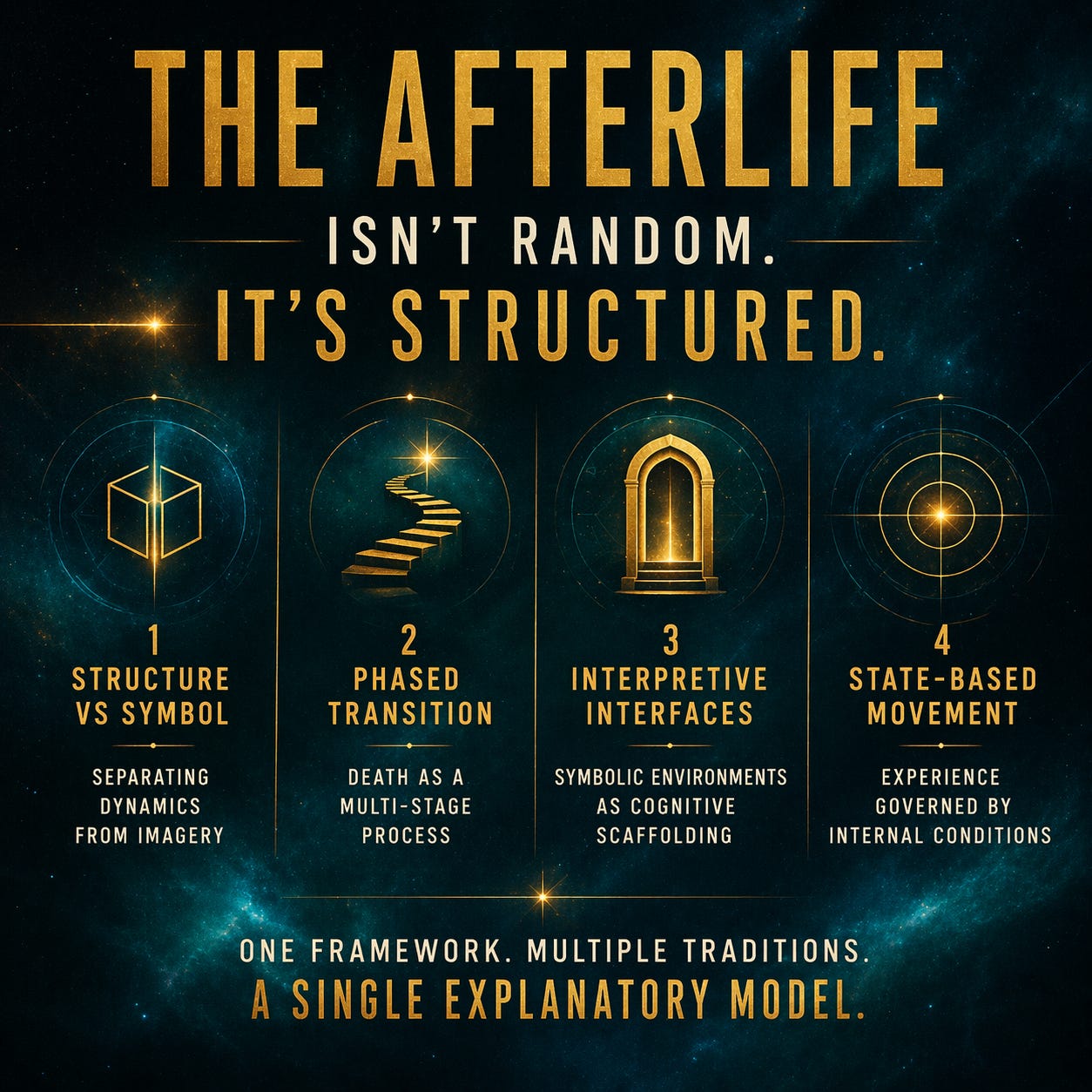
The mistake is assuming culture creates the experience. In CTM terms, culture behaves more like a rendering layer—a constraint system that shapes how non-local processes within field-based consciousness/mind are displayed to the experiencer.
Same underlying process → different symbolic output.
What I've done in my own work is try not to lose sight of the forest on account of any single tree, but rather, to build a forest (model) that accounts for ALL the trees.
This is no easy task, as you can clearly see, given that there appears to be no one else in the field—outside of one of my colleagues and collaborators who features prominently in Book 2—who has made any real progress with it.
Most, in fact, never even try.
People—even the extremely intelligent ones—generally end up in their own preferred rabbit holes and pet theories and colossal blind spots that a wider view would prevent.
Most scholars simply avoid seriously grappling with the metaphysics their own data invites them to consider. As if the pursuit of truth somehow undermines one’s academic “credibility.” Or maybe it’s just too much of a time crunch?
Recently NDE researcher Anthony Peake publicly (and very courageously) walked back his own afterlife theory based on the devastating realisation that the panoramic life review does not feature in ALL cultures across all times.
“Back to the drawing board,” were his exact words. (I applaud the honesty!) This came from one of the FEW serious investigators who has at least tried to reconcile modern scientific insights with raw human experience (e.g. NDEs)—someone who actually took post-mortem ontology seriously.
In my Conciousness Transition Model (CTM), the life review isn’t a mandatory feature of “the afterlife”—it’s a specific type of system-level feedback event that occurs under certain constraint conditions.
Change the constraints → the review doesn’t render (or it doesn’t render in the same way).
This revelation of Peake’s came through his discovery of Dr Gregory Shushan's excellent historical study on the NDEs and afterlife concepts of ancient cultures around the world (Sumerian, Chinese, Egyptian, etc.). The book is called “Near-Death Experience in Ancient Civilizations”.
For what it’s worth, I never agreed with—nor was I able to make sense of—Peake’s theory that, at the moment of death, the psyche re-enters the life just lived—effectively locking into a recursive loop of that same lifetime, not as a replay, but as a re-lived experience from within.
The evidence actually does not support that view, as readers of my forthcoming book will see comprehensively. What DOES happen, in many instances, is a rapid—or even instantaneous—immersive re-experiencing/replay of the life just lived (often time-reversed), but this is merely a temporary transition event, not the end point of a systemic process which actually extends further into post-mortem consciousness.
Peake’s model struggles with variation in post-mortem reports, partly because it obscures the overall forest with a few select trees. As a historian, Shushan doesn’t “disprove” Peake directly—he removes the universality Peake’s model depends on.
That model requires the life review to be structurally central. In reality, the data shows it’s culturally contingent—and that’s the fracture. What Shushan’s work makes clear is that the panoramic life review—often treated as a core feature of the death process—isn’t universal at all.
Last year I read Shushan's 2025 release, so it was already familiar territory to me by the time Peake announced that his foundational ideas had just been shipwrecked on the rocky data of Shushan’s historical study. I appreciated the seriousness of Shushan’s extensive historical inquiry and found it most useful in consolidating what I had already built out and largely finished.
Did I have to change any part of my metaphysics based on what his book contained? No.
Was my afterlife model adversely affected in any significant way? No.
Why? Simply because my framework already did something rare: it accounted for the variations in different cultures’ versions of NDEs and mystical experiences on the basis of logic and evidence.
Imagine finding a single model and framework that quite literally accounts for every single major researcher’s data and conclusions—and advances the broader metaphysics a quantum leap.
My work subsumes the work of: Peake, Shushan, Greyson, Ring, Tucker, Moody, Stevenson, and any other major NDE or reincarnation researcher on the public circuit. (It is also more rigorous and rational than fringe commentators such as Wes Penre and other adjacent writers still hypnotised and bamboozled by ideas of soul traps and adjacent concepts—lacking an intellectual framework to actually make sense of them and WHY/HOW the ideas originate in the first place.)
One awkward factoid that stands out to me as I survey the landscape of respected academic researchers with serious credentials is this: the absence of a unified, cross-domain metaphysics of the afterlife—including an explanatory framework and model accounting for the various diverse experiences reported over millennia by everyone from royalty to beggars.
Shushan offers a potent historical survey but stops short of proposing a fully developed explanatory model to account for the data—though his work clearly supports the survival of consciousness and is compatible with more mind-centred interpretations.
In subsuming the work of these respected (and fringe) commentators and researchers, Book 2 also takes the extra steps of integrating the wider metaphysical ideas of Plotinus, Blavatsky, Vedanta, and Gnosticism—and also *reconciles* certain aspects of these different systems that have remained conceptually disconnected. (Most researchers either stay within empirical boundaries or inherit metaphysical assumptions they never attempt to reconcile.)
Either of those alone would make this book unique in the field.
But I also reconciled Monroe’s and Moen’s OBE data and frameworks (i.e. Monroe’s Focus Levels) with Theosophical models—another awkward challenge studiously dodged by everyone, it seems. If you ever wondered how Monroe’s Belief System Territories within Focus 24-26 fitted in with the seemingly laminar “geographical” astral and mental planes of Theosophy, the contradiction disappears once you realise they’re describing the same underlying environment—just experienced in different ways, through different modes or lenses of perception.
In one case, reality is highly fluid and shaped by belief; in the other, it appears more stable and ordered. Same system—different modes of experience.
My aim here is to try to paint a picture of what I’ve built and the time and hassle and confusion it can save people. I see how the lack of a coherent metaphysics causes people to talk past each other and miscommunicate—it’s never been clearer.
This isn’t just about publishing a book—it’s about putting a coherent model into circulation that can actually move the conversation forward, past the fringe and New Age fluff, as well as the stultification of mainstream academia.
If this work resonates with you, here’s how you can help move it forward:
– Pre-order the book (this directly determines how far this reaches)
– Share this post with someone who’s wrestling with these questions
– Or simply forward it to one person who’s ready for a more coherent model
That’s how ideas like this either die quietly… or actually land where they need to.
Thousands of hours of work and pondering. And here’s the thing: even if you did spend the last 23 years researching like I have, there’s no guarantee the same insights would have occurred—these findings are NOT the inevitable result of X number of years spent on the job. They were never guaranteed. (If time on the job was the critical factor then there would be any number of weathered veterans who would have already had these insights.)
To be sure, obsession must have vastly increased my chances in obtaining the clarifications and insights featured in the book. Obsession combined with standing on the shoulders of the giants who have gone before me has brought us here.
I won’t lie: the climb up the mountain has been gruelling.
While Book 1 did have some original thoughts and insights by me, it was largely seen as a compendium and encyclopaedia. The sheer volume of synthesised material is apparently what imprinted itself on people’s minds more than anything else. Pioneering sound researcher Eileen McKusick (shout out to !) explicitly mentioned the “mind-boggling” size of the bibliography in her public review.
14 years later, Book 2 is more advanced.
While it is still somewhat encyclopaedic, it advances a more original view overall—something that has never been articulated quite like this. Encyclopaedias tend to consolidate what’s already known; they rarely attempt to build new, unified models from the ground up. Most investigators would see the scope of the multi-disciplinary dynamic of the book and surely dismiss me as a lunatic for even trying. Because when you begin to grasp the sheer scope of the task, it can look intimidating, to say the least.
And the fresh insights have continued occurring deep into what I thought were the “final” stages of spit-polishing the work. Little did I know that things would continue to crystallise—and crystallise some more.
No doubt that as I go through the final editing passes, even more will unfold.
If you want early access to what I’ve built—and to see where this is going—you can step in HERE 👈
When the pre-order campaign closes, everything premium and extra goes with it.
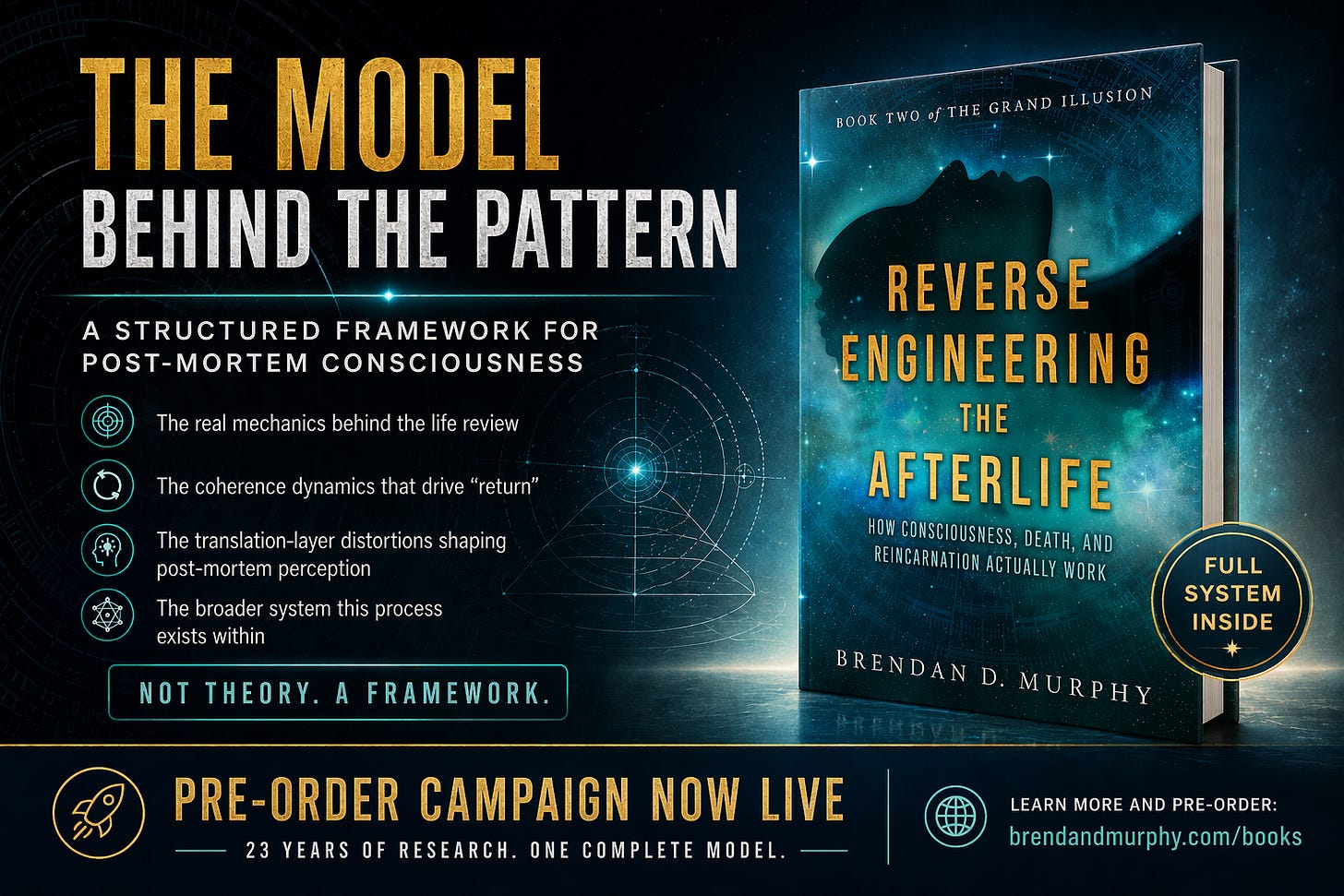
Click to pre-order your copy while premium options are still available
About Brendan & His Other Offers
Brendan is architect of the Consciousness Transition Model (CTM), an emerging framework that integrates NDEs, OBEs, and centuries of altered state observational data into a coherent map of post-mortem reality. Brendan researches consciousness and the origins of modern metaphysical narratives.
His work synthesises contemporary data with classical esoteric frameworks, most notably in Reverse Engineering the Afterlife—Book 2 of The Grand Illusion series—a landmark study into the afterlife system and rules of non-physical perception and state changes.
Grab your copy of the first volume “The Grand Illusion: A Synthesis of Science and Spirituality — Book 1” (also available as a discounted add-on in the pre-order campaign of Book 2)
It’s here. Get your pre-order in for the astonishing Book 2 of “The Grand Illusion”
Upgrade Your Internal Operating System (and Biofield)
Watch the free How to Evolve Yourself (WITHOUT Hard Work or Meditation) Masterclass to learn how this transformative evolutionary biofield activation and healing work with sound could change your world. Watch now to register and save your seat for the next live ceremony

Comments
Nothing yet. Say the first thing.
Sign in to join the conversation.