
Be first in line to access the groundbreaking Book 2 of THE GRAND ILLUSION series
Experience the “revolutionary healing science expanding the boundaries of being.” (NEXUS mag) > EVOLVE YOURSELF biofield activations.
Grab a paid subscription for full access (includes starting Chat threads, access to all audio versions 🎧 + comments on all pieces). Paid members get direct access to me and priority conversation in Chat.
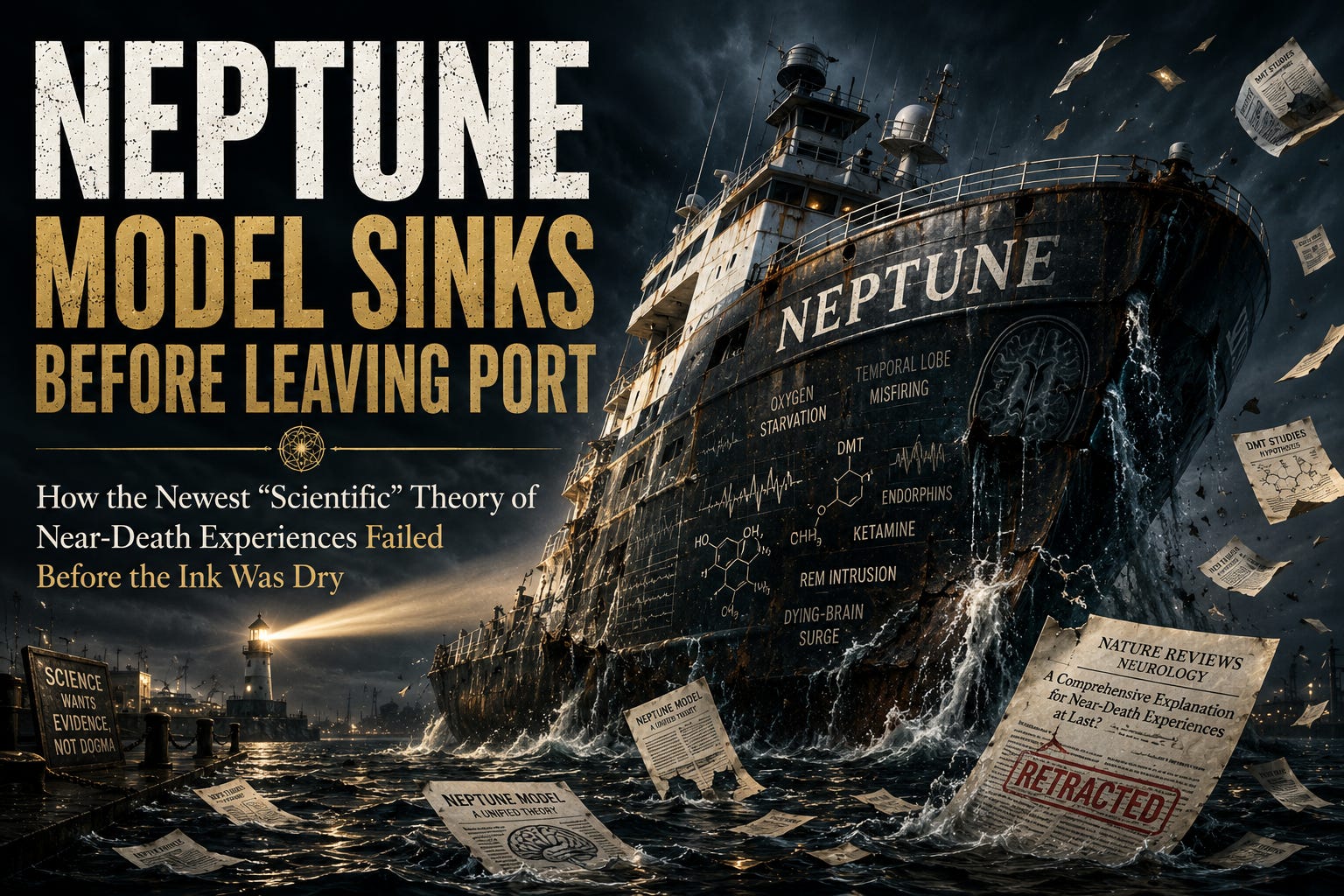
In 2025, a multinational team of neuroscientists published a review in Nature Reviews Neurology meant to settle the matter once and for all. They gathered up every physiological hypothesis ever floated to explain away near-death experiences—oxygen starvation, carbon dioxide, temporal-lobe misfiring, ketamine, DMT, endorphins, REM intrusion, the fashionable “dying-brain surge”—and bolted them together into a single grand machine. They gave it an appropriately grand name: the Neurophysiological Evolutionary Psychological Theory Understanding Near-Death Experience, or NEPTUNE. The press did what the press does, lauding a “comprehensive explanation for near-death experiences at last.”
We were to believe the dying brain had finally been decoded.
Then, in October 2025, two of the most credentialed researchers in the field—Dr Bruce Greyson and Dr Marieta Pehlivanova of the University of Virginia’s Division of Perceptual Studies—published a quiet, surgical reply in Psychology of Consciousness: Theory, Research, and Practice. Its title was understated: “A Neuroscientific Model of Near-Death Experiences Reconsidered.” Its content was not. Point by point, they showed that NEPTUNE either contradicts the data it claims to explain, or simply walks past the data it cannot.
(In other words, it does what every other piece of materialist apologetics has ever done whilst pretending not to.)
This is not a fringe blogger sniping at scientists. Greyson built the standard clinical instrument the entire field uses—the Greyson NDE Scale. When he says your “comprehensive” model is neither comprehensive nor, in places, even consistent with the evidence, that is not merely a difference of opinion.
It’s closer to a verdict. But we don’t need to take his word for it.
I have spent a large part of Book 2 documenting precisely why models like NEPTUNE keep failing, so let me walk you through what just happened—and why it matters far more than another academic squabble.
Notice what NEPTUNE actually claims. Not that the brain is simply involved in near-death experiences—of course it is; NDEs are usually triggered by cardiac arrest, trauma, anaesthesia, or grave illness. Nobody disputes the physiological doorway. The NEPTUNE claim is stronger and sneakier: that brain activity produces the experience, full stop, and therefore that consciousness is something the brain manufactures and death extinguishes.
That is the materialist golden calf dressed up as a scientific finding. And as Greyson and Pehlivanova demonstrate, the moment you look closely, the machine comes apart.
Start with the model’s shiniest new part—the one the headlines loved most.
In recent years a handful of studies reported a late “surge” of high-frequency gamma activity in the brain around the time of death, and materialists seized on it. “There it is,” they said. “That’s the firework display that generates the white light and the life review—a final electrical spasm, nothing more.”
NEPTUNE leans on two of these studies in particular: Vicente and colleagues (2022) and Xu and colleagues (2023).
There is one small problem.
As Greyson and Pehlivanova point out, neither study involved a single patient whose heart had stopped. In the Xu study, the comatose patients were monitored after ventilation was withdrawn, but cardiac activity persisted the entire time, and not one of them showed any sign of consciousness.
The Vicente paper was a single elderly patient with a traumatic brain injury, a subdural haematoma, continual seizures, anticonvulsant drugs, dissociative drugs, anaesthesia, and anoxia—a confounding stew with no baseline recording of his normal brain—and, once again, his heart was still beating when the celebrated EEG changes occurred. The gamma activity they trumpet is also the exact signature produced by scalp-muscle spasm in the frontal and temporal electrodes, which is precisely where it showed up.
Then comes the killing detail, and it comes from Sam Parnia’s large AWARE-II study (2023), which NEPTUNE also cites. Among the patients who showed EEG patterns supposedly “consistent with consciousness,” and the patients who actually reported a near-death experience or any awareness at all—there was zero overlap. None. The people whose brains lit up didn’t report anything; the people who reported something didn’t light up.
As Greyson and van Lommel observed, that isn’t evidence that the surge is a biomarker of the NDE. It’s evidence of the exact opposite.
Here is where my own framework parts company with the lazy thinking of NEPTUNE’s authors. I do not deny these neurochemical events. In Reverse Engineering the Afterlife I treat the gamma surge, the endogenous DMT cascade, and the loosening of GABAergic inhibition as real and significant.
But they are merely the door, not the house. They mark the onset of perceptual decoupling—awareness detaching from sensory input—not the moment consciousness is manufactured. A surge of disorganised electricity in a still-perfused brain cannot account for a lucid, structured, remembered experience reported by people who, by every clinical measure, had no functioning cortex and no heartbeat.
As researcher Dirk Meijer notes, the most complex and intense experiences people report are associated precisely with reductions—or even elimination—of brain metabolism. Less brain, more experience. This is the precise opposite of what NEPTUNE needs to be true for their model to work.
The second failure is quieter and, to my mind, more damning, because it is a failure of epistemological nerve. NEPTUNE “explains” near-death experiences by quietly declining to discuss their most evidential features.
Take the out-of-body experience (OBE). To “explain” it, NEPTUNE points to studies where electrically stimulating the temporoparietal junction produces a sense of disembodiment. But as Greyson and Pehlivanova show, these induced sensations are nothing like the OBEs of an actual NDE. Under stimulation, the centre of consciousness stays inside the body; the perspective is the normal one, through the eyes; any “double” seen is static; and—crucially—the subject knows it isn’t real.
In contrast, in a genuine NDE the centre of awareness leaves the body, moves independently, perceives the scene from outside, and the experiencer insists it was more real than waking life. Most decisive of all: no electrical stimulation has ever produced accurate perception of something not visible to the physical eyes.
And yet that is exactly what veridical NDEs deliver, again and again.
The Dutch cardiac patient, deeply comatose and cyanotic, who later told the nurse exactly where she had placed his dentures and described the resuscitation room he was never conscious in. Pam Reynolds, her body cooled, her blood drained, her brainstem response abolished, who accurately described the bone saw and overheard a remark about her small blood vessels. Al Sullivan, who—from a position external to his body—watched his surgeon “flapping” his arms in a peculiar way he could not have known about—a genuine, idiosyncratic habit the surgeon had, confirmed afterward.
I devote a long stretch of Reverse Engineering the Afterlife to these cases for a reason: they are reproducible, corroborated, and reported to witnesses before verification.
Worse still (for NEPTUNE) are the Peak-in-Darien cases. In fact, these are devastating for materialist apologists: experiencers who meet a deceased relative they did not know had died—or, as in the woman who met the brother she never knew she’d had, someone whose very existence had been kept from her. You cannot hallucinate the death of a person you have no way of knowing is dead.
NEPTUNE’s authors concede their model “does not cover all key NDE features.” Just so—but the features it cannot cover are not footnotes. They are the evidential heart of the matter—the epistemological fulcrum the whole debate turns on.
It’s the classic trademark move of physicalists to sweep under the rug what physicalism cannot even begin to explain.
The third failure is structural, and once you see it you’ll spot it everywhere in the materialist literature. Call it the resemblance fallacy: ketamine produces dissociation; NDEs involve dissociation; therefore the glutamate system produces NDEs. The logic is no better than Greyson’s own analogy—staying up all night leaves you foggy and confused; so does being drunk; therefore the sleep-deprived man is intoxicated.
The fallacy being described is affirming the consequent—a formal logical error of the form:
If A then B
B is true
Therefore A is true
Run the substitutions and the whole edifice more than wobbles:
- Ketamine. The author of the original ketamine model, Karl Jansen, concluded after twelve years of study that ketamine is “just another door” to the NDE—not its producer. NEPTUNE cites his model but omits his retraction.
- DMT. A careful phenomenological comparison (Potts, 2012) found more differences than similarities between DMT trips and NDEs. And when researchers compared the two within the same individuals, NDEs were rated as more disembodied—this is precisely the feature physical models can’t touch.
- Endorphins. Endorphin euphoria lasts minutes to hours. NDE bliss stops the instant the patient wakes. Wrong pharmacokinetics, wrong off-switch.
- REM intrusion. Near-death experiencers report REM-intrusion phenomena no more often than the general population, have longer REM latency, and routinely have NDEs under anaesthesia that suppresses REM. And REM intrusion is usually frightening; NDEs usually aren’t (some are, but they’re the minority).
- Temporal-lobe epilepsy. The epileptologist Ernst Rodin—who favoured a neurological explanation—admitted that in three decades and hundreds of temporal-lobe seizure patients, he had never once seen the symptomatology of an NDE during a seizure. Most such patients have no memory of their seizures at all. And abnormal electrical discharge doesn’t build a coherent, vivid experience; it abolishes normal function.
There’s even a tidy illustration in the tunnel. NEPTUNE suggests dying visual cells produce it. But Susan Blackmore—who developed the hypothesis they lean on—long ago clarified that “tunnel vision” means the loss of peripheral sight: a shrinking to a blank centre. The NDE tunnel is the opposite—a structured passage, often with spirals, a grid, webs, stars, and a light at the end, with peripheral perception intact.
(Blackmore also did the definitive study demolishing the idea that the tunnel effect in NDEs was caused by a memory imprinted via birth as the baby traversed the birth canal.)
The NEPTUNE model explains one thing by quietly substituting another that happens to share a name.
And now the part that turns a flawed model into a philosophical embarrassment.
(Drum roll)
The NEPTUNE authors state, in writing, that they
“excluded dualistic theories from our discussion owing to the lack of empirical neuroscientific evidence and the fact that a fundamental tenet of neuroscience asserts that human experience arises from the brain.”
Read that again. They defined the conclusion they wanted into the rules of the game, then declared victory. Pathetic.
As Greyson and Pehlivanova note with devastating economy, “the hypothesis that all human experience arises solely from the brain is an assumption of physicalist philosophy and not ‘a fundamental tenet of neuroscience.’”
And here is the exquisite irony: two of the four sources NEPTUNE cites to justify banishing non-materialist models were written by Giulio Tononi—who has since publicly disavowed that very tenet, warning that without an account of consciousness itself we are “back to magic, or at least square one,” and cautioning against “a self-appointed tribunal… the academic equivalent of the congregation for the doctrine of the faith” deciding which ideas are permissible.
This is what philosophers call promissory materialism—the standing IOU that the brain will explain consciousness someday, just not today, and certainly not by examining the evidence that contradicts it. An ideology defended by exclusion, not data. You do not get to call your theory “a comprehensive explanation” when you’ve ruled the leading—and easily the most explanatory—rival off the field before kickoff.
One could be forgiven for thinking the authors of the NEPTUNE study might not have true scientific inquiry at the forefront of their thinking.
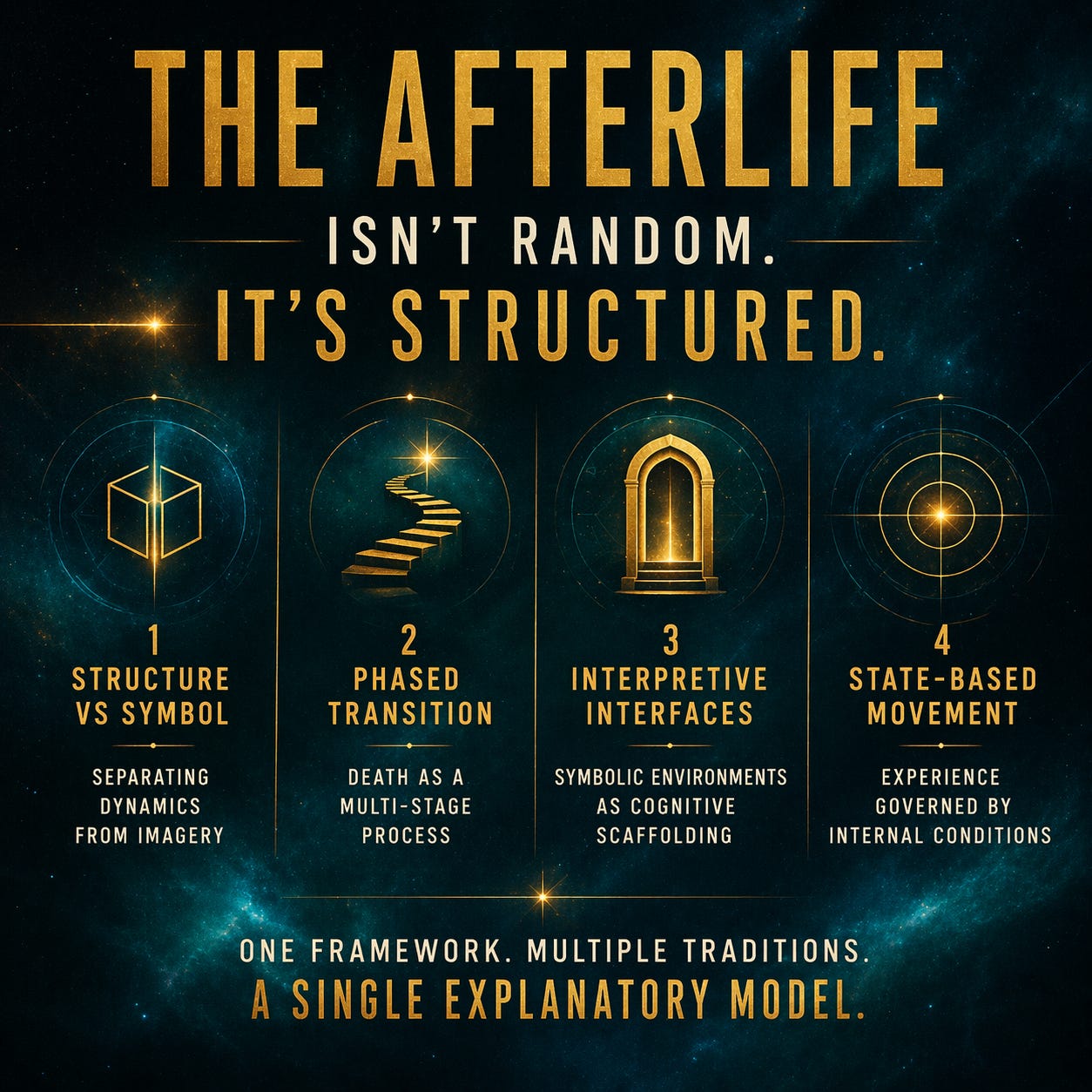
Strip away the apparatus and a more disciplined picture emerges—the one I build, case by case, in Reverse Engineering the Afterlife. I call it the Consciousness Transition Model (CTM), and it begins by refusing two lazy answers at once. Death is not the instant annihilation the materialist assumes—the evidence is very clear on that point. But nor is a near-death experience a postcard from heaven—a glimpse of some fixed location waiting on the other side. Both are interpretations imposed on the data.
The data point to something more interesting: a transition.
In the CTM, what the dying system undergoes is a Biological Disengagement Event—not an endpoint but a change of operating conditions. Awareness decouples from sensory input; the body stops being the sole reference frame; experience shifts into internally generated, thought-responsive environments rendered as tunnels, light, landscapes, and presences.
The “being of light” functions not as an external judge but as a stabilising interface; the life review is not a courtroom but a memory-integration process—with unbelievably high-resolution. None of this requires the surge, the DMT, or the gamma coupling to be the “cause.” Those are merely the neurological mechanics of the doors of perception opening.
What walks through it is a separate question—the one NEPTUNE was built to avoid.
This is also why I am careful about what the evidence does and does not establish. Veridical perception during verified flat-line EEG does not, on its own, prove the survival of consciousness in the ultimate philosophical sense. (My framework goes beyond this actually.)
What it does is fatal enough: it falsifies the strong form of the materialist hypothesis. Accurate information acquired during clinical death—reported to witnesses before it could be confirmed—cannot be accounted for by any mechanism materialism currently has on the table. NEPTUNE included. And the recent review by Angeli-Faez, Greyson and van Lommel (2025) places these experiences squarely during cardiac-arrest unresponsiveness—not conveniently before or after, where a tidy materialism would prefer to file them.
So NEPTUNE is not a breakthrough. It is the most elaborate patch yet on a paradigm that keeps springing leaks in the same three places: the verified perceptions, the encounters with the unknown dead, and the heightened, structured awareness that appears exactly when the brain should be incapable of producing anything at all. Each new model is more sophisticated than the last. Each one still has to pretend the most important data isn’t there.
The materialists keep building better ships to sail away from the evidence—and the evidence keeps sinking them anyway.
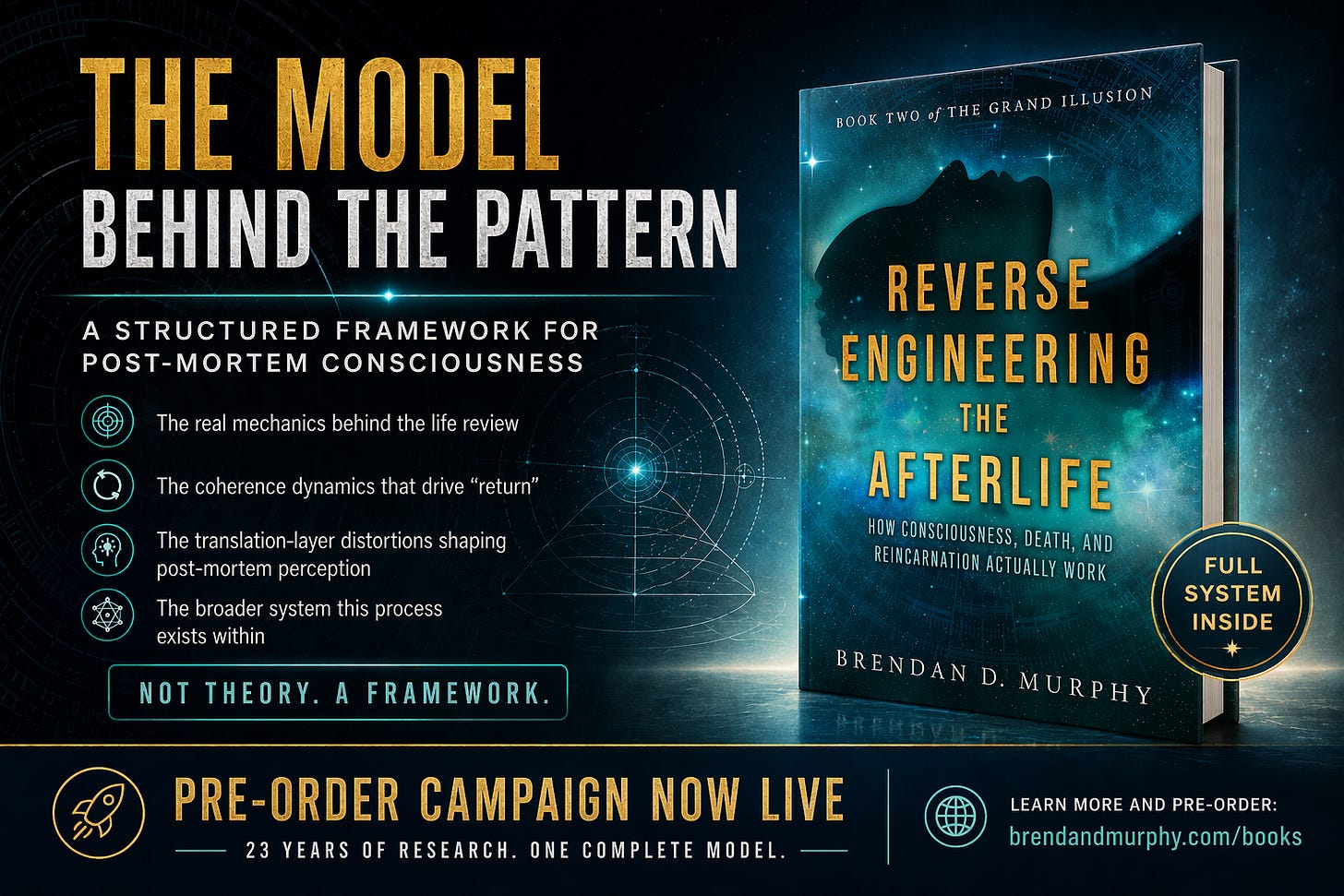
To be clear: while near-death experiences are a key data point, the Consciousness Transition Model reaches well past them—into out-of-body states, the interlife, reincarnation data, and what the world’s esoteric traditions and the hard evidence, cross-examined together, actually say about non-physical existence.
The result is exactly what the field has lacked for decades: a structural-architectural and processual account of post-mortem existence—what happens, in what order, and why—rather than another collection of anecdotes.
If you want the full picture—including the Consciousness Transition Model laid out in full—it’s all in Reverse Engineering the Afterlife. Pre-order it here.
Brendan is architect of the Consciousness Transition Model (CTM), an emerging framework that integrates NDEs, OBEs, and centuries of altered state observational data into a coherent map of post-mortem reality. Brendan researches consciousness and the origins of modern metaphysical narratives.
His work synthesises contemporary data with classical esoteric frameworks, most notably in Reverse Engineering the Afterlife—Book 2 of The Grand Illusion series—a landmark study into the afterlife system and rules of non-physical perception and state changes.
Grab your copy of the first volume “The Grand Illusion: A Synthesis of Science and Spirituality — Book 1” (also available as a discounted add-on in the pre-order campaign of Book 2)
Watch the free How to Evolve Yourself (WITHOUT Hard Work or Meditation) Masterclass to learn how this transformative evolutionary biofield activation and healing work with sound could change your world. Watch now to register and save your seat for the next live ceremony
Comments
Nothing yet. Say the first thing.
Sign in to join the conversation.