
This interview continues my Soy/Somos conversations with people in the U.S. rooted in more than one culture. As a naturalized American citizen, I want to understand pieces of the mosaic that make up this nation. These conversations feel essential.
Born and raised in Colombia, Sonia moved to the United States, where she received a bachelor's degree in journalism from the University of Massachusetts at Amherst and a master's in international and public affairs from Columbia University. She writes and lives in the San Francisco Bay area with her family.
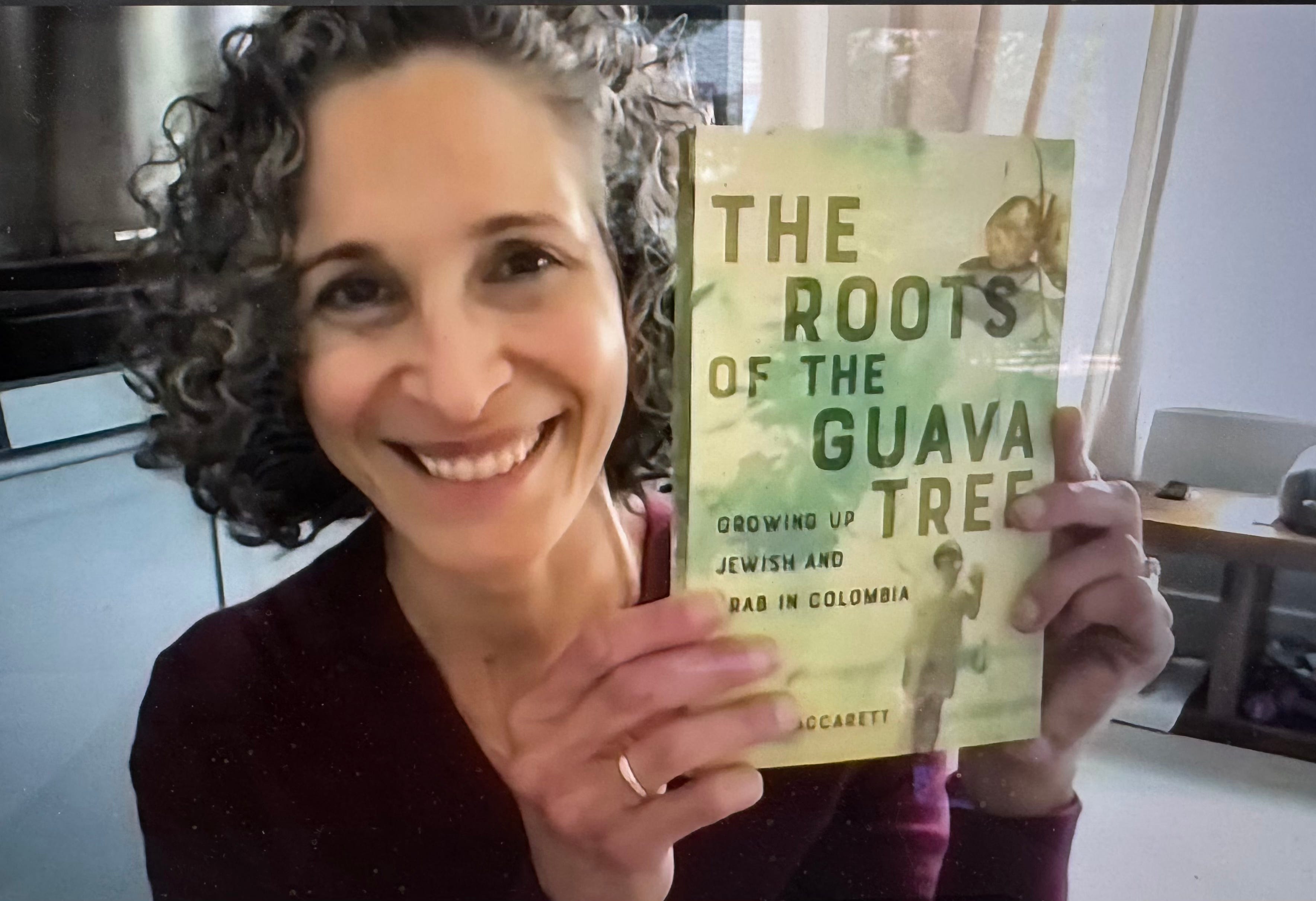
Sonia, it's such a pleasure to meet you here on the screen. Having read your book in final pages, I feel that I know you well. Do we begin with the "elevator pitch"?
—You meet a stranger in the elevator about to get off who asks you, "What is your book about?”
Are you ready? It's the story of a girl coming of age in Colombia struggling to understand her identity as the daughter of a Jewish mother and a Christian Palestinian father as the increasing violence of the 1980s engulfs her country.
How do you summarize something complex, a story full of heart? Talk to me about the guava trees.
We'd moved to this house in the country with a large backyard when I was five. My father had big hopes and plans for this yard. When we first move into the house, I'm trying to grow carrots. My dad is trying to grow a grape leaf plant to make dishes from the Middle East. The more he tries to plant certain things, the more the land resists. The climate is too tropical. There are infestations of insects. The guava trees that predate us on the property are the only things that thrive.
It's what I wanted for me and my family—to thrive, rooted in place.
Your writing is vivid. Characterizations feel authentic. “My father was a closeted introvert.” "As a teenager I desperately want long, painful, entrapping hair.” Where did you hone this vivid language?
I loved language. I loved books. I was an avid reader of songs and song lyrics. Of course, I grew up in a vivid place, with screeching parrots and bats at night.
When you move to the new house in a remote neighborhood of Cali you also move to an American school where you study in English.
I believe the way that the school was structured then was that until fourth or fifth grade, all classes were in English. In middle school and high school, they began incorporating classes in Spanish. Latin American and Colombian history, Spanish language and literature. So, I became fully bilingual, while my parents were more comfortable in Spanish.
You are a child of parents not religious in a predominantly Catholic society. Your parents say that in this school you will get “a broader view of the world.” What do they mean by this?
Both my parents were born in Colombia, they were first generation Colombians from poor, struggling families. My father grew up Catholic but was not observant as an adult. They were proud to be Colombian. They also valued bi-culturalism and speaking several languages. And they valued a secular education.
Colombia had saved both of their families. On my Jewish grandparents' side, they were escaping European pogroms and persecutions. Ending up in in Colombia, they would narrowly miss the Holocaust.
My father's family, Palestinian Christians from Bethlehem, were looking for a better life, as most immigrants do, free from enforced conscription.
Probably it was an extreme scandal when my parents married. They were modern, in their own way, independent. Stubborn and proud. My mother's family was from Bogotá. My father was born in Barranquilla where many Arab Colombians had settled.
The two communities were more similar than different. My Jewish grandparents had a store that sold cloth, also clothing made to measure, so they were tailors. They also sold thread and buttons, all the adjacent things that go with clothing. My Arab grandparents had a variety store that sold similar things. The two communities also developed overlapping industries, textiles in particular. First, it was imports, then manufacturing.
The memoir describes the discomfort you felt with being "different."
I wanted to be like everyone else. I longed for my parents to be fully thriving. My Arab grandmother was a wonderful cook, tabbouli, hummus, tahini.... My Jewish grandmother made gefilte fish. Cali was a small town. My friends would say, "comida rara."
I wanted to have a first communion like my Catholic friends. My Jewish friends would have a Bat or Bar mitzvah. I didn't have that. No rite of passage. We didn't belong to a religious institution. We had a Christmas tree, but none of the religious meaning. I think my parents felt we'd be safer with less information. It originated, I believe, from a protective impulse.
In addition to religion, my parents think, no earrings, and short hair, because my hair was thick and unmanageable. You can probably appreciate that there was not a single Latin American girl without earrings and short hair.
¡Qué horror!
My parents brought another culture into my world. It was this intellectualizing. "I don't have to pierce my baby girl's ears. That seems barbaric." And then my dad adds, "Well, you're playing around in the pool and stuff—you're going to get your earrings caught on something." Some people thought I was a boy. On top of that, I didn't have a religion.
I wanted to belong. I was an inquisitive, nosy child. They'd say OK, not important, diffusing the questions.
Your family was caught in two times of extreme turmoil, the political and drug wars in Colombia of the 1980s. The Lebanese War of 1982, when Israel invaded Lebanon. Both described in the book. What was the overall impact on your family?
The violence in Colombia made us afraid of everything. There was an epidemic of kidnappings and house invasions. There was concern and distrust all around. These were terrible times for all Colombians. Some people, like me, left for college and did not return. The country changed and evolved. Those who emigrated missed home as they remade their lives. Those who stayed went through hard times at home.
Did you know someone who was kidnapped?
Yes, someone at school. Everyone knew someone. If they didn't know them personally, they knew of them by one degree of separation. It became a shockingly common practice.
The Lebanese War happened far away. There were such strong disagreements about a place none of us had ever been to. It was the first time that I saw my parents identifying as Palestinian and Jewish. They had nuanced positions. It's not like they couldn't see the other's point of view, but they couldn't come to an agreement about what had happened. There were two narratives.
"The world's future depends on collaboration," they both say. But now, suddenly, my humanist, secular parents want to be tribal. I feel something new: rage. I want to scream and throw things at the walls and yell at them."
My parents were private, and arguments were done behind closed doors. When we were home, I knew there was tension, but I didn't witness an argument. We happened to be traveling in New York one time; and, because we were staying in a hotel, all of a sudden, it became very public. It was a wake up call for me. Identity is not nothing.
My parents valiantly tried to live outside history.
Why did you write The Roots of the Guava Tree when you did?
I never planned to write a memoir. When you leave your home, there is no space for what came before in the immediate years when you're rebuilding your life. I was also raising a family and working full time. Then life got quieter. The kids were a little older. I had a vivid dream of my childhood home. This was a significant moment.
It is often said of memoir that it is unfinished business. —Something was left unsettled. Memoir is a voyage of discovery.
I am very moved by memoirs, by stories of people's experiences.
What memoirs have you loved?
The Color of Water by James McBride, a black man's tribute to his white mother. Dani Shapiro's many memoirs, especially Inheritance, where Shapiro discovers what made her feel that something was amiss in her family.
What was it about The Color of Water that you liked so much?
The narrative structure used by McBride, His and his mother's story open up like a mystery. He tells his story then has a chapter about his mother, alternating between the two. At the end we have a full sense of his childhood and his mother's life.
I imagine there's a sort of echo for you, Sonia. Your memoir is about discovery of who your parents are.
Absolutely.
What was the hardest part of writing?
In the memoir I was responsible for real people in my life while trying to write authentically from my point of view. I was determined not to take liberties. My love for my family grew as I wrote about them, thinking about them as individuals making choices in their time.
The Roots of the Guava Tree will be available in bookstores on August 12, which is just around the corner. Do you have any readings scheduled?
Readings will be listed on my website soniadaccarett.com very shortly. I welcome private book club engagements as a guest author in person or via Zoom.
One of the unexpected and beautiful results of being involved in memoir writing for so long has been that I've been a witness to other people's stories and have developed a deep appreciation for the things that make us different—and, of course, similar. I want to inspire people to explore who they are and what they have gone through to get to this moment.
Do you plan to publish the book in Spanish?
Not immediately, but certainly this is something I will consider.
Would you be able to write it in Spanish yourself?
In Spanish it would be a learning curve, but it would be exciting.
Is there something I haven't asked that you would like to say?
I am interested in how cultures and ideas flow into one another. Never in history have so many people moved to so many different places with access to the views of others. We're more interconnected as human beings than we have ever been. Yet we seem more divided than ever in some ways.
I am remembering one of my first interviews with a Spaniard. His name was Manuel. With wonder in his voice, he said to me, "If I could wake up in one hundred years, my greatest curiosity would be to see if human society has evolved into one race. I would hope to find no barriers or prejudice."
And then—uniqueness and difference are wonderful things. As with our food, we are losing the specificity of food with all the commercialization. Complexity can be very important.
This thing about difference, when you live on the bridge between two countries or cultures, not fully belonging, you can see far. You can make choices. When I came to this country—without thinking of it in those words—I felt I was a citizen of the world. Human was my team.
Being a humanist—I think that's what my parents were hoping to create. I now understand so much more about them.
Dear Readers, I hope you found this conversation with Sonia Daccarett illuminating. Please show the love by checking the heart and leaving a comment. You can preorder Sonia’s book at any bookstore of your choice.
What here moves you? As you know, this is a conversation.
Thanks for reading Breathing In Spanish! Subscribe for free to receive new posts and support my work.
Comments
Nothing yet. Say the first thing.
Sign in to join the conversation.