
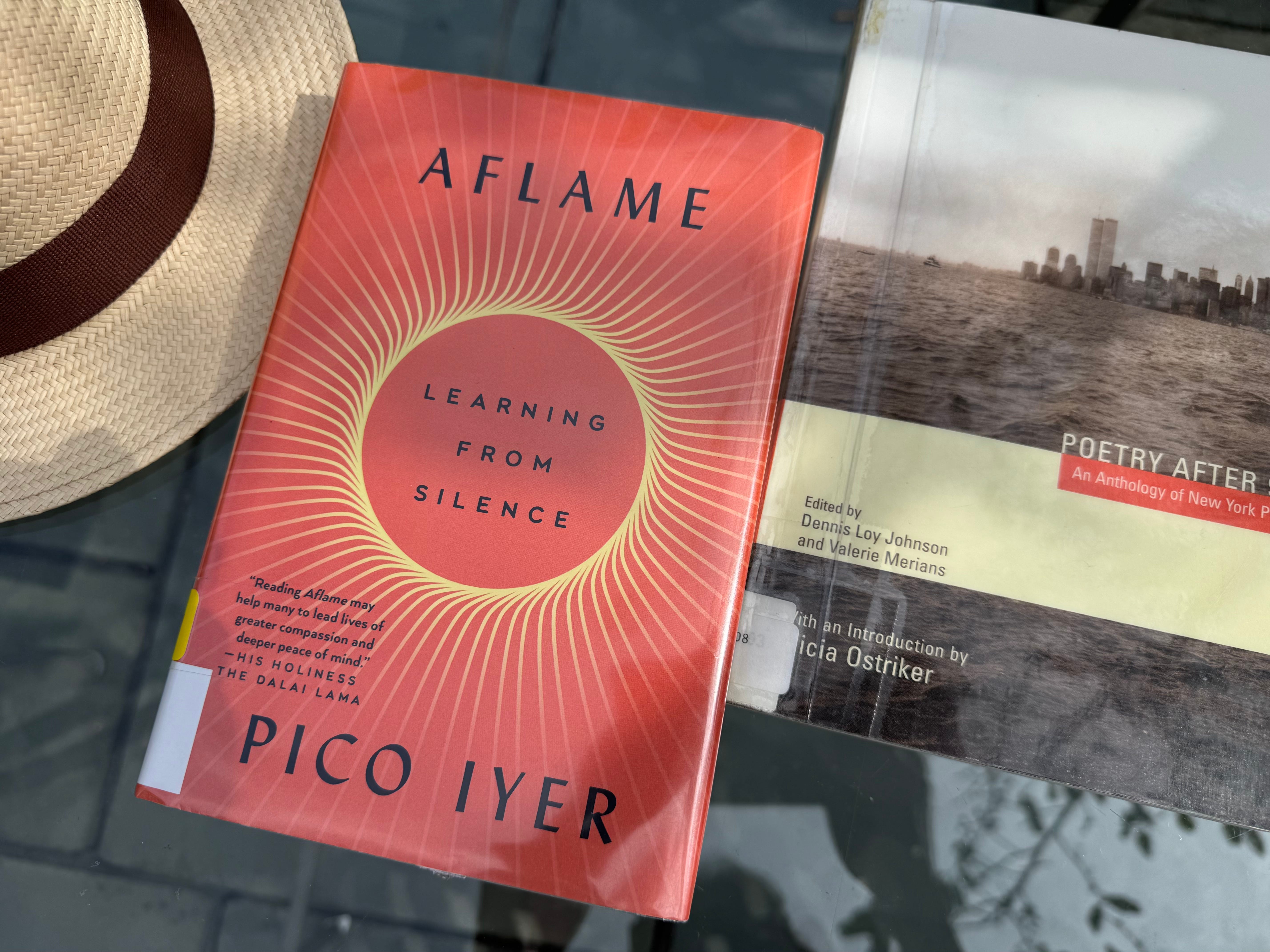
The library was full of children and their nannies cooling off in the over-chilled AC. It was a blistering day. I'd driven there for a book that had not arrived. Feeling no pressure, I lingered at the bookcases for newly published books, something I never do. Caught sight of the glowing, Pico Iyer book: Aflame: Learning from Silence.
It felt as if the fates had pulled me there on that very hot day.
I know something about Pico Iyer. He's a writer and journalist, a kind of guru for our complicated times. It turns out he's made more than one hundred retreats to a small Benedictine monastery in California.
I am halfway through this slender book and feel a calm wash over me, as if I am experiencing the silence he is experiencing, quieting the noise in the world.
"So why am I exultant to find myself in the silence of this Catholic monastery? Maybe because there's no "I" to get in the way of exultancy. Only the brightness of the blue above and below. That red-tailed hawk circling, the bees busy in the lavender. It's as if a lens cap has come off and once the self is gone, the world can come flooding in, in all its wild immediacy."
At the library, I take myself to the poetry section (.811 on the Dewey System). Another book catches my eye: After 911: An Anthology of New York Poets.
“In the immediate aftermath, there were poems everywhere... Plastered on the shelters at bus stops and the walls of subway stations. Downtown, people scrawled poems in the ash that covered everything. Prose wasn't enough. Everybody apparently knew this.”
Forty-five poets are represented, mostly with a single poem. I've now read many of them, and I notice my comfort with New York Poets, a plain-spoken quality. Should I be surprised? I've lived in New York for much of my life.
Here's the beginning of Nikki Moustaki's extraordinary poem, link for the full poem in the title:
Text within this block will maintain its original spacing when published
First: Don't use the word souls. Don't use the word fire.
You can use the word tragic if you end it with a k.
The rules have changed...
Why did the editors leave out the prophet of the Nuyorican diaspora, the poet Martin Espada? Here's one of the most powerful poems of our time, read by the poet.
Text within this block will maintain its original spacing when published
Alabanza. Praise the cook with the shaven head
and a tattoo on his shoulder that said, Oye,
a blue-eyed Puerto Rican with people from Fajardo,
...
We are heading to a new 911 anniversary twenty-four years later. The trajik events caused changes in the world that we have not recovered from. The poems return us to our humanity.
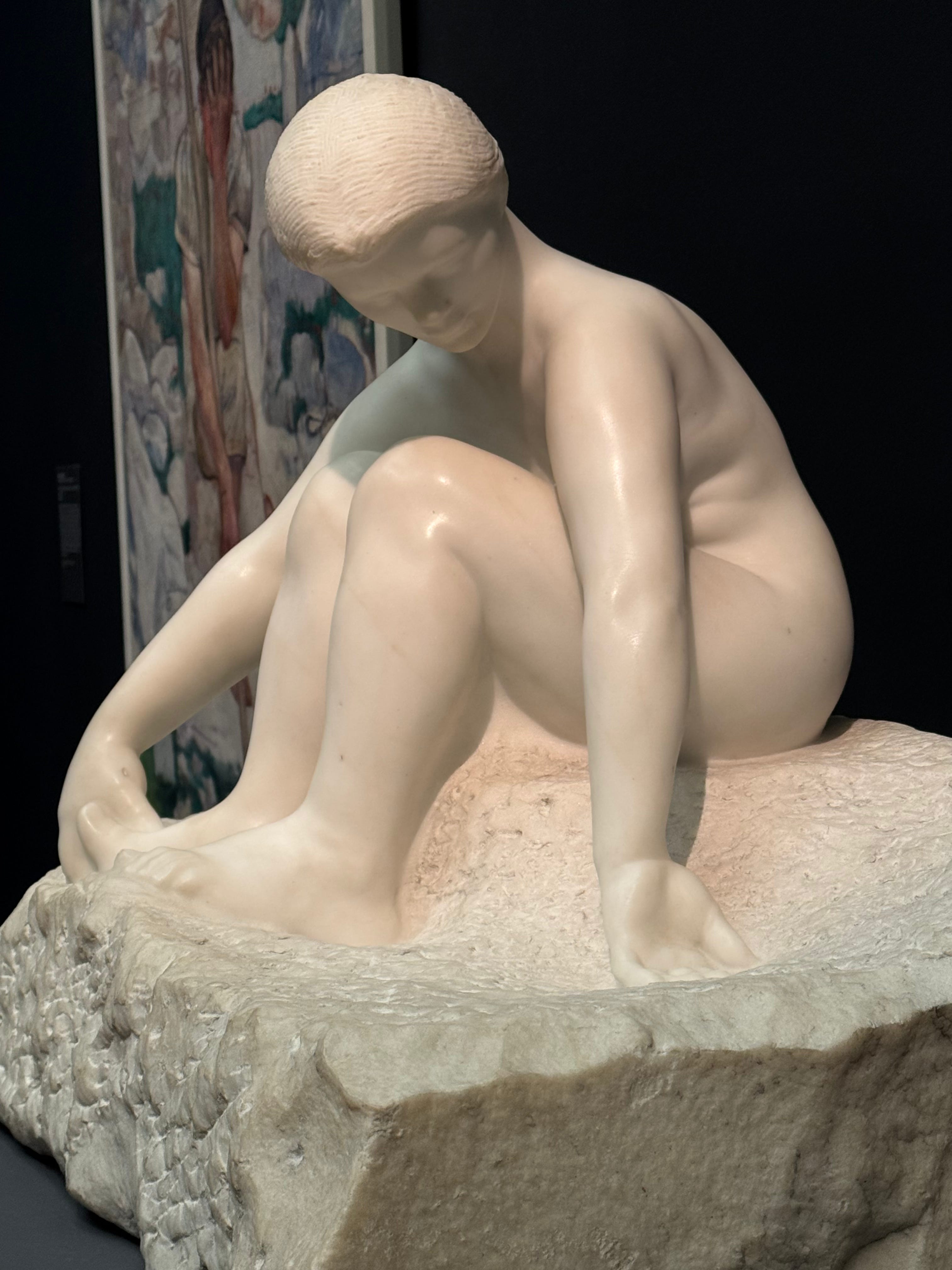
On a Saturday two weeks ago, I visited the Metropolitan Museum in NYC. This was the day before the closing of the "Sargent in Paris" exhibit, and the museum was teeming with people. It was a beautiful day, and everyone was smiling. I roamed the museum for hours, across enormous, high-ceilinged rooms displaying Greek and Roman truncated torsos, gods and goddesses, putti.
Text within this block will maintain its original spacing when published
lustrous / luster / shadows / turning / folding
bending / living / line / dimpled / full
At the Rodin galleries taking up several rooms, I came upon a small-scale bronze version of "Balzak," Rodin's study for the enormous sculpture that towered at MoMA, the Museum of Modern Art, for decades. "Balzak" at MoMA was the gut punch that drove me to work in clay and the human figure for more than three years, hands and fingers pounding, molding, turning. It was an emotional time in my life.
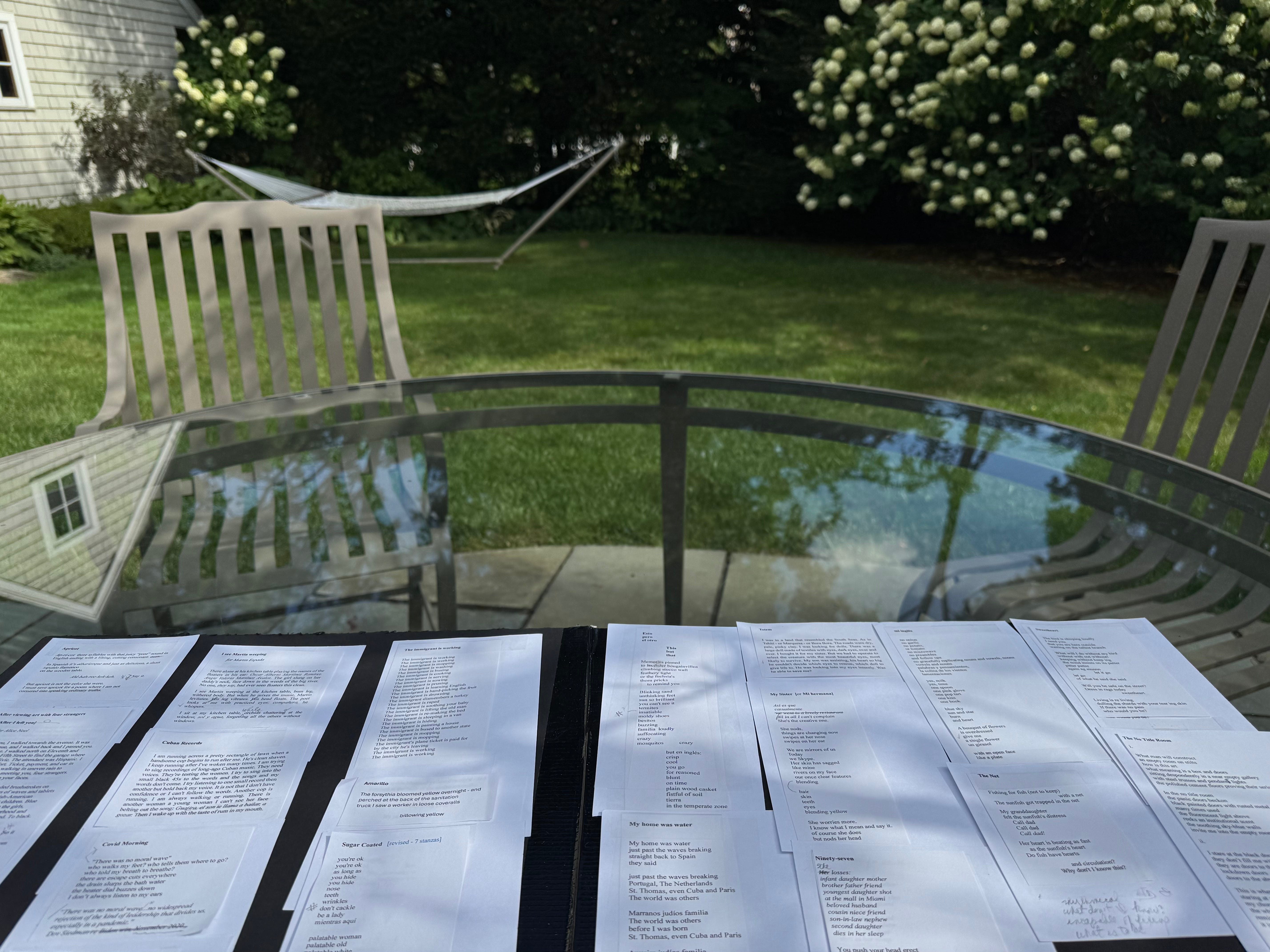
I am sitting at my patio table overlooking our small yard, three hydrangea bushes making a mountain of white blossoms against the backdrop of evergreen trees and the white cotton hammock.
I am working on a chapbook, a gathering of finished poems that "speak" to each other. Chapbooks are slender books, typically 30 pages or so, 25 poems or so. I need to address the issues: what are my poems about, which have a similar aesthetic? Which poems hold a little magic? A chapbook, it is said, is itself a poem.
I've been told to make miniature versions of my worthy poems, paste them on index cards and move them around on stiff, folding boards. "Carry these everywhere you go!"
That's what I am doing in the picture, happily, as if in grade school. I like the music of my poems. I want to admit that right away. I suppose, my best poems are speaking to me, poem persona and reader—the same me.
When ready, next step: submit the manuscript to publisher.
Dear Readers, I hope you are finding some ease and refreshment in this usually more peaceful month of August. I leave you with Pico Iyer words:
"The world isn't erased here; only returned to its proper proportions. It's not a matter of finding or acquiring anything, only of letting everything extraneous fall away."
If you feel moved, please comment, and show the love by checking the heart. As you know, this is a conversation.
Comments
Nothing yet. Say the first thing.
Sign in to join the conversation.