
This interview continues my Soy/Somos conversations with people in the U.S. rooted in more than one culture. Aquí estoy. Aquí estamos. This is who I am.
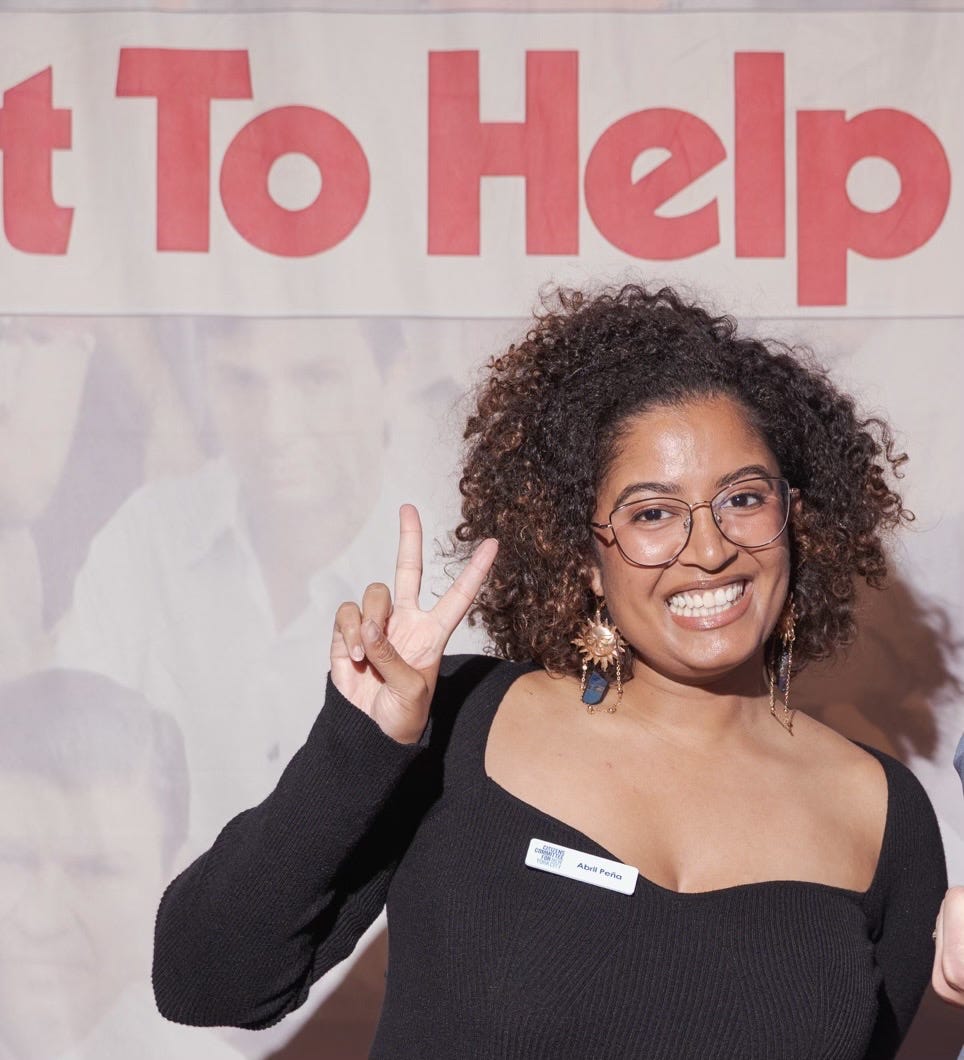
Abril Peña and I met at the “Nuestras Voces” (Our Voices) event in New York City in May of last year, performing five-minute true stories about Latin culture in the U.S. The event, held at City Winery, was sponsored by Writers Read in partnership with Carnegie Hall.
It’s a pleasure to meet with you again, Abril. Your name means April, of course. Were you born in April?
I was born in May! My mother explained to me long ago that she was going to name me Abril (ah-BREEL) even if I’d been born in December. “¡Me encanta la primavera!” Gracias a Diós she didn’t name me ‘Mayo’.
Tell me about your mom.
She loves everything Bohemian and peaceful. It’s beautiful to see her at this stage in her life, no longer raising children. She is an architect—she still works. She has a beautiful garden that she tends to. I call her granola mom sometimes.
The side of me that loves personal reflection comes from my mom.
And your dad?
The side of me that tries to figure out how to connect this person to that opportunity, that side is my dad.
My dad owns a bodega in the Lower East Side of New York. The store is about the same age as me. I believe we are both turning 30 next year.
His family first arrived in the Lower East Side. He is Dominicano by birth.
Like the Irish immigrants, the German, Italian, Jewish, Chinese. And so many others.
When I think of my dad, I picture him behind the counter at the store. He is a prime example of a small-business-owner who remembers every customer’s name, who hosts events in his neighborhood, who knows everyone.
When I was a kid, a shy kid, I used to get so irritated with my dad. He would be stopped every two minutes by someone he knew, and this would lead to a ten-minute conversation.
Then I became him. If I see the guy who does my laundry, or my person from the local bakery, I stop to say hello. The community-minded person I am, I get from him.
And here we are, exactly where I wanted to be, Abril. What appealed to me so much when I met you in the city was hearing about the work you do supporting grassroots community projects. Can you tell me more?
I work with a non-profit that distributes grants for community-led grassroots projects run by volunteers. Neighbors who get together to solve a problem in their community.
I manage the relationship with our corporate donors. It boils down to inspiring donors to use their resources for the benefit of the communities they serve.
This relationship is of value in both directions. In the United States, for example, banks have a responsibility to work with a certain percentage of low and moderate-income communities they serve. Activities sponsored by banks in the past have included workshops on financial literacy and workforce development.
How does it work?
Community groups apply for funding through us, and we apply for funding from the corporations and foundations. Since we support the smallest projects, we are having an impact on mostly the working class, people of color, people who historically have not had access to funding for their ideas.
The groups we help usually don’t have a formal structure. They might be community gardens, food pantries, support groups for women, queer people, seniors, after-school programs that don’t have traditional means of funding.
Can you give me a specific example?
Close to my heart, I would say, Bronx Special Kids, where volunteers provide resources and engaging activities—honestly, simple joy—to kids who are neurodivergent in the Bronx.
The person who began this project is a mother of two neurodivergent children. She’s active in schooling issues as well. She found an art teacher willing to contribute time and another professional who works with autistic children. They hold gardening and painting classes, recently teaching how to cut up fruit, workshops designed specifically for these children’s needs.
A program like this one is appealing to donors, but it is hard for a company to support it directly because groups like this one don’t have 501(c)(3) status that permit donors to make tax deductible contributions. They usually don’t have non-profit status, with past records or a board of directors. We act a as a go-between and keep tabs on the groups.
How much money are we talking about?
The support awards are relatively small, up to $5000. You would be amazed at what incredible opportunities are possible with these limited funds.
Abril, why are you drawn to this work?
As I was finding my footing at Baruch College, I took the route of Corporate Communications, a Liberal Arts degree that allowed me to take a variety of classes. I knew I enjoyed business but not enough to commit to the business-school route (especially not if it involved mandatory calculus classes!). I enjoyed the flexibility of applying business skills in other areas.
I held a lot of roles at one nonprofit while in college, a business program I’d been involved with in high school. My main work was recruiting corporate volunteers to judge competitions and work with students. I loved it. I’d been that student while in high school.
My high school had been small and not well funded. Most students were immigrants or first-generation Americans. You wouldn’t expect students from our school to go to college or pursue work in human resources, marketing, or finance. The program opened doors for us.
It is important to see examples of people like you who are succeeding to believe that you can do these things. We came from working class families. Most of our parents did not work in offices. They were not CEO’s and CFO’s.
When we met, you said to me that you always felt inclined toward social justice.
Thinking back, this could be because I was the eldest sister and had to instill rules with my siblings. Being a third parent.
I was vigilant of the rules: What is morally just? What is the right thing?
I also grew up with boys. My mother’s side of the family is all boys. I have two little brothers and seven boy cousins on my mother’s side.
Maybe that is why I was a little feminist, too. I had to defend myself. If they said anything bad about girls, I’d be there to say, we are not! I had asthma but was adamant about playing sports with them. I probably picked this up from my mother who encouraged me to be independent.
Is your mother also Dominican?
Yes. In our culture there is a lot of machismo, but my grandfather did not follow that. My mother and my aunts have told me that my grandfather always encouraged them to get an education, to work, to have their own money. He was very liberal, not what you’d expect from a Dominican man of his generation.
Dominicans find some way to laugh, joke, and be unserious, too.
It keeps our energy up, even with so much fear and adversity.
Is there a question you were hoping I asked you?
Being interviewed leaves you with a funny feeling. I spoke about this to our mutual friend, Henry, “El Cuentista.” Sometimes it’s hard for us to feel worthy of that. But it does feel important.
It’s the storytelling. You and I are both storytellers; that’s how we met. Your work is important, immigrants and their stories. I love the work that you are doing.
I am writing stories with the Dominican Writer’s Association. They’re amplifying writers across the Dominican diaspora who don’t feel “Dominican enough.” The group is celebrating their ten-year anniversary this year. The stories they’ve been able to capture and publish--it’s unheard of!
Keep writing, Abril. Keep giving. It’s been such a pleasure to hear your story.
Dear Readers, I hope you find this conversation with Abril Peña illuminating. Please show the love by checking the heart and leaving a comment.
What here moves you? As you know this is a conversation.
Comments
Nothing yet. Say the first thing.
Sign in to join the conversation.