
Breaking the Bottleneck is a weekly newsletter and interview series covering manufacturing technology and physical AI. Want to chat? Reach out at aditya@machinafactory.org or connect with me on LinkedIn.
This newsletter is brought to you with support from our partners: Jiga, Upkeep, Industry 4.0 Club, Ironloop, and T51.
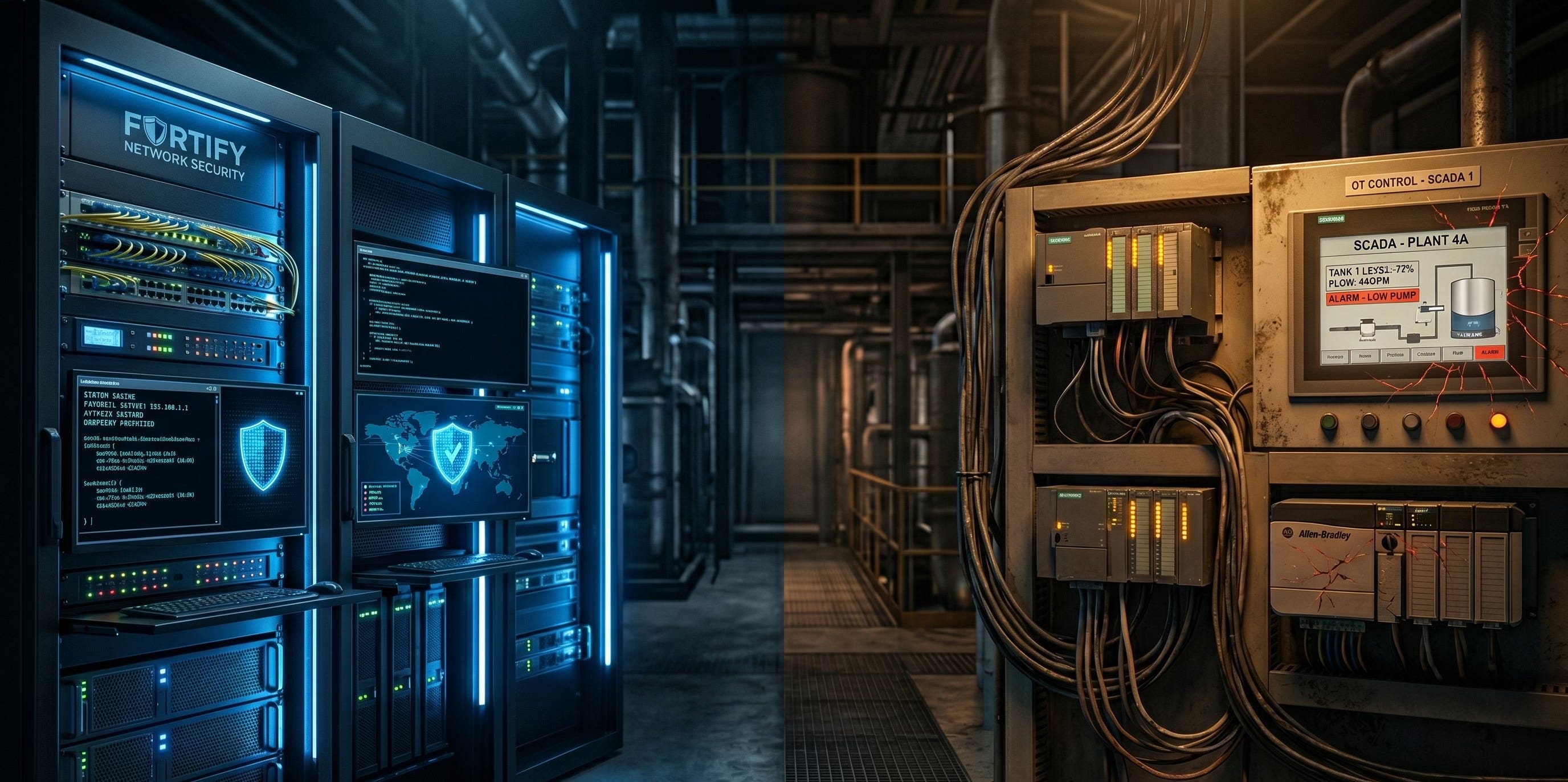
Anthropic's Project Glasswing is the most important defensive cybersecurity initiative in years. At first glance, it has a glaring blind spot, not a single OT OEM or industrial cybersecurity company in the room.
A couple of weeks back, Anthropic unveiled Claude Mythos Preview, a frontier model the company says is too dangerous to release publicly. Mythos can autonomously discover zero-day vulnerabilities, write working exploits, and chain multiple flaws together across complex software stacks. It has reportedly already surfaced thousands of high-severity bugs in every major operating system and browser, including a 27-year-old flaw in OpenBSD. Project Glasswing is the coalition Anthropic built around it: twelve launch partners using Mythos to find and patch vulnerabilities in the world’s most critical software before adversaries develop similar capabilities. A frontier lab voluntarily withholding a model and routing its power to defenders first, that’s the right instinct. My problem is who’s announced to be in the room, and who isn’t.
AWS, Anthropic, Apple, Broadcom, Cisco, CrowdStrike, Google, JPMorganChase, the Linux Foundation, Microsoft, NVIDIA, and Palo Alto Networks are the hyperscalers, security vendors, chipmakers, and one bank that form the substrate beneath modern digital life. Anthropic has extended access to 40+ additional unnamed organizations, some of which may well be industrial. But the named cohort sets the public narrative, and that narrative is IT-first. Notably, the launch partners are all software producer organizations whose code Mythos can directly audit. That logic explains v1. It also tells you exactly what v2 should look like.
The absence of utilities, grid operators, water systems, refiners, chemicals, automotive, aerospace, rail, ports, and defense primes is conspicuous, especially for a company navigating a complicated relationship with the Department of Defense, the single largest buyer of industrial hardware in the country. The threat data corroborates it.
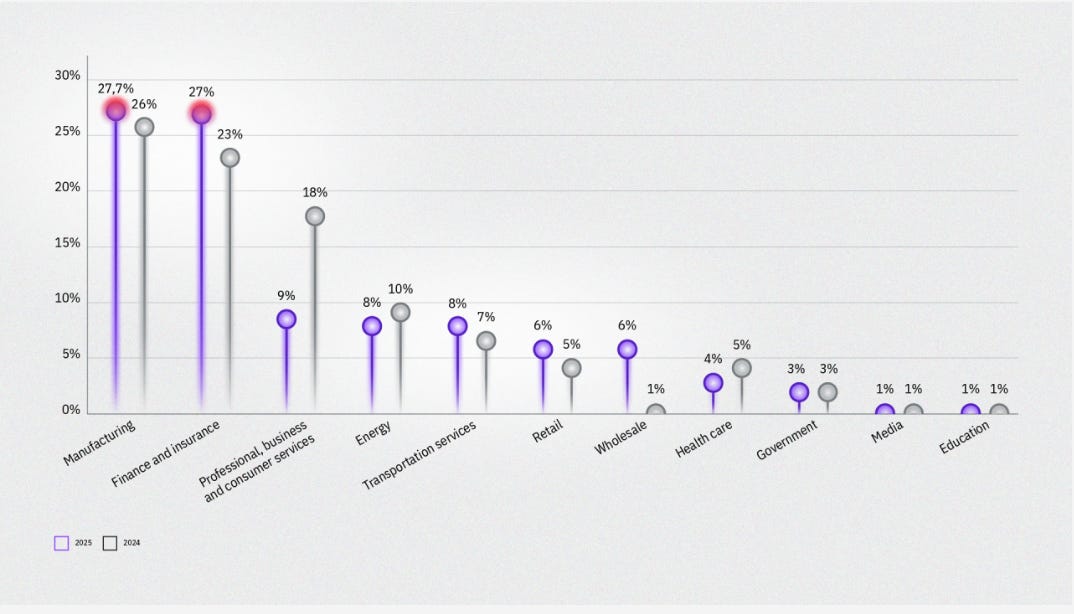
There's an IT arrogance in fielding a cybersecurity coalition without the industry that has been the most attacked sector on the planet for five consecutive years. Manufacturing accounted for 27.7% of all incidents across top sectors last year. The most common entry point is the exploitation of public-facing applications, which drove 32% of breaches, exactly the IT-exposed foothold that precedes OT compromise. Browsers get patched in days. The systems that deliver water, food, and energy to hundreds of millions of people run on firmware that hasn't been tested in a decade.
That neglect has real consequences. As we move into a more geopolitically fraught world, the ability to fight wars, move goods, and maintain a stable energy base depends on industrial systems, not browsers. Look at Jaguar Land Rover’s March 2025 cyberattack, which shut down manufacturing operations and rippled through automotive supply chains for weeks. Or the December 2025 attack on Poland’s energy sector, where threat actors compromised internet-facing edge devices, deployed wiper malware, damaged RTUs, and destroyed HMI data, causing operators to lose view and control of distribution systems. Or the recent Stryker breach, where Iranian-linked actors claimed an intrusion, a reminder that industrial-adjacent companies are being hit and that OT exposure often isn’t yet public. Colonial Pipeline is worth remembering too, not as an OT attack, but as proof that even an IT-side compromise can lead to catastrophic physical-world outcomes. Billing systems went dark, and fuel to the East Coast shut off for five days. The 2003 Northeast blackout cost an estimated $6 billion in two days.
The common thread isn’t browser zero-days. It’s an IT compromise, whether it pivots into OT or simply paralyzes the business systems that keep industrial operations running, combined with the direct targeting of internet-exposed assets: Modbus, OPC, PLCs, RTUs, HMIs, historians, and a long tail of legacy controllers running two-decade-old firmware never designed to touch a network.
The next cohort should be industrial, OT OEMs, their customers, and the security vendors that protect them, and it has to look different from v1. “Glasswing Industrial” should pull in OT vendors upstream of every plant floor, including Schneider, ABB, Emerson, Honeywell, Yokogawa, GE Vernova, and Mitsubishi, alongside OT-native security vendors that monitor these environments. These are the code producers in the OT stack, and they're where Mythos can do the work it's built for: auditing firmware, engineering software, and protocol stacks at the source, so fixes flow downstream to every asset owner.
Making this work is harder than assembling a new partner list. Mythos’s demonstrated strength is auditing modern, well-documented codebases. PLC firmware lives inside walled gardens, vendor-proprietary RTOSes, and IEC 61131-3 dialects with virtually no open-source visibility. A Siemens S7 blob is not Chromium. Any external auditing model is entirely dependent on vendor cooperation and access to sources. Even with access, the vendor tooling gap is significant. Simulated environments that let you confidently validate whether a firmware change is safe barely exist at scale. IT software rolls forward and back. OT firmware doesn’t. That’s precisely why v2 can’t just be v1 with new logos. It needs a shared, air-gapped testbed of representative OT stacks, donated controllers, virtualized DCS environments, and emulated protocol traffic where models can experiment without operational risk.
There’s also a legitimate question about whether Glasswing is even the right vehicle for this, or whether the industry can self-organize. Open-source models are closing the capability gap with frontier systems on a roughly six-month lag, and that gap is shrinking. If an OEM like Schneider or Honeywell can run Mythos-class vulnerability discovery in-house on their own firmware within a year using open-weight models, the need for a centralized Anthropic-led coalition diminishes. The more interesting long-term question may not be “will Anthropic invite industrial companies?” but “will industrial companies build this capability themselves before they’re invited?” The answer probably depends on how seriously OEMs treat security tooling as a product obligation rather than a compliance checkbox. But until that capability matures, any coordinated program still needs ground rules, and Glasswing's current rules don't fit.
The disclosure regime has to change, too. Glasswing’s 135-day clock works for browsers. It’s a nightmare for PLCs, where patch cycles routinely run 12 to 24 months due to validation, outage windows, and safety recertification. Glasswing Industrial would need a disclosure framework built around compensating controls, segmentation, virtual patching at the firewall, and detection rules as legitimate interim mitigations while firmware fixes are validated. Findings should route through CISA, which already runs the federal coordinated disclosure program for ICS, alongside DOE CESER for energy and the sector ISACs. Unlike the IT cohort, where vendors patch and push, OT fixes require asset-owner coordination at sector scale.
Glasswing v1 is the right idea executed against the wrong threat surface for half of the economy that physically produces things. The gap between “securing the world’s critical software” and “securing the world’s critical infrastructure” is the gap between a browser zero-day and a substation going dark. One is an inconvenience. The other is how cities and economies stop functioning.
This newsletter is brought to you with support from our partners: Upkeep, Jiga, Industry 4.0 Club, Ironloop, and T51.
Comments
Nothing yet. Say the first thing.
Sign in to join the conversation.