
Welcome! Every week I cover the 5 most important things that happened in medicine, as well as some smaller things to make sure nothing’s missed. Let’s get into it!
Circulating tumor DNA (ctDNA) — DNA released from tumors, shed into blood — has a few different uses in cancer: from monitoring response to therapy to identifying targetable mutations, to predicting relapse and population screening.
This week, the first ctDNA-based approach was approved to guide cancer therapy based on molecular residual disease — in muscle-invasive bladder cancer, where around 50% of patients have recurrence even after successful surgery (cystectomy, removal of the bladder).
Current surveillance largely relies on imaging and clinical features like symptoms to detect recurrence — ctDNA can detect molecular evidence much sooner.
The approval is based on this trial, where molecular residual disease was detected using Natera’s Signatera diagnostic kit (also approved this week, to go along with the therapy). Those with residual disease, detected by positive ctDNA, who received the PD-L1 inhibitor, Atezolizumab, had better survival than those who received placebo:
This might also mean that those with negative ctDNA can avoid unnecessary therapy.
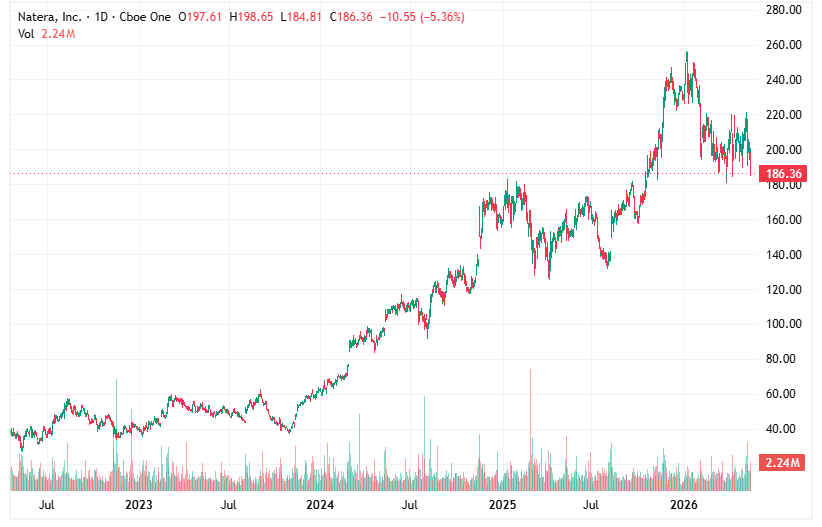
The excitement here is real — and reflected in the Natera stock price over the last few years:
There are many other trials using the same approach to detect recurrence and guide treatment decisions — for example, in colorectal cancer, breast cancer, and lymphoma.
Given the sensitivity of cancer detection using ctDNA, there is even hope that this approach could be used to help patients avoid surgery after neoadjuvant therapy — there’s evidence that might work in bladder cancer, rectal cancer, and breast cancer.
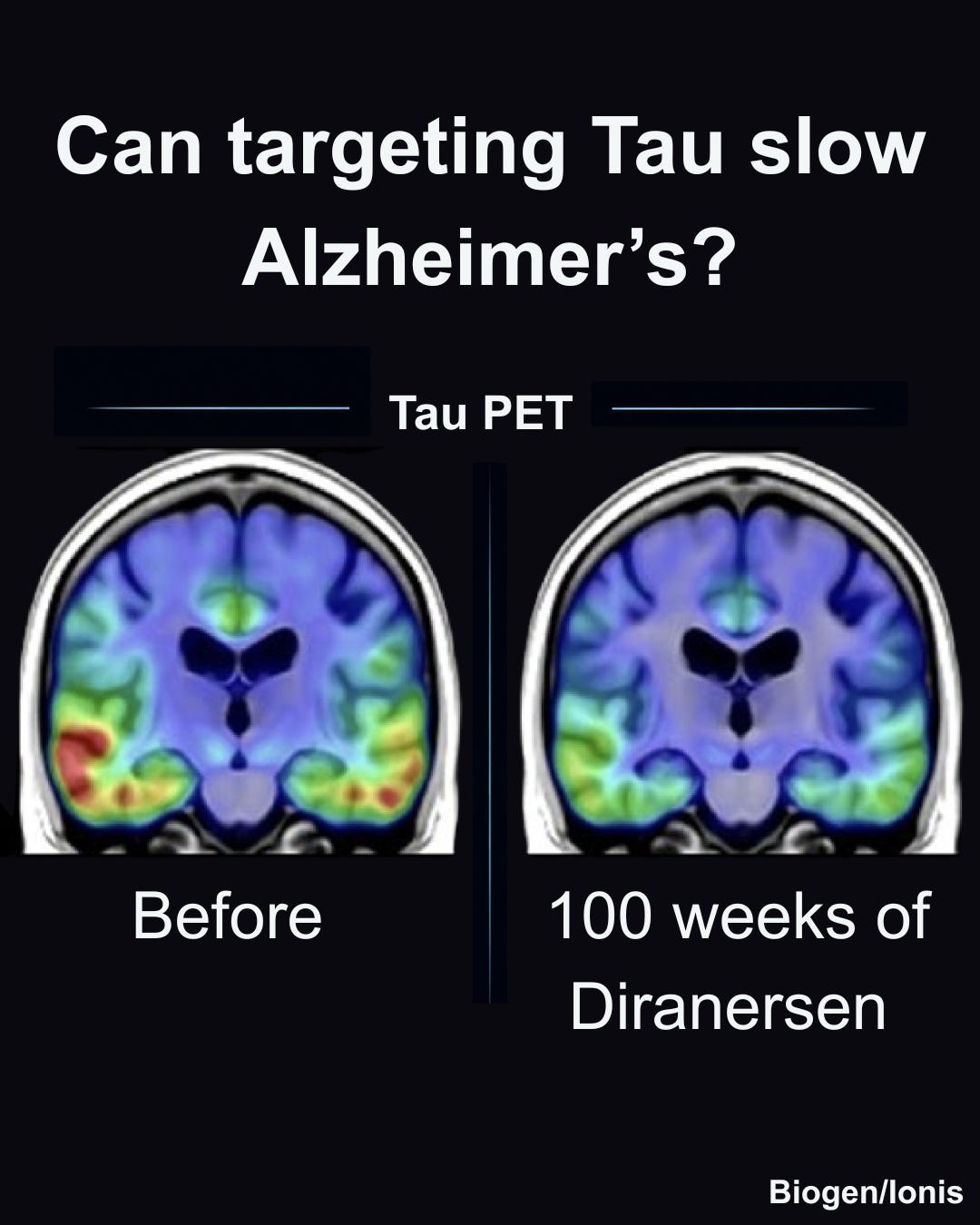
Tau is central to the Alzheimer’s cascade — it aggregates as oligomers and fibrils, degenerating neurons in the hippocampus. This starts many years before diagnosis, and leads to loss of hippocampal volume and cognitive decline:
Diranersen is an antisense oligonucleotide, developed as a collaboration between Ionis and Biogen, that depletes the mRNA encoding Tau. In a previous phase 1 trial, it effectively prevented accumulation (and even helped clear) Tau from the brains of patients with Alzheimer’s:
This week, the phase 2 trial read out in patients with early, symptomatic Alzheimer’s. The primary endpoint was dose-responsiveness of Diranersen on cognitive decline (measured by Clinical Dementia Rating–Sum of Boxes, CDR-SB). We don’t have the detailed data yet, just the headline: cognitive decline was slowed, but this was not dose-responsive (the effect wasn’t stronger when the dose of Diranersen was increased).
So this is a mixed bag — the lack of dose responsiveness could indicate statistical noise rather than genuine therapeutic effect — though this would certainly not be the first time a drug ‘fails’ in phase 2 and succeeds in a subsequent phase 3. Biogen have said they will now progress this to phase 3, so either way, we will find out!
Just to highlight the heat of Tau as a target, Biogen/Ionis are not the only ones working on this — there is a lot of attention here:
This week, we saw results for the very first oral pill proven to prevent Covid after an infectious exposure. This has been a long time coming — here’s a short history of the trials that have been done on this:
Ensitrelvir (2026) — Succeeded
Casirivimab/imdevimab (2021) — Succeeded historically, but variant-dependent
Bamlanivimab (2021) — Succeeded historically, but variant-dependent
Tixagevimab/cilgavimab (2022) — Failed
Paxlovid (Nirmatrelvir/ritonavir) (2024) — Failed
Molnupiravir (2023) — Failed
Hydroxychloroquine (2021) — Failed
Lopinavir/ritonavir (2021) — Failed
Favipiravir (2026) — Failed
Ivermectin (2020) — Failed
Here are the data — household contacts of people with Covid (within 3 days of the index patient’s symptom onset) were given Ensitrelvir or placebo for 5 days:
On the basis of these data, Ensitrelvir was approved in Japan in March — and other regulators around the world are looking at it now too. It could be particularly useful for occupational exposure in hospitals, or for people who are very high risk (for example, in care homes).
Comments
Nothing yet. Say the first thing.
Sign in to join the conversation.