
I love a16z’s Charts of the Week series, so I have shamelessly stolen the idea. I’ll cover the most important charts from the world of medicine.
This newsletter is sponsored by Scholara (ok, it’s my own platform) — check it out! If you’d like access for your team, you can try out the full version for free — just send us an email.
In 1986, the best therapy for multiple myeloma (relapsed or refractory, after 1-3 lines of previous therapy) was a steroid, dexamethasone — and progression-free survival was about 3 months. Since then, sequential breakthroughs mean that now >80% of people can go years without progression, and (the trials haven’t run for long enough yet) but there might be permanent disease control.
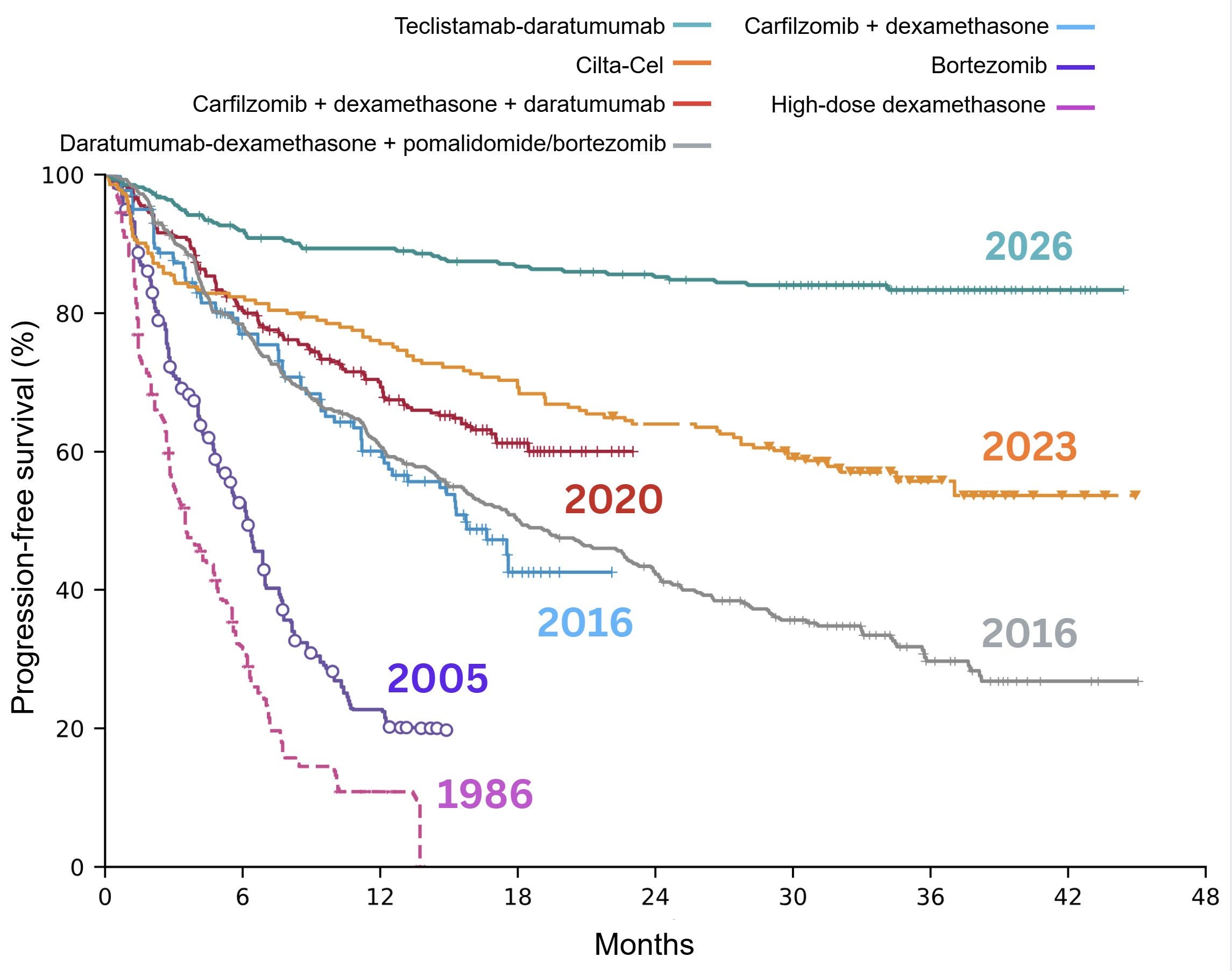
These data compare different trials from different times (and between patient groups that are not absolutely equivalent), so they are not directly comparable — but it works nicely as an illustration.
Can clinical trial success be predicted using AI? These guys have done it, and provided 10 of their predictions. One of them is for Daraxonrasib — the pan-Ras inhibitor that’s currently being tested in RASolute 302, a phase 3 trial vs. chemotherapy, in metastatic pancreatic cancer:
Here’s the prediction: progression-free survival of 5.39 months for Daraxonrasib (vs. chemotherapy’s 3.39 months), which translates to an overall survival of 10.14 months (vs. 6.77 months with chemotherapy).
To do this, they modelled a few things — control arm survival, phase 2 to 3 efficacy translation, progression-free survival to overall survival translation, statistical design and readout maturity — and ran this through 100,000 Monte Carlo simulations.
Here’s some more details on their thesis:
This idea is fascinating to me — I will watch and update how close their predictions are!
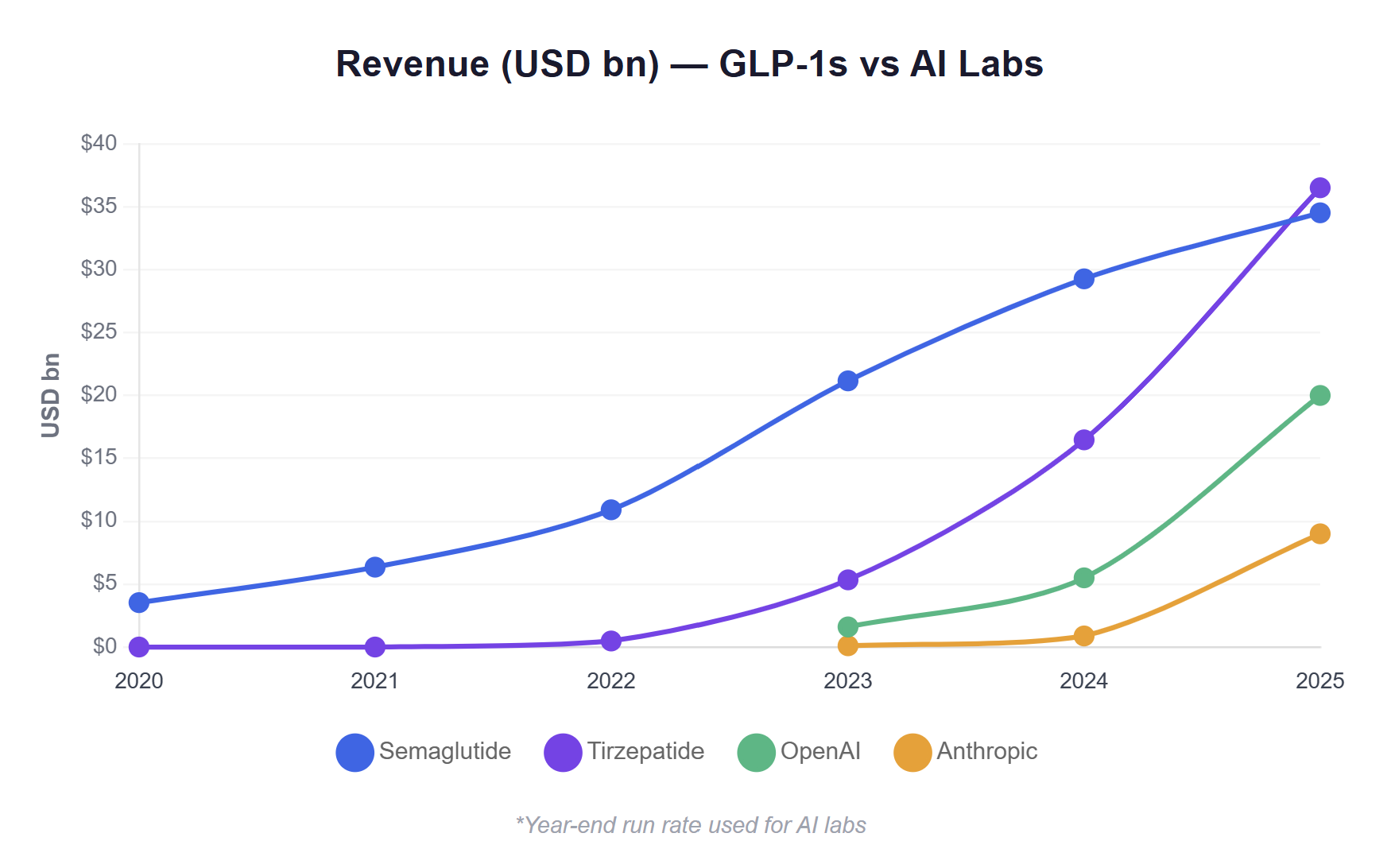
Summing the revenue made by GLP1 weight loss drugs (Semaglutide or Tirzepatide) and comparing them to all of the revenue made by the frontier AI labs (OpenAI or Anthropic) GLP1s are way ahead.
As someone on Twitter said, this is a ‘funny if a bit senseless comparison’ but… here it is:
Comments
Nothing yet. Say the first thing.
Sign in to join the conversation.