
Welcome back to The BREAK–DOWN newsletter. This week we have two big pieces of news. Firstly, if you take out a yearly subscription for our print issue, not only will you get our next two issues, Issue #3 and #4 on AIRBORNE and CHINA, to be published in Spring and Autumn next year, we’ll also send you copies of the two issues we have published to date for free!
To get the deal all you need to do is take out a print subscription via our website between now and the 12th December.
The second piece of news is that we are splitting up our ICYMI list of essays and podcasts the BREAK–DOWN editors have enjoyed over the past fortnight from our regular update. So, for the first time, see what we have been reading below.
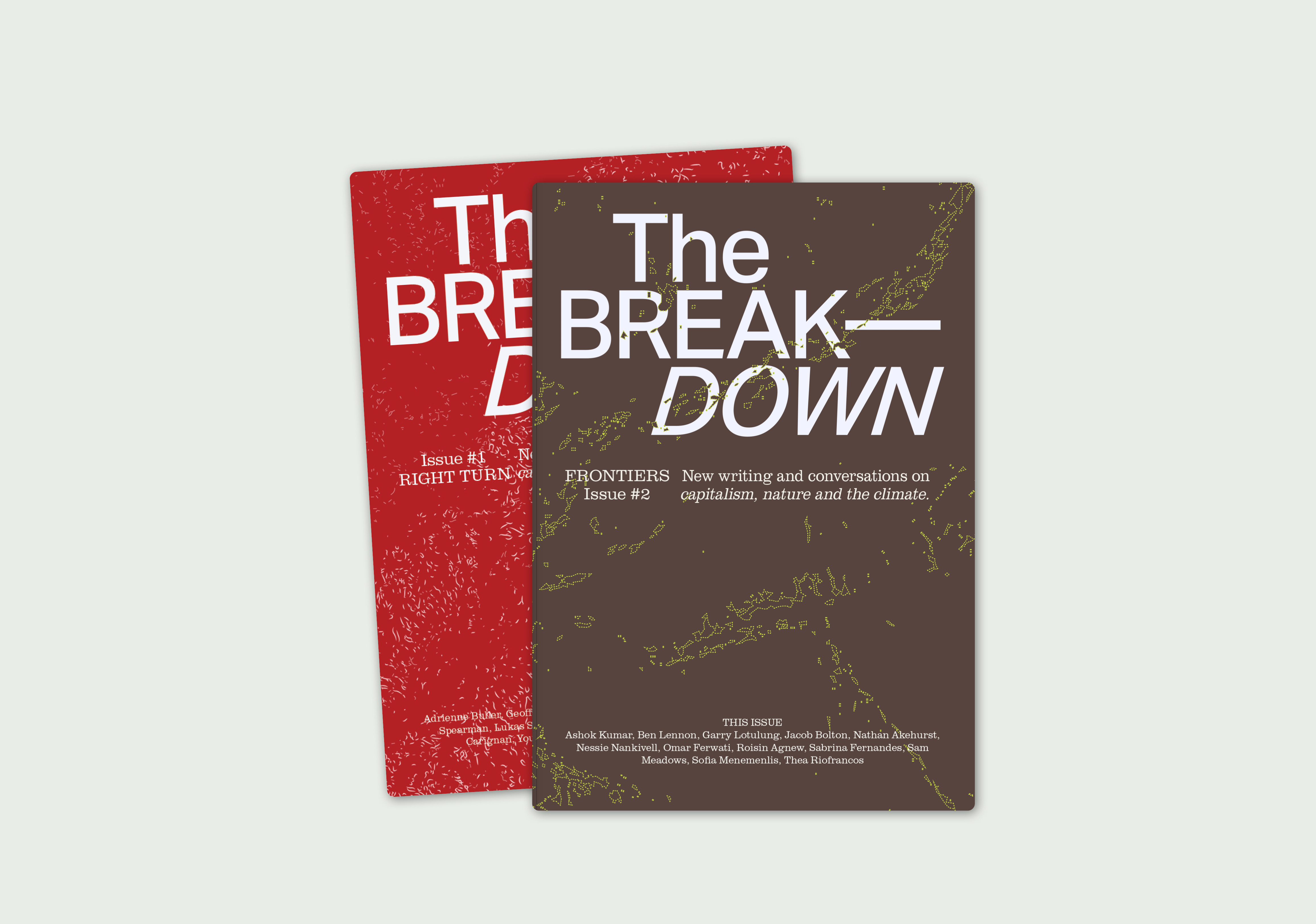
Subscribe before 12 December to receive our next two print issues (Spring ’26 + Autumn ’26) PLUS our past two issues for free.
Subscriptions make our work possible—support independent climate storytelling.
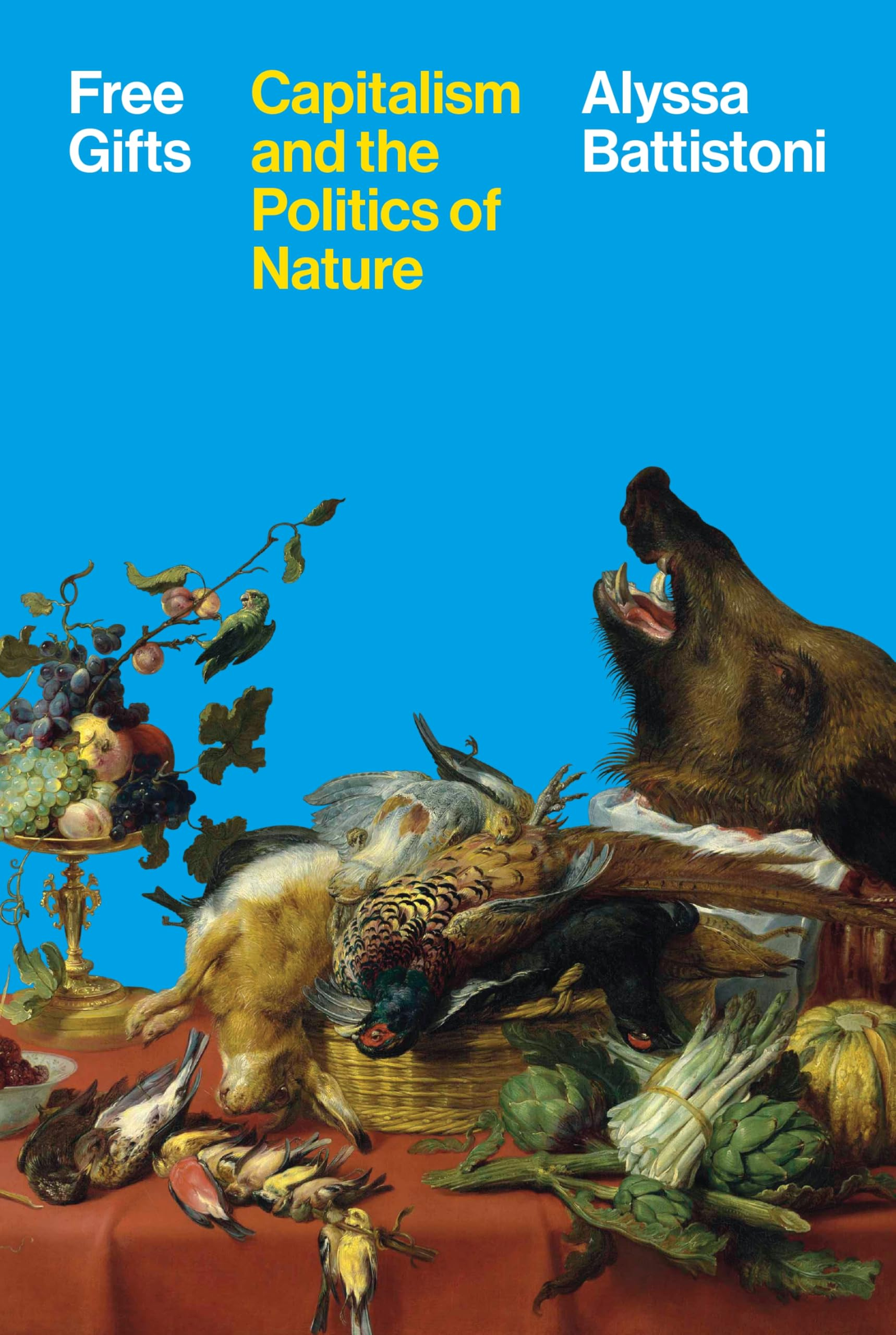
The good folk at the Law and Political Economy Project are currently hosting a symposium dedicated to Alyssa Batistoni’s new book, Free Gifts: Capitalism and the Politics of Nature. The book is a brilliant, wide-ranging and sophisticated work of Marxist theory, and it’ll undoubtedly change the terrain on which we on the climate left will be working in future. As Alyssa writes in her introduction to the symposium:
Free Gifts is, primarily, a work of critique; it does not offer an immediate policy program or political strategy. I hope, however, that it can inform both. Take, for instance, struggles over the classic example of social cost: the smokey chimney and its effects on nearby communities. From the left, these have typically been framed in terms of environmental justice, highlighting the uneven distribution of pollution and the disproportionate effects on working class communities and communities of color. While I draw on these analyses, I also locate pollution more firmly within the hidden abode of production itself, reading it as the byproduction of surplus matter alongside commodities, and identifying the forms of class power that allow some people to impose material harms on others in the pursuit of profit. The upshot is that we should understand struggles over pollution not as “new social movements” arising around “social issues” beyond the traditional questions of political economy, but as class struggles at the point of production in their own right, and thus as challenges to capitalist rule.
You can read Alyssa’s opener, plus the responses by Madison Condon, Jedidiah Britton-Purdy and Rob Hunter on the LPE blog.
And if that isn’t enough, on Monday next week we’ll be publishing our latest interview between Alyssa and Adrienne Buller, which will be available wherever you get your podcasts.
Readers of The BREAK–DOWN will already be familiar with the Israeli-American geoengineering startup, Stardust Solutions, which was featured in Sofia Menemlis’s revelatory essay from Issue #2, “The Sunlight Managers”. Now, that company appears well on its way to deploying its technology to block out the sun’s radiation through the use of proprietary, for-profit aerosol releases into the stratosphere: in October this year, Stardust announced that they had passed $75 million in funding. As Sofia writes, “Blocking out the sun is a bizarre proposal, and one which presumes its own failure: it is imperative because we can’t lower greenhouse gas emissions; but it is so dangerous that its use is only conceivable to its advocates if we do.” That’s the logic of these ventures. And that is the view from the outside; Politico, however, have given us an insider’s view, and it’s as startling as you’d imagine.
Just before the visit with Pasztor in Switzerland, a document was sent to POLITICO Magazine. It was a “pitch deck” Stardust had shared with potential investors as it sought a second round of funding. The slideshow was marked “proprietary and confidential” and dated 2023. If any doubts remained about how seriously Stardust should be taken, the document, reported here for the first time, dispelled them. The gap between what it contained and what the company had said publicly was very large. […] The document laid out a startlingly ambitious roadmap for Stardust’s plans. The timeline, for one thing, was jarringly short and raised serious questions about how there could be time for research and regulation, when, for example, it aimed to begin a “gradual temperature reduction demonstration” in 2027.
The latest issue of the LRB has James Meek’s latest report from a Britain beyond the Westminster bubble. This time, Meek is in Blyth, in Northumberland, and it is, as ever, a vital piece of reporting.
I hadn’t come to Blyth to write about Reform. I’d come to satisfy my curiosity about a fantastical factory that at one time was set to be built nearby, a huge new manufacturing plant that was going to make batteries for electric cars and bring thousands of jobs to the area. Three thousand, according to some reports. Eight thousand, according to the more imaginative. Announcing in 2022 that the government was financially supporting the project (in fact, it never did), Boris Johnson and his ministers managed to include every trope of British industrial boosterism in a single press release. The new plant was ‘testament to the skilled workers of the North-East’, it would put Britain ‘at the helm’ of the ‘global green industrial revolution’, it would ‘level up’ the ‘industrial heartlands’. It was ‘a major boost’ and ‘a resounding vote of confidence’. It would ‘unlock investment’. In an especially tired cliché engendered by the very technology the batteries were supposed to abolish, it would help ‘turbocharge the local economy’.
No batteries were made; the factory was never built. The green revolution went unhelmed (by Britain at least – China had already taken the wheel). The company, Britishvolt, collapsed just after Labour won power in 2024, but the Starmer government has pursued the link between green jobs, economic growth and votes in the same gung-ho spirit as Johnson, Democrats in the US and mainstream parties in the EU. The transition from fossil fuels to zero-carbon energy needs huge investment; investment brings jobs, which can be steered towards ailing post-industrial areas; jobs bring security, prosperity and contentment; tax revenue pays for better public services. The toxins of communal hate drain away in the cleansing spa of growth. Glowed-up citizens reward the politicians at the ballot box. Fade up ‘What a Wonderful World’.
The monumental changes that have taken place in the Chinese economy and society over recent decades are finally, belatedly, being discussed for their profound implications by western intellectuals. Not all of these changes have been good, of course, but it does at least seem clear now that whatever happens there will come to shape the future direction of the world economy. Nowhere is this clearer than in green energy. As Kaiser Kuo, the host of the excellent Sinica Podcast, notes in his recent essay for the Ideas Letter, “China now accounts for more than half of the world’s installed solar and wind capacity combined. Roughly three-quarters of all renewable energy projects currently underway worldwide are either in China or being driven by Chinese contractors. About 30% of global emissions come from China, but so too does much of the growth in decarbonization technology.” All of which have deep, global implications. Kuo’s essay is superb on what all this means:
In conversations I’ve had over the last few months in Beijing with professionals spanning various industries, from biotech to automotive, from renewable energy to humanoid robotics, I’ve heard variations of the same observation: The transformation that has swept through their sectors in China over the past two decades—or even just the past five years—would be utterly unfathomable to anyone who hasn’t witnessed it firsthand. They describe returning from conferences in the United States or Europe struck by a disconnect: The tsunami of transformation coming from China just isn’t felt with an urgency remotely commensurate with the scale of the disruption in store.
We’re currently planning a future issue, for Autumn next year, on precisely these questions. We’ll announce more about this shortly, but in the meantime if you have ideas for people/pitches then keep us in mind.
I’m reluctant to double-plug the LRB, but their second most recent print issue, which also features friend of The BREAK–DOWN Brett Christophers, had this superb essay by David Runciman. In it, Runciman writes at length on the risks of global depopulation, as birth rates across the world plummet and as populations age. Interestingly, he places the question of demographic change alongside that of the climate crisis, tracing it from the 1960s fears about the “population bomb” and the limits to growth through to the spectre of multiple interlocking crises today.
Depopulation is at present a problem for affluent societies: in general, the richer a country the fewer children its citizens will have. Whereas a warming world will affect the poorest places on Earth first – including sub-Saharan Africa – those are also likely to be the last locations where populations will stop growing. Canada may soon be ground zero for falling birth rates – its TFR is almost as low as Japan’s – but it will probably wait longer than most to experience the worst effects of climate change. In that sense, Canada is sub-Saharan Africa when it comes to depopulation and sub-Saharan Africa is Canada when it comes to climate. But these stories will also interact. In the face of declining populations and growing strains on labour forces, rich countries will become more and more dependent on immigration to maintain numbers. At the same time, as those parts of the world with growing populations become less habitable because of climate change, the impetus to move from South to North will increase. Just one of these factors on its own – either depopulation in the North or climate change in the South – could be enough to drive mass migration. Taken together they make it inevitable. Anyone who thinks the 21st century will not see the biggest global movement of peoples in history has not been paying attention.
And finally, last week Britain’s Labour government released its much anticipated Nuclear Regulatory Review. Britain, it found, is “the most expensive place in the world to build nuclear projects”, much of this due to a fragmented and flawed regulatory landscape. The full report is available here, and I link to it not because it is actually one of the best pieces of writing on climate we have seen over the past fortnight –– which would be weird of any government report, naturally; we’re not total oddballs –– but because I’m yet to read anything that critically evaluates it in any kind of depth beyond X threads from Growth Addicts and YIMBYs. If you have seen anything on this you would recommend, or would like to tackle this for us, then get in touch!
Comments
Nothing yet. Say the first thing.
Sign in to join the conversation.