
Welcome back to the BREAK–DOWN’s regularly newsletter. Obviously, much has happened since we sent you the last one, and we’ll be publishing responses later this week so be sure to keep an eye out for that. (For now, I can recommend Tom Stevenson’s essay from the forthcoming LRB, “Iran, Week One”, as well as this series from Equator.) But, suffice to say, the effects the war will have on climate and energy policy will be profound (we can see this already in Britain, with the many of the leading parties clamouring to be seen as the most evangelical advocates for a renewed push for North Sea oil and fracking in an attempt to sure up the country’s oil and gas supplies.)
We’re also in the final stretches of getting our next print issue, “Airborne”, off to the printers. We’ll be announcing the details of that very soon, but I can say with confidence that it’ll be our best yet! Make sure you subscribe now to be the among the first to get your copy.
Now, however, time for something a little different. This week, Dom Davies, Reader in English at City St George’s, University of London, has compiled an annotated reading list of graphic novels that help illuminate the climate crisis. Formally inventive and beautifully written and drawn, they range from a memoir of a worker in Canada’s oil industry to works of reportage on the ecological devastation wrought by modern extractive industries. It’s a brilliant introduction to a seemingly booming genre.
For the uninitiated, it may seem odd to read about comics and the climate crisis in the same sentence. Comics are more often thought of as “low” cultural entertainment for young people, something we grow out of, not into. We read them to escape the world, not confront it.
If the recent stream of superhero movies has made such associations understandable, there is an adjacent tradition that has used narrative drawing to document the grim underside of modernity. This tradition runs back at least to Francisco Goya’s Disasters of War, a series of 82 prints that recorded crimes committed against civilians by Napoleon’s armies during his invasion of the Iberian Peninsula. Made in the decades immediately before the invention of the photograph, Goya’s drawings ensured that the brutality of this campaign would not be lost to the propaganda of the French Empire. Much like a graphic novel, Disasters of War derives its force from its arrangement of images into narrative: only when read in sequence do we realize the violence against civilians in each plate is not collateral damage, but part of Napoleon’s deliberate military strategy.
In the two centuries since, the camera has become an expression of power; the history of wealth extraction is also a history of image-making. Under this visual regime, photography has often been prohibited in the most extreme spaces of exploitation and atrocity, so that drawing came to be formally associated with survivor testimony. From plantations and war zones to detention centres and concentration camps, people sketched their experiences from memory to make record of events that authorities preferred to keep out of view. Against the performative objectivity of the camera, the drawn line became a subjective technology and statement of witness: “I swear I saw this,” as the anthropologist Michael Taussig has put it.
It is through drawn records of the Holocaust that this subversive visual practice merged with the history of comics to produce the modern graphic novel. Art Spiegelman’s translation of his father’s testimony into Maus, a comic serialized through the 1980s, and awarded a Pulitzer Prize in 1992, was inspired by earlier strips made by Jewish inmates of Nazi concentration camps. Spiegelman would go on to mentor Joe Sacco, a comics artist who describes his practice as “slow journalism,” and whose work has documented the lives of civilians caught up in conflict-ridden territories, from Palestinians under Israeli occupation to Bosnians after the break-up of Yugoslavia. That Sacco has more recently made comics about the fracking and its displacement of indigenous populations invites us to see spaces of extraction as not only frontiers of the current climate crisis, but the latest sacrifice zones of the capitalist world-system.
Once asked whether it was in bad taste to make a comic about the Holocaust, Spiegelman replied that “it was the Holocaust that was in bad taste.” Indeed, it is precisely because comics are not taken seriously that they are able to deal with such serious subjects. Superheroes aside, comics—or “comix”, as they were known in the 1960s counterculture—have long been outside the mainstream, drawing power from their subversive irreverence and using underground spaces to tell stories of those who don’t fit into conventional histories or perspectives. Since the 1990s, non-fiction graphic narratives have built on this heritage. The analogue exposure of the violence of extraction offering a formal rebuttal to the ephemerality of digital media, returning us to the all-too-material infrastructures that actually make our online life possible.
The following list is intended as a guide for interested readers. With only five comics, it is by no means exhaustive—there are many other graphic novels that address climate misinformation, detail climate science, and document climate disasters. All are available in English and accessible online.
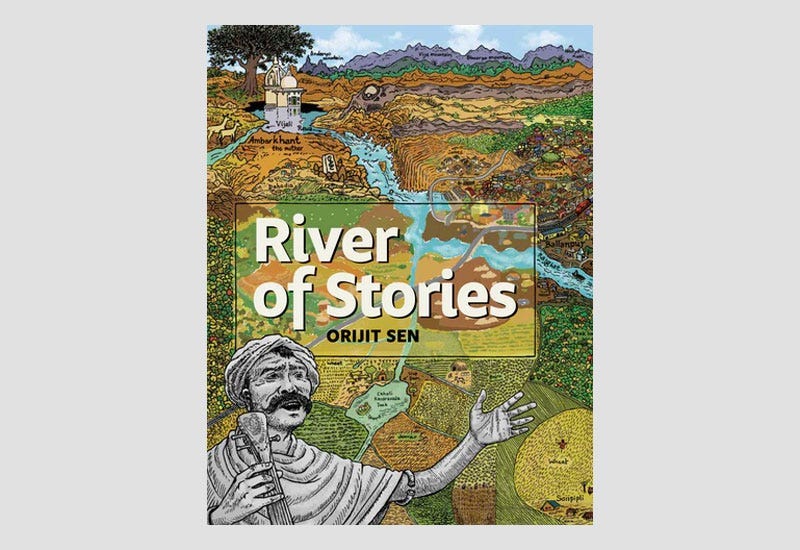
Orijit Sen is widely regarded as the grandfather of the Indian Graphic Novel, a genre that has boomed since the early 2000s. When River of Stories was published in 1994, it was arguably the subcontinent’s first “serious” book-length graphic narrative. Inspired by the 1960s’ underground comix scene, it documents the struggle of the Narmada Bachao Andolan (NBA), a coalition of dispossessed indigenous (or Adivasi) communities and international activists who fought to save the Narmada River from a huge infrastructure project, the Sardar Sarovar Dam. Initial work on the dam began under India’s first Prime Minister, Jawaharlal Nehru, in the 1950s, but it wasn’t until the influx of foreign capital with the liberalization of the Indian economy in the 1990s that construction proper started. Its completion would wipe out biodiverse landscapes inhabited by Adivasis in order to provide hydropower for the subcontinent’s energy-hungry cities. Sen spent two years interviewing both NBA members and state officials, eventually producing a comic that exposed the potential ecological damage of the dam and helped to stall its construction into the 2000s.
Sen presents River of Stories as a fictional account of a journalist, Vishnu, who travels to the Narmada Valley after talking with his cleaner, an Adivasi migrant displaced from her land by the dam’s development. This narrative framing invites the comic’s implied urban reader to see how rising consumption in India’s cities is tied to a hidden programme of extraction in the rural periphery. Sen then encases this documentary project in an additional narrative frame that foregrounds the voices and mythologies of Adivasis who have lived on the land for centuries. The comic is preoccupied with the violent enclosure of this common land by a ruthless state bureaucracy, with the dam infrastructure reducing the plurality of the Adivasis’ “river of stories” to the linear plot of capitalist modernization.
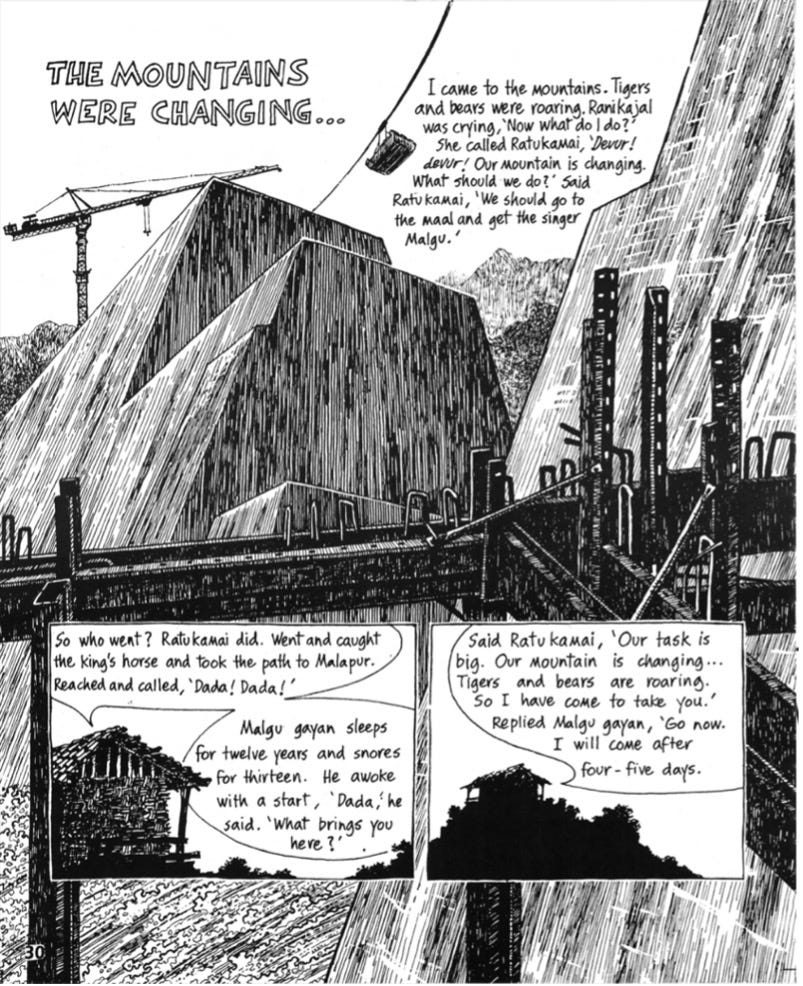
Sen makes full use of comics’ unique spatial form, dramatizing the contest over narratives and territories. He shows how the incursion of frontier roads and property-making practices do not merely break up Adivasi ways of living, but entirely transform time and space through fixed schedules, construction deadlines, technologies and debt repayments. This layering of narrative and visual frames also allows Sen to criticize the Indian state’s reproduction of earlier colonial ways of seeing that had written off entire ecologies as “backwaters” inhabited by “savage” populations.
Comics are an art of abstraction and adaptation: composed from icons and images, they are intuitively legible across both cultural and geographic borders. Sen uses this to invert degrading colonial stereotypes, turning them into a universalizing story about the shared experiences of extraction zones throughout the global world-system.
The political achievements of River of Stories were immediate and concrete, with the work playing a pivotal role in obstructing the dam’s development. Three decades later, however, the work endures because of its formal innovations, which helped set the terms for the next generation of extraction comics.
Joe Sacco is perhaps the world’s most famous comics journalist and like Sen, his work is inspired by the dissenting art of underground comix, with the influence of cartoonists like Robert Crumb particularly evident. His first comic, Palestine, a series of dispatches from the Occupied Territories in the wake of the First Intifada, was serialized in the same years that Sen was working on River of Stories. In the thirty years since, Sacco has documented the plight of communities at the sharpest ends of ethnic conflict and colonial dispossession. His comics areoften celebrated for his detailed panoramas, but it is only with Paying the Land from 2020 that the environment moves from background to foreground, becoming the primary subject of Sacco’s investigations.
Paying the Land takes its title from a tradition of the Dene, the indigenous people who have lived for centuries in Canada’s remote Northwest Territories. Whenever a Dene person takes something from the land, whether firewood or animal pelts, they must pay it back with an offering. The practice is ritualistic, designed to reproduce a culture that is contingent on a more sustainable relationship with the environment. This stands in stark opposition to the extractive view of the tar sands operations that has ripped through this part of Canada, abstracting entire ecosystems into the economic value of the bitumen buried beneath the surface.
Formally, Sacco foregrounds the difference between these basic ontologies in contrasting page layouts: while the Dene’s stories are depicted in flowing sequences devoid of comics gutters or grids, the sections addressing the history of the settler state or the modern extraction economy are broken up by sharp frames that resemble the lines on colonial maps.
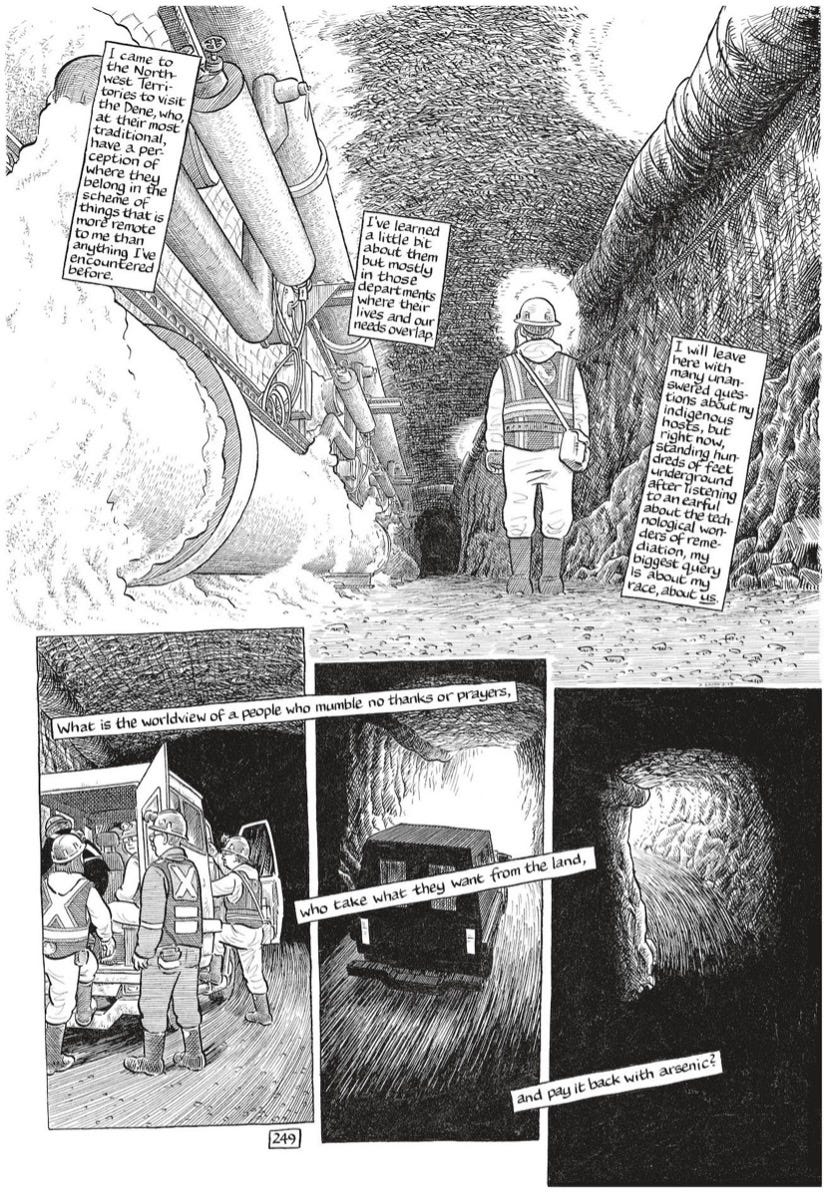
Despite the simplicity of this visual technique, there is nothing reductive or romanticizing in Sacco’s work. Throughout, Sacco documents the interviews he conducted with indigenous leaders who lament the steady erosion of their territories and their culture but who feel they must work pragmatically with the fossil fuel corporations who will only bypass their communities if they do not cooperate. Sacco leads us from the trauma of Canada’s residential school system, which for over a century destroyed families and communities, to a new cohort of young activists as they begin to wield the language of decolonization and assert a revitalized Dene identity. Running like a thread throughout is Sacco himself, his characteristically clumsy avatar guiding the “outside” reader into seeing the environmental costs of their own fossil fuel addictions.
Paying the Land brilliantly folds this extensive research into a totalising view of the Northwest Territories and the position of the tar sands in the wider world-system. The book may take its cue from the climate crisis and destructive impact of fracking, but great care is taken to show how this as only the latest in a string of settler colonial practices, from the earliest trading of animal furs to the building of oil pipelines. He even reflects on the extractive nature of his own relationship with the Dene: he is after all “extracting” their stories and packaging them into a graphic novel that will be sold as a commodity on the literary marketplace.
If Paying the Land is more ambivalent about the power of resistance than River of Stories, it’s a reflection of the revanchist success of global capital in the intervening years. Even so, Sacco offers clear-eyed view of the totality of fossil capital; an urgent reminder that, despite the geographic remoteness of Canada’s Northwest Territories, what is happening there is no longer distant from any of our lives.
First published in 2022, Kate Beaton’s Ducks: Two Years in the Oil Sands stands somewhat at odds with the work of Sen and Sacco. No straightforward work of documentary non-fiction, Beaton’s is instead a graphic memoir of her time working as a tool crib attendant for the oil industry in Alberta, Canada. Ducks may be close to Paying the Land geographically (oil rush towns like Fort McMurray feature in both comics), but it does not approach the extraction zone with the dispassionate gaze of an investigative journalist or the openly political agenda of an environmental activist. Rather, it is an insider’s view, written and drawn by someone with firsthand experience of an extraction zone, capturing the lifestyles of the mostly white, blue-collar workers who have migrated from economically stagnant parts of Canada to the oilfields. The intimacy of Beaton’s account makes its critique of the fossil economy particularly devastating.
The comic began as a series of short strips made while Beaton was working on site for Syncrude, one of the world’s largest open-pit mines that extracts bitumen and refines it into crude oil. She published these on her blog, Hark! A Vagrant, giving them the collective title “Ducks” after a huge flock of migrating ducks drowned in Syncrude’s toxic tailings in 2008, the drowned ducks serving as a metaphor for the thousands of Canadians who travel to Alberta to find work in the oil sands. 2008 was also the year of the financial crash; since then, fossil fuels have remained one of Canada’s few growth sectors. Ducks is a brutal exposé of this predicament, tracking the way debt and austerity have created a floating class of migrant labourers that can then be variously persuaded and coerced into working in the oil industry.
While these forces are systemic and abstract, Ducks renders them frighteningly concrete. The comic begins in Cape Breton, Nova Scotia, just after Beaton graduated from college with a mountain of student debt. She wants to make it as an artist, but this is a neoliberal world in which education is a commodity and the underfunded arts sector runs mostly on unpaid internships. Saddled with spiralling interest payments, Beaton knows her ambitions will come to nothing without savings or inheritance. She therefore makes the decision to spend two years of her young adult life working in the extraction zone, clocking up enough to pay off her debts and giving herself a secure financial platform from which to launch her career. Insofar as she has been able to do this, there is a profound irony behind Ducks: its excoriating critique of the conditions faced by tar sands workers is made possible by the wages that Beaton earned while at Syncrude.
There is nothing triumphant about Ducks, which shows how extraction interacts with different economic forces to produce a space of exception where basic laws go unenforced, where common sociality is suspended, and where the money is just about good enough to prevent people from leaving despite the escalating dangers. For Beaton, this is exacerbated by her position as an isolated young woman in a world dominated by men who, hundreds of miles away from their families and friends, consider themselves accountable to no one. At the centre of Ducks is an episode of sexual assault that can be read as a metaphor for our rapacious relationship with the environment, but which is just as powerfully understood as evidence of the violence of a society that has allowed all of its most basic safety nets to be systemically eviscerated.
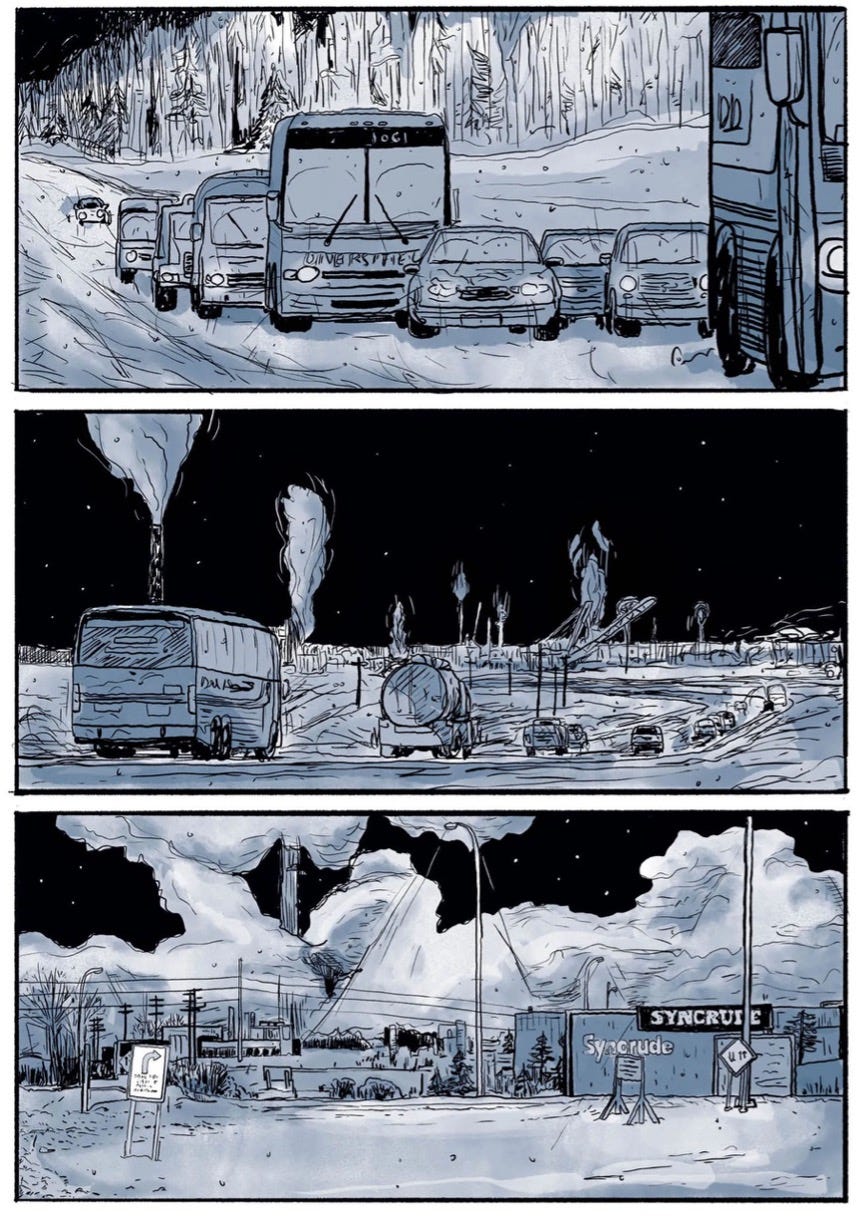
Beaton’s simultaneously intimate and infrastructural critique of extraction is made possible by her innovative use of form and aesthetics. Most of Ducks is told in claustrophobic layouts composed of six to twelve panels per page. These tight windows shrink our vision, creating in the comic’s most tense narrative moments a sense of breathlessness that registers the somatic experience of suffocating. It is as though the fumes from the tar sands are emanating directly off the page.
At the same time, Beaton fronts each chapter with large open pages, combining these with occasional “silent” sequences—images, but no words—that linger over the bleak realities of the mine’s physical environment, devoid of people and painted in a range of blue hues. These are like alien landscapes, something from the moon perhaps, a reminder of the paradox of extraction zones: on the one hand these are places apart from normal society, where basic civic behaviours are suspended; on the other they are fundamental to modern life, their seemingly extra-terrestrial environments reflecting back at us the extent of our own alienation.
While one of the defining features of the modern graphic novel is that it tends to be researched, written, and drawn by a single “auteur,” in the long history of comics creation this is the exception rather than the rule. Giants like Marvel and DC still use a Fordist-style assembly line of scrip-writers, pencillers, inkers, colourers and letterers, while in the French bande dessinée tradition it is common to find writers teaming up with artists and researchers.
Crude: A Memoir brought together the Ecuadorian lawyer Pablo Fajardo, French journalist Sophie Tardy-Joubert and French artist Damien Roudeau, along with Hannah Chute as translator of the English edition. The graphic memoir tells Fajardo’s life story, beginning in the 1970s with his migration from southern Ecuador to the Amazon rainforest for work on the Texaco oil fields. Unlike the similarly autobiographical Ducks, which offers few stories of resistance to the toxic work culture at Syncrude, Fajardo is quick to join both worker and indigenous mobilizations against horrendous conditions in the Ecuadorian oil industry.
The comic depicts Texaco’s transformation of the Amazon into an extraction zone as a transparent case of settler colonialism, documenting the corporation’s construction of a securitized town in the middle of the rainforest for its US employees, named Lago Agrio, after the city of Sour Lake in Texas.
Fajardo becomes involved with liberation theologists who raise funds to train him as a lawyer so he can protect the interests of local communities against this violence. After some early victories, the comic’s main action takes off when Texaco (now Chevron) depart from Ecuador, leaving behind a disastrous oil spill that has been described as the “Amazon Chernobyl.”
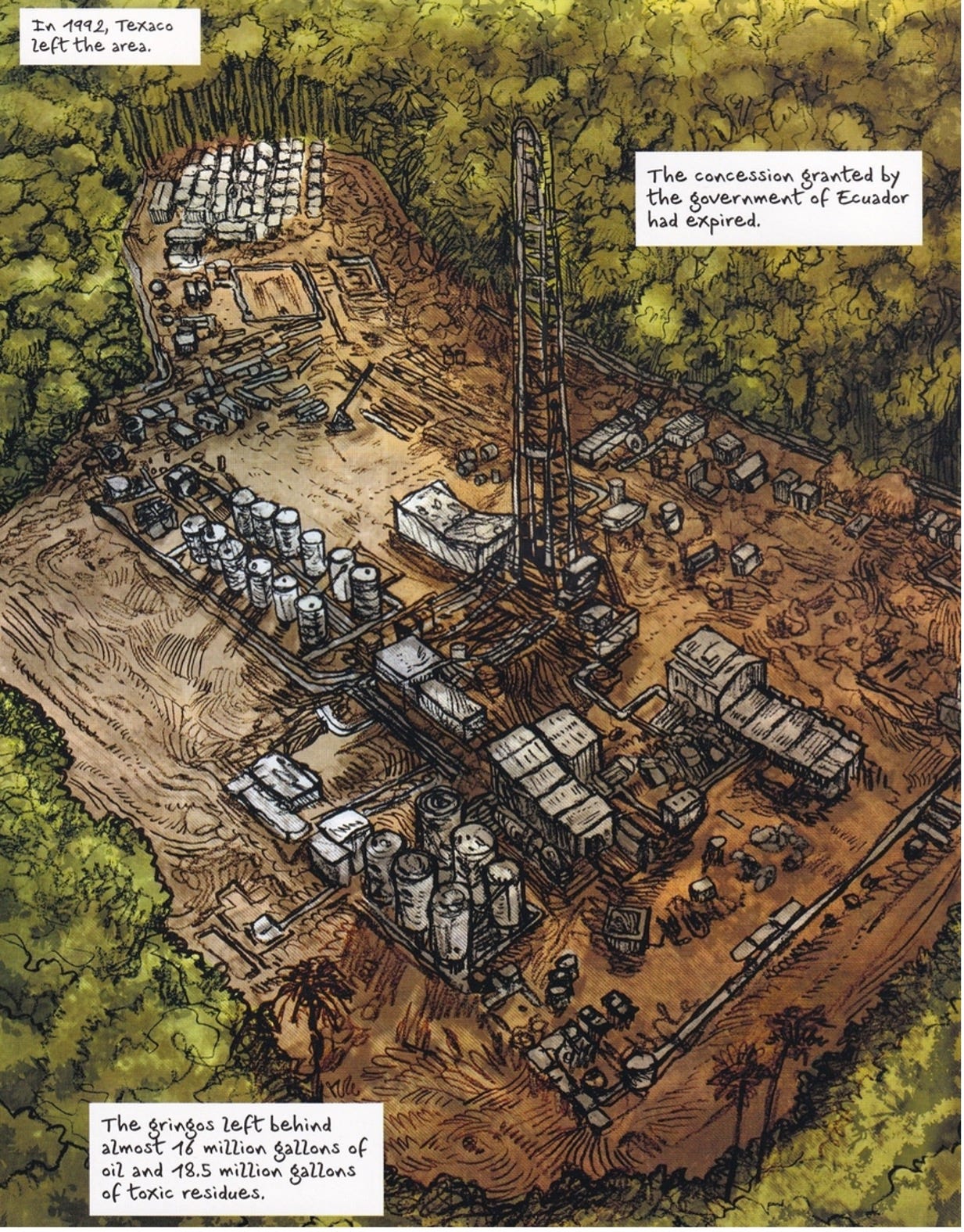
Crude then tracks the community’s successful pursuit of Chevron for $9.5 billion compensation through various national and international courts, with Fajardo at the helm. The case made history and attained global attention after director Joe Berlinger’s 2009 documentary film, Crude. However, in later years, it became clear Chevron were not ready to concede. In a meta-documentarian move characteristic of comics journalism, the graphic memoir explains how hundreds of hours of outtakes from Berlinger’s film were subpoenaed by the US corporation and used to launch a campaign of bribery and aggression that would undermine the earlier verdict. More than a decade later, Chevron is still yet to pay the compensation that is owed. The comic concludes with Fajardo’s campaign for justice through the United Nations and the International Criminal Court, focusing particularly on his calls for reforms to international law that would make it work in the interests of communities impacted by extraction.
Tardy-Joubert met Fajardo while writing a profile on him in 2014, but unlike Sacco’s trademark investigative style, the journalist herself is absent from Crude, which prioritizes Fajardo’s account and allows him full narrative control. Similarly, where Beaton’s Ducks has no overarching narrator, the reader left to draw their own conclusions, Fajardo’s voice directs our interpretation at every stage. If the comic is more didactic as a consequence, it fits with its more openly political ambitions. Crude: A Memoir is as much about building resistance to extraction through the fragile legal and international institutions as it is documenting the experience of those in the Ecuadorian Amazon.
This doesn’t make Tardy-Joubert and Fajardo’s graphic novel any less thought-provoking, however. Moreover, Damien Roudeau’s sumptuous graphics and creative use of form ensure that Crude: A Memoir is an aesthetic as well as an educational experience. It is also the only graphic novel in this list to make extensive use of colour, with multiple crayoned lines building into thick tapestries that represent the Amazon rainforest and its indigenous inhabitants. By leaking the greys and browns of fossil fuels and infrastructures through these colourful environments, Roudeau adds visual urgency to Fajardo’s political message.
This is another collaborative project from Latin America, commissioned and developed by Peruvian-based media organization Ojo Público, or “Public Eye”. Available to read online for free in both Spanish and English, La Guerra Por el Agua, or The War Over Water, is the only webcomic on this list. While comics readers have tended to prefer the weight of codex-bound books, there is huge potential in the format, which adapts the basic storytelling techniques of conventional graphic narratives and blends them with infographics, photographs, short animations and interactive templates.
The War Over Water uses several of these to investigate the ecological consequences of the Tía María mining project in the Arequipa Region of southern Peru. Tía María is a vast opencast mine owned by Southern Copper Corporation, the world’s largest copper mining company. Its water-intensive extraction processes have dried up the landscape, severely impacting local farmers and indigenous populations who have been living off the land for centuries. The state has backed Southern Copper, on the basis of claims that their taxes will be reinvested in modernization projects that will improve the lives of Peruvians. In this perhaps paradoxical promise to fund progressive policies with profits from extraction we see the contradictions of the “Pink Tide” of leftwing governments that swept Latin America in recent decades. However, as the case of the Tía María mine illustrates, many of the foreign corporations involved in such projects have become experts at tax evasion, and the benefits are rarely felt by communities at the frontiers of extraction. As mining gobbles up resources and makes self-subsistence impossible, a war has broken out between disenfranchised populations and profit-driven corporations, who have the backing of the militarized state apparatus. The climate crisis has only exacerbated this social tinder box. Successive years of drought have rendered water ever more scarce.
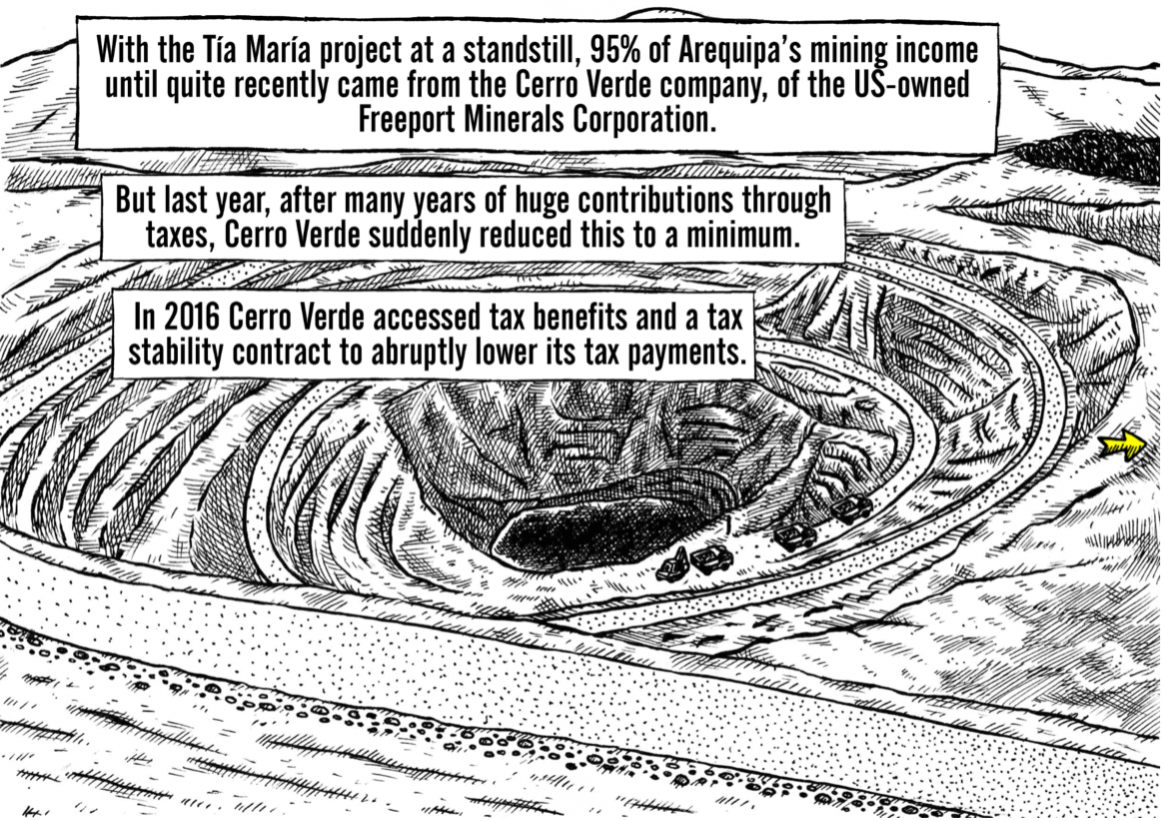
The team behind The War Over Water was composed of two members of Ojo Público, investigative journalist Nelly Luna Mancio and web developer Jason Martínez, as well as the prolific Peruvian comics creator Jesús Cossio. Their central objective, as Nelly Luna describes it, was to find a way of guiding readers between territorial conflicts on the ground—at least five protestors have been killed by security forces since the opening of the Tia María mine—and the wider constellation of interests that have conspired against basic democratic structures.
Comics are already an agile form, capable of moving between narrative scales, and this elasticity is heightened in the modern webcomic which can float maps over landscapes and contextualize headline-grabbing violence with individual witness testimonies. In doing so, readers become active participants. Rather than simply scrolling through or flicking to the next page, they must click on different sections of the comic to reveal new sources of information. This gives the reader unusual control over some parts of the narrative, which does not move forward until they have decoded an image and interacted with it. It’s a laborious reading experience, antithetical to the passive flows of social media—which, after all, are made possible by the copper mined in Tía María, turned into smartphones in China and sold to consumers across the world.
By mapping these connections, and registering their materiality, The War Over Water is able show how we are all implicated in modern extractive practices. Indeed, Ojo Público’s account of the militarized confiscation of scarce resources is a reminder of the grim future that twenty-first-century capitalism is has in stall for all of us. Extraction comics may not be able to change this future, which is in fact already the present for many across the world-system. But as all the comics creators introduced in this list surely know, it is much easier to struggle for alternatives when you can see clearly what it is you’re up against.
Dom Davies is a Reader in English at City St George’s, University of London. He is the author of The Broken Promise of Infrastructure (Lawrence Wishart 2023) and Urban Comics: Infrastructure and the Global City in Contemporary Graphic Narratives (Routledge 2019), and co-author with Candida Rifkind of Graphic Refuge: Visuality and Mobility in Refugee Comics (Wilfred Laurier University Press 2025). More information about his research is available at www.drdomdavies.com.
No posts
Comments
Nothing yet. Say the first thing.
Sign in to join the conversation.