
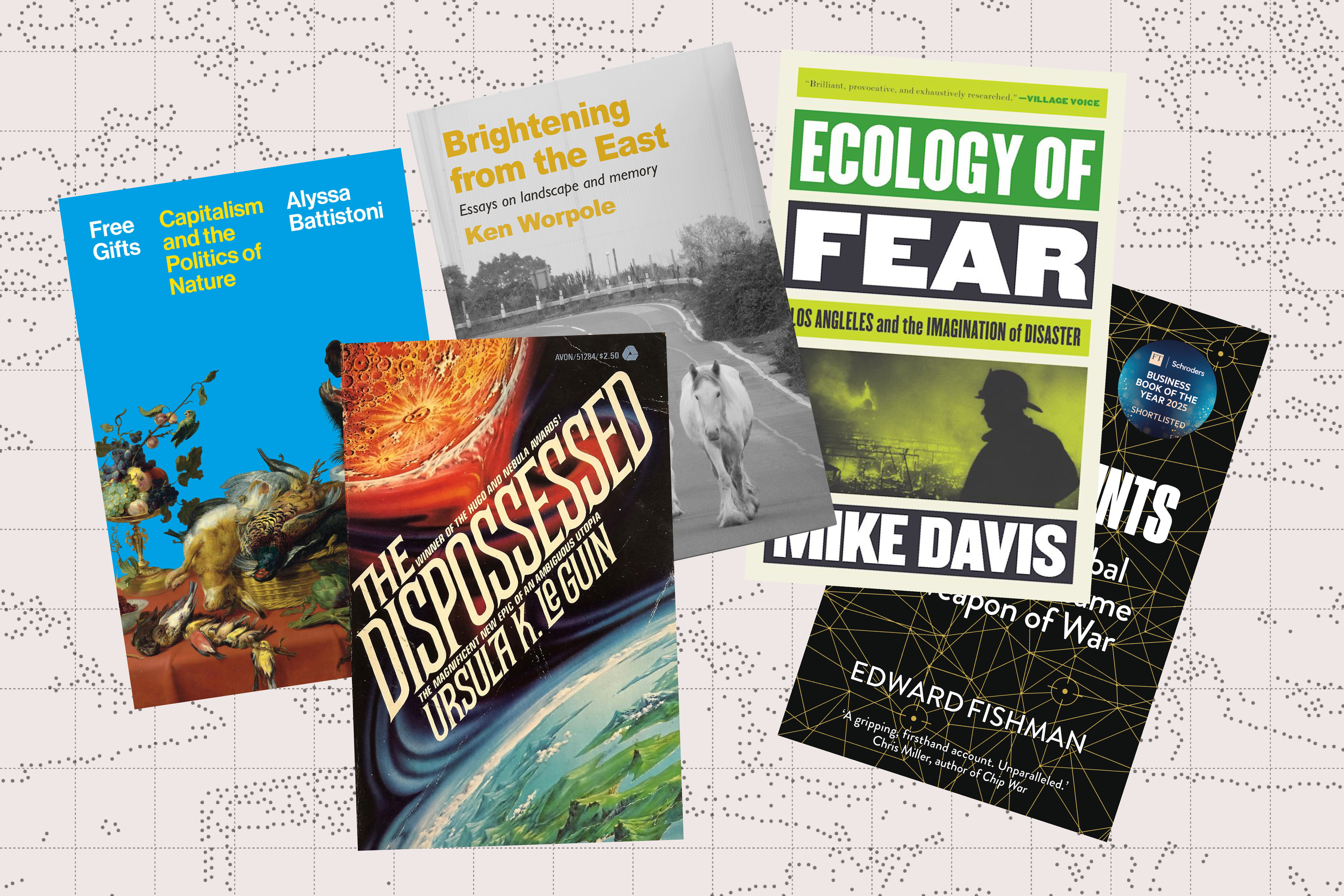
Welcome to our *final* newsletter of 2025! Today, rather than our usual list of essays the editors of the BREAK—DOWN read over the past few weeks, we have asked some of our favourite writers and contributors to tell us the best books they read this year. It’s a great list, ranging from the late Mike Davis’s opus, Ecology of Fear, to works of sci-fi and essays about the landscape of Essex — it even has an unpublished PhD thesis, stretching the idea of a books of the year list nearly to breaking point.
I wanted here to thank all of our readers, subscribers, listeners and contributors for their support in 2025. We have even bigger plans for 2026, which we will no doubt spam you with in the new year, but we couldn’t have done even a fraction of what we have so far without your support. Thank you!
We’d also love to hear our readers favourite reads (or re-reads!) of the year, so please let us know down in the comments!
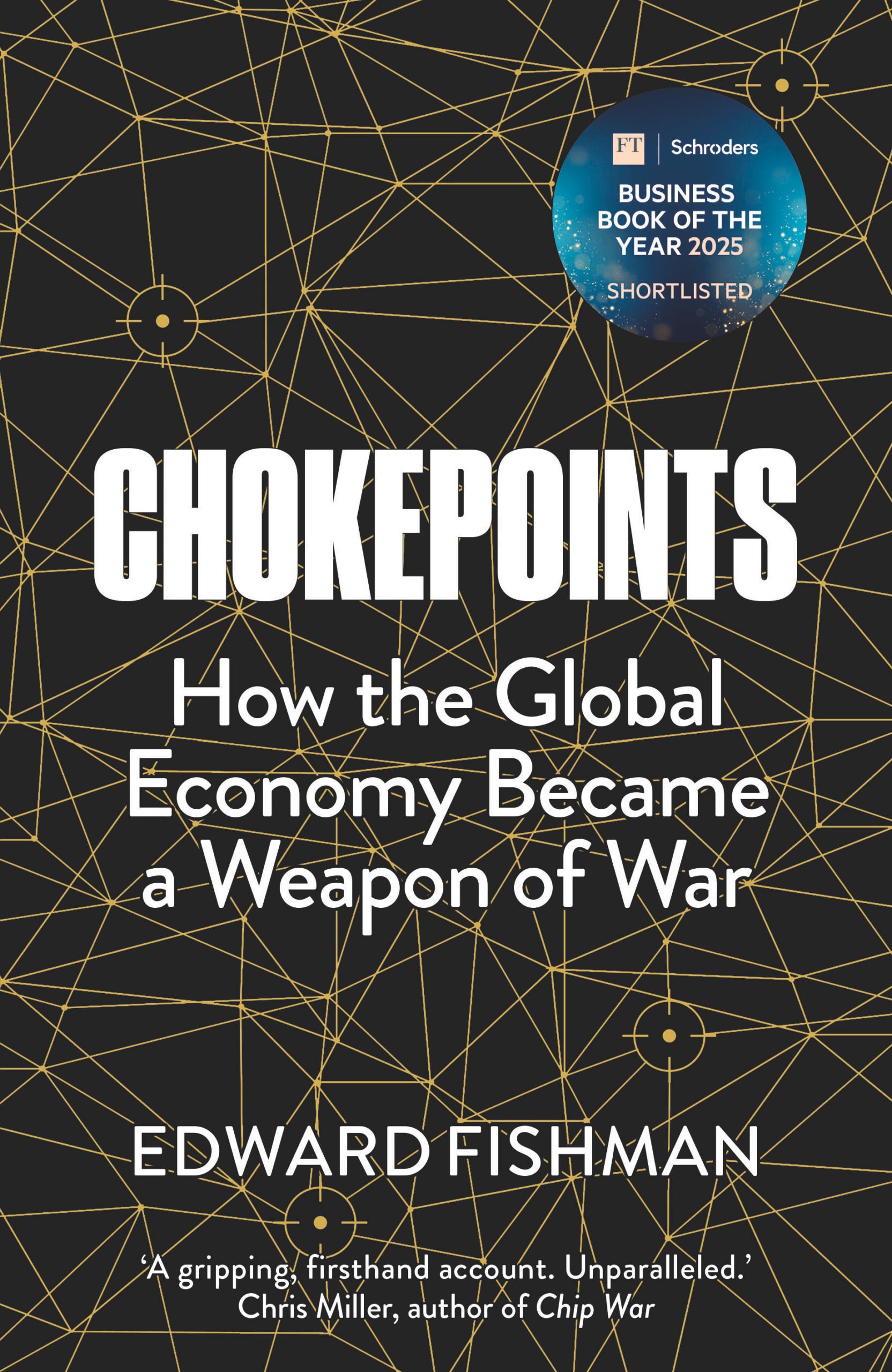
Of the nonfiction books I read this year, the one I enjoyed most and learned most from was Edward Fishman’s account of America’s modern “economic warfare” against Iran, Russia and China, Chokepoints (2025, Elliott & Thompson). It’s just a great blend of politics and economics, and incredibly clearly written. What I particularly appreciated is that Fishman uses his access to many of the main characters and indeed his own involvement in the story not to grandstand or showoff – a hugely irritating attribute of books like Kenneth Rogoff’s Our Dollar, Your Problem, which I also had the misfortune to read this year – but solely to provide insight that would otherwise have been hard to offer.
Brett Christophers, a professor at Uppsala University and author of The Price is Wrong: Why Capitalism Won’t Save the Planet, as well as “Failure as Success” from The BREAK—DOWN Issue #1.
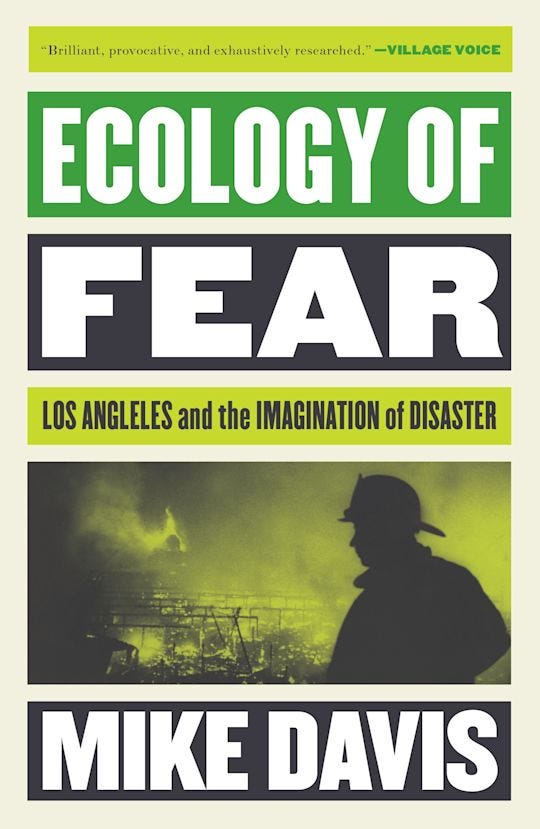
Nearly a year on from the Los Angeles fires, most debris has been hauled out of the foothill neighborhoods of Altadena, but a campfire smell lingers over the frighteningly empty landscape. Southern California’s tendency towards environmental catastrophe, writes the late Mike Davis in Ecology of Fear (1998), stands apart in kind from the temperate geographies of New England and Europe. In this sequel to City of Quartz, Davis explores LA’s compounding social and ecological contradictions by way of its earthquakes, fires, tornadoes, and man-eating mountain lions. Then, through a systematic reading of disaster stories in pulp fiction, forgotten literature, soft-core porn, B-movies, and blockbusters, he traces the racialized fears and fantasies that animate audiences’ delight in LA’s fictional obliteration. Ecology of Fear is wonderful and prescient, and its chapters on fire are essential context for January’s disaster.
Sofia Menemenlis, a PhD candidate in Atmospheric & Oceanic Sciences at Princeton University and author of ‘The Sunlight Managers’ from the BREAK—DOWN Issue #2.
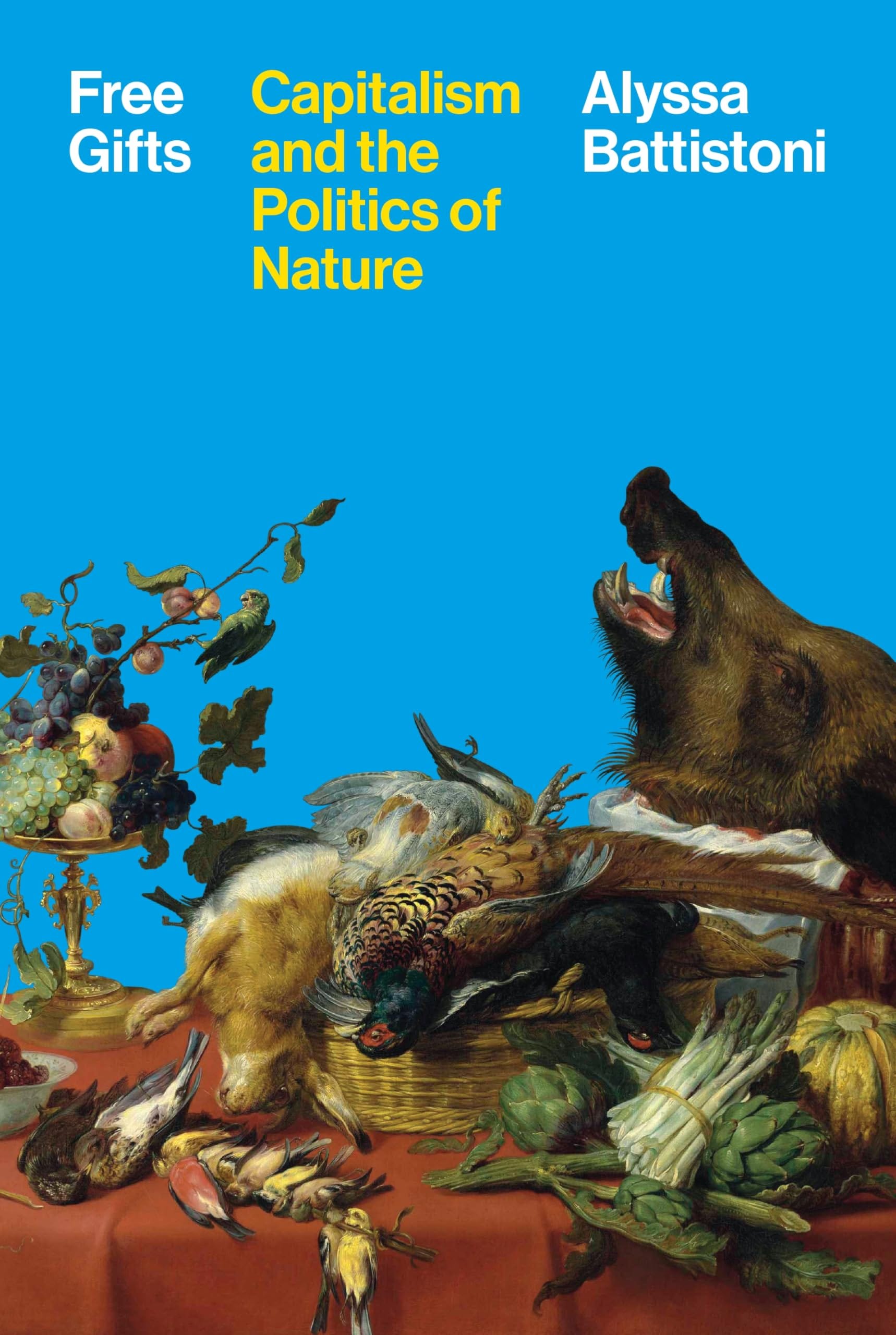
For anyone reading who also listens to our podcast, it’ll come as no surprise to hear that Alyssa Battistoni’s Free Gifts: Capitalism and the Politics of Nature (2025, Princeton University Press) was my favourite non-fiction work this year. People overuse this word, but it was a ‘masterful’ piece of political theory, whose concluding chapters—amounting almost to a treatise on freedom—I found rather moving. Fair warning: the early chapters are dense (we’re talking political theory, after all), but the effort is well worth the payoff. The best thing I’ve read on the politics of nature.
On the fiction side, I’ll admit that I restarted a book I’d failed to finish (humiliating) during my mercilessly brief “I’ll give audiobooks a try” phase: Ursula Le Guin’s classic, The Dispossessed (1974). I’ve never read a novel that constructs such a complete and visceral alternative world and political system without it feeling forced. I was confronted, in a challenging but inspiring way, with the strength of my own principles and how they might hold under harsh conditions—an important emotional exploration for any eco-socialist looking forward at a potentially grim future. It’s also very funny: the worst thing you can be called on Anarres, the moon society, is a “profiteer”. And it’s just gorgeous. A story about the wonder of scientific inquiry, the violence of class and property, and solidarity across divides—I promise, even if you hate science fiction, this is for you.
Adrienne Buller, Founder and Editor of The BREAK—DOWN, and author of ‘The Value of a Whale’ which won the 2024 Zencey Prize in Ecological Economics.
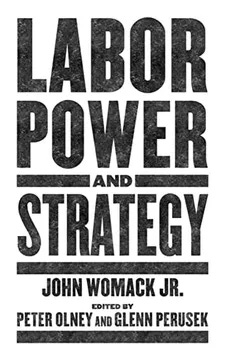
I happen to believe that key to the left winning basically anything it cares about, including climate, is rebuilding the labor movement. If the main barrier to most of our goals is capitalist power, then the power of an organized working class is the main historical example we have of an effective counterweight. Yet, how should we understand labour’s power strategically? In a new book Labor Power and Strategy (2023, PM Press), the labour activist Peter Olney interviews a retired Harvard labor historian, John Womack Jr., for the answer. Womack’s historical research was on Mexican history but, on his account, he stumbled into the power of electricity and other industrial workers in shaping Mexico’s revolutionary period. In the interview, Womack provides a startlingly simple thesis - labour’s power is rooted in its ‘strategic position’ to shut down vulnerable nodes in the networks of industrial supply chains. If we want to revive the labour movement in general, we better embark on a ‘technical’ analysis of those industrial networks to identify capital’s points of vulnerability. The book as a whole features several critical “responses” to Womack’s ideas from some of the most prominent labour organizers and scholars, including the late and legendary Jane McAlevey, and a response from Womack itself. While the book is not about climate politics per se, it holds key ideas for how workers can regain their power through militant strikes that force powerful actors to concede to labour’s demands. It is my view that if we actually did rebuild working-class power in this way, it would not be long before those demands could also include the kinds of large-scale investments in green energy and infrastructure necessary for decarbonization (not to mention the accelerated phase out of the fossil fuel industry itself). With this book, and Womack’s hardnosed strategic guidance, we can move in that direction.
Matthew T. Huber, author of ‘Climate Change as Class War’.
The book that changed my thinking most this year is not really a book at all but rather a dissertation that should be a book. I realize that an unpublished dissertation sounds dry as dust, but let me make my case! Baker studies the history of The Limits to Growth, arguably the most important environmental book of the twentieth century (far surpassing Silent Spring or The Sand County Almanac). That report, written by Donella Meadows and predicated on a computer model built by Jay Forrester’s team, sold more than a dozen million copies since its publication in 1972 and by being the first simulation of the global economy and environment it is the forebear of the countless integrated assessment models that compose the backbone of climate politics today. The Limits to Growth is strangely both influential and obscure, especially its connection to the shadowy Club of Rome that commissioned the study. Only one other historian has studied it (Fernando Elichirigoity, who wrote Planet Management in 1999), but Kevin T. Baker’s “World Processors: Computer Modeling, the Limits to Growth, and the Birth of Sustainable Development,” (2019, PhD diss, Northwestern University), benefits from more archival sources and a better grasp of computer science. What makes “Word Processors” special is that Baker offers readers a new historical narrative. He had expected to encounter in the archive the standard dramatis personae—environmetnal activists, ecologists, and cyberneticians—but was surprised to instead find European technocrats, management theorists and practitioners of ‘system dynamics’, and esoteric branch of computer modelling. The initiates of the Club of Rome were not even particularly interested in environmental issues, but instead sought to stabilize society after the upheavals of 1968. Baker convincingly shows how environmental politics became a question of management—hence the industrialists or business schools mandarins—with modelling as its preferred tool. The purpose of such simulations was not to ‘see’ the future, as other historians have commonly assumed, but to give planet managers a ‘feeling’ for how the system operated to better manipulate it. After reading this dissertation, it is impossible to think the same way about environmental history, the emergence of ‘the planetary’ in the 1970s, and the role of modelling today.
Troy Vittese, co-author of ‘Half-Earth Socialism’.
Given how much has changed in the last five years, it would be easy to dismiss James Ferguson’s Presence and Social Obligation (2021, Prickly Paradigm Press) as a “pandemic” book, already hopelessly out of date. But Ferguson’s case for a new kind of distributive politics—one that affords each person a share of the social wealth wherever they happen to be, regardless of their citizenship status or what sort of work they do—could not be more relevant today, as leaders around the world try to unring the bell of globalization by restricting even the most basic social protections to fewer and fewer people. Ferguson’s main argument is that citizenship and labor are no longer adequate criteria for determining who is owed what. Too many people live abroad; too many people work entirely or partly off the books, as day laborers, delivery drivers, waste pickers, mothers, uncles, and many other things besides. If social wealth is owed only to “citizens” or “workers,” huge numbers of people would seem to be owed nothing at all. Ferguson proposes that distribution instead be based on ownership and presence. You deserve a share of what we collectively produce because you own what we collectively produce—and not because you labor for a wage but because without your contribution we would have less. And you deserve a share because you are here, regardless of where you came from or what groups consider you a member. Ferguson, who died in 2025, was a brilliant anthropologist attuned to the complexity of on-the-ground politics. He acknowledges how hollow these sorts of normative claims can sound, especially in moments of right-wing reaction. But his (very) short book is tightly argued and rich with examples, all of which make clear that we cannot expect those currently monopolizing our collective wealth to give us our share; we have to take it.
Casey Williams, Postdoctoral Fellow at Tokyo College, an Institute for Advanced Study at the University of Tokyo, and author of ‘Reading Stuart Hall for the Climate Crisis’.
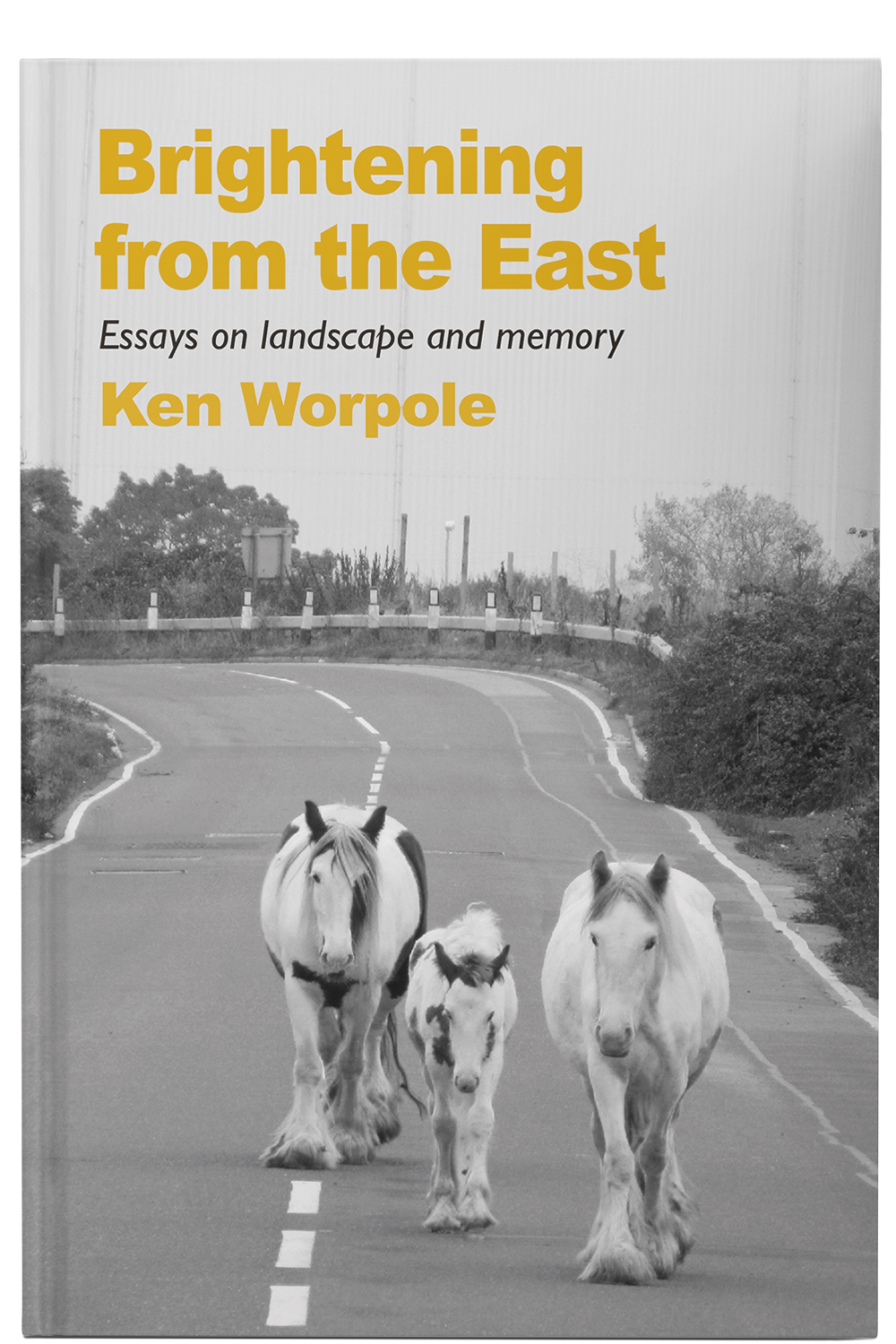
Ken Worpole has long been one of the finest writers about the English landscape, particularly that part of it that runs east out of London into the Essex reaches and the North Sea beyond; a “bastard” landscape, Worpole calls it in his latest book, Brightening from the East (2025, Little Toller), a complex and enduring mix of industry and agriculture, leisure and ecology, which a strange and complex social history. The book is a wonderful collection of essays, including some of Worpole’s most personal writing to date, and it contains two of my favourite of his pieces: a brilliant short essay on church halls via the TV comedy series Detectorists, and a longer piece on the Othona community, a religious back-to-the-land community on the Essex coast based partly out of a group of Nissen huts. There’s something of Richard Mabey, an essay on whom is included in the book, and his “unofficial countryside” in much of the writing, and deep shades too of writers like John Berger, Colin Ward and Raymond Williams. Brightening from the East is a joy from start to finish, and a book I will regularly return to.
John Merrick, Deputy Editor of the BREAK—DOWN.
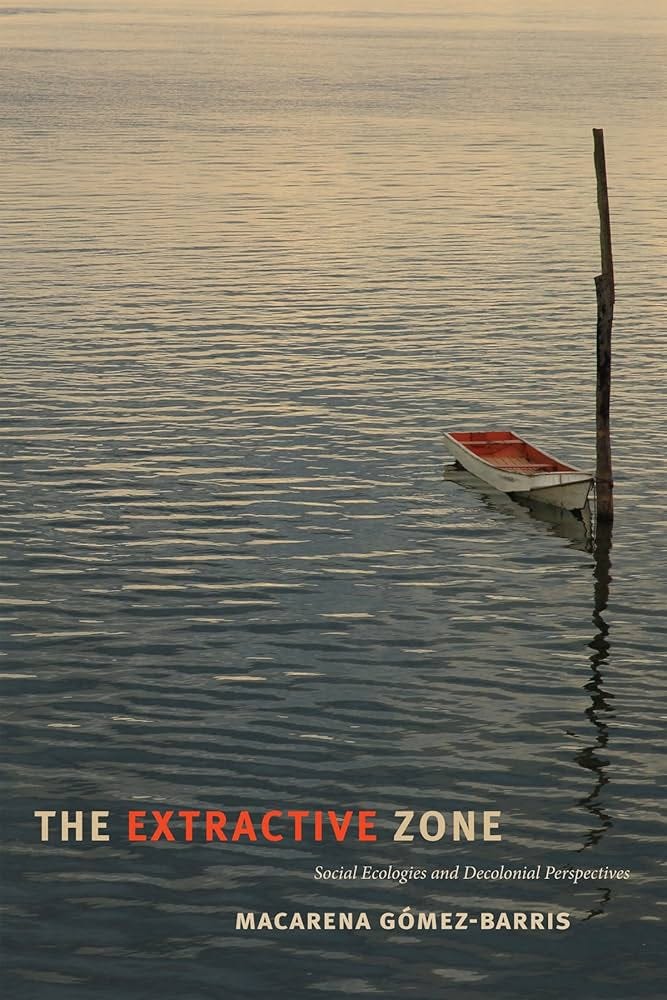
I read The Extractive Zone: Social Ecologies and Decolonial Perspectives by Macarena Gómez-Barris (2017, Duke University Press) after her lecture at Courtauld in May 2025. I was mesmerised by her crafted diagnosis of the extractivist realities in South America through a feminist writing that foregrounds empowerment and on the ground resistance. I also felt inspired, which is a rare feeling when reading about extractive capitalism.
I also loved the tiny book, Islands of Exile: Hemmed in by the Sea (2025), a collection of short essays published by Kyklada Press; another precious companion this year. Drawing together writings on tourstification of the Aegean archipelago, the closed borders of Europe and architectures of imprisonment and torture, I appreciated the commitment to the context and material conditions of a global struggle. I have followed the work of David Bergé in this series of short publications and I am always inspired by their ability to craft a cohesive yet expansive narrative that is grounded in place.
Pinelopi Gardika, architect and publication designer for The BREAK—DOWN.
No posts
Comments
Nothing yet. Say the first thing.
Sign in to join the conversation.