

The World Cup starts tomorrow and, as usual, Brazil comes to a standstill. Goldman Sachs has published its predictive model for the tournament—sophisticated, using 50,000 Monte Carlo simulations and an Elo system adapted for soccer—and the result is not encouraging: Brazil is only the fourth favorite, with just an 8% chance of lifting the trophy, behind Spain (26%), France (19%), and Argentina (14%). Soccer is soccer, and models get things wrong. But cold, hard signals rarely lie for very long—on or off the field.
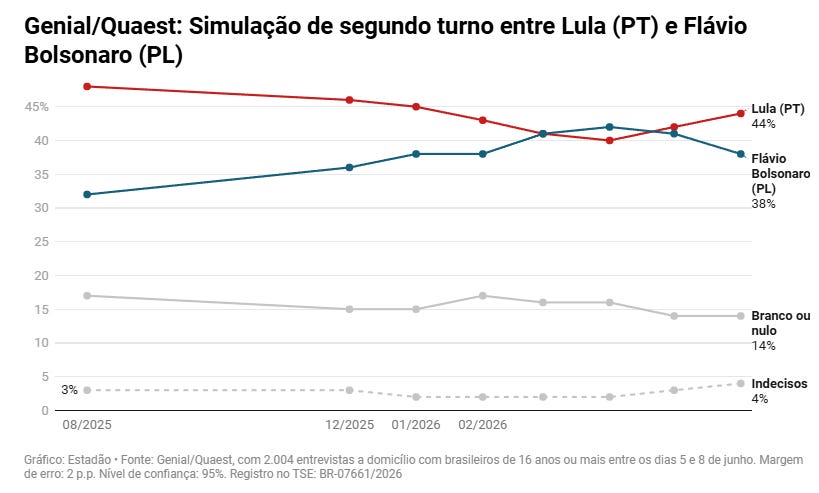
Why this introduction? Because this year we also have presidential elections, and the political environment has changed significantly in recent weeks. The June Genial/Quaest poll shows Lula with a 10-point lead in the prompted first-round vote intention survey (39% to 29%) and a 6-point lead in a simulated runoff against Flávio Bolsonaro (44% to 38%). Three factors explain the president’s improved standing: the impact of the income tax exemption is still resonating; the Desenrola debt-renegotiation program has reduced the percentage of heavily indebted Brazilians; and the Banco Master scandal, with 58% of respondents believing that Flávio may be hiding illegal involvement, has pushed the senator’s rejection rate to 56%. In short: Lula bought votes efficiently, and his opponent helped by stumbling.
But I am not fooled by electoral numbers. What truly concerns me is Brazil’s fiscal trajectory—and to understand what may lie ahead, it is worth looking at what is happening right now in Indonesia.
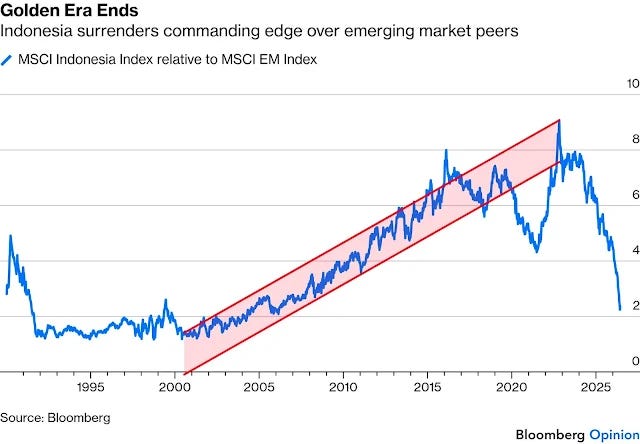
The country enjoyed decades of consistent growth under Joko Widodo, with responsible economic policies, current-account surpluses, and a stable currency. Indonesia’s MSCI index posted impressive gains relative to the broader emerging-market universe between 2001 and 2022—one of the strongest performances among its peers. With Prabowo Subianto’s rise to power in October 2024, the script changed: a populist agenda, expansionary spending, and in September, the dismissal of Finance Minister Sri Mulyani Indrawati—a former World Bank director and a key pillar of the country’s credibility. The market did not forgive.
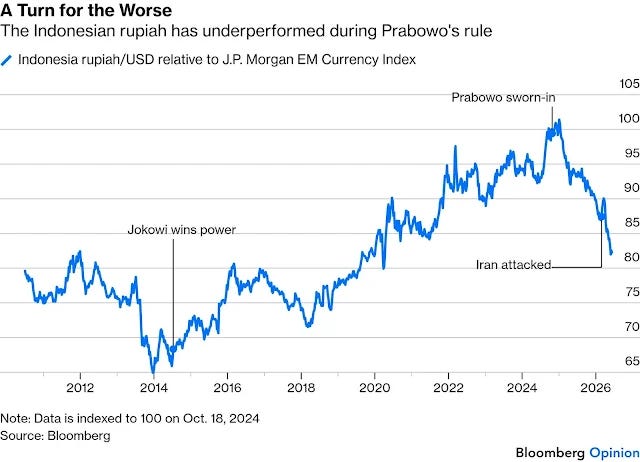
The rupiah entered a gradual collapse. Since Prabowo took office, the currency has lost more than 20% against J.P. Morgan’s emerging-market currency index—precisely while its peers were recovering. Jakarta’s stock market was down 38% for the year, making it the worst-performing index among more than 90 global indices tracked by Bloomberg. The Indonesian stock market’s price-to-earnings ratio fell to its lowest level since the 2008 global financial crisis.
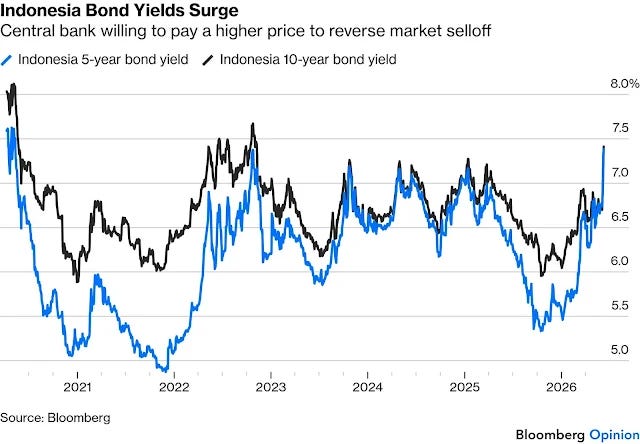
Bank Indonesia tried to stop the bleeding. In May, Governor Perry Warjiyo surprised markets with an unscheduled interest rate hike. It did not work. Three weeks later, in June, he was forced to repeat the move—another emergency increase of 25 basis points, the second unscheduled hike since he became central bank governor eight years ago. Foreign exchange reserves have fallen for the fifth consecutive month. Yields on 5- and 10-year sovereign bonds have surged above 7.5% annually and continue to rise.
Analysts’ diagnosis is straightforward: monetary policy alone cannot reverse what fiscal policy is undoing. Capital Economics summed it up well—the central bank is acting like a bandage on an open wound. What is needed is a clear shift in government policy toward a more investor-friendly approach. For now, that is not part of Prabowo’s plans.
Why does this interest me so much? Because Indonesia’s trajectory is strikingly similar to what I see taking shape in Brazil. Public debt is growing rapidly, long-term inflation-linked government bonds (NTN-Bs) are already trading at real yields between 8.2% and 8.7% per year—levels the market only accepts because the exchange rate remains relatively stable. And the exchange rate remains stable only because investors are comfortable holding securities that offer extraordinarily high returns. A golden trap.
Evolution of NTN-Bs (real yield offered, % per year):
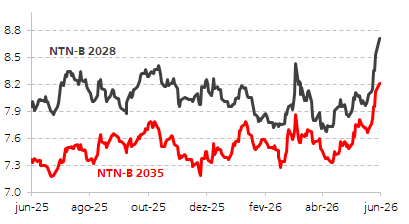
The difference between Brazil and Indonesia is one of degree, not nature. Brazil has a deeper capital market, debt that is mostly denominated in local currency, and a stronger institutional track record. But the mechanism is the same: fiscal populism eroding credibility, a central bank pressured to compensate with ever-higher interest rates, and an exchange rate that holds up only as long as real yields adequately compensate for risk. When that equation reverses—and it always does—the adjustment is violent.
I strongly suspect that a second Lula term would be a more intense version of what is already underway. Without the constraints of a first term and with reelection secured, the natural tendency would be to deepen the redistributive and interventionist agenda, with increasingly less concern about what financial markets or foreign investors think. The process does not happen overnight, but long-term interest rates are already signaling that the market does not believe the current balance is sustainable.
The same Goldman Sachs that models World Cups with 50,000 simulations knows that models have limits. But structural signals rarely lie for long. The Plan B scenario—a more severe fiscal breakdown, capital flight, and an out-of-control exchange rate—is no longer merely a tail risk; it is becoming the base case. Better to accept that now than to be surprised when the numbers stop being mere warning signs.
Technical Analysis
In the post “Scraping the Bottom of the Barrel” (raspando-o-tacho), I made the following comments about the Ibovespa:
“The major implication of the five-wave formation is that the correction of green wave 4 will be a zigzag rather than a triangle, which is more common in fourth waves. I tried to highlight the likely path of this orange A–B–C wave. In the short term, the target for completing orange wave A would be around 162,000.”
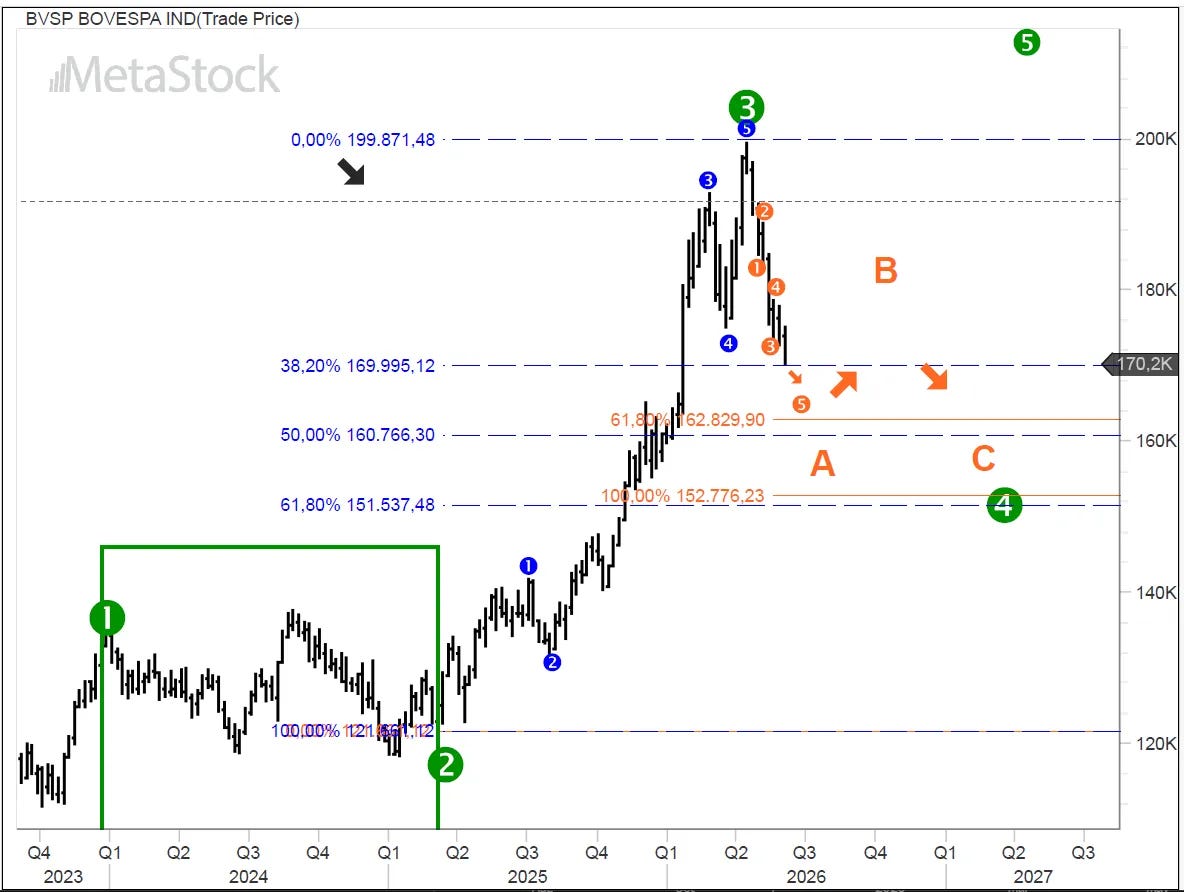
Very little has changed over the past week, but everything suggests that orange wave A has not yet finished. It will likely end somewhere between 162,800 and 160,700. After that, an upward move should follow—but how far? Roughly speaking, between 185,000 and 190,000. Remove the orange wave count to “clean up” the chart, leaving only wave 5.
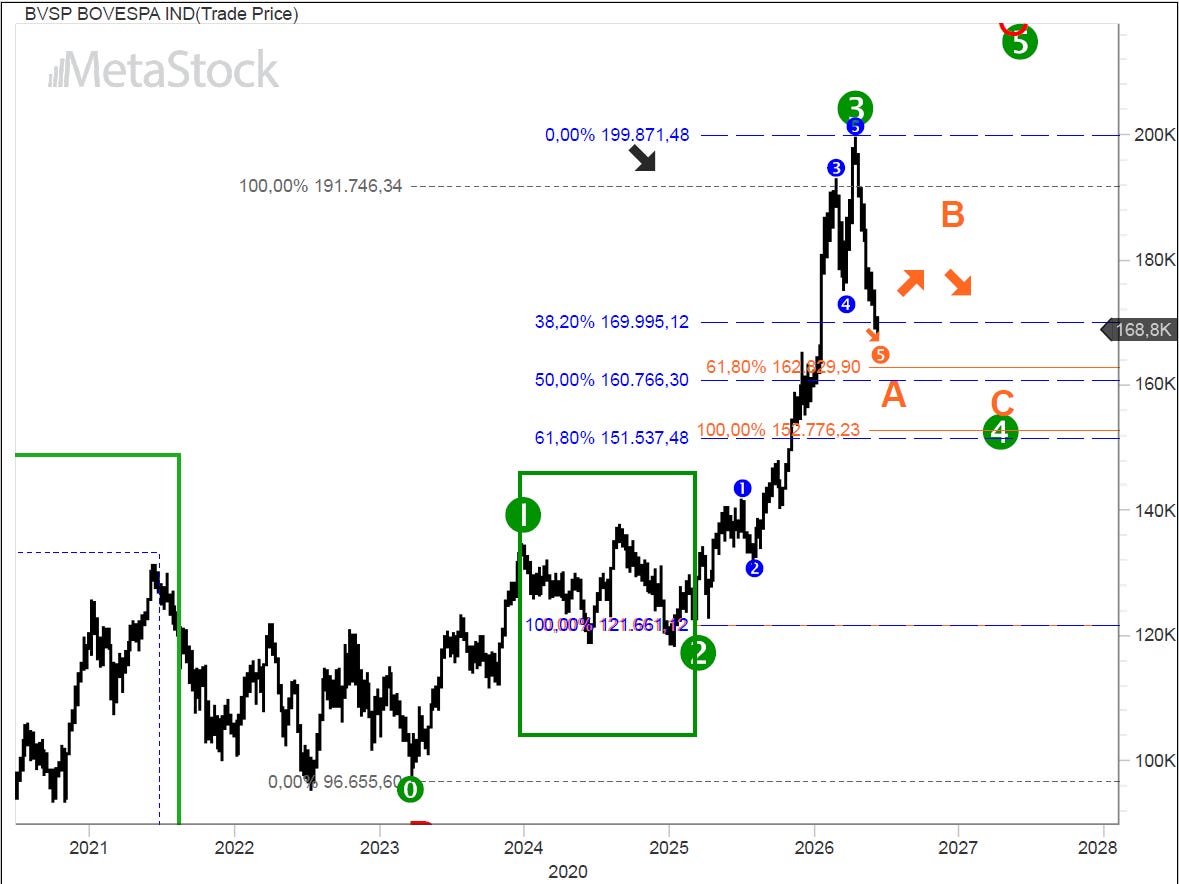
Given my darker outlook for Brazil—and because the speed of Indonesia’s deterioration has impressed me—I believe it is necessary to consider a more negative scenario for the Brazilian stock market.
What would that look like? If, instead of following the proposed zigzag pattern, orange wave A is actually a higher-degree wave 1, orange wave B is wave 2, and the subsequent wave 3 breaks below the level that invalidates my current count—134,400—then the picture changes completely. I will not go into detail, but I want to issue the warning.
And if that happens, it would reinforce my most frequently repeated observation about the Ibovespa: that its long-term structure is not directional but corrective.
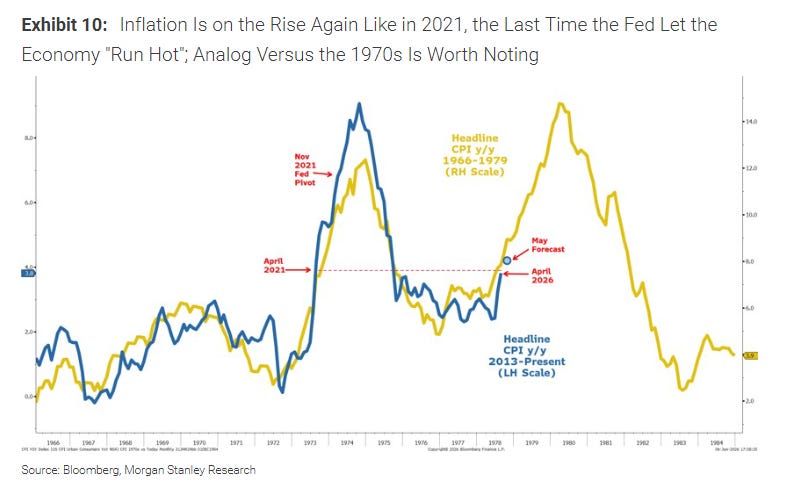
Today, the U.S. CPI inflation report was released. Although headline inflation remains elevated at 4.2% year-over-year, core inflation came in more subdued at 2.9%. Look how accustomed we have become: we now consider 2.9% “moderate” and forget that it is still nearly one percentage point above the Federal Reserve’s target. Readers know that I neither like nor believe in historical analogies, but I must admit that the chart below, comparing today’s inflation path with that of the 1970s, is becoming remarkably similar. Will I have to eat my words?
The S&P 500 closed at 7,266, down 1.62%; USD/BRL at R$5.1900, unchanged; EUR/USD at 1.1537, unchanged; and gold at US$4,072, down 4.38%.
Stay tuned!
Original Post: Click Here
This is not an investment recommendation.
About the Author of this Post: David Gotlib has 45 years of experience in investment management. An engineer from Polytechnic School of the University of São Paulo, he was one of the founders of the first Brazilian hedge fund in 1993 (AUM US$ 1 billion). Later, he was Managing Director of Deutsche Bank Asset Management (AUM R$ 2.2 billion) until the company was sold to Bradesco. He is currently the manager of his own investment portfolio and the author of the blog Acertar na Mosca, where, since 2011, he has shared his thoughts on the global economy and the financial market on a daily basis.
Comments
Nothing yet. Say the first thing.
Sign in to join the conversation.