
Today I have the pleasure of interviewing Brazilian investor Felipe N..

From September 2023 to May 2026 his historic performance will be the envy of anyone.
His portfolio returned 97.87% in the period, versus 51.09% for Ibovespa.
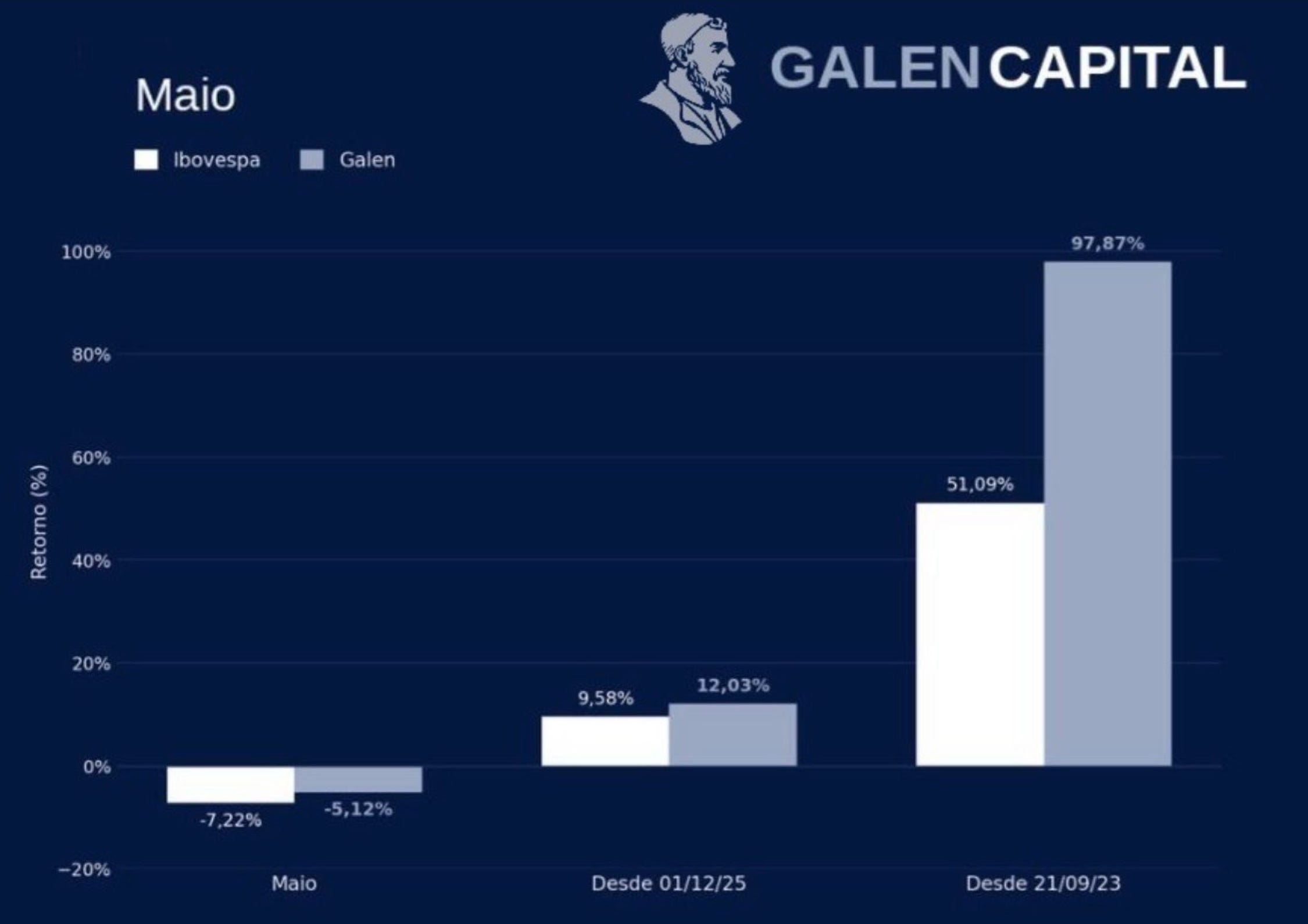
This guy knows how to generate real value.
Shall we meet him?
BZ: Felipe, could you tell us a little about yourself?
FN: I am a surgeon by training and have been investing in the stock market for over 20 years. A few years ago, I decided to focus my investments on Brazilian equities and achieved consistent returns through my personal account. To centralize the management of my own assets, as well as those of family members and close friends, I established the Galen Stock Club. As the assets under management grew and results remained consistent, I began dedicating more and more time to managing it.
The club’s performance attracted the attention of a strategic investor, and during that process I became closer to my current partner, Yuhzo Breyer, a portfolio manager who delivered exceptional results while leading Dynamic FIA. We decided to join forces and launch an asset management firm: the strategic investor acts as a capital partner, funding the operational structure, while Yuhzo and I are responsible for investment management and allocation. The Galen Club’s assets have already surpassed R$30 million, and we are in the final stages of registering the management company with the regulator. Once this process is completed, the club will be converted into equity mutual funds (FIAs).
BZ: What is your strategy for making money on the stock market?
FN: Buying good companies at attractive prices. In practice, this means prioritizing companies with growing earnings, low leverage, strong corporate governance, and valuations that are discounted relative to the quality of the business. We maintain an active and relatively concentrated portfolio of 15 to 20 companies, diversified across large-, mid-, and small-cap stocks. Our primary focus is the Brazilian market, with selective international exposure through BDRs and ETFs listed on B3.
We strive to thoroughly understand the companies we own and remain disciplined about the relationship between price and value.
BZ: What is your process for finding a new buy opportunity? What filters do you use?
FN: I follow the vast majority of companies in the Ibovespa at a high level through quarterly earnings reports and sell-side research. When a company catches my attention—whether due to valuation, a turning point in fundamentals, or a corporate event—I conduct a deeper analysis: I build my own financial model, speak with investor relations, and discuss the thesis with both bullish and bearish investors. Then I begin building a position, monitoring it and adjusting its size over time.
Another important filter is the constant exchange of ideas with investors I admire who have consistently outperformed the Ibovespa, such as Rafael Freitas, Renato Reis, Guilherme Cambraia, Júlio Borba, Augusto Krappa, Leonardo Piovesan, Khalil de Lima, and Matheus Bantel, among others.
BZ: How do you value a share: DCF, Multiples, implied IRR, a mix of the previous ones, …?
FN: A combination, depending on the nature of the business. Multiples (especially P/E and EV/EBITDA) are the starting point, but always based on future projections. What matters is the earnings the company will generate going forward, not its historical performance.
DCF and implied IRR serve as guiding tools. DCF helps us understand how much value is being created in companies undergoing transformation or significant investment cycles, while implied IRR provides a benchmark for comparing expected returns across positions and against the real interest rates available in Brazil, which represent a high opportunity cost. Alongside our models, we compare our assumptions with market consensus, as significant divergences may indicate opportunities. We seek a margin of safety and prioritize investment theses that do not require an optimistic scenario to succeed.
BZ: How do you like to build your stock portfolio, considering the number of companies, sectors and concentration?
FN: We typically hold 15 to 20 stocks, with around 50% of assets concentrated in our highest-conviction positions. We operate with risk limits: a maximum of 30% exposure per sector and 15% per company. This structure gives us enough concentration for successful investments to have a meaningful impact on returns without exposing the portfolio to excessive long-term risk.
BZ: How often do you like to rebalance your portfolio?
FN: Rebalancing is continuous and driven by two variables: changes in fundamentals and price movements. We sell or reduce positions when fundamentals deteriorate or when the stock price approaches what we consider fair value. We increase positions when the risk-reward profile improves. With 15 to 20 holdings, it is natural that we are constantly trimming stocks that have appreciated significantly and reallocating capital to more attractive opportunities.
BZ: How long on average do you hold a position in your portfolio?
FN: There is no predefined holding period. The duration of each position depends on valuation and the risk-reward relationship relative to other opportunities. Some positions last only days when the stock quickly reaches our estimate of fair value or when a better opportunity arises. Others have been in the portfolio for years because the company continues to grow while the stock remains undervalued.
BZ: Do you believe that graphical analysis, together with fundamental analysis, can help with the buying and selling points of stocks?
FN: Our approach is fundamentally driven, and fundamentals guide all allocation decisions. That said, I recognize that many successful investors achieve consistent results using technical analysis. We use it in a tactical and complementary way: moving averages, support levels, and resistance levels can help determine the best timing to increase or reduce positions that have already been selected based on fundamentals.
BZ: What are your favorite sectors on the Stock Exchange? And the ones you avoid? Why?
FN: I do not have favorite sectors a priori. We analyze companies individually, and the portfolio reflects where we find the best balance between quality and price at any given time. Naturally, there are sectors where we have greater analytical depth and that frequently appear in the portfolio, such as utilities, real estate developers, energy, financial services, and healthcare. In healthcare, I believe my medical background can sometimes help in evaluating hospital operations and discussing industry trends with professionals.
What we avoid are certain characteristics rather than sectors: companies in turnaround situations with persistent losses, excessive leverage, or consistently deteriorating results.
BZ: Do you use stop loss? Where do you usually place it?
FN: I do not use price-based stop losses. If I like a company’s fundamentals and valuation, a price decline without a corresponding deterioration in fundamentals is an opportunity to increase the position, not sell it. That said, a significant drop is a warning sign that prompts us to revisit the thesis and verify whether fundamentals have truly remained intact. Our stop-loss is fundamentally driven: we exit positions when the investment thesis deteriorates. Risk management begins with portfolio construction, through position and sector limits, and by requiring a margin of safety before investing.
BZ: Do you use derivatives? What is your strategy?
FN: Occasionally and conservatively. Our primary strategy is covered call writing at strike prices where we would already be willing to reduce or exit the position. If the stock does not reach the strike price, we keep the premium. If it does, we sell at a price we already considered attractive. Over the course of a year, this strategy can generate additional returns for the portfolio with controlled risk, since we do not write uncovered options.
BZ: What is the cheapest company on the stock market today?
Comments
Nothing yet. Say the first thing.
Sign in to join the conversation.