

There's no worse feeling than inadvertently becoming an investor in a short-term trade. One of the most common mistakes made by stock traders and investors is failing to plan, thus turning a speculative trade into involuntary shareholding when the trade goes against them. This typically occurs when traders become hesitant to accept a loss and admit defeat. The most common rookie error is injecting a few thousand dollars into an opportunity and then stubbornly holding the position even when it doesn't perform as anticipated. This is the quickest way to deplete your trading account.
I'll break down the importance of stop losses in a later post, but for now, it's crucial that you understand the monumental difference between investing and speculating.
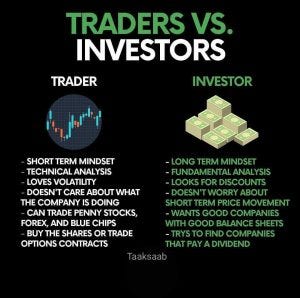
When someone invests in a stock, their outlook should be upwards of 5 years or more, with few exceptions. When you're trading, your outlook can be as little as 5 minutes. The key difference between the two is that when someone is 'investing,' they shouldn't care about what the price does in the short term once they own their position.
Think of it as the difference between renting shares in a business vs. owning a small piece of a company.
If you invested in a stock at $10 per share and it drops to $5 the next month, this situation can be viewed as an opportunity rather than a setback. The significant price reduction allows you to acquire more shares of a company you favour at a substantial discount – essentially, a 'buy two for the price of one' situation compared to your initial cost per share.
For a long-term investor who believes in the underlying strength of the business, this downturn represents a gift rather than a cause for concern. It aligns with the philosophy of 'BTFD' (Buy The F#cking Dip), emphasizing the strategic advantage of accumulating more shares during a market dip. This perspective underscores the potential benefits of a long-term investment strategy, turning market downturns into favourable opportunities for value-driven investors.
On the speculative, hype, timing, or momentum side of things, you purchase a stock at $10 per share, only to see it plummet to $5 the following month. Without a predefined plan, you've effectively relinquished half of your position. However, had you implemented a stop loss, say at 10%, you could have shielded yourself from significant downside, limiting your loss to just $1 per share.
By not having a strategic plan in place, you've sacrificed 50% of your position, and the road to recovery becomes an uphill battle. Not only must the stock return to $10, but it needs to double in value for you to break even - and that’s statistically very unlikely in the short term. While it might seem like common sense, many traders allow their stock holdings to plummet by 50%. With a well-thought-out plan, such a significant downturn becomes an implausible outcome.
Maintaining a physical trading journal helps stick to a pre-planned strategy and keeps emotions in check when things go off course. Even in successful trades, the impulse to cash in on gains due to greed or fear is strong. It's a common challenge, but disciplined traders cut losses quickly and let profitable positions ride. The written plan serves as a reliable guide in navigating the unpredictable nature of the market.
On the flip side, if a trade goes south, and there's no robust plan in place, particularly around a stop loss, you risk becoming an unintentional long-term investor. Watching that position decline day after day takes a toll on your mental well-being, influencing subsequent trade decisions. In the trading world, failure to plan is a sure path to trouble.
The practice of averaging down sparks debate, teetering between a prudent move and a potential downfall. Its appropriateness depends on the context.
Consider the long-term investment scenario, where you consistently add to an ETF position with a diverse stock portfolio each month. In this context, the strategy aligns with dollar-cost-averaging, a sound practice over the extended term. This approach capitalizes on price fluctuations, allowing you to benefit from lower prices during market downturns. In such cases, averaging down becomes a savvy move.
For a trader engaging in speculative plays on a gold position using call options, the decision to average down when the trade turns unfavourable can be likened to 'throwing good money after bad.' Doubling down on call options in this scenario, especially when the original trade should have triggered an immediate stop-out, is a common yet detrimental practice. It stands out as the primary mistake observed among both novice and experienced traders, presenting a straightforward path to diminishing the overall value of one's portfolio.
Opinions on averaging down often overlook a crucial distinction between long-term investing and short-term speculation. Averaging down, or practicing dollar-cost averaging on positions intended for long-term retention, is generally considered a prudent strategy. However, the narrative changes when adding funds to a position that has moved against you in an attempt to reduce the average cost and 'break even sooner.' This approach is a common yet amateur mistake, as it tends to undermine the core principles of effective trading. The author emphasizes these insights from expensive personal experience.
Before executing a fill order to initiate a long or short position, a trader should invest a substantial amount of time in paper trading. This cost-free method proves to be the most efficient way to meticulously plan out an investment or trade. Neglecting this planning phase equates to setting oneself up for failure, as the saying goes, 'failing to plan is planning to fail.'
Paper-trading, as the name suggests, involves simulating trades on paper as a cost-free method to test the waters and evaluate how one would have performed with real capital. Many online brokers now offer free practice-trading accounts, and various software programs enable simulated trading at no cost. However, the old-fashioned approach of using pen and paper remains just as effective, offering valuable practice for future journaling when real capital is at stake.
Even the most skilled traders engage in paper-trading and back-testing before deploying capital. Despite the temptation to jump into the market right away, mastering the skill of trading demands substantial practice and repetition behind the scenes. Patience is key, as becoming proficient in this field requires honing one's abilities in a simulated environment before stepping into the actual market arena. Just like any skill, the path to performing at a professional level involves significant practice and preparation.
In early 2009, I was inspired by a persuasive article highlighting the increasing demand for cost-effective solar energy solutions. Sharing the same outlook, I eagerly sought to capitalize on the impending surge in solar popularity. I delved into researching various solar stocks for a short-term swing trade, targeting a 2-3 month timeframe. However, my initial misstep occurred when I opted for the cheapest-priced option. It's a common trap to be enticed by a low price-per-share, thinking you can acquire more shares. However, statistically, a more prudent approach involves considering the first or second-largest players in the relevant sector. This not only helps protect against potential downsides but also enhances the probability of positive performance.
Entering the solar market in early 2009, I opted for a company with a per-share price of approximately $0.80. My initial investment comprised 250,000 shares, with the anticipation of a swift swing into the dollar range for a promising 20% gain within a few months.
The primary error in this scenario was selecting a highly illiquid stock. The consequences of this choice, and the intricacies involved, will be a topic for detailed discussion at a later date.
In typical penny stock fashion, as I aggressively entered the market and began buying shares at the ask, hidden sellers emerged, capitalizing on the opportunity to sell into the bid – a commonly observed phenomenon. This influx of selling pressure swiftly drove the stock down to the $0.70 range within a few days. Rather than exercising caution, I continued to accumulate, purchasing another hundred thousand shares as the price dipped to about $0.68.
Reflecting on this, it becomes apparent that my mindset was characterized by a blend of degenerate risk-taking, gambling tendencies, and a perilous blindness to escalating greed. At the time, I reveled in the notion of ‘controlling over 350k shares of this promising new solar venture,’ but in hindsight, it was a manifestation of a high-risk mindset that proved to be less strategic and more impulsive.
About a month into the venture, as the stock dwindled to around the $0.45 mark, concern finally set in. In an attempt to mitigate losses, I decided to double down, further lowering my cost per share. With well over half a million shares, a growing unease prompted me to reach out to the company's management, seeking reassurance and validation for my decision.
Upon speaking with the CEO, I received all the affirmations I craved, fueling my fear, validating my ambitions, and intensifying my greed. This interaction triggered a detrimental chain of events, leading to more share purchases driven by an inflated ego and a desire to boast about 'owning a million shares' and being intricately tied to a supposedly promising startup. In hindsight, this phase marked the most damaging part of the ordeal, transforming me into an involuntary investor entangled in a trade gone awry.
At this point, I had deviated from my plan, driven by emotions like fear, greed, and the fear of missing out (FOMO). My decisions were no longer rational.
By now, a substantial part of my liquid capital was invested, and I was facing a significant loss. I had a cost basis of around $0.75 for my 1 million shares, which were now trading at about $0.40. The company, facing financial challenges, opted for a private placement, selling new shares at $0.45 to accredited investors. This move diluted the company, increasing the shares outstanding from about 25 million to 40 million. In hindsight, this was a crucial moment where cutting ties should have been the clear decision.
Following a private placement to secure funding and sustain the business, the market capitalization of the company, priced at $0.40, rose to approximately $16 million. Before the capital raise, the market cap at the same price would have been around $10 million. This shift highlighted the impact of the fundraising activity on the company's valuation.
Dilutive share offerings significantly affect the price-per-share and market cap of a business. Monitoring penny stocks closely is crucial, as loose regulations often allow substantial share issuances to management and investors, impacting individual investors who might be unaware of the rising share count. This case saw a dramatic increase in shares throughout 2009, underscoring the need for strong independent directors. Governance is key to safeguarding against inexperienced or ineffective management.
Side note; CEO.ca and X.com shouldn’t be the only places where you do your due diligence. Yes, I'm talking to us all with that statement.
It's common to perceive a declining share price as an indication of a cheaper business. However, the market cap may remain constant or even increase as companies add more shares to the issued and outstanding amount, offsetting the decrease in share price. This aspect is crucial to consider in your due diligence process. The lack of specific disclosure around dilution between reporting periods is a potential trap and warrants attention from regulators.
In less than five months from my initial purchase, the price per share dropped to $0.25 after the private placement's four-month unlock period allowed sellers to offer their shares. However, the business's total market cap was now back near its level from many months prior, surpassing $0.60 per share. This underscores how volatility and dilution can significantly influence the perceived value of a business.
Needless to say, my own naivety, greed, and eagerness to please the ever-optimistic CEO, coupled with my growing ego and the increased share count, resulted in a self-inflicted downfall. As I boasted to others about my 'big position,' its value plummeted to less than half of what I initially paid due to the ill-planned trade. This entire situation was avoidable had I crafted and adhered to a well-thought-out plan in the first place.
I share this example of the solar trade because it underscores an equally important lesson about becoming an involuntary shareholder, finding oneself strapped in and potentially facing a fractional rollback in the volatile realm of micro-cap companies.
As regrettable as it was that I purchased a company near a dollar and failed to sell when it plummeted below a quarter, the situation worsened as the company approached the end of 2009. The share price had dropped so significantly that attracting new investment became impossible. To address this, the company implemented a rollback - a strategic move often taken when management has made a series of poor decisions. One notable misstep was engaging in check swaps with promoters, a cannibalistic process that I will delve into in a later post.
When a company with 100 million shares outstanding sees its price per share drop to 5 cents, it often resorts to a reverse split, like a 10-for-1 split. This means the 100 million shares are consolidated into 10 million shares, and the price per share adjusts to 50 cents instead of 5 cents. This maneuver is typically driven by optics and often reflects poor management and financial responsibility, essentially resetting the capitalization table of a struggling business.
Drawing a parallel, recent stock splits like those of $TSLA and $AAPL can be deceiving. While younger investors might perceive the lower price post-split as "cheaper," it's crucial to recognize that this is often a cosmetic change. In reality, the market capitalization may remain unjustifiably high. A case in point is Tesla, which, despite the split making its share price seem more affordable, is actually more expensive at $375 than it was at $1,450 per share just 30 days ago before the split. This trend is concerning, as some traders may still mistakenly view the current price as more attractive than it was before the split. Price per share means nothing; market cap is everything.
A share rollback is akin to slicing a pizza differently - same total value but different-sized pieces. Similarly, in a rollback, the company's overall value remains constant, but the number of shares decreases, adjusting the price per share.
Investors often miss this, focusing solely on the increased price per share. Post-rollback, some may sell quickly without realizing the change, causing a sudden price drop. This common misunderstanding emphasizes the need to consider more than just the price per share.
When Mr. CEO is running around town, pitching a private placement at $0.50 with 10 million shares outstanding, it appears more appealing than if the same offering were at $0.05 with 100 million shares outstanding. Despite selling shares at the same price in both scenarios, the market cap or "pre-money valuation" remains $5 million pre and post rollback. This illustrates a deceptive tool in the penny stock market, highlighting how optics can be manipulated to create a more attractive image for potential investors.
Returning to my solar venture, once I accumulated over a million and a half shares, the company underwent a 5-for-1 reverse split. This left me with only 300,000 shares and a new cost basis of around $1.25, while the post-split share price dropped to $0.20. Despite investing over half a million dollars, my "investment" a few quarters later was worth less than $60,000, with no indication of returning to the initial buying levels. To make matters worse, the company was actively seeking new investors like me, as the CEO's primary focus was selling stock rather than solar panels.
Despite the significant setbacks, post-rollback, the CEO persisted in urging me to "buy more cheap shares," claiming the stock was "undervalued" and would "definitely come back when people figure out how cheap they are." This echoed the standard script of the penny stock pushers.
I eventually accepted the tax loss and decided to never check the chart or the price of the stock again. The peace of mind gained from finally exiting losing trades is often invaluable, and in this case, it was a loss I should have cut a week after the trade went against me. Ego, greed, fear, and the desire to please others all played a part in this loss. More importantly, it turned out to be a monumental waste of time and energy - hundreds of hours spent only because I clung to a trade when I knew right away it was a mistake. This real-world example highlights how easily emotions can obstruct sound business decisions, even when one knows better. It also underscores the vast difference between blindly flipping start-up stocks vs. truly investing in actual businesses.
Plan your trade and trade your plan and never let bad trades turn you into an involuntary investor.
-B
No posts
Comments
Nothing yet. Say the first thing.
Sign in to join the conversation.