
In February, the EU’s energy commissioner visited Algiers for routine partnership talks with little sense of urgency. Seven weeks and a war later, Italian Prime Minister Meloni and Spanish Foreign Minister Albares flew south to beg for gas. Both left with communiqués, neither left with molecules.
Meloni announced that Italy and Algeria would “deepen their already strong partnership” through Italy’s ENI and Algeria’s Sonatrach, including new cooperation on shale gas and offshore exploration. No volumes, no timeline. Albares pushed for increased pipeline flows to Spain. Same warm words, same lack of specifics.
The impending gas crunch will hit both countries substantially. Spain generates about 20% of its electricity from gas, while Italy is at 40%, according to The Statistical Review of World Energy. In 2024, 45% of Italy’s LNG imports came from Qatar. With Qatar LNG offline, courting suppliers is a matter of political survival.
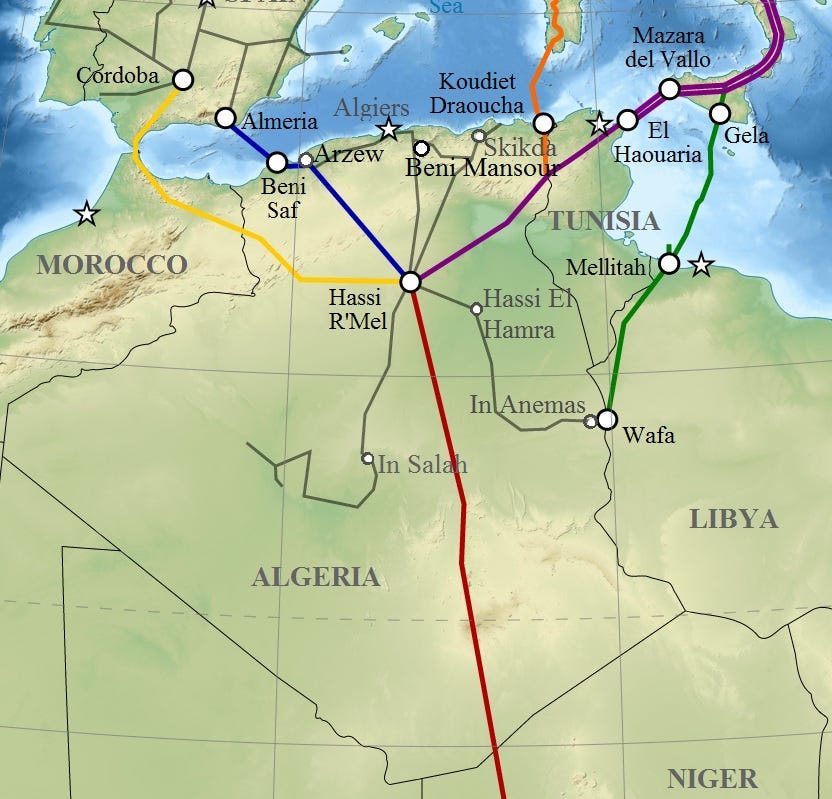
In principle, rushing to Algeria makes sense. According to the U.S. Energy Information Administration, Algeria sits on 159 trillion cubic feet (Tcf) of proved gas reserves, the eleventh-largest endowment on the planet. Three pipelines connect Algeria to Europe: TransMed runs under the Mediterranean to Sicily and onward into Italy’s gas grid. MedGaz links Algeria directly to Spain’s southeast coast. A third, the Maghreb-Europe pipeline, once carried gas to Iberia via Morocco, but it’s been shut since 2021 over a diplomatic rupture between Algiers and Rabat. Today it runs in reverse, sending Spanish gas south to Morocco.
Algeria isn’t the only supplier European leaders are pinning their hopes on. Officials are running the same playbook with Azerbaijan and Egypt: collecting handshakes and memoranda from every producer willing to take the meeting. None of these meetings fail to tick off the usual boxes of commitment to climate targets and renewables—a strange incantation of a luxury belief that entirely misreads the correct priorities ahead of what could become the biggest energy crisis in history.
For clues whether such efforts can actually ease Europe’s energy woes, the Algerian case will almost certainly be instructive. Let’s find out why.

Start with the potential that European planners love to cite. TransMed, the main pipeline to Italy, runs at roughly 60% utilization (nameplate capacity of 33.5 bcm per year vs. 21 bcm flows in 2024). Algeria’s LNG terminals run at 46% utilization (25 million tonnes per year vs. actual output in 2024: under 12 million tonnes). MedGaz, the pipeline to Spain, is the only piece of infrastructure running near capacity, at roughly 90% utilization (9.4 out of 10.5 bcm).
The logic seems obvious: the pipes are half empty, so the upside is built in. However, the pipes aren’t half empty because the deals haven’t been struck. It’s because the gas isn’t there to fill them. The utilization gap is the result of a production deficit that’s been getting worse for twenty years.
Algeria’s gas exports peaked in 2005 at 64 bcm. Last year they came in at 49 bcm. That’s a 24% decline over two decades—not because production collapsed, but because domestic consumption absorbed any growth. In 2005, Algeria consumed roughly 22 bcm of its own gas. By 2024, that figure had more than doubled to roughly 50 bcm. The exportable surplus has been shrinking every year.
The drivers are self-reinforcing. Algeria has 47 million people, a median age of 28, and a population growing at 1.4% per year. Gas generates 99% of the country’s electricity, and electricity demand is growing at over 5% annually. Most critically, domestic gas is priced at a tiny fraction of its market price.
![Algerian President Abdelmadjid Tebboune (R) and Italian Prime Minister Giorgia Meloni (L), hold a joint press conference following their bilateral talks at the El Mouradia Presidential Palace in Algiers, Algeria, on March 25, 2026. [Algerian Presidency / Handout - Anadolu Agency]](https://substackcdn.com/image/fetch/$s_!fwNf!,f_auto,q_auto:good,fl_progressive:steep/https%3A%2F%2Fsubstack-post-media.s3.amazonaws.com%2Fpublic%2Fimages%2F681df2f1-04a9-43d7-b1d0-85ee4378281d_920x613.jpeg "Algerian President Abdelmadjid Tebboune (R) and Italian Prime Minister Giorgia Meloni (L), hold a joint press conference following their bilateral talks at the El Mouradia Presidential Palace in Algiers, Algeria, on March 25, 2026. [Algerian Presidency / Handout - Anadolu Agency]")
The price typically lands between $0.30 and $1.10 per MMBtu for households, and even lower for specific industrial sectors. One-tenth to one-thirtieth of what the same molecule fetches at the Italian border. At that price, there is zero demand-side discipline. And no Algerian government that remembers the civil war of the 1990s—200,000 dead—is going to touch energy subsidies to free up molecules for European buyers.
Sonatrach’s own commercial behavior confirms the trajectory. ENI, Enel and Edison—Italy's three long-term buyers—hold supply agreements with the Algerian state company totaling roughly 13 bcm per year, all expiring in 2027-28.
When those contracts were last renegotiated in 2019, the buyers held the leverage. ENI nearly halved its volumes and Enel cut by more than half. Sonatrach tried to find additional buyers and couldn’t. The market was loose and Algerian oil-indexed gas looked expensive.
Today the situation has flipped with Europe being desperate for molecules. But Sonatrach isn’t offering expanded long-term commitments. Bloomberg reported in March that Algeria is pushing Italy toward spot purchases rather than higher contract volumes. That’s not just a supplier seizing a seller’s market, it’s a producer rationing a declining exportable surplus.
Can Algeria drill its way out of the squeeze? First, there are natural obstacles to production growth. The gas is locked under the Sahara, where freshwater availability stands at just 295 cubic meters per capita, far below crisis thresholds. Fracturing demands massive volumes of water, not a method that works well in the desert.
Second, the economics of the Algerian state work against export. A cubic meter of gas priced at $0.30 for a domestic household buys more political stability than the same cubic meter sold at $10 to ENI. Algeria isn’t hoarding gas out of spite, the regime’s survival calculus and the physical constraints pull in the same direction: the molecules stay home.
In the foreseeable future, Algeria can’t deliver what Europe needs. But the question isn’t just whether Algeria can export more gas. It’s whether any of the suppliers Europe is courting are capable of being long-term exporters at all. There’s a simple ratio that separates structural exporters from wasting ones. European planners don’t seem to use it.
Take a country’s proved gas reserves and divide by its population. Call it reserves per capita. It won’t tell you exactly when a country flips from exporter to importer. But it tells you which direction gravity is pulling.
Qatar: 295 Tcf per million. Qatar could export gas for centuries and not notice. Russia: 12 Tcf per million and improving every year as its population declines. These are structural exporters, countries where the resource base so vastly exceeds domestic demand that no plausible consumption trajectory can absorb it.
Now look at where the gradient turns. Algeria: 3.4 Tcf per million and falling. Egypt: 0.5 Tcf per million. Egypt was a gas exporter a decade ago, a net importer today. The lower the ratio, the stronger the pull toward domestic absorption. Azerbaijan sits at 6 Tcf per million. Higher than Algeria, but already importing Russian gas to backfill domestic demand while maintaining export commitments to Europe. Even at that level, the treadmill has started.
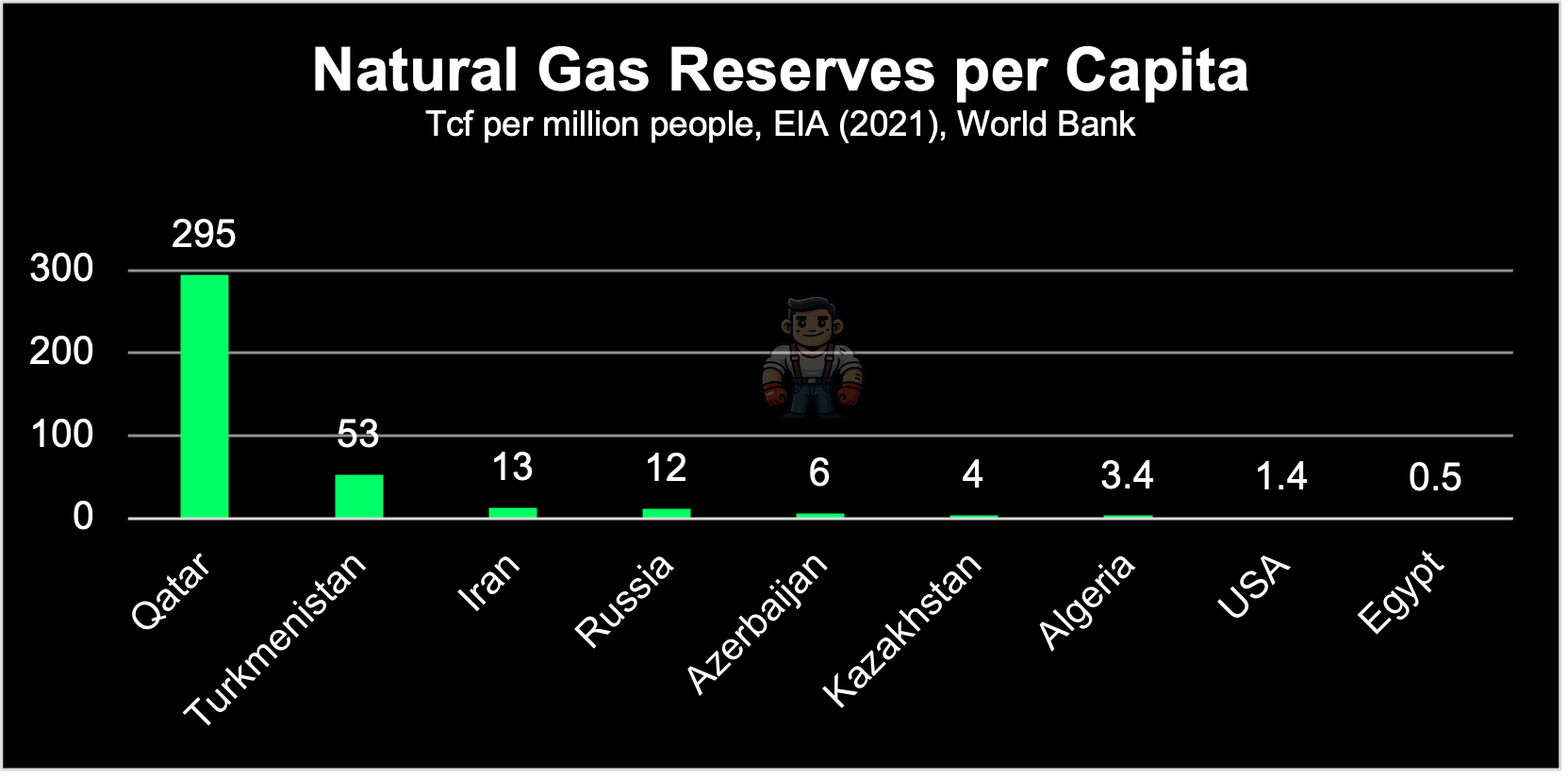
Europe’s post-Russia diversification strategy has systematically selected suppliers near the bottom of the gradient. Algeria, Azerbaijan, Egypt—these are young, growing countries with legitimate development ambitions and populations that need cheap energy. Meanwhile, the countries with ratios an order of magnitude higher—the ones with reserves so deep that domestic demand could never absorb them—are the ones Europe has either sanctioned or lost to war. Russia is cut off by choice. Qatar is cut off by bombs. The diversified import model fails because the suppliers Europe can still access are developing economies on the wrong side of the arithmetic.
The outlier and test case is the United States. It is now Europe's single largest LNG supplier with a ratio of 1.4 Tcf per million—lower than Algeria. Right now, record exports seem to contradict the ratio because new capacity happened to come online just as Qatar went offline. But forces that tend to keep molecules at home—AI-driven power consumption, petrochemicals, and industrial reshoring—are accumulating.
This creates a binary. Either the ratio holds, and US exports to Europe plateau or decline once the crisis normalizes—in which case Europe’s largest supplier isn’t a structural lifeline. Or the US proves to be an exception to the pattern, which would itself be a major finding: it would mean the world’s largest gas consumer can defy the gravitational pull.
Until falsified, the geopolitical direction of travel seems to confirm the ratio’s logic. In a world of contested shipping lanes, reshoring, and transactional alliances, the incentive to lock up molecules for domestic use only strengthens. Next time a European leader flies south to sign a partnership agreement, run the ratio. It will tell you more than the communiqué.
Share this article with anyone who thinks Europe can buy itself out of this crisis!
📨 People in boardrooms, energy desks, and hedge funds keep forwarding this. Stop getting it late — subscribe now!
Already subscribed? Thanks for helping make BSJ quietly viral.
No posts
Comments
Nothing yet. Say the first thing.
Sign in to join the conversation.