
Germany’s nuclear phase-out is a masterclass in ideological purity backfiring. The founding myth of the Green Party is that nuclear power is existentially dangerous, therefore shutting down some of the safest power plants on the planet was an imperative. The inevitable result — Germany is today Europe’s top CO₂ emitter, now more reliant on coal for its electricity — is conveniently ignored. The dogma trumps clear thinking and it doesn’t stop at nuclear power.
Grant the premise behind the green movement: reducing CO₂ emissions is the overriding industrial policy objective. If the premise holds, the rational response is to deploy every available decarbonisation tool with greater urgency, not less. Carbon capture and storage (CCS) is one of those tools. It’s the only tool, in fact, for capturing the unavoidable chemical emissions from cement calcination, which cannot be eliminated by electrification. A policy apparatus serious about its own premise would have accelerated that infrastructure.
Instead, a de facto ban was imposed. In 2012, the Carbon Dioxide Storage Act was passed, allowing CCS only for trial and demonstration projects, with a total storage limit of 1.3 million tonnes. The law gave federal states the right to prohibit CCS entirely on their territory, and most states did so. The green argument: CCS is not “real” decarbonisation since it still allows the creation of CO₂. At best, it’s a fossil fuel lobby delay tactic. Ideological purity only knows the true way or no way.
For thirteen years, German industry could not pursue CCS regardless of economics or engineering readiness. This changed in November 2025 when the new Carbon Dioxide Storage and Transport Act (KSpTG) came into force. It’s the first statute in German legal history to permit commercial CCS at all.
Earlier this month, the EU Commission approved a German subsidy scheme to kickstart commercial CCS. Will this mark a turning point in industrial decarbonisation, or is it merely the decarbonisation narrative buying itself one last reprieve? Time to take a closer look.

CCS is a three-step logistics business. First, the factory separates CO₂ from its exhaust, essentially filtering the carbon dioxide out of the smokestack stream. Second, the CO₂ is compressed into a dense fluid so it can be moved efficiently, the same way natural gas is compressed for pipeline transport. Third, it travels by pipe or tanker to a disposal site and is pumped deep underground into porous rock formations capped by impermeable stone, where geological pressure traps it.
The cost of CCS stacks therefore in three layers too: capture, transport, and storage. Capture runs €13–22 per tonne for concentrated industrial streams (ethanol production and natural gas processing) where the CO₂ arrives pre-separated. Cement costs north of €50 per tonne, because the emissions come out of the chemistry itself, not the combustion. Aluminium smelters are estimated to run up to €300 per tonne. Transport adds a number that varies widely since a coastal connection is a different problem than a continental pipeline. Storage adds €1–20 per tonne. The EU Joint Research Centre puts the all-in range at €13–103 per tonne across industrial applications in a 2023 paper.
CCS could, in theory, be an attractive way to avoid the cost pressure caused by the European Emissions Trading Scheme (ETS), which puts a price on CO₂ emissions. At about €80 per tonne today, the ETS pushes towards CCS for the cheapest capture processes but leaves sinter plants and aluminium smelters, for example, well out of reach. Denmark and the Netherlands already run national subsidy schemes to bridge that gap, and Germany has followed suit. It has introduced a €5 billion Carbon Contracts for Difference scheme that the Federal Ministry for Economic Affairs and Energy describes as follows:
Carbon Contracts for Difference [CCfD] are modelled on private-sector hedging contracts, i.e. risk hedging instruments: They offer companies financial planning security with regard to certain price developments (for example, for energy carriers such as hydrogen) and thus hedge against risks that currently still stand in the way of investment in climate-friendly production processes.
ETS serves as the reference market. As such, the contract guarantees the difference between the agreed strike price and the price of a CO₂ certificate, measured against emission reductions relative to a conventional reference technology. If the strike price is above the current CO₂ price level, the state subsidises the project.
While the details of what emission reductions trigger funding grow increasingly complex, treating €5 billion as a direct per-tonne CCS subsidy reveals the scale mismatch. The scheme runs 15 years: €333 million per year. At an average abatement cost gap of €58 per tonne (the midpoint of the EU Joint Research Centre’s €13–103 per tonne range), the fund can subsidise 5.7 million tonnes per year of captured emissions. Against Germany’s 105-million-tonne industrial CO₂ flow, that is a measly 5% coverage.
The priority mismatch is striking too. Germany spent €18 billion on renewable electricity subsidies in 2025 alone. The CCfD allocates €333 million per year. The ratio is 54:1. A single year of renewable subsidies equals 54 years of CCS support at current rates. Nevertheless, EU Climate Commissioner Teresa Ribera proclaims:
This scheme will help deliver substantial emissions reductions in key sectors, using public support in a targeted and proportionate way. It shows how we can move forward on decarbonisation while preserving a level playing field and ensuring that competition continues to work for Europe’s long-term prosperity.
This is laughable not just because the funding is too thin to compete against countries without a carbon tax. The required infrastructure does not exist.
The cement industry association (VDZ) estimates that Germany will have to build a 4,800 km (2,980 miles) CO₂ pipeline network at a cost of approximately €14 billion to decarbonise its cement, lime, and waste incineration industries. One section is scheduled to open in 2029. Its length: 28 km (17.4 miles). Only 4,772 km left to go.
Another problem is storage. Onshore storage is not allowed at the federal level, but the states can allow onshore storage of CO₂ within their territories through an opt-in provision. There can be little doubt that green NGOs will fight any such plans through to the highest courts, leading to year-long delays at best.
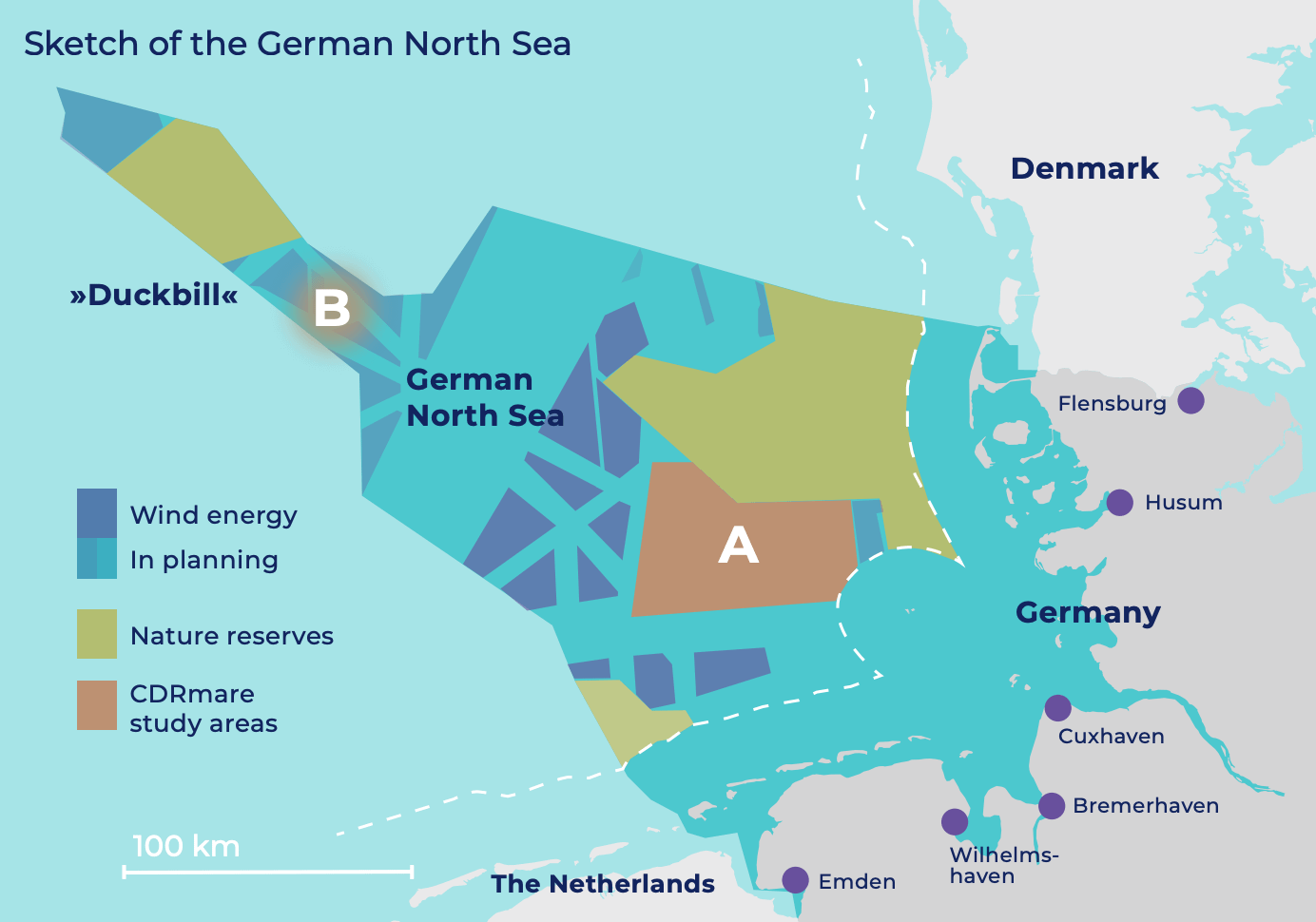
That leaves offshore storage. The German Federal Institute for Geosciences (BGR) estimates storage capacity in the German Exclusive Economic Zone (EEZ) of the North Sea at approximately 0.9 to 5.5 billion tonnes of CO₂. But simulations show that only up to 10 million tonnes of CO₂ per year can be injected in the examined “Area A”, the geologically less challenging zone within that EEZ. That is approximately 10% of Germany’s industrial CO₂ flows.
One way around storage is utilization. Heidelberg Zement is building a plant in Lengfurt, Germany that will capture CO₂ and liquefy it for the industrial gas market via a joint venture with Linde. But the European liquid CO₂ market absorbs just 3.5 million tonnes annually. Germany’s share is perhaps one million tonnes across all applications, while the country’s cement calcination alone emits about 20 million tonnes. The entire industrial CO₂ market is dwarfed by the calcination problem alone.
In short: The funding is insufficient, the infrastructure does not exist, and thirteen years of developing solutions have been lost. The counterfactual writes itself. Statista puts German wind and solar subsidies between 2000 and 2024 at almost €229 billion, when the country could’ve just stuck with nuclear. One can only imagine what even a fraction of that sum would have bought in CCS infrastructure.
Industry forced to decarbonise under these conditions has only one workaround: displacement — moving production to jurisdictions without carbon costs, or shuttering capacity entirely. But displacement is not decarbonisation. Turkey will supply the cement, China the glass and steel.
None of that stops the Federal Ministry for Economic Affairs from clinging to its unmoored fantasies. In one sentence it shows how thoroughly it has lost contact with reality:
As soon as transformative production can be carried out more cheaply than conventional production, the payment relationship established by the CCfD is reversed: Additional revenues of the subsidized companies then flow back to the state.
Cement production that requires CCS can never be cheaper than cement production without it, because the conventional process vents CO₂ to the atmosphere at zero cost. Nor can steel, chemicals, or glass decarbonise via CCS at lower cost than venting. If the low-carbon route were cheaper, companies would adopt it without subsidies. They would race ahead of competitors.
The ministry’s reversal clause assumes a world where the state must force companies to save money. That world only exists when carbon prices are high enough to push industry out of the bloc anyway. With ideological purity supreme, this outcome is exactly the point.
Share this article with a true believer!
📨 People in boardrooms, energy desks, and hedge funds keep forwarding this. Stop getting it late — subscribe now!
No posts
Comments
Nothing yet. Say the first thing.
Sign in to join the conversation.