

When we launched this series, we said we’d keep updating it as AI evolves. While the foundation of Parts 1 through 4 still holds, it’s actually the framework that keeps moving. As more operators have written back, and after a pre-event survey we ran with 20+ growth- to late-stage consumer brands in LA, we realized the framework was missing a layer.
Part 4 answered one question: hire, tool, or agent? But once you decide a function belongs to a tool or an agent rather than a person, a second question follows — and it’s the one most operators skip: how much should that tool or agent actually be allowed to do on its own?
Most AI advice for consumer brands collapses into one question that turns out to be the wrong one: “How do I automate everything?”
The answer to that question, even if you could get to it, wouldn’t help you. You’d end up with brand-voice decisions getting made by a machine that doesn’t know your customer. You’d ship a thousand A/B tests no human had time to review. You’d over-automate the parts of your business that needed your judgment (dare we say, even, heart) and under-automate the parts that needed someone to stop pulling spreadsheets at 11pm on a Wednesday.
The right question:
Which functions in my business should be automated? Which ones shouldn’t?
This is Part 5 of the AI Operating Stack series. Part 1 covered the foundation stack every brand needs before AI. Part 2 walked through the six-dimension audit to run before you buy another tool. Part 3 went deep on the weekly business review. Part 4 answered hire vs. tool vs. agent — the lean operating model behind the $100M, 30-person brand. This one is the layer that sits on top: once you know what’s a tool or an agent, the autonomy ladder tells you how far to let it run. It’s the framework we now use to triage every “should I automate this?” question in our portfolio.
It has four rungs. None of them are aspirational. All four are correct answers, depending on the function.
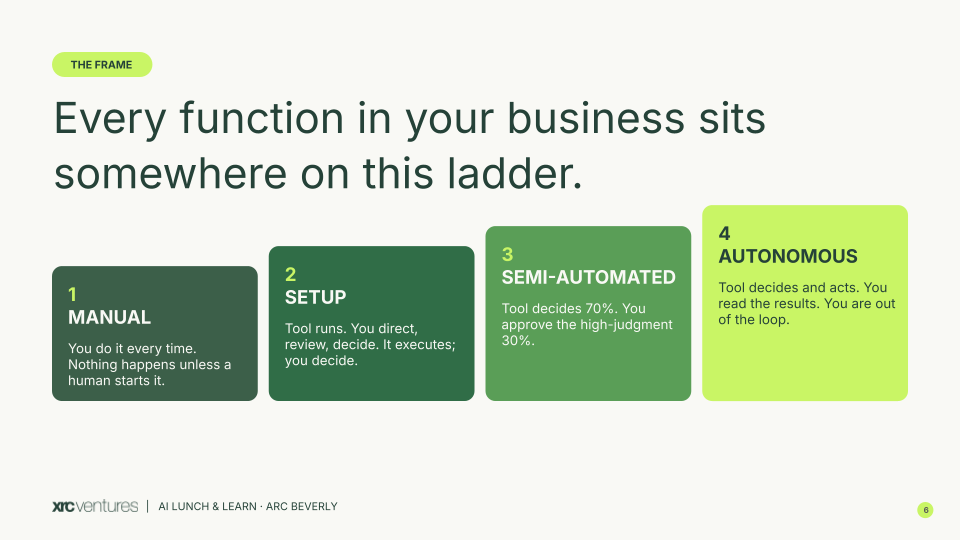
Manual. A human starts the work, does the work, and finishes the work. Sometimes they use AI as a thinking partner along the way, sometimes they don’t. Most consumer brands operate the majority of their functions at Manual — including some that should stay there forever.
Setup. A tool is configured to do the work, but a human still decides when the work runs, which version to ship, and whether to act on the result. The tool executes; you decide.
Klaviyo flows live here.
Triple Whale dashboards live here.
Claude chat is here — opening a chat, pasting in a draft, copying the rewrite back
Shopify lives here.
Semi-Automated. The system makes the routine decisions on its own and queues the consequential ones for a human’s approval. You see ten drafts on Monday morning, you approve eight, you reject two, and the system ships them. You’re not deciding when to do the work anymore — the system is. You’re just deciding yes or no.
Autonomous. The system makes the decisions and takes the actions without you. You read a summary on Friday. You’re out of the loop on the individual choices. The system is doing the work, optimizing the work, and reviewing the work against criteria you set once.
The four rungs look like a hierarchy but there are a MENU. The strategic question is which function of your business belongs on which rung.
When we surveyed 24 consumer brand CEOs and operators ahead of our recent AI Lunch & Learn in Los Angeles, the results were revealing. Seventy-five percent told us they use AI every day—primarily as a thinking partner, analyst, copywriter, or research assistant. But most were still operating between the Manual and Setup rungs of the ladder. Only 29% had anything running reliably on its own, and just one company in the room had a workflow that could reasonably be described as fully autonomous. In other words: adoption is widespread, but autonomy is a rare exception.
The rungs are easier to feel than to define. Let me walk through them with one task every consumer brand does on a regular basis: writing a product description.
You — or a senior copywriter, marketing manager or an agency — ingest the brand voice in your head, look at the product, and write the description. Sometimes you reference a brand bible. Sometimes you wing it. Quality depends on who’s behind the keyboard that day. If a single description takes 10 to 30 minutes; a launch with 12 SKUs eats a day of someone’s week.
Some functions in your business should never leave Manual. Brand voice, in its strictest sense, is one of them. The decision about what your brand sounds like in the world is yours. But the act of writing copy that adheres to that voice — that’s a different question.
This is where most of the founders and CEOs in our survey—and most of the operators in the room at our AI Lunch & Learn—told us they are today. They have Claude, ChatGPT, Gemini, or some combination open every day. They use AI to write copy, analyze data, brainstorm campaigns, summarize meetings, and act as a general thinking partner.
The surprising part is that even among daily users, very few had optimized this. Most were still relying on one-off prompts and ad hoc conversations rather than structured inputs, exemplars, context, and repeatable workflows. In other words, the adopted AI, but they hadn’t yet operationalized prompting. The result is inconsistent outputs but the system was never given the information required to produce an A-level result.
Here’s what A-level inputs look like:
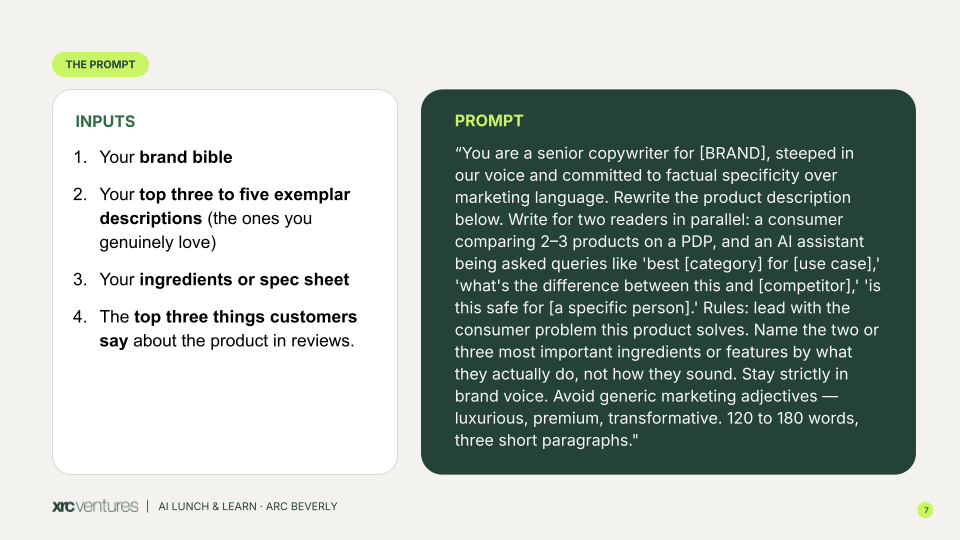
You have Claude ingest four things: your brand bible, your top three to five exemplar descriptions (the ones you genuinely love), your ingredients or spec sheet, and the top three things customers say about the product in reviews.
Then you give it a prompt that looks something like this:
You are a senior copywriter for [BRAND], steeped in our voice and committed to factual specificity over marketing language. Rewrite the product description below. Write for two readers in parallel: a consumer comparing 2–3 products on a PDP, and an AI assistant being asked queries like ‘best [category] for [use case],’ ‘what’s the difference between this and [competitor],’ ‘is this safe for [a specific person].’
Rules: lead with the consumer problem this product solves. Name the two or three most important ingredients or features by what they actually do, not how they sound. Stay strictly in brand voice. Avoid generic marketing adjectives — luxurious, premium, transformative. 120 to 180 words, three short paragraphs.
This prompt is doing more work than most operators realize:
First, it gives Claude a role, not just an instruction. You’re asking it to behave like a senior copywriter who understands your brand, your customer, and the constraints of the assignment.
Second, it names two important readers in parallel: the consumer evaluating products on a PDP and the AI assistant answering questions on that consumer’s behalf. Most brands write for one or the other. Increasingly, the winning descriptions will do both.
Third, it explicitly tells the model which questions the AI assistant is likely being asked: best [category] for [use case]?, what’s the difference between this and a competitor?, is this safe for a specific person? That’s what makes the description GEO-ready.
Fourth, it includes explicit avoids: no luxurious, no premium, no transformative. Those words are among an LLM’s default tendencies. They’re easy, generic, and… they actively hurt GEO because they fail to communicate anything specific about the product. Banning them forces Claude to find actual substance: to explain what the product actually does, who it’s for, and why it matters.
Finally, the word count and format constraints matter more than most people think. A target of 120–180 words sets a defined structure and creates consistency across every SKU. Without those guardrails, the model will produce wildly different lengths, tones, and levels of detail, making your catalog feel like it was written by different people. Because, in effect, it was.
None of these techniques are revolutionary - they are best practice. That’s the difference between asking an AI chatbot for help and building a repeatable system that consistently produces A-level outputs.
Still, you paste in the product description, Claude rewrites it, you copy the output back into Shopify. The quality jumps dramatically if you’ve given it the right inputs.
Most of the consumer brands in our portfolio operate this function at Setup right now. That’s not a criticism — Setup is a meaningful step up from Manual, and most brands haven’t moved beyond it.
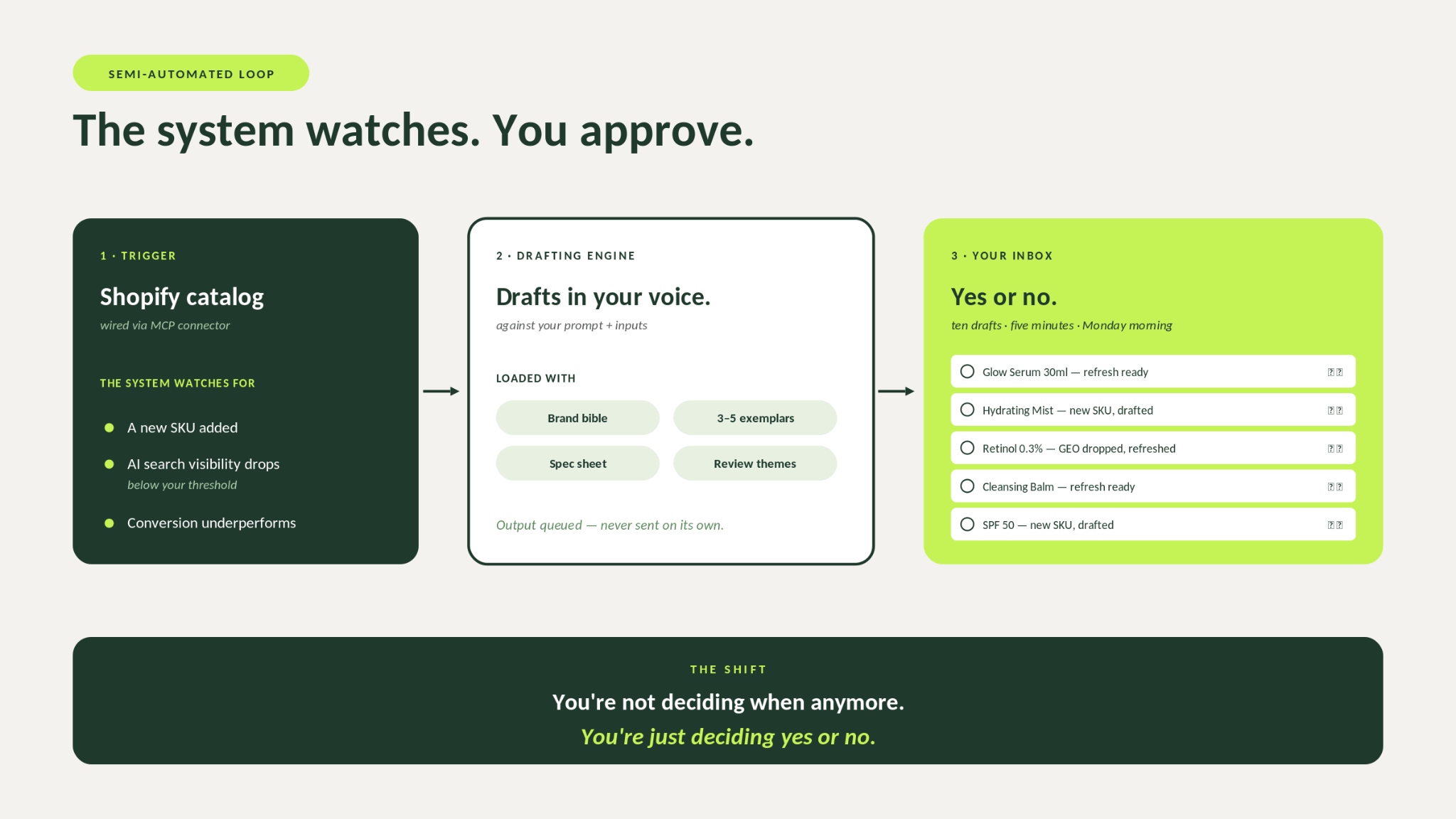
This is where real leverage comes.
The tool is wired into your Shopify catalog through an MCP connector. It monitors your product pages and the moment a new SKU is added, or a description’s AI search visibility drops below a threshold you set, or conversion underperforms, the system drafts the rewrite. In your voice, against your prompt with your exemplars and inputs already loaded.
Then it queues the draft in a single place for you to approve.
You review ten descriptions in ten minutes on Monday morning. You’re not deciding when to refresh anymore.
This is the moment you start to gain back real time. At Manual, a launch of 12 SKUs eats a day. At Setup, a few hours. At Semi-Automated, ten minutes — and now you’re refreshing descriptions you’d never have touched before, because the cost of touching them is near zero. The descriptions get sharper, AI search visibility climbs, and your conversion follows.
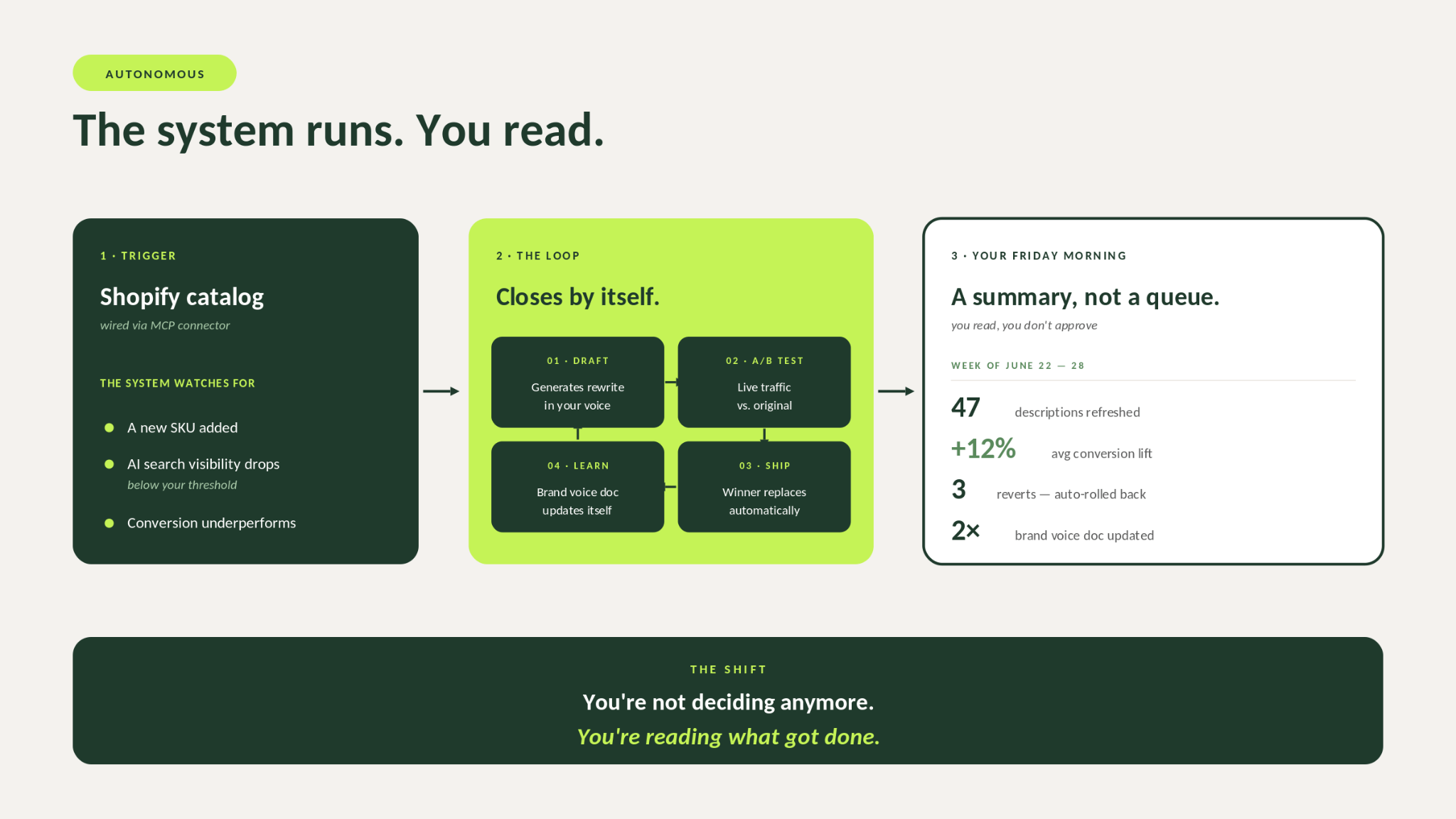
In this stage: the system identifies the underperforming description, drafts the rewrite, A/B tests it against the original on live traffic, measures lift, ships the winner, and updates your brand voice document as it learns what’s working.
You read a weekly summary on Friday morning:
Forty-seven descriptions refreshed
+12% average conversion lift
Three reverts auto-rolled back when they underperformed the original
Two updates to the brand voice document, reflecting language patterns that statistically resonated with your audience.
You’re out of the loop on the individual descriptions entirely. The system is doing the work, optimizing the work, and reviewing the work.
Most consumer brands do not have any function operating at this level. The ones who have — and we’ve watched a few build it — describe it as a different kind of operating leverage than they’ve experienced before.
This is the part most operators get wrong on the first read.
The instinct, once you see Autonomous, is to go for it. Every function, every workflow, every decision.
Some functions have to stay Manual forever — the strategic positioning of the brand, the decision to enter a new category, the conversation with your most valuable customer when something goes wrong. Other functions should stay at Setup because the engineering cost of climbing isn’t worth the marginal leverage. And some need to be at Autonomous yesterday because they’re eating your time and the system can do them better than your team can.
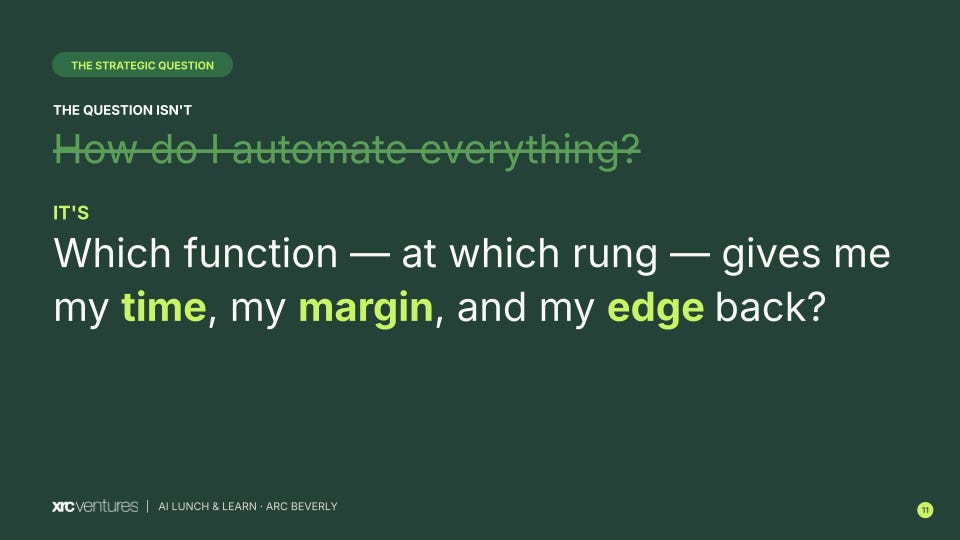
Time. Margin. Edge. Those three words are the test for whether a function should be automated. If moving a function up a rung doesn’t measurably return at least one of the three, you’re spending engineering and tool budget on the wrong thing.
Here’s how we’re thinking about it across our portfolio - based on where the technology is today. Take it as a hypothesis to start from, not a prescription — the right answer for your business depends on your stage, your team, and what’s eating your work week.
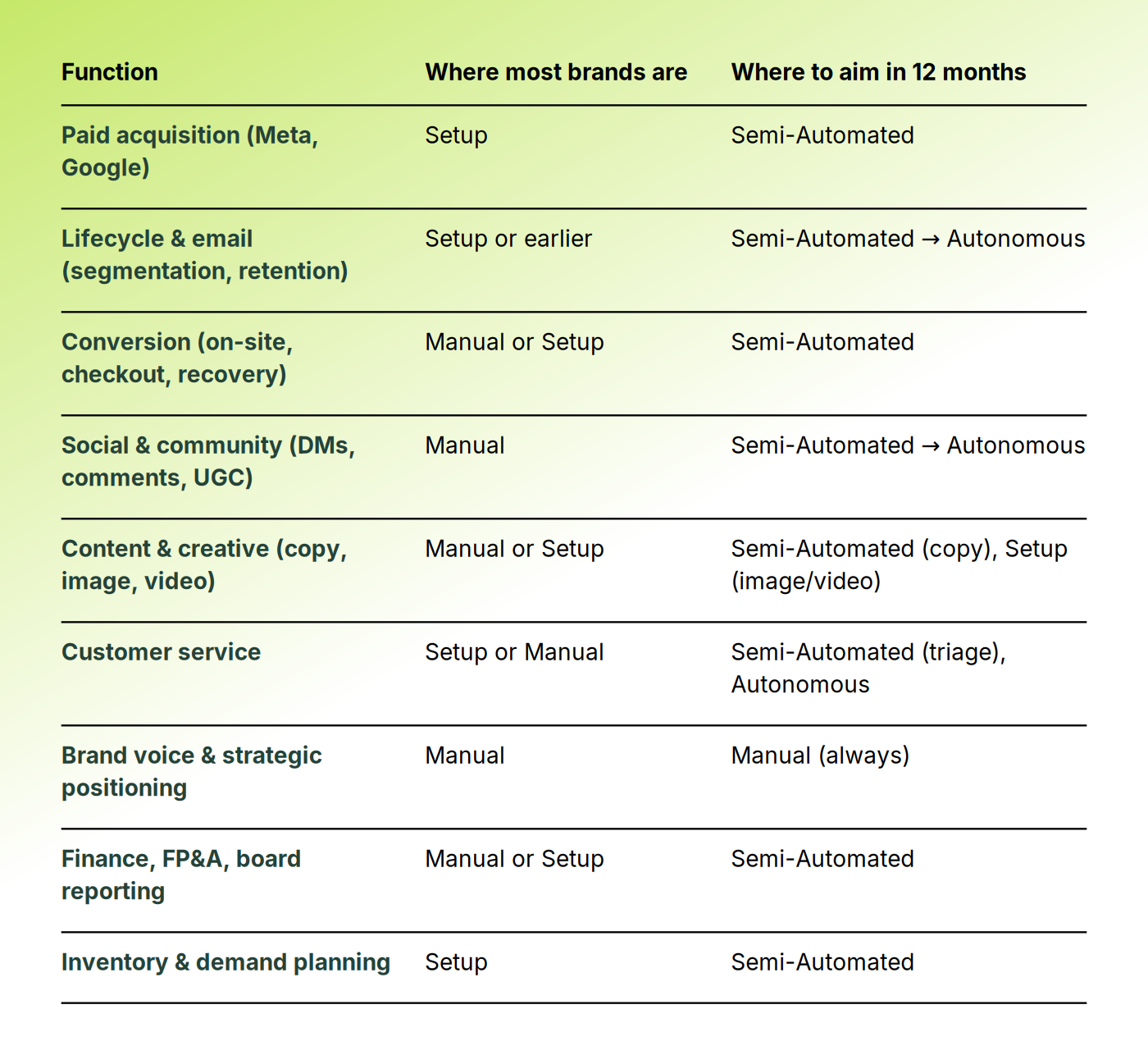
The pattern: very few functions should be at Autonomous today, even for brands moving fast. Most should be at Semi-Automated — that’s the rung where consumer brands gain the most operating leverage relative to the cost of getting there.
The brands that get this wrong over-engineer their way to a few Autonomous functions and leave the rest at Manual. The brands that get it right move ten functions up one rung each and find that the compounded effect of ten Semi-Automated functions running at once is meaningfully better than two Autonomous ones.
We ran this framework live with some of the top consumer brand CEOs in LA, in partnership with J.P. Morgan. The room included CEOs and founders from brands like Kosas, Vegamour, Tower28, Orebella, Glo Skin Beauty, ClearStem, Cecred, Arey, among many others. The numbers from the pre-event survey were illuminating — and not for the reasons we expected.
75% of the room told us they use AI daily. Three out of four CEOs in attendance are using Claude, ChatGPT, Gemini, or some combination as a working partner.
29% said anything in their business is reliably running on its own. Seven out of twenty-four. The other seventeen said they’d tried and failed, had something running but unreliable, or hadn’t started.
58% said they lose 10+ hours a week to a manual process they keep saying they should automate. A full workday a week, gone, for more than half a room of operators who already use AI daily.
That gap — between using AI and automating with AI — is the gap the ladder exists to close. It’s also, in our view, the single largest source of operating leverage available to consumer brands in 2026. The brands that close it first will operate at a meaningfully different revenue-per-employee than the brands that don’t.
Three of our portfolio companies walked the room through what climbing the ladder actually looks like, function by function:
Gigit AI on paid acquisition and conversion — the case for moving the most expensive marketing function on your P&L from Setup to Semi-Automated, with Meta’s Andromeda algorithm change making the cost of not climbing higher every quarter.
Relvino on lifecycle and email — the case for skipping past Semi-Automated entirely and replacing rules-based engines like Klaviyo and Attentive with autonomous 1:1 decisioning. The argument: a $20M brand wastes roughly $2M a year sending the wrong message to the wrong customer.
Swapt on customer retention from Amazon — the case for the Autonomous path on a function most brands didn’t realize they could automate at all, because the data they need has historically been locked behind the marketplace.
One operator put it this way in their pre-event survey: “I know what I know — and more importantly, I know what I don’t know.” That’s the most honest starting point any CEO can have with this stuff.
If you’ve read this far, you’ve earned a concrete next move. Three of them, actually.
Audit your five marketing functions against the ladder. Take 20 minutes. For each of paid acquisition, lifecycle, conversion, social, and content, write down which rung you’re on today and which rung you’d benefit most from moving to in 90 days. Not all five — pick the one that returns the most time, margin, or edge.
Start one rung at a time. If you’re at Manual, start with Setup. If you’re at Setup, start with Semi-Automated. Don’t try to leap two rungs — the cost goes up exponentially and the ROI follows the same curve. The fastest brands in our portfolio compound one-rung moves quarter over quarter, not two-rung jumps once a year.
Write down what the system isn’t allowed to decide. Before you climb, define the guardrails: brand voice principles, offer floors, banned claims, escalation triggers. This is the single most important document you’ll write all year. It’s what makes Autonomous safe, and what makes Semi-Automated work.
The brands compressing decision cycles fastest in 2026 aren’t running smarter prompts. They’re running their functions at the right rung of the ladder, and they wrote the guardrails down before they let the system make calls.
Part 6 will focus on what most brands miss: the guardrails. Not the prompts, not the tools, but the operating principles, escalation rules, and decision boundaries that make Semi-Automated systems reliable enough to trust. It’s the document you write once and benefit from hundreds of times. Coming in July.
At XRC, we’ve spent the last decade working alongside consumer founders, operators, and public CPG companies as technology reshapes how brands are built and scaled. The lesson is consistent: the advantage rarely comes from having access to a tool first. It comes from knowing where to apply it, how much autonomy to give it, and where human judgment still matters.
That’s also the philosophy behind our AI Lunch & Learn series. Before each session, we survey participating founders and operators to understand where they’re losing time, margin, and attention. We then curate both the conversation and the technology around those specific problems. The goal isn’t to show founders every new AI tool on the market. It’s to put the right operators and the right solutions in the same room around a problem that actually needs solving.
The result is a different kind of conversation: less hype, more implementation; less product demo, more operating model.
If you’re a brand operator interested in our workshops in LA, NYC or Miami: Join Waitlist Here.
If you’re a technology founder solving a real solution: Apply Here.
If you’re a corporate leader interested in a session for your team or simply want to compare notes—reach out at dianam@xrcventures.com.
XRC Ventures has been investing at the intersection of consumer and technology since 2015. This series reflects what we’ve learned building alongside the operators doing the work.
No posts
Comments
Nothing yet. Say the first thing.
Sign in to join the conversation.