

When we published the 2026 Longevity Benchmark, the most common reaction we heard was not surprise.
It was confirmation.
The research didn’t identify a brand-new category or breakout product. It confirmed something many teams have been sensing: longevity is reshaping consumer behavior across health, wellness, beauty, and personal care—well before it shows up in category definitions or acquisition pipelines.
This piece sits after the Benchmark report, not alongside it. The report showed where longevity-driven demand is forming. This piece shows when to act on it—and how to know if you’re early, on-time, or late.
Because by the time longevity becomes a “category,” the learning has already happened. The brands have been built. The premiums have been priced in.
What follows is a three-phase timing framework based on six signals we tracked across thousands of data points. Each phase requires different actions, different risk tolerances, and different investment theses.
Most large CPG portfolios are stuck between Phase 1 and Phase 2 right now. The question is whether they’re learning fast enough to choose their timing—or waiting long enough that timing chooses them.
Phase 1: Behavior Forming (Signals 1-2): What’s Happening: Usage patterns shift before financials do
Phase 2: Market Reorganizing (Signals 3-5): What’s Happening: Retail, categories, and consumer expectations realign
Phase 3: Window Closing (Signal 6): What’s Happening: Capital catches up, learning gets expensive
The signals: Frequency increases, Daily Compounding Replaces Episodic Relief
Longevity-aligned demand expresses itself first through frequency, not scale.
Products shift from episodic use to habitual use earlier than adjacent categories. Consumers don’t describe them as fixes—they describe them as routines.
This shows up subtly but consistently:
Higher repeat purchase velocity before top-line acceleration
Longer subscription tenure where subscriptions didn’t previously exist
Products increasingly paired together rather than swapped out
Importantly, these changes often precede visible revenue growth by quarters—or years.
Example: Seed Daily Symbiotic
Launched as a gut health product (traditional relief positioning)
Early adopters shifted to daily use within 60 days despite no explicit “daily routine” messaging
Repeat purchase rates hit 40%+ while category average remained sub-25%
Revenue inflection came 18 months after frequency pattern established
Now positioned explicitly around daily maintenance, but the behavior led
Example: Mosh Protein Bars
Brain health positioning that could have been episodic (study snack, afternoon slump)
Instead saw 3.2x purchase frequency vs. category average within first 6 months
Consumers self-organized into daily routine usage (morning ritual, post-workout)
Subscription attach rate 35% vs. 12% category benchmark
Frequency validated before mass retail distribution
What This Means: By the time revenue data confirms the trend, competition has intensified and valuations have moved.
Longevity doesn’t eliminate demand for relief products. It changes the relationship consumers have with them.
Across digestive health, skin, energy, and recovery, products historically positioned around acute need are increasingly evaluated through a compounding lens. Consumers ask less, “Does this fix something?” and more, “Does this make me better every day I use it?”
This favors:
Daily routines that build resilience over episodic interventions
Products that stack benefits rather than resolve discrete issues
Felt improvements that compound, not just sustain baseline function
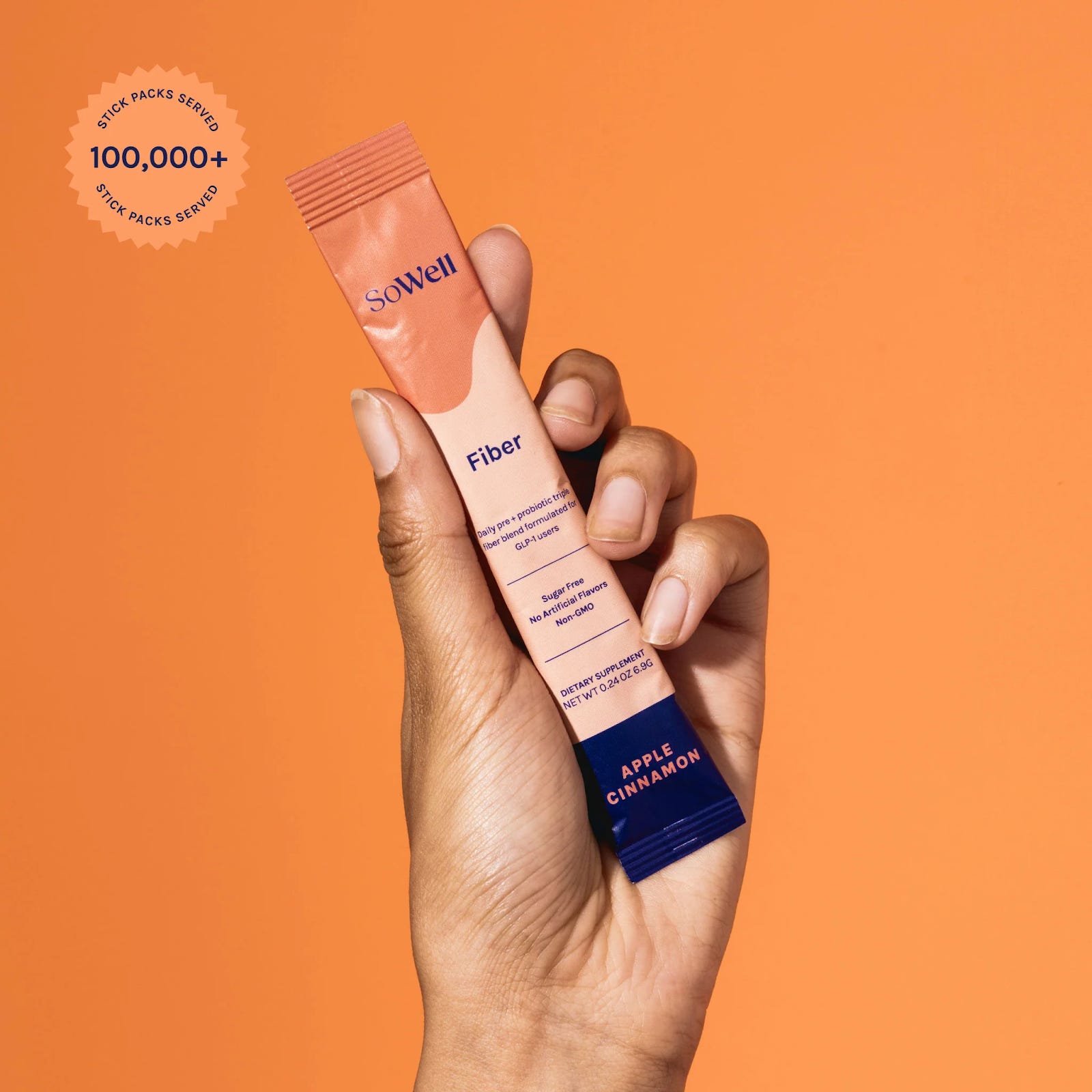
Example: SoWell Health Daily Fiber Packs
Formulated for GLP-1 users experiencing digestive side effects
Could have been positioned as relief (”take when needed for discomfort”)
Instead positioned as daily infrastructure (”support your system to function optimally”)
Result: 60%+ repeat rate, strong subscription velocity
Key insight: Customers report feeling “off” when they skip it—classic dependency behavior, not optional wellness
Categories don’t disappear—value migrates to products that compound over time
Example: Topicals Faded Serum
Originally positioned around hyperpigmentation treatment (fixing dark spots)
Consumer behavior showed daily prophylactic use—building toward even skin tone, not just treating issues
Brand repositioned toward “progressive improvement of skin resilience”
LTV increased 40% as use case shifted from episodic treatment to daily compounding
Key insight: Customers describe results as “getting better over time,” not “staying the same”
Now launching additional products around building skin resilience (barrier strength, redness reduction)
Example: LMNT Electrolytes
Started as hydration for athletes (performance/recovery = relief positioning)
Actual usage: daily hydration ritual for baseline optimization
Key insight: Customers report feeling “off” when they skip it—the benefit compounds through consistency
The value isn’t solving dehydration (reactive)—it’s building hydration resilience (proactive compounding)
Flavor variety drives daily adherence; the routine itself becomes the infrastructure
Business model shifted to reflect compounding economics (subscription, bulk packaging, auto-ship)
What This Means: Daily compounding products create different unit economics. They increase lifetime value not through upselling intensity. Customers experience them as foundational, not optional.
From a portfolio perspective, this matters because traditional CPG underwriting models miss it. You’re not modeling promotional lift or household penetration—you’re modeling dependency formation through felt compounding benefits.
The products that win aren’t the ones consumers think about using. They’re the ones consumers feel wrong not using.
✅ If you’re seeing Signals 1-2: You’re early (high uncertainty, high learning opportunity)
What to do:
Track usage frequency in your pipeline, not just revenue growth
Look for brands where repeat rates are 1.5-2x category average before top-line inflection
Prioritize founder conversations about how customers actually use the product vs. how it’s positioned
Build small early positions to gain learning access—don’t wait for proof
Underwrite based on frequency trajectory, not current revenue scale
What NOT to do:
❌ Wait for syndicated data to confirm the pattern (by then you’re in Phase 2)
❌ Dismiss brands with “small” revenue if frequency signals are strong
❌ Require clear category definition before engaging
❌ Compare to traditional CPG metrics without adjusting for maintenance economics
The signals: Performance replaces claims, categories boundaries blur, retail adapts
In longevity-aligned categories, differentiation increasingly rests on felt performance, not on claims, ingredient lists, or brand storytelling alone.
Consumers talk about energy, resilience, recovery, tolerance, durability—outcomes they experience repeatedly over time.
This doesn’t mean science stops mattering. It means science only matters insofar as it shows up in lived experience.
In crowded categories, this has consequences:
Claims blur faster
Language converges
Marketing-led differentiation decays
What compounds is perceived superiority over time
Example: AG1
Entered a saturated greens powder market with similar ingredient profiles to competitors
Differentiation: customers, including myself, consistently report “I feel it working” (energy, digestion, immunity)
Not about claims—about repeatable felt experience
Result: massive brand loyalty despite premium pricing and ingredient parity
Competitors with similar formulations struggle because performance perception lags
Example: Momentous vs. Generic Creatine
Creatine is creatine—scientifically commoditized
Momentous built around performance trust: third-party testing, pro athlete partnerships, batch consistency
Customers report confidence in product quality translates to perceived performance benefit
Premium pricing sustained despite ingredient equivalence
Trust becomes the performance differentiator
What This Means: The Benchmark data shows longevity accelerates this sorting mechanism. Brands that perform consistently earn repeat behavior. Brands that rely on explanation or marketing struggle to sustain it. In Phase 2, the market starts separating winners from noise.
Consumers do not experience longevity through a single category. Portfolios often still do.
One of the clearest insights from the Benchmark report: convergence of nutrition, beauty, personal care, and OTC around shared performance jobs—energy, resilience, inflammation management, durability.
Consumers build routines across categories long before organizations reconcile them internally.
Reporting structures, innovation teams, and acquisition strategies remain siloed even as usage converges.
Example: The “Resilience Stack” What consumers are actually buying together:
Adaptogens (stress management)
Collagen (skin/joint support)
Omega-3s (inflammation)
Magnesium (sleep/recovery)
Probiotic (gut-brain axis)
These span 4-5 traditional categories (supplements, beauty, functional food, OTC). But consumers experience them as a single routine optimizing for “resilience over time.”
Example: Retail Assortment Gaps
Beauty retailers carry collagen skincare but not collagen supplements (different buyers)
Supplement retailers carry magnesium but not topical magnesium (different categories)
Food retailers carry functional beverages but not complementary supplements (different aisles)
Consumers shop across all three to build their routine
The brands ahead of the curve in Phase 2: those building multi-category offerings that reflect actual consumer routines
Example: Sakara Life - Food + supplements + beauty (integrated longevity routine)
Example: Ritual - Expanding from supplements into personal care (shared “essentials” framing)
Example: Nutrafol - Hair supplements + topicals + scalp care (full hair longevity system)
What This Means: Longevity doesn’t disrupt categories overnight. It exposes portfolio rigidity gradually. The white space isn’t in entirely new categories—it’s in adjacencies that feel obvious to consumers and invisible to legacy structures.
Retail data in the Benchmark report reinforces a familiar sequencing pattern:
Specialty retail reorganizes first (Vitamin Shoppe, GNC, Sephora, Credo)—grouping products around use case, routine, and performance rather than brand lineage or ingredient. Education improves. Assortments become more legible.
Mass retail follows later, once behavior is validated and economics are clearer.
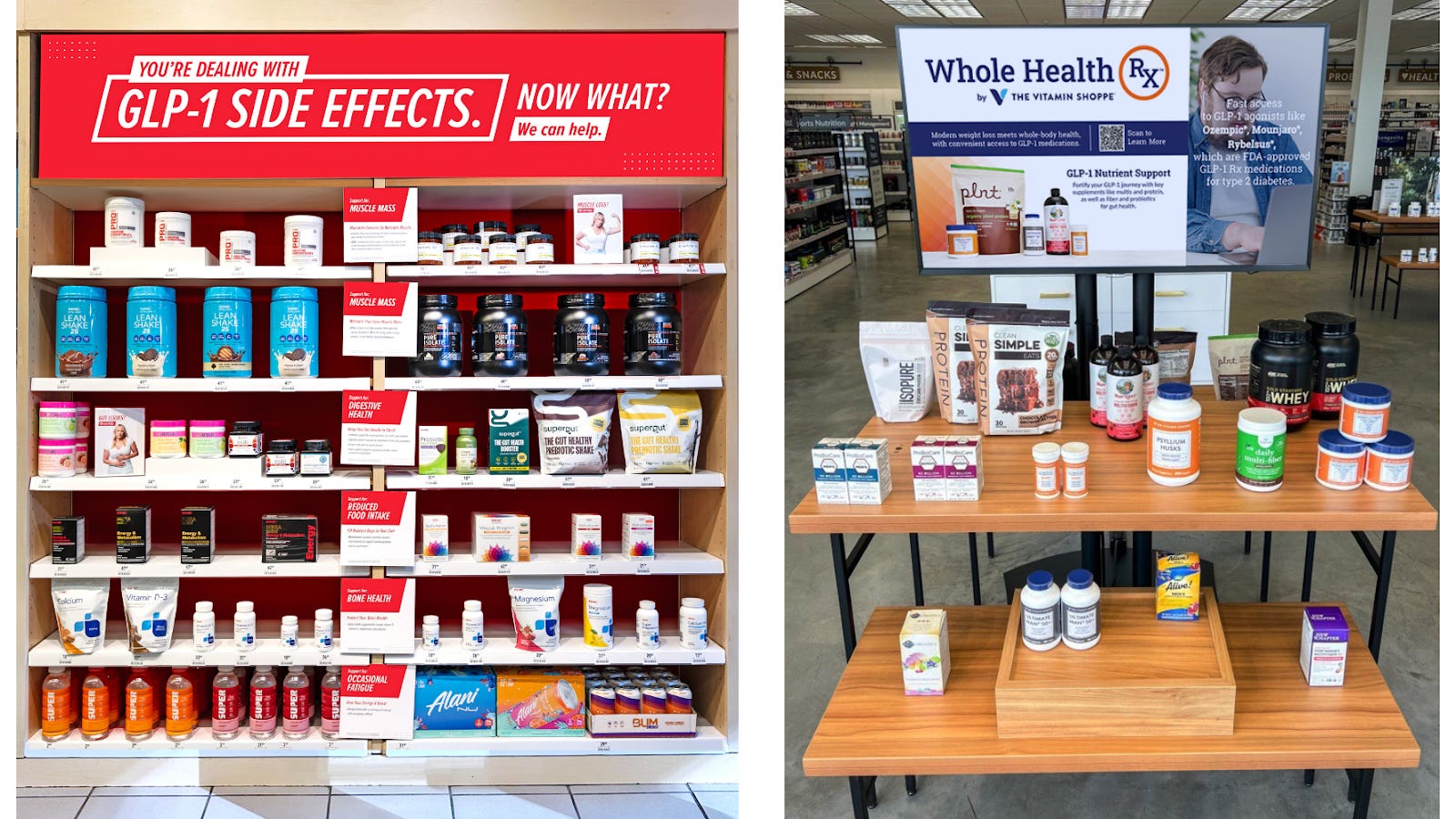
Specialty retail organizes around use case and routine (left), while mass retail remains SKU-dense and claim-led (right). Longevity acts as an organizing logic that reduces cognitive load and increases repeat behavior.
Example: GLP-1 Product Merchandising
Vitamin Shoppe (Q3 2025): Dedicated GLP-1 support section, organized by outcome (digestive support, protein optimization, micronutrient replenishment)
Walmart (Q4 2025): GLP-1 products scattered across vitamins, protein, fiber—no organizing logic
Gap timeline: 6-9 months between specialty clarity and mass adoption
Implication: Specialty validates behavior; mass captures scale
Example: “Longevity” as an Organizing Principle
The Vitamin Shoppe: “Healthy Aging” endcap featuring NAD+ boosters, cellular health, mitochondrial support
Erewhon: “Longevity Essentials” section curating across supplements, beauty, functional food
Whole Foods (national): Still organized by legacy categories (vitamins by letter, beauty by concern)
What This Means: When specialty retail starts reorganizing around a behavior, learning is already happening at the consumer level. Waiting for mass to formalize the shift means you’re behind the curve - pricing has moved and competition has arrived.
✅ If you’re seeing Signals 3-5: You’re on-time (validated behavior, pre-consensus pricing)
What to do:
Prioritize brands with demonstrated performance trust (not just claim differentiation)
Look for portfolio expansion across blurring category boundaries (e.g., supplement brand adding topicals)
Track specialty retail assortment changes as leading indicators
Build conviction around multi-category platforms, not single-SKU hits
Underwrite based on routine integration, not category share
What NOT to do:
❌ Wait for mass retail validation (by then you’re paying a premium)
❌ Evaluate brands solely within their launch category (miss the adjacency opportunity)
❌ Dismiss brands because “the category is crowded” (performance separation is happening)
The signal: Learning becomes expensive
This signal is structural, not behavioral.
What’s happening:
Early-stage capital remains constrained relative to prior cycles
Later-stage and buyout capital is more available—but increasingly selective
Result: Fewer early experiments funded, proof points more expensive to access
For large portfolios, this means: Learning doesn’t disappear—it gets pushed later, into acquisition processes where uncertainty is highest and optionality is lowest.
The Benchmark data makes clear: Longevity demand is already forming. The question isn’t if it will matter, but when learning happens relative to capital deployment.
Example: The Clean Beauty Timeline (2014-2020)
2014-2016 (Phase 1): Behavior forming—consumers seeking “free-from” formulations, frequency increasing
2017-2018 (Phase 2): Specialty retail (Credo, Detox Market) reorganizing; brands like Drunk Elephant, Youth to the People scaling
2019-2020 (Phase 3): Major acquisitions at premium multiples (Drunk Elephant to Shiseido $845M, Tatcha to Unilever ~$500M)
Learning cost: Early investors paid 0.5-1.5x revenue; corporates paid 5-8x revenue
Example: Functional Beverages (2018-2024)
2018-2020 (Phase 1): Behavior forming around nootropics, adaptogens (OLIPOP, Poppi early days)
2021-2022 (Phase 2): Specialty and natural channel reorganizing, mass testing
2023-2024 (Phase 3): Valuations spike; OLIPOP reportedly exploring sale at $3B+ valuation
Learning cost: Seed investors paid sub-$50M valuations; strategics looking at 10-15x revenue
What This Means: Longevity has a high cost of waiting—not because the opportunity vanishes, but because the ability to shape it diminishes. By Phase 3, you’re buying outcomes, not building them.
⚠️ If you’re only seeing Signal 6 (or arriving late to Signals 1-5): You’re late (paying for certainty, limited optionality)
What to do:
Accept that you’re acquiring proven outcomes, not building new theses
Focus on operational value creation, not market timing
Look for category leaders with sustainable performance moats
Underwrite based on mature maintenance economics and defensibility
What NOT to do:
❌ Expect early-stage multiples on late-stage assets
❌ Assume you can “fix” category positioning (consumer behavior is set)
❌ Ignore integration complexity of multi-category platforms
The Longevity Benchmark report maps where demand is already forming.
The harder work is deciding when to learn, how to structure that learning, and how to align it with portfolios that still need to perform today.
The advantage increasingly belongs to those who recognize the signals early enough to choose their timing—rather than having it chosen for them.
If the Benchmark report shows where the shift is happening, this framework shows when to act—and what happens if you wait.
We recently opened Cohort 2 applications for our Brand Builder grant program to support emerging CPG brands that are growing on DTC. Learn more and apply here by February 28.
No posts
Comments
Nothing yet. Say the first thing.
Sign in to join the conversation.