
A few weeks ago we were at CAGNY. This week, the team is heading to Expo West.
Two rooms. Two energy levels. Two very different signals about where Consumer is heading in 2026.
CAGNY is where large CPGs speak to Wall St analysts and institutional investors. It’s polished, controlled, and disciplined. Companies clarify guidance, reinforce strategic priorities, and demonstrate command over margins, mix, and market share. They also present professionally produced company videos.
Expo West is different. It’s chaotic in the best way. Thousands of emerging brands with new formats, claims, rituals and new demographic targeting. The room is spirited…less about strategic priorities and polish, and full of DIY signs and handouts representing what consumers are excited to experiment with next. The interesting question sitting between those two rooms is this:
Who is actually built to act on emerging behavior now — not just study it — and win the next 3–5 years?
What CAGNY Revealed
Across presentations, several themes repeated.
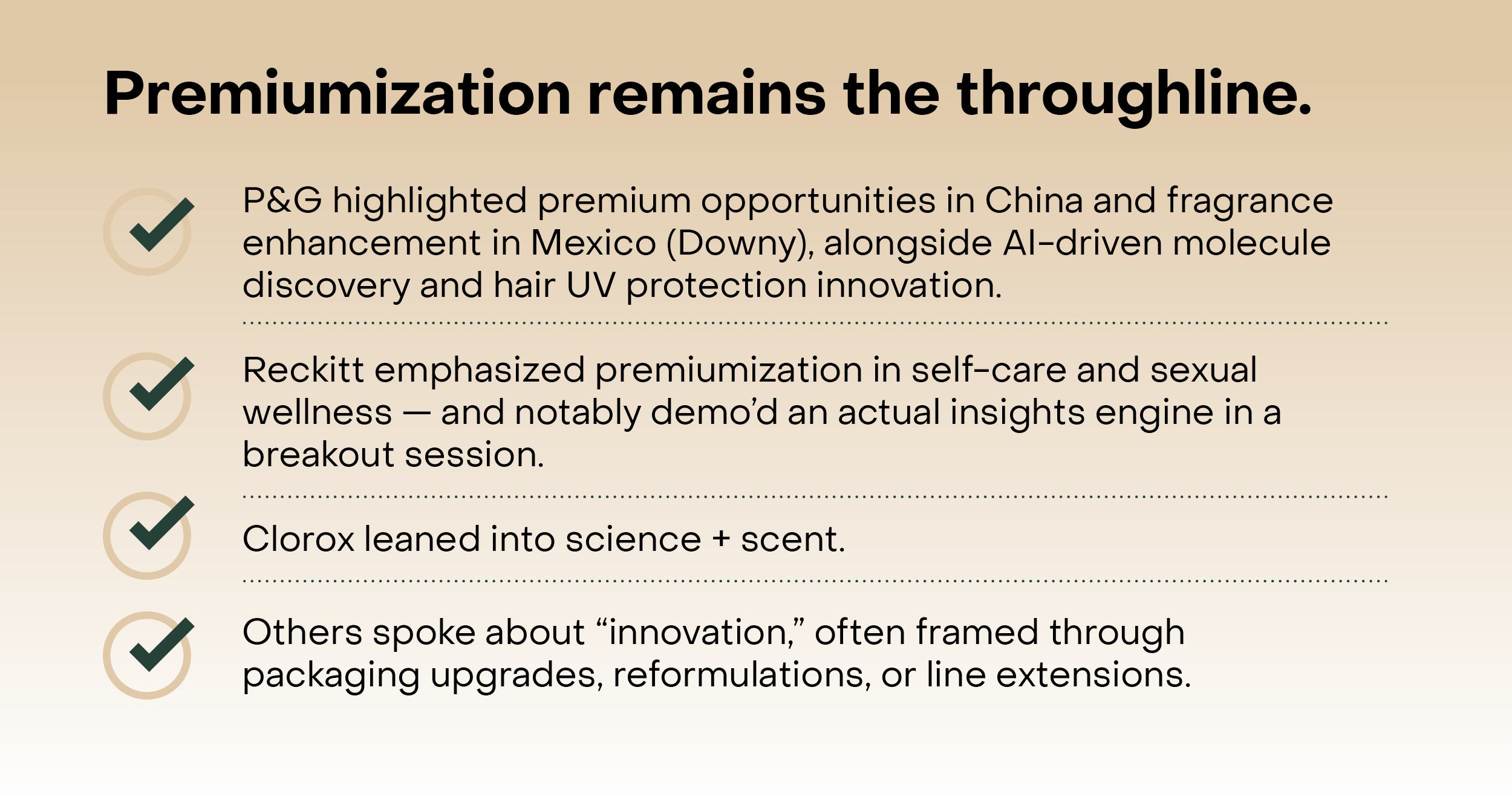
To be clear: these are sophisticated operators with massive R&D budgets and real deep data capabilities. Their global distribution is unmatched.
But the consumer-facing expression of that innovation often felt flat.
If “innovation” had been a drinking game, it would have been a lively room. But in many cases, what was described as innovation looked more like optimization.
One company cited moving from an opaque white bottle to a clear one to signal “natural.” Another spoke at length about generative AI reducing molecule discovery timelines from 6–8 years to 8 months, but struggled to point to new brand creation or breakthrough platforms resulting from it. When asked in breakout sessions about proprietary science or novel technologies, that same CEO responded: “We work with several partners.”
There is nothing wrong with incremental improvement. In fact, at enterprise scale, it’s often the right call. But it raises a sharper question:
Most large CPG innovations are built to deliver 3–5% growth. The question for 2026 is: what innovation can break out of that range?
What Expo West Will Test
Expo West will feel different.
We’ll hear from founder-CEOs who are in the weeds of their businesses — less polished, more candid. They’ll talk about doubling sales, carving out new use cases, reframing categories, and seeing whitespace before data validates it
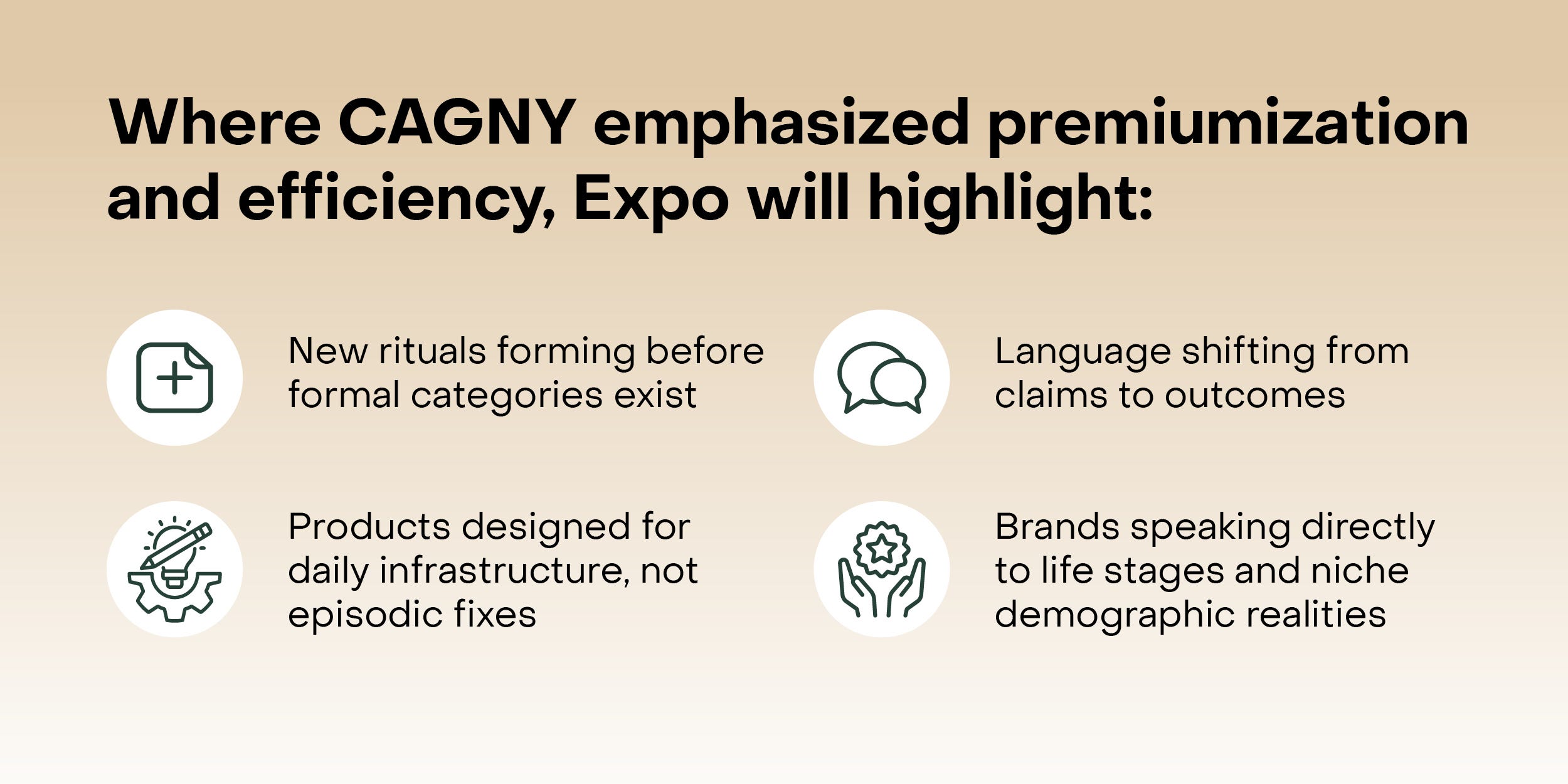
The key difference between CAGNY and ExpoWest goes beyond size; the proximity to the final customer’s behavior is a real differentiator.
While many may think of ExpoWest as a sourcing trip, we use it as a signal environment.
The question we ask as we walk the aisles:
What is changing? Who understands it first?
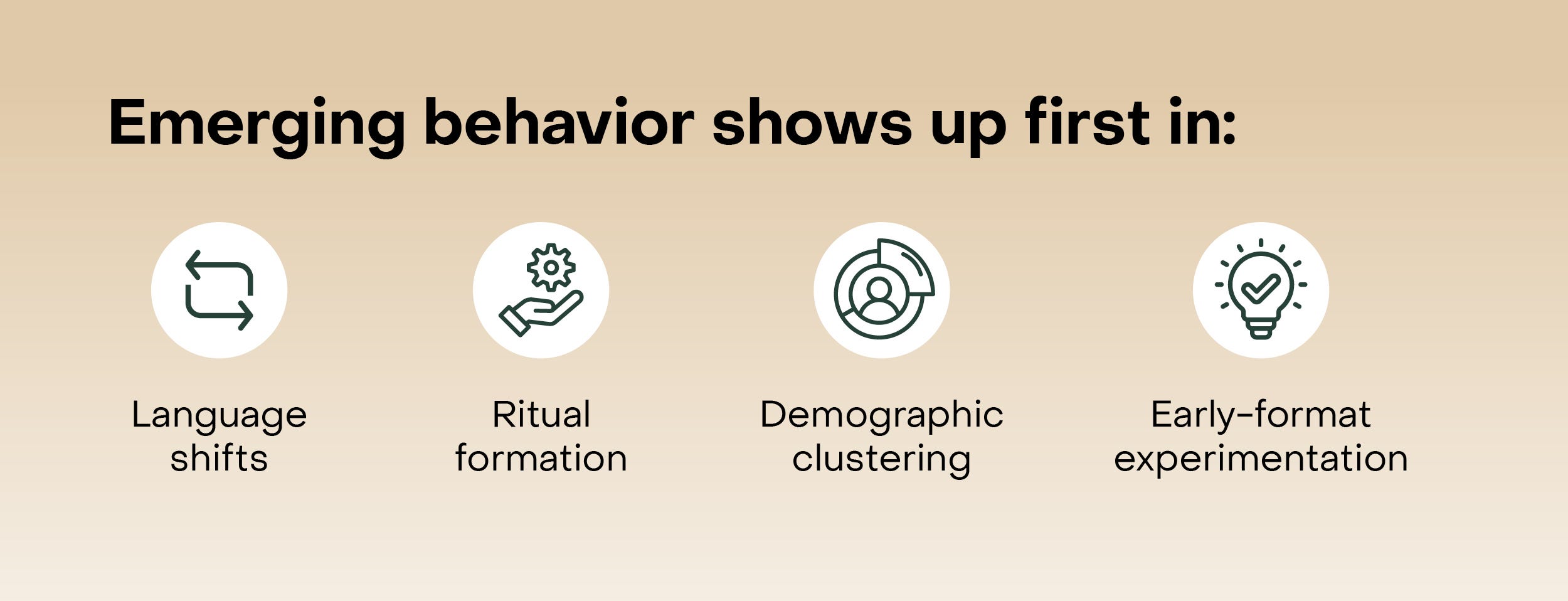
Here’s what we look for:
Frequency over novelty.
Is the product daily and habitual — or occasional and hype-driven?Ritual fit.
Does it slot naturally into existing routines, or require new behavior?Language convergence.
Are unrelated brands describing the same problem in different ways?
When multiple brands cluster around aging energy, GLP-1 digestive shifts, midlife hormone support, or preventative cognitive health we notice a real behavioral formation.
And increasingly, one signal we expect to see more of: fragrance as infrastructure.
Fragrance is emerging in premium the way “skinification” reshaped body, then hair. Not just scent as aesthetic — but scent as performance layer:
Mood regulation. Identity signaling. Longevity of effect. Cross-category layering.
The question is not whether fragrance grows. It’s whether larger portfolios have permission to treat it as a platform — or if it remains a line extension.
The Real Gap Isn’t Big vs. Small
This is not about resources.
Large companies have more data than ever, AI-enabled insights engines, global trend tracking, massive R&D budgets, and retail sell-through visibility at scale. But these systems are designed to measure what has already worked. They don’t show what is forming.
The harder part is not seeing the signal - I’ve walked those aisles with C-suite executives before – It’s acting on it.
The cereal aisle makes this concrete.
US cold cereal volumes have been declining for more than 25 years. The category lost consumers to protein shakes, Greek yogurt, and anything that didn’t require a bowl. The incumbents — General Mills, WK Kellogg, Post — collectively hold billions in R&D spend, decades of shelf relationships, and armies of category managers. And yet, all major cereal companies have been losing share, with private label now at 9% of all cereal sold at US retailers, up from 5.6% just four years ago. In the most recent measured period, actual unit volume declined 1.3% — meaning any dollar “growth” was entirely price-driven, not consumer-driven.
Meanwhile, Catalina Crunch — founded by Krishna Kaliannan, a Type 1 diabetic who built the product to solve his own problem — crossed $200M in brand sales, growing high double digits, at high-teens EBITDA, with 30,000+ points of distribution. He did this without legacy brand architecture or an internal board of advisors.His success resulted because he is a founder who understood the consumer before the data did.
The incumbents saw the signal. Kellogg’s CEO said it plainly to investors: “While there are smaller brands in the market that are winning, we could do that, too.”
They could and yet they didn’t. That’s not a capital problem. That’s a permission problem.
The CEOs at CAGNY know what’s winning. The gap isn’t insight — it’s an operating model built to optimize what already scales, not to build what can meaningfully change the growth trajectory.
Having worked alongside several large CPGs, we understand that acting requires two types of permission:
Brand permission — Does the brand credibly stretch there? Can a mass brand authentically go super-premium? Can a heritage OTC brand own preventative longevity?
Internal permission — Are teams incentivized to take that risk? Or are they penalized if it fails?
That’s where institutional design matters more than capital.
The Institutional Question for 2026
CAGNY showed us disciplined capital allocation. Expo West will show us accelerating consumer experimentation. Both are rational, but discipline alone can not create relevance.
And increasingly, even Wall Street is starting to notice the gap.
On the Colgate-Palmolive Q4 2025 earnings call, Nik Modi of RBC Capital Markets asked CEO Noel Wallace a question: “Some of your larger competitors have announced — and probably will announce soon — organizational design changes that are less category-centric and more solutions-centric. How do you think about organizational structure? And do you think that making any changes might make sense just given the way the world is evolving?”
That question didn’t come from a founder or a VC. It came from one of the most respected consumer analysts on Wall Street.
When structural permission starts showing up as a line of questions on earnings calls — not just from operators or investors in emerging brands, but from sell-side analysts probing CEOs — the conversation has shifted. The market is beginning to ask whether organizational design is a competitive advantage or a liability.
If fragrance is becoming a behavioral layer, if preventative daily health is replacing episodic solutions, if consumers are designing systems and routines rather than buying SKUs — then the question is not whether large companies see it. It’s whether they are structured to do something about it.
Do they have incentive structures that reward early experimentation? Brand architectures that allow adjacent stretch? Governance models that tolerate complexity where it creates value?
Because the market does not pause while internal debates resolve. And now, apparently, neither do the analysts.
The Structural Choice for 2026
Between CAGNY and Expo West sits a subtle but consequential tension. Large companies are optimizing for certainty. Consumers are compounding new behaviors in real time.
The risk for big CPG is not over-expansion or de-prioritizing the core business. It’s allocating all your capital to defend 3–5% growth while the next 5–7% layer forms somewhere else.
For corporates: Use Expo West not as a sourcing trip, but as a diagnostic. Where are daily routines shifting? Which behaviors are compounding? And does your portfolio architecture actually allow you to participate — or only to extend what already exists?
For founders: Understand that premiumization is not enough. Operational readiness and platform clarity matter more than ever.
For investors: Signals appear in language and frequency long before they appear in revenue.
The next set of winners won’t simply spend more. They will be the ones structurally designed — and strategically willing — to act while behaviors are still forming, not after they’ve scaled.
This is a prioritization decision.
And, we argue, it has to be made now — not three years from now when the market has already re-rated who can grow.
If you’ll be at Expo West this week, we’d love to continue the conversation.
We’ll be walking the floor with this exact lens — looking less for the next “hot brand” and more for the behaviors quietly compounding underneath the surface.
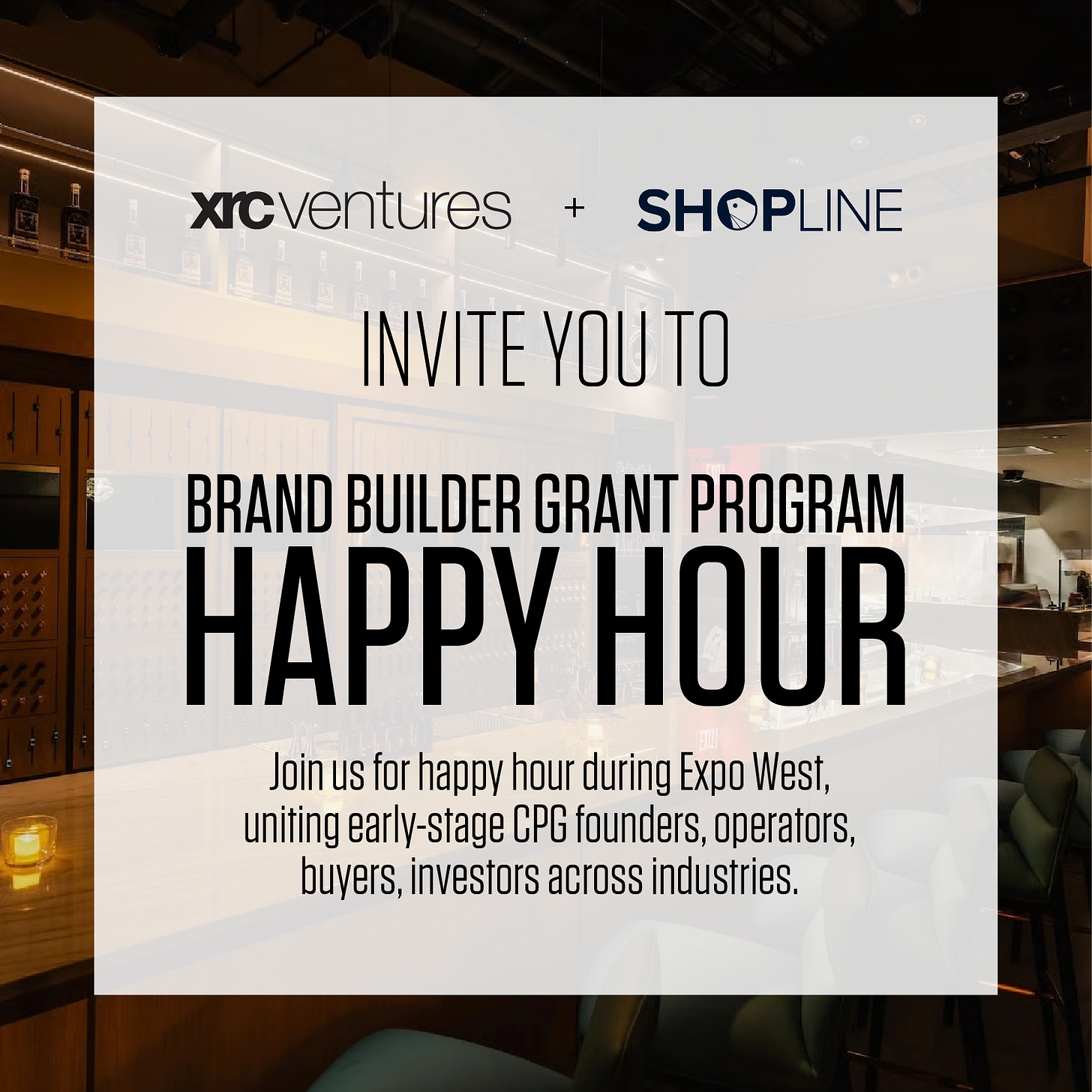
And on Thursday, March 5th, we’re hosting a small Happy Hour with founders, operators, corporates, and investors who are thinking about these structural questions in real time.
If you’re in town and want to join, reach out.
The best conversations tend to happen off-stage.
Thanks for reading The Brand Capital Report! Subscribe for to receive our insights and analysis.
Comments
Nothing yet. Say the first thing.
Sign in to join the conversation.