
The Final (Clinical) Examination is the last step of the Australasian Veterinary Examination (AVE), designed to assess your practical and clinical competence as a veterinarian.
It’s conducted in English, over 5 days, and held twice a year (usually mid-year and end-of-year).
The exam is held only in Australia.
You must pass the Preliminary (MCQ) Examination before you can attempt the clinical component.
The Final must be attempted within 3 years of passing the MCQ.
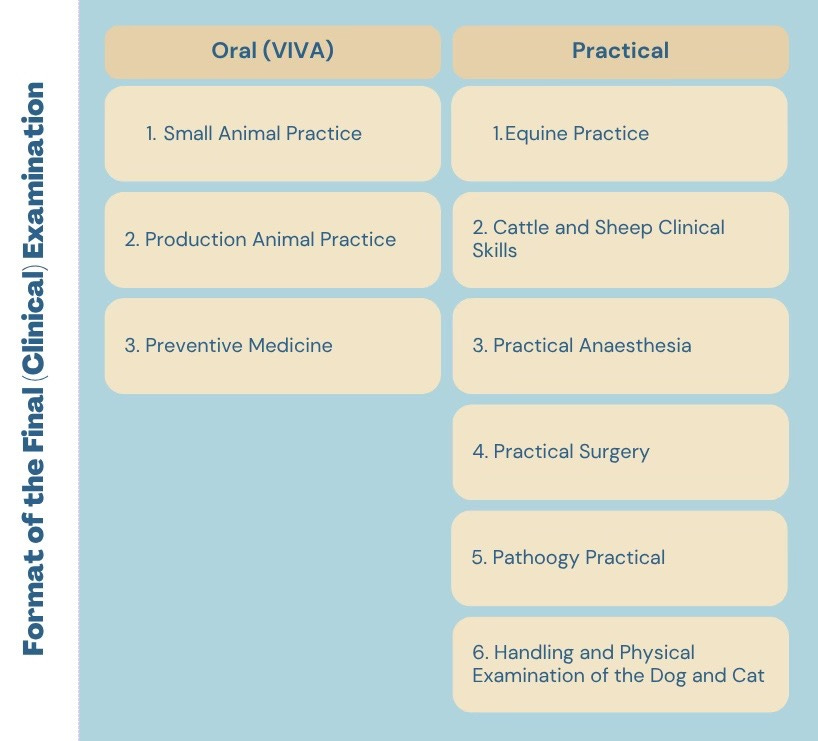
The exam includes a combination of Oral (Viva Voce) and Practical components, divided into 9 sections:
READ the AVBC Booklet
There’s a new version (April 2025). Read pages 10–23 carefully. They contain essential details on the format and expectations. [🔗 Link here: AVBC Booklet 2025]Identify Your Weak Areas
Are you more confident with small animals but less experienced in cattle? Or maybe equine handling is your weakness? Make an honest list of areas needing improvement.Plan Your Placements Strategically
Once you know your weaknesses, look for clinics where you’re not only allowed to observe but also encouraged to ask questions and get involved - even with basic tasks.The goal is to gain exposure to a variety of cases, procedures, and workflows. Choose environments where veterinarians are open to teaching and understand what you're preparing for.
Allocate Time
Studying for this exam is time-consuming. You might need to take holidays or unpaid leave to properly prepare.Save for It
Besides the exam fees, consider costs of travel, accommodation, and time spent on unpaid placements.
Write a Professional Introduction Email
Introduce yourself, explain your goals, and describe what you can offer to the clinic or vet.
✉️ We strongly recommend writing your own professional email, use your own words and voice to introduce yourself genuinely. Keep AI assistance limited.Research Clinics Widely
Be ready to travel - cattle and equine cases are more likely found outside big cities.Time It Right
Plan placements around busy seasons for practices so you can observe more cases and procedures.Most Clinics Will Require Insurance
Most veterinary practices will ask you to provide proof of Professional Indemnity and Public Liability Insurance before starting a placement.
🔗 Check details here: AVE Candidate Hub – Insurance Info
You can prepare from overseas, but you must meet the same clinical competencies as a new Australasian graduate, as defined by the AVE Committee (AVEC).
Use the AVBC checklist to make sure you're meeting the required standards.
Practical skills can be learned anywhere - but make sure they align with AVE expectations.
You’ll be presented with 4 clinical scenarios and will be assessed on:
Understanding of the case
Ability to integrate diagnostic results (e.g. imaging, pathology)
Formulation of differential diagnoses
Justification of treatment decisions and possible outcomes
Best preparation method:
📚 Study based on clinical scenarios. For example:
Diarrhoea in a dog: walk through the diagnostic algorithm, possible causes, and treatments
Sudden death in 10 beef cows: think epidemiology, differential diagnosis, diagnostic tests, and farm-level management
Are you struggling with a specific section of the exam, or just feeling overwhelmed with how to get started?
We’re here to help.
Coming soon: You’ll be able to book 1:1 sessions directly from our homepage.
Whether you need help preparing for a specific station or organising your study plan, this support will be designed to your needs.
If there’s something you're unsure about, or a question you think should be added to this guide, let us know!
We're here to support you through this challenging process.
Preparing for the Final Clinical Exam is a marathon. With structured preparation, placements, and scenario-based studying, you’ll set yourself up for success. Save this post, share it with friends, and start planning your roadmap today.
Thanks for reading and for your continued support, we’ve got your back! ✨
Anto & Nat 🩺
No posts
Comments
Nothing yet. Say the first thing.
Sign in to join the conversation.