
Randomized trials sit at the top of the evidence hierarchy, but single cases are often where the insight starts. H.M. and Phineas Gage taught clinical neurology how the brain is organized. In autonomic neurology, single patients revealed antibodies that block specific receptors. And in neurodegeneration, one extraordinary person can point to a protective mechanism hiding in plain sight.
Aliria Rosa Piedrahita de Villegas, from Antioquia (Colombia), was that kind of case for the Alzheimer’s disease field. And then, all that happened afterwards, came into question.
On 13 August 2026, Science published an investigation by Charles Piller and Jennie Erin Smith into the most discussed about genetics story of the past decade.¹
This is the same group that uncovered other fraud cases related to neurodegeneration drug development, which I covered.
In this post I delve into these new fraud allegations. But so far, no paper has been retracted, no journal has issued a correction or expression of concern, no institution has announced a finding, and the two key researchers inputed in the investigation have, so far, remained silent.
Neurologist Francisco Lopera began seeing families with early-onset dementia in Antioquia, Colombia, in the early 1980s. He and his colleagues traced it to a single mutation in presenilin 1, PSEN1 p.Glu280Ala, known locally as the paisa mutation. The kindred they eventually mapped runs to roughly 6,000 people, about 1,200 of them carriers. In a landmark 2011 natural-history study, median onset of mild cognitive impairment in carriers was 44 years and of dementia 49.² For a paisa carrier, AD is close to inevitable.
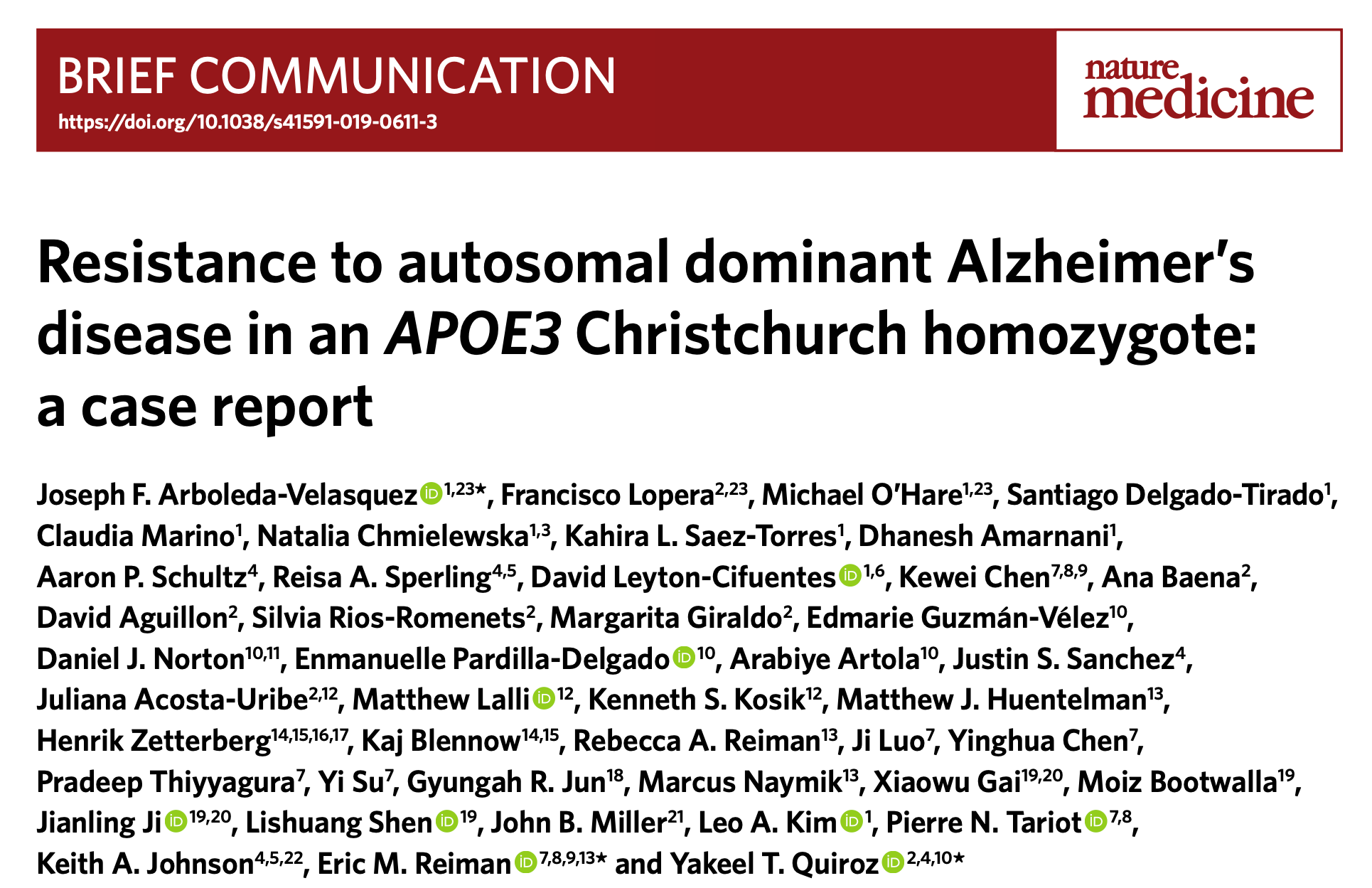
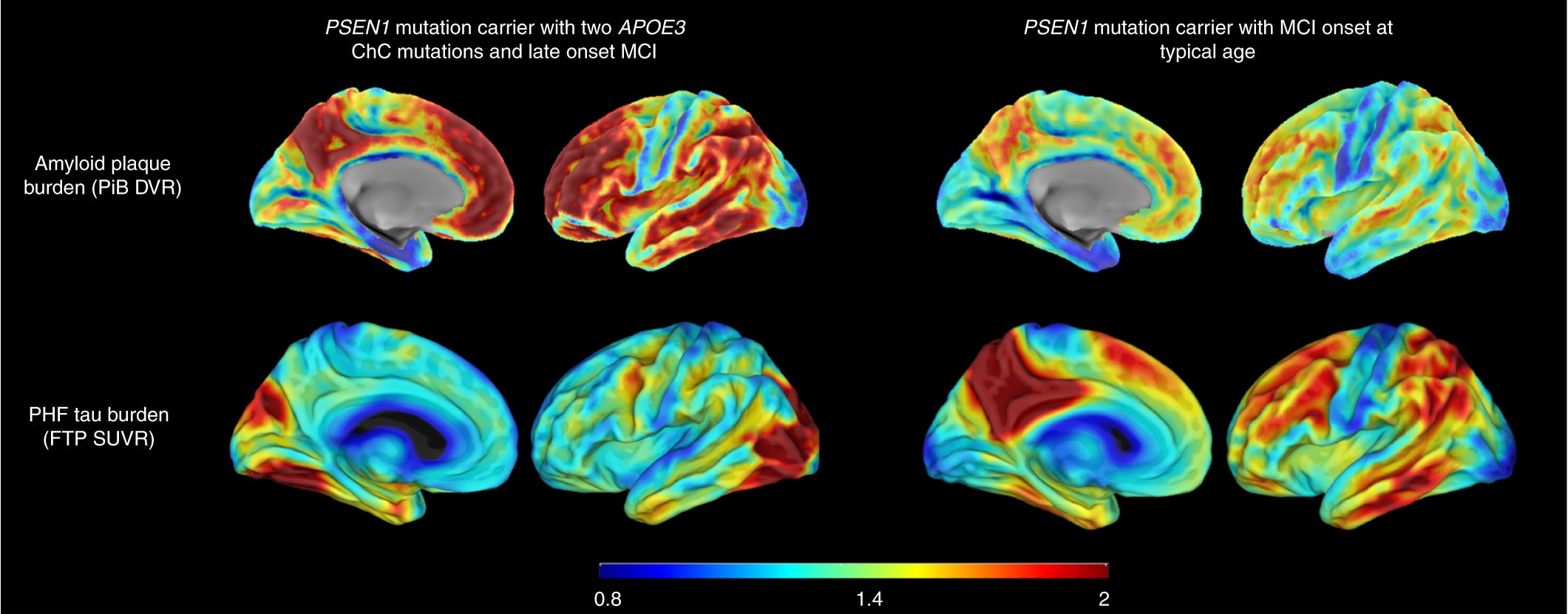
Aliria was the exception that made the field. She carried the paisa mutation but stayed cognitively intact into her 70s. Two of Lopera’s proteges helped characterize the case. Joseph Arboleda-Velasquez, trained at Antioquia and then Harvard, ran the genomics; he is now an associate professor of ophthalmology at Harvard Medical School and Mass Eye and Ear. Yakeel Quiroz, a neuropsychologist at Massachusetts General Hospital, ran the imaging and biomarkers. Both came out of Medellín; they are married. Arboleda-Velasquez arranged the genetic testing, and Quiroz the imaging: Aliria carried two copies of a rare variant of the APOE gene, R136S, known as Christchurch.³
The variant sits in the region that governs how the ApoE protein binds heparan sulfate proteoglycans — which becomes important later. The case report appeared in Nature Medicine on 4 November 2019.
This story appeared in the front page of the New York Times the same day.
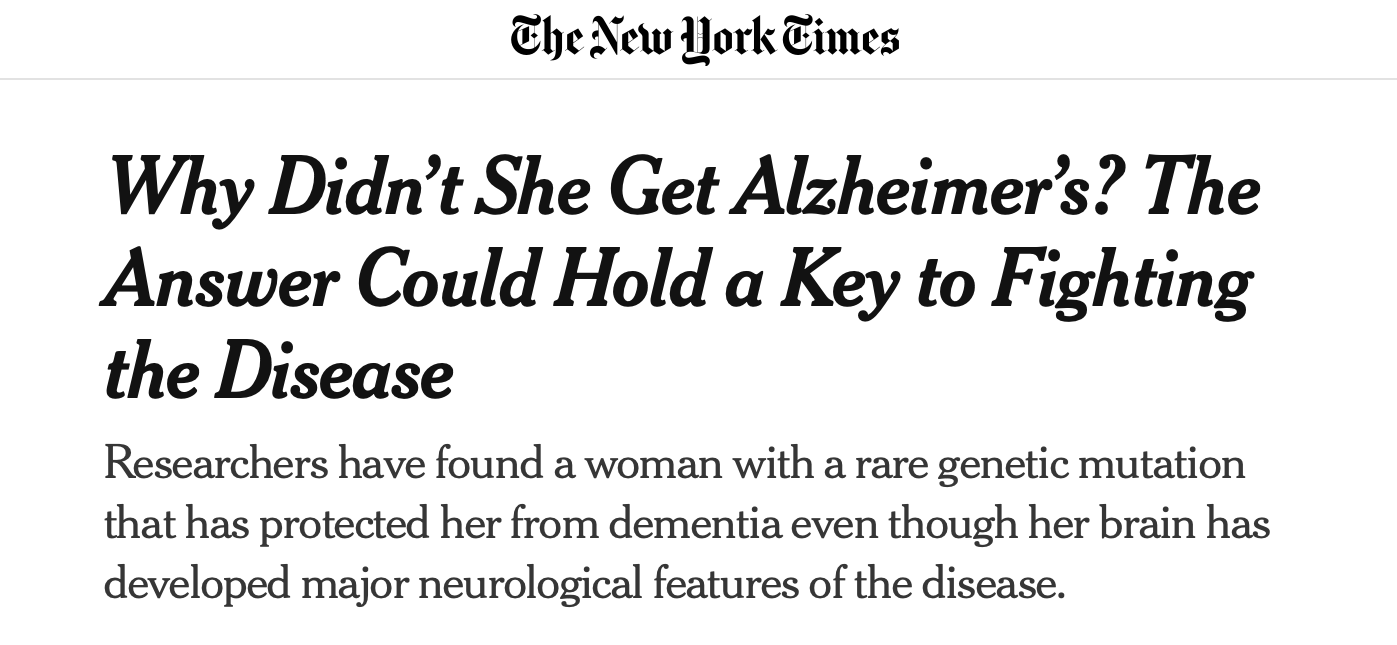
Aliria died in 2020, at 77, of metastatic melanoma; her family donated her brain. This also made it in The New York Times.
None of that is challenged by the Science investigation. A woman with two copies of Christchurch escaped a disease that should have taken her decades earlier. This is real. The question is about everything that came later.
In May 2023, the same group reported a new protective variant in the same kindred — RELN p.His3447Arg, “Reelin-COLBOS,” in a man whose symptoms began at 67.⁴
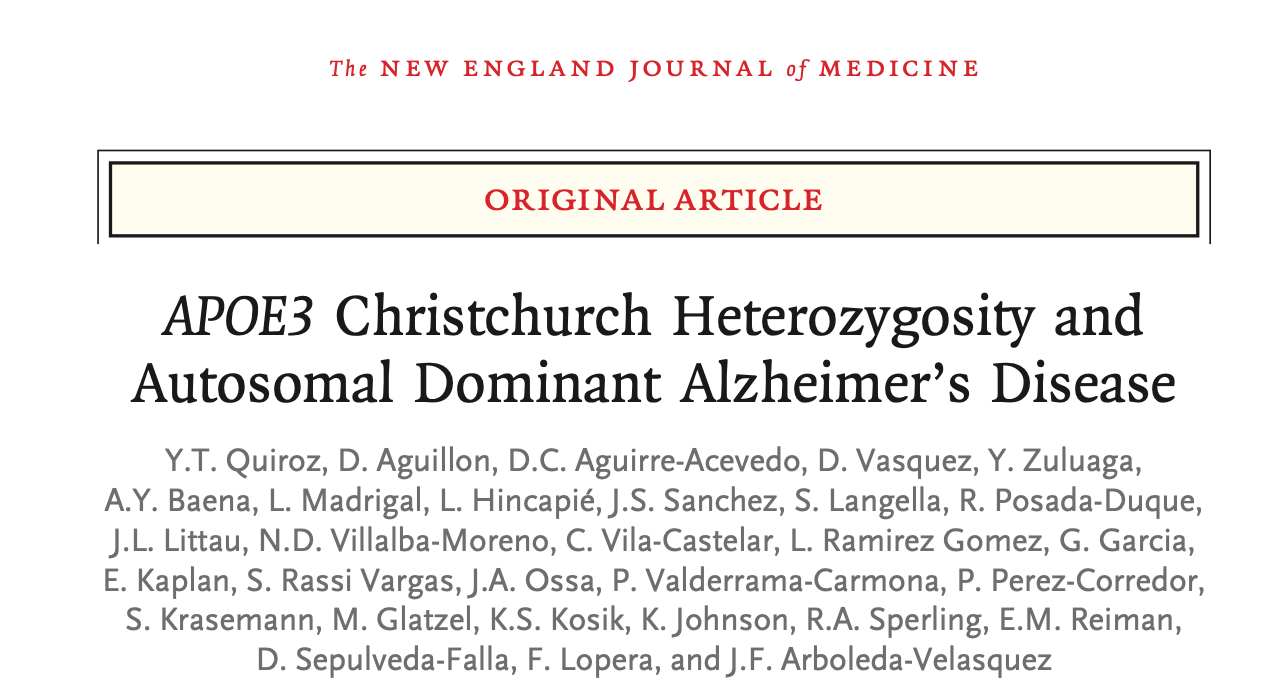
Then, in June 2024, in the New England Journal of Medicine, they made the leap that turned a single case into a population claim: they identified 27 people carrying one copy of Christchurch among 1,077 paisa carriers — Aliria had two — and reported that one copy delayed AD onset.⁵
Biotech followed with two assets that are, so far, in non-human development.
Epoch Biotech, which Arboleda-Velasquez co-founded in 2022, is developing an antibody (7C11) designed to block exactly the ApoE–heparan-sulfate interaction that the Christchurch variant weakens; it presented non-human primate pharmacokinetic and biomarker data at AAIC in London on 15 July 2026.
And a gene therapy — an AAV carrying an APOE2 allele engineered to contain Christchurch — is under development in Ronald Crystal’s group at Weill Cornell under a five-year NIA award, with a planned phase 1A in 15 patients; the same construct sits in Crystal’s company Lexeo as the preclinical asset LX1021 designed to express a “Christchurch-modified APOE2” protein in the CNS of APOE4 homozygous patients (so Lexeo is combining two protective factors here, APOE2 and Christchurch; whether the construct will be able to express the protein to the levels seen in Aliria or the heterozygous carriers is not specified).¹³
The Science reporters analyzed more than 1,000 documents and interviews with over 20 experts, collaborators, and insiders.¹ They identified three problems that point toward fraud.
The images. Science asked three forensic analysts — Matthew Schrag, Kevin Patrick, and Elisabeth Bik, all unpaid — to examine twelve Christchurch or Reelin-COLBOS papers with reviewable image data. They reported duplications or anomalies in three, plus eight further papers from the same network.¹ One flagged paper is the March 2024 organoid study reporting that Christchurch boosts Wnt signaling.⁶ The researchers were asked for original files and supplied none. The Neuroscience Group of Antioquia said the concerns involve “a limited subset of publications” and don’t affect the underlying conclusions.¹ Notably, the analysts found no anomalies in Yadong Huang’s November 2023 Nature Neuroscience study — the strongest mechanistic paper, to which I’ll return.⁷
The age of onset. This is the heart of the matter.
In March 2023, Nicholas Cochran and colleagues published an analysis of what modifies age of onset across the kindred. They named 13 candidate variants. Christchurch was not among them.⁸ Four months later, at AAIC in Amsterdam, Quiroz presented data on 12 single-copy carriers whose symptoms had reportedly begun 4-7 years later than expected. Cochran recognized the patients from the database he had just used — and the recorded onset ages had changed. In one case, by 10 years.¹
Asked to explain, Quiroz wrote that many cases “were not reviewed or studied using the comprehensive procedures that we now use,” that the team had reopened hundreds of cases, and that changes rested on clinician consensus.¹ But a clinician who sat on that review committee told Science it was “definitely not hundreds.” Arboleda-Velasquez supplied the case lists and attended the meetings; invited reviewers were blinded to genotype, but he and Quiroz were not; and for most cases, the clinician said, the committee advised against changing anything.¹
Here is the issue: the published effect exists only after the revisions. Cochran, Alison Goate, and Michael Greicius wrote to NEJM showing that carriers were roughly 20 times more likely than non-carriers to have had their onset ages adjusted, and that in a subset of carriers who had been characterized in a prior systematic analysis, median cognitive-impairment onset was actually one year earlier in carriers, and dementia onset identical.⁹ “Unless and until the authors explain why the Christchurch carriers in the NEJM paper were 20 times more likely than noncarriers to have their ages at onset adjusted,” Greicius told Science, “I have to assume the books were cooked.”¹
The case files Science obtained make the abstraction concrete. In one, the age of mild cognitive impairment was moved from 42 to 52 — though the same file records impairment “detected on neuropsychological evaluation at age 42.” In another, dementia onset was moved from 45 to 50, though the narrative shows the patient had by then depended on a caregiver for two years: “She must be bathed, dressed, and even fed.”¹ Let me be plain about that second one, because it is the whole dispute in a single line. A patient who has needed help bathing, dressing, and feeding for two years does not have new-onset dementia. She has established, moderately advanced disease. Recording that year as onset is not a borderline judgment call.
The published numbers themselves are wide and, in one case, self-undermining. For single-copy carriers vs matched non-carriers, the paper reported median cognitive-impairment onset of 52 (95% CI 51–58) versus 47 (47–49), and dementia onset of 54 (49–57) versus 50 (48–51).⁵ The dementia intervals overlap. But the more important point is upstream: the separation is there at all only because the ages were revised — and revised in the carriers. An earlier conference-and-preprint version of this analysis reported 12 carriers among 421; the published paper reported 27 among 1,077.⁵
The case that never appeared. At AAIC 2022, a poster from David Aguillón indicated the team knew of a second homozygous carrier — a second Aliria. That person has not been mentioned since and does not appear in the 2024 NEJM chart of known carriers. Correspondence reviewed by Science suggests the person is being followed and is nearing the usual paisa onset age.¹ If they become impaired on schedule, Cochran noted, it would be strong evidence against the hypothesis.
While the 2024 NEJM paper was in preparation, Lopera was dying of metastatic brain cancer. By mid-2024 he struggled to speak. He had learned of Cochran’s concerns and ordered an internal data review, though it’s unclear he was well enough to see it through.¹ He died on 10 September 2024, at 73.
When Cochran wrote in July 2024 to say he, Goate, and Greicius intended to submit a formal letter, Arboleda-Velasquez replied that Lopera had instructed them not to respond, adding: “You have caused me and a dying man a great deal of grief.”¹ On 31 October 2024, NEJM published the critics’ letter alongside a reply signed by Arboleda-Velasquez and Lopera.⁹ Lopera had been dead 7 weeks.
Posthumous authorship is not itself improper — if a person contributed and approved the work before dying, publishing under their name is standard. What the investigation reports is more specific: colleagues told Science that Lopera had been too ill to contribute to that reply.¹
Put the integrity concerns aside and ask the plain scientific question: outside this group, is there evidence that a single copy of Christchurch protects?
So far, no, and, in fact, there is some evidence suggesting it might be damaging. Two Spanish siblings each carrying one copy developed Alzheimer’s at 53 and 66. A study of 37 heterozygotes in the UK Biobank found no clear protection. A preprint in May 2026 found no protective signal for R136S in an Admixed American meta-analysis.
Of four Reelin-COLBOS carriers without an early-onset mutation, three became impaired in their early 70s.¹ Diego Sepulveda-Falla — senior author on the first Reelin-COLBOS paper — later reviewed brain tissue from protected patients and concluded that any protection likely requires a whole constellation of rare variants, not one switch.¹ Goate’s summary: without a second Aliria, the hypothesis is “kind of built on a house of cards.”¹
The mechanistic biology has not evaporated, and this deserves emphasis, because “the onset ages were manipulated” and “the whole idea is wrong” are different claims.
David Holtzman’s group showed in Cell (December 2023) that humanized Christchurch knock-in mice have reduced tau seeding and spread.¹⁰ Huang’s Nature Neuroscience paper — the one the forensic analysts cleared — showed two copies of R136S rescuing APOE4-driven tau pathology in mice and human neurons, with only partial protection from one copy.⁷ That is important: even the cleanest supporting paper suggests one copy does less than two, which is exactly where the human dispute lives.
The critics mostly don’t contest the bench work; they contest the translation. “We’ve seen countless experiments that look like a million bucks in mouse models but fail miserably in humans,” Greicius said.¹ And the homozygous hypothesis might survive even if the heterozygous one collapses — Holtzman thinks two copies may genuinely delay disease while adding that he is “not convinced from the current human data that [Christchurch] in heterozygous form is protective.”¹
Two therapies are being developed to replicate an effect whose human evidence is now contested, and one of them is funded to dose patients.
Under the framework I use for reading trials, none of this has cleared the first gate.
Before you ask if a drug works, you ask if the observation behind it is real — measured properly, in the right patients, by a method that couldn’t have produced the result artificially. In the case of these programs, they went from one case, to target validation, to a late non-clinical development stages in about 5 years. The usual, necessary steps in between (independent, blinded confirmation that the heterozygous beneficial effect exists in more than one family and that are clearly attributed to this single variant) haven’t occurred yet. That doesn’t mean the biology is wrong. The homozygous case is real, and the non-human work is real. It means the confidence in the press releases has run ahead of the evidence, and that the evidence the therapies rely upon (that one engineered copy of Christchurch can protect a normal brain) is the evidence under scrutiny .
Aliria’s daughter, Rocío Villegas, took the news of the fraud investigation graciously:
“My mother was unique and special, I’m sure she had lots of unique genes.”¹
That may be the most accurate sentence anyone has offered — and, if protection takes a constellation of unidentified variants (rather than just one), closer to the scientific reality.
If you work in Alzheimer’s genetics: does the homozygous hypothesis survive if the heterozygous paper doesn’t? And for anyone following the Colombian cohort, what should happen to the programs now funded on top of it? I’d like to hear it in the comments.
If you find this kind of analysis useful — reading a study for what it actually shows — consider subscribing.
Reading a study for what it shows is the same skill as reading a clinical trial: what is the evidence, how large is the effect, what is the benefit-risk, and what is just a good story. That’s what my clinical trial book is about.
A Patient’s Guide to Clinical Trials: Navigating the Promise and Pitfalls of Experimental Treatments (Bloomsbury) — available now.
This analysis represents my personal views, not necessarily those of my employer, and is based entirely on publicly available information.
References
Piller C, Smith JE. Magic or realism? Science. 13 August 2026;393(6812). Image analysis by Matthew Schrag, Kevin Patrick, and Elisabeth Bik.
Acosta-Baena N, Sepulveda-Falla D, Lopera-Gómez CM, et al. Pre-dementia clinical stages in presenilin 1 E280A familial early-onset Alzheimer’s disease: a retrospective cohort study. Lancet Neurol. 2011;10(3):213–220.
Arboleda-Velasquez JF, Lopera F, O’Hare M, et al. Resistance to autosomal dominant Alzheimer’s disease in an APOE3 Christchurch homozygote: a case report. Nat Med. 2019;25(11):1680–1683.
Lopera F, Marino C, Chandrahas AS, et al. Resilience to autosomal dominant Alzheimer’s disease in a Reelin-COLBOS heterozygous man. Nat Med. 2023;29(5):1243–1252.
Quiroz YT, Aguillón D, Aguirre-Acevedo DC, et al. APOE3 Christchurch heterozygosity and autosomal dominant Alzheimer’s disease. N Engl J Med. 2024;390(23):2156–2164.
Perez-Corredor P, Vanderleest TE, Vacano GN, et al. APOE3 Christchurch modulates β-catenin/Wnt signaling in iPS cell-derived cerebral organoids from Alzheimer’s cases. Front Mol Neurosci. 2024;17:1373568.
Nelson MR, Liu P, Agrawal A, et al. The APOE-R136S mutation protects against APOE4-driven tau pathology, neurodegeneration and neuroinflammation. Nat Neurosci. 2023;26.
Cochran JN, Acosta-Uribe J, Esposito BT, et al. Genetic associations with age at dementia onset in the PSEN1 E280A Colombian kindred. Alzheimers Dement. 2023;19(9):3835–3847.
Cochran JN, Greicius MD, Goate AM, correspondence; reply by Lopera F, Arboleda-Velasquez JF. N Engl J Med. 2024;391(17):1660–1661.
Chen Y, Song S, Parhizkar S, et al. APOE3ch alters microglial response and suppresses Aβ-induced tau seeding and spread. Cell. 2024;187(2):428–445.e20.
API ADAD Colombia crenezumab trial, NCT01998841: 252 randomized, enrolled 2013–2017; topline 2022; full results Lancet Neurol, 2025.
Wardell MR, Brennan SO, Janus ED, et al. Apolipoprotein E2-Christchurch (136 Arg→Ser). J Clin Invest.1987;80(2):483–490.
Lexeo Therapeutics Form S-1 (2023) and subsequent filings: LX1021 described as a Christchurch-modified APOE2 gene therapy for APOE4 homozygotes; LX1001 (AAVrh.10-APOE2) under NCT03634007 at Weill Cornell under a Cornell license.
Comments
Nothing yet. Say the first thing.
Sign in to join the conversation.