
Fibromyalgia is real. People who have it show measurably amplified pain processing, and many have spent years being told their bodies are exaggerating. Nothing below argues otherwise. I'm criticizing what a study concluded, not whether the illness exists or affected patients are suffering. Weak evidence for a genetic cause is not evidence against a disease.
On July 28 2026, Nature Medicine published the largest genetic study of fibromyalgia ever done: a genome-wide meta-analysis of 54,629 patients, 2.5 million comparison controls, eleven cohorts, open data and code.¹ It's serious work. It also ends with a conclusion the data didn't support, and a paragraph about future drugs that could do some harm to patients who read it.
The study found 26 genetic variants that tracked with a fibromyalgia diagnosis.
The strongest sits in HTT, the Huntington’s disease gene, and raises the odds of a fibromyalgia diagnosis by about 9%. Every tissue with a significant signal was a brain region, and 12 of 13 cell types were neurons. Genetic overlap with other conditions ran very high — above 0.7, on a scale where 1.0 means identical — for low back pain, PTSD, sleep problems, and irritable bowel syndrome.
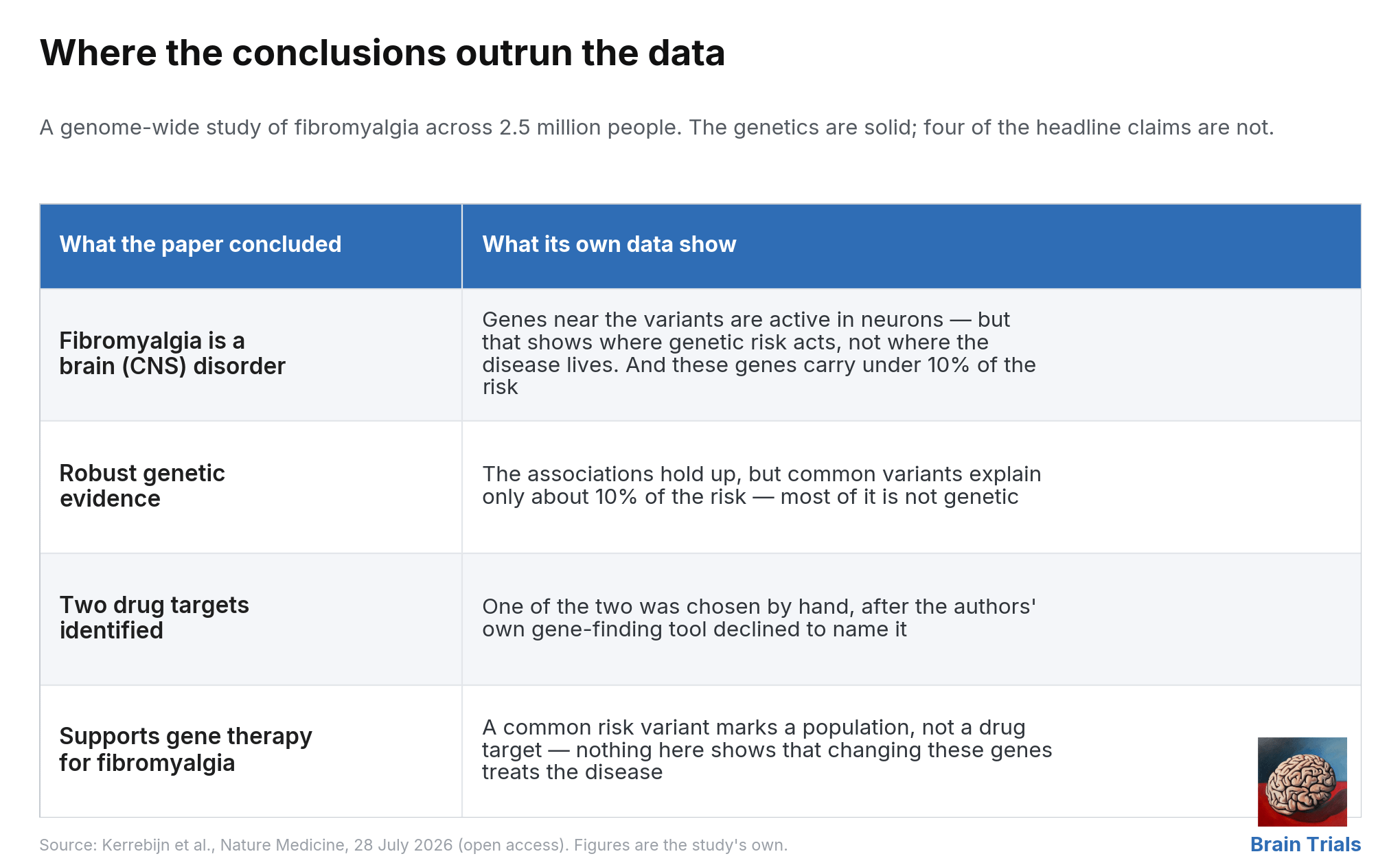
From this the authors wrongly concluded that “fibromyalgia is a central nervous system disorder”, and that they had found two drug targets.
No. And this needs saying first, because HTT is described everywhere as “the Huntington’s disease gene.”
HTT is switched on in nearly every cell and does many jobs: moving cargo along nerve fibers, cell signaling, waste clearance, brain development. Huntington’s disease is caused by one specific change, an expanded stretch of repeated DNA letters (CAG) in the first of the gene’s 67 sections.
The fibromyalgia variant is a different change in a different place. This stretch of the gene holds a short run of identical building blocks; the reference version has four copies and this variant has three. One fewer, rather than dozens more.
This variant is also everywhere, not just in some of the people with a fibromyalgia diagnosis. In gnomAD, the standard reference database of human variation, it appears in about 7% of gene copies among Europeans — roughly one healthy person in seven carries it, and 4,127 people in that database carry two copies.² Again, those are population samples, not patients with diagnoses. It’s formally classified as a benign variant in ClinVar,³ and it clears the frequency threshold that clinical genetics treats as stand-alone evidence of benign impact.⁴
Now the effect size. Fibromyalgia was diagnosed in about 2.5% of these populations, and the variant raises the odds by 9%. So carriers run at roughly 2.7% instead of 2.5%. About 97 of every 100 carriers of the HTT variant will never get fibromyalgia — tens of millions of people in Europe alone.
One caution, because it cuts both ways: “benign” means the variant doesn’t cause inherited disease. It doesn’t mean it does nothing. A variant can be benign in the clinical sense and still confer some risk, even if modest, on a common condition. What’s ruled out is the idea that carriers harbor a disease mutation.
Fibromyalgia is not a neurodegenerative disorder, and nothing here suggests it does.
Everything downstream depends on this.
A person counted as having fibromyalgia if their record contained the billing code M79.7 (”fibromyalgia”) at least once, ever. No need to meet diagnostic criteria. No need to rule out other diagnoses. No requirement that the same code appeared a second time. Everyone without the code became a control, including people never examined.
Most research on medical records requires at least two codes on separate dates, to filter out provisional labels a later visit overturned. This study required only one. And nobody looked forward: five or ten years after that first code, what were these people eventually diagnosed with? There’s no follow-up analysis in the paper.
That matters more here than for most conditions, because fibromyalgia is a diagnosis of exclusion. The code goes in when other explanations haven’t been found.
The consequence shows in the authors’ own variability. The share of people carrying the code ran from 1.2% in the Estonian Biobank to 7.5% in the Michigan cohort, recruited largely around surgery. A sixfold spread for the same illness means part of what’s measured is how local doctors use the code.
Two more patterns point the same way. The strongest genetic overlaps in the whole study were with neck-and-arm pain and muscle pain — neighboring codes for overlapping complaints. And across the 26 sites, the trait overlapping most often was educational attainment, at 10 of 26 sites, ahead of BMI at 8 — not a pain trait at all. Educational attainment is among the most socially entangled measures in human genetics.
Then there’s the finding that should have sent someone to the records: sleep apnea, at 7 of 26 sites. Sleep apnea is badly underdiagnosed and causes fatigue, unrefreshing sleep, aches, and brain fog. Two of those appear in this paper’s own opening definition of fibromyalgia. The study files sleep apnea under metabolic disease and never asks whether it might be generating some of the cases.
The missing analysis is straightforward, and these biobanks hold decades of records: require two codes, six to twelve months apart; set a minimum follow-up period; remove patients who later got a different explanation — inflammatory arthritis, thyroid disease, sleep apnea, diabetes, cancer. Rerun it and compare.
That decides the argument. If the HTT signal shrinks under a stricter definition, some of it was misdiagnosis. If it holds, my objection collapses. Either answer is worth having.
Again, I’m not claiming these patients are undiagnosed diabetics. I’m claiming the study can’t separate shared biology, co-morbidities, and misdiagnosis — and which one of these dominates changes what these 26 genetic variants mean.
Let’s assume that most of these “fibromyalgia” diagnoses are correct. Three findings still stand:
It settled a long argument about the immune system. No signal in the immune-gene region, none in immune cells, essentially no overlap with eosinophil counts. Where immune overlap appeared, it was strongest with the vaguest versions — seronegative rather than seropositive rheumatoid arthritis, non-allergic rather than allergic asthma. Classic autoimmune disease looks different.
It checked the obvious trap in its own headline result, testing whether the HTT variant tracked Huntington’s risk after accounting for the actual mutation, then repeating the check in a second population. Plenty of papers would have skipped that.
HTT isn’t a preposterous candidate for a pain-related genetic risk variant. Huntingtin appears in the sensory nerves that carry pain signals. A protein it binds, HAP1, shows up in pain-sensing neurons and the spinal cord, rises in chronic pain, and mice with less of it have less excitable pain neurons.⁵ The biology is plausible. My objection is that better explanations were not excluded.
Fibromyalgia is diagnosed several times more often in women. Here, 87.7% of patients were women. If genetics drove that gap, a study this size should have caught it. It found the opposite. The genetic architecture in men and women was essentially identical, correlating at 1.03. Same variants, same directions, similar sizes.
The authors draw the conclusion: the sex gap probably isn’t genetic, and likely reflects non-genetic biology, environment, or diagnostic bias. I think that conclusion is more useful than any gene in the paper.
The authors (wrong) reasoning is as follows: fibromyalgia is partly heritable, the genetic signal sits near genes switched on mainly in neurons, therefore it’s a disorder of the central nervous system.
The first two steps hold. The third doesn’t, for four reasons.
The analysis locates genetic risk variants that explain <10% of the risk, not the disease. It asks which tissues express genes near the risk variants.⁶ Where inherited risk acts and where pathology lives can be far apart.
The test doesn’t discriminate. Neural signal appears for a huge range of traits. Across these same 26 variants, the most frequent overlap is educational attainment — not a disease at all, and strongly neural. The authors note in passing that obesity is also associated with risk variants in genes expressed in the CNS. A finding that turns up almost everywhere can’t say much about anything in particular.
Their own results don’t say “central.” The results section describes neurons across the central and peripheral (i.e., autonomic, enteric) nervous systems. The second-strongest cell type was enteric neurons, in the wall of the gut. The strongest was a hippocampal population the authors describe in terms of putting sensory experience in context, not producing the pain. They also concede that overlapping expression between related cell types limits how precisely any signal can be pinned down. The abstract keeps the confidence and drops “peripheral.”
Add that genetics explains less than 10% of the variation here, and the claim is doing more work than the data allow. None of this makes fibromyalgia psychological: the amplified pain processing at its core is well documented on other grounds.⁷ This study just doesn’t add genetic proof that the disorder lives in the brain.
No - at least not based on this paper, and this is the part I think will hurt patients most.
The discussion names two drug targets, calls the HTT and GPR52 pair “a clear repurposing opportunity,” and says another result supports developing gene therapies for fibromyalgia specifically.
A small genetic effect could still mark a good drug target — the variants near HMGCR barely shift risk, and statins work. But that logic only holds if you know which gene the signal implicates, and here that’s the weak link. Take GPR52. The variant sits inside a different gene. The authors ran a machine-learning tool built to identify the responsible gene, and it named one at 19 of the 26 sites.⁸ At this one it declined. They then reached about 150,000 DNA letters away to GPR52by hand, reasoning that it controls huntingtin levels and is already a Huntington’s drug target. The discussion then presents HTT and GPR52 as supporting each other. That’s circular: HTT justifies reaching past the nearest gene to GPR52, and GPR52 then props up HTT.
A patient reading that scientists found molecular drug targets may conclude the real treatment is a drug that doesn’t exist yet, and that everything available now is a consolation prize for people whose illness isn’t taken seriously. That gets the evidence backwards and will make the patient suffer. The best-supported treatments in fibromyalgia are unglamorous: graded exercise, better sleep, pacing, cognitive behavioral approaches, and a few approved drugs with modest benefit. None are placeholders.
The authors’ “genetic risk score” deserves the same scrutiny. It predicted fibromyalgia with an accuracy of 0.59, where 0.5 is a coin flip, moving expected rates from about 1.0% in the lowest fifth of genetic risk to 2.4% in the highest. Useless in the clinic.
Set the abstract “central nervous system disease” phrase, and the drug paragraph aside, and something coherent remains.
A small share of fibromyalgia risk — less than 10% — tracks with specific genetic variants.
These variants have known biological functions and sit in neurons, in central and peripheral (enteric, i.e., the gut) nervous systems.
They are shared widely with irritable bowel syndrome, PTSD, dissociative disorders, insomnia, and a long list of regional pain conditions.
None point to the immune system.
The condition is only modestly heritable.
And whatever explains why so many more women receive this diagnosis, the genome doesn’t seem to be it.
This is not a single-gene illness waiting for a gene therapy fix. It looks more consistent with a shared genetic vulnerability in how the nervous system interprets and reacts to its environment — surfacing as pain, fatigue, irritable bowel symptoms, sleep problems, and/or anxiety/stress, depending on the rest of a person’s life. Many patients will recognize that immediately.
So I’d take the study’s data but leave its conclusions.
Fibromyalgia, and the suffering of the people who have it, is real. The illness doesn’t need a 9% change in odds at a Huntington’s gene variant to become legitimate. It was legitimate before this paper, and it still is.
If you live with fibromyalgia, or treat it, I’d like to know how this study landed for you: as validation, as false hope, or as neither. And for anyone in the field: would the HTT signal survive a stricter case definition with follow-up, and is there a good reason not to run that analysis?
If you find this kind of analysis useful, consider subscribing.
Critically interpreting a study for what it actually shows is the same skill as reading a clinical trial: what’s the evidence, how big is the effect, and what’s just a good story. That’s what my book is about.
A Patient’s Guide to Clinical Trials: Navigating the Promise and Pitfalls of Experimental Treatments (Bloomsbury) — available now.
This analysis represents my personal views, not those of my employer, and is based entirely on publicly available information.
Notes
Variant details. Figures are from gnomAD v4.1.1 for rs149109767, the three-base deletion at chr4:3,228,683 (GRCh38), corresponding to the in-frame glutamic acid deletion the paper describes: overall allele frequency 0.0656 across 1,610,112 alleles with 4,127 homozygotes; non-Finnish European 0.0737; admixed American 0.1207; East Asian 0.0003. That 400-fold ancestry range is the kind of pattern that can generate false associations through population structure; the authors’ European-only analysis kept HTT as the top signal, which addresses most of that concern. gnomAD also flags a discrepancy between its exome and genome estimates (0.067 versus 0.054), unsurprising for a short indel in a repetitive stretch. The same identifier indexes an insertion allele at that position which is essentially absent from the population and is not the variant in question. ClinVar variation ID 1599428, germline classification Benign, submitted by Labcorp Genetics under Sherloc criteria, last evaluated 2 February 2026, condition recorded as not provided — a single submission rather than an expert-panel consensus.
Carrier arithmetic. Carrier estimates assume standard population genetics. The figure of 97 in 100 carriers going undiagnosed combines the frequency with the reported odds ratio of 1.09 and the study’s median diagnosed prevalence of 2.5%. That’s the proportion who never receive the diagnosis, which is not the same as the proportion without symptoms — a distinction that matters given how unevenly this diagnosis is applied.
Tissue analysis. Brain tissues were compared against non-brain tissue rather than against all other tissues, which is the standard version of this method but does make brain findings more likely to surface. Cell types came from a mouse single-cell atlas, so these are mouse neuron types mapped onto human genes.
Kerrebijn I, Bjornsdottir G, Arbabi K, et al. The genetic architecture of fibromyalgia across 2.5 million individuals. Nature Medicine, published online 28 July 2026. https://doi.org/10.1038/s41591-026-04492-6.
gnomAD v4.1.1, variant rs149109767. https://gnomad.broadinstitute.org
ClinVar variation ID 1599428 (HTT p.Glu2643del). https://www.ncbi.nlm.nih.gov/clinvar/variation/1599428/
Richards S, Aziz N, Bale S, et al. Standards and guidelines for the interpretation of sequence variants. Genetics in Medicine. 2015;17(5):405–424 — the framework in which a population frequency above 5% is stand-alone evidence of benign impact.
Pan J, et al. Huntingtin-associated protein 1 inhibition contributes to neuropathic pain by suppressing Cav1.2 activity and attenuating inflammation. Pain. 2023;164:e286–e302.
Finucane HK, Reshef YA, Anttila V, et al. Heritability enrichment of specifically expressed genes identifies disease-relevant tissues and cell types. Nature Genetics. 2018;50:621–629 — the tissue and cell-type method.
Fitzcharles M-A, Cohen SP, Clauw DJ, et al. Nociplastic pain: towards an understanding of prevalent pain conditions. Lancet. 2021;397:2098–2110 — the central sensitization framework this study tests.
Schipper M, et al. Prioritizing effector genes at trait-associated loci using multimodal evidence. Nature Genetics.2025;57:323–333 — FLAMES, the tool that declined to call the GPR52 site.
Comments
Nothing yet. Say the first thing.
Sign in to join the conversation.