
The year was 1913. A young Swiss psychiatrist named Carl Jung had just broken with Freud, and by his own account, he was coming apart at the seams. He called it his “confrontation with the unconscious.” Most people call it a nervous breakdown. Either way, Jung spent the next several years alone, staring into the depths of his own mind, and came out the other side with a theory that still rattles around psychology departments today: underneath our individual minds sits a shared psychic layer, stocked with the same cast of characters, that every human being on earth is quietly plugged into.
He called it the collective unconscious. I call it one of the best arguments I know for playing golf by yourself.
I’ve spent decades with my hands, quite literally, inside people’s brains. I’ve cut through skull, moved aside the very tissue that makes you you, and closed people back up good as new, or at least trying to be. You’d think after all that, I’d tell you the mind is just wiring and voltage. Firing patterns, nothing more. Something I can’t put my finger on though convinced me there’s more going on in there than the machinery accounts for.
Jung thought so too. He argued that buried under our personal memories is a deeper, older layer we all share, populated by archetypes: the Hero, the Shadow, the Wise Old Man, the Great Mother. These aren’t metaphors he made up over tea. He believed they were etched into us the way instincts are etched into a spider that’s never seen a web but builds one anyway. Every culture, every era, keeps producing the same handful of stories, because we’re all drawing water from the same well.
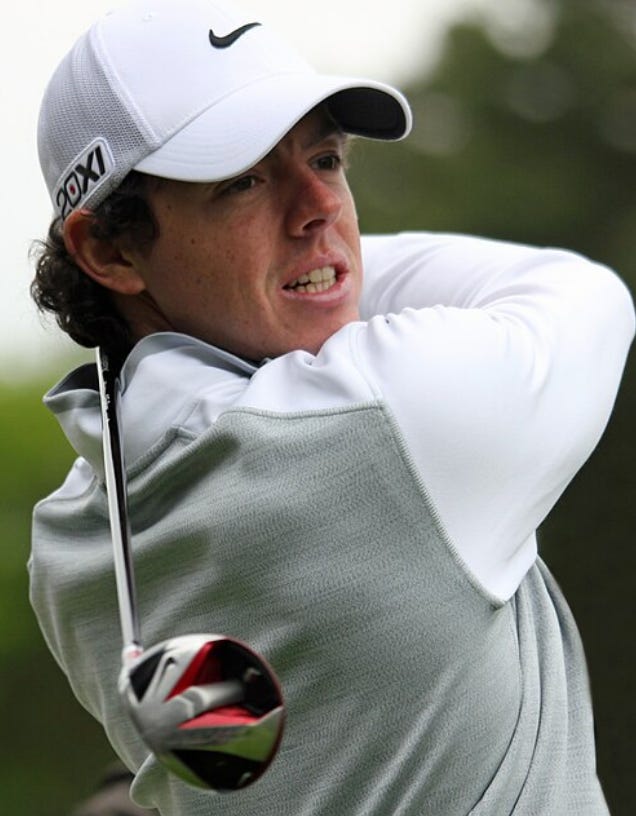
The trouble is finding a moment quiet enough to hear it. Most of us don’t. We wake up to a phone already lit up with seventeen things demanding an opinion, and by the time we get to bed we haven’t had four consecutive minutes of unsupervised thought. Tiger Woods and Rory McIlroy have spent their careers chasing trophies on golf’s biggest stages, surrounded by cameras and roaring galleries. Good for them. But I’d bet neither one has discovered what I found on an empty course at six in the morning, with nobody else on it but me.
Here’s the scene. You show up before the sun’s fully up. Nobody’s booked the tee time with you. No cart chatter, no cell phone buzzing in your pocket, no scorecard to defend to anyone but yourself. Just you, the dew still sitting on the fairway, and eighteen holes stretching out in front of you like a question nobody’s going to help you answer.
The swing itself starts doing something strange after a few holes alone. It stops being a swing and starts being closer to a metronome. Back, pause, through. Back, pause, through. There’s a hypnotic quality to the repetition that I recognize from the operating room, honestly, that same narrowing of attention where the outside world gets quieter and quieter until it’s gone.
I can tell you what’s happening under the hood, because that’s the part of this I actually get paid to know. Repetitive, focused movement quiets the prefrontal cortex, the part of your brain that won’t shut up about the email you forgot to send and the thing you said wrong in 2011. As that chatter fades, your brain shifts toward alpha and theta wave activity, the same patterns you see right before sleep, right before a flash of insight, right when creativity tends to show up uninvited. Cortisol drops. The whole system loosens its grip.
And when the analytical mind finally steps out of the room, something else wanders in.
The Hero shows up on every tee box, whether you notice him or not. You’re the one walking off the safety of flat ground toward a fairway you can’t fully see the end of, past bunkers and water and rough that’s going to try to eat your ball whole.
The Shadow, Jung’s word for the part of ourselves we’d rather not look at directly, shows up the moment your drive hooks left into the trees for no reason you can explain. Play with a foursome and you can blame the wind, blame your partner’s chatter, blame the guy who cracked a joke mid-backswing. Play alone and there’s nobody left to blame. It’s just you and the slice, looking at each other.
The course itself starts to feel like Jung’s Wise Old Man, if you let it. The old oaks lining the fairway, the way the terrain slopes exactly the way it wants to regardless of what you want, the plain fact that a ball hit fifteen degrees open is going to go right no matter how badly you need it to go straight. The ground doesn’t negotiate. It teaches patience by simply not caring whether you’ve learned it yet.
Somewhere around the back nine, a hawk usually shows up, circling the tree line on a thermal, doing in thirty seconds what took you four hours and a bag full of clubs to almost accomplish. There’s something almost insulting about it. There’s also something that yanks your head up out of the grass and reminds you that the three-putt on fourteen is not, in the grand scheme of things, a civilization-ending event.
By hole sixteen, you’ve stopped narrating your round in your head. You’re just watching the ball, this small dimpled thing that Jung would’ve probably called a mandala, a stand-in for wholeness, and for a stretch of time the line between you and the course gets blurry. You’re not separate from the wind and the grass and the swing anymore, you’re just part of the same motion. It doesn’t last. Nothing like that ever does. But it’s real while it’s happening, and you don’t forget it.
I’m finishing a book right now, The Brain Eternal, out on Kindle before long (pre-order here https://www.amazon.com/dp/B0HC56FVFJ), about exactly this: how much of what makes us human doesn’t live neatly inside the three pounds of tissue I’ve spent my career operating on. Solitary golf is the cheapest, lowest-tech experiment you can run on that idea. No lab required. Just a tee time nobody else wants, at an hour nobody else is awake for.
You come off eighteen holes alone different than you went in. Not relaxed, exactly, though that too. Something underneath the relaxation shifts slightly and stays shifted.
We are, all of us, starved for a kind of quiet we’ve mostly stopped scheduling. Next time your calendar clears up, skip the group tee time. Go by yourself. Let the swing do what it does. There are a few old archetypes out on that empty course who’ve been waiting a long time for you to show up alone.
No posts
Comments
Nothing yet. Say the first thing.
Sign in to join the conversation.