
Dear friends,
I’ve always believed stories have lives of their own. They wander for a while, and then one day they find someone who’s ready to receive them. I’m glad this one found you.
Today I’m republishing one of my favorite essays because it has become the first story episode of my new podcast, The Seeker.
For most of my life, I’ve been drawn to questions that don’t have easy answers. As a journalist, those questions carried me around the world. As a spiritual seeker, they led me to monasteries, sacred sites, and long stretches of wilderness in search of God and, if I’m honest, myself. Then I discovered memoir writing, which asks us to stop looking outward for a while and turn inward.
That’s what The Seeker is about: true stories about the search for a meaningful life.
If you enjoy what you find here, I’d love for you to click the ❤️, leave a comment, or share these stories with someone who might appreciate them. This newsletter will always be free, but if you’d like to support my writing, podcast, and the community we’re building together, I’d be honored if you became a paid subscriber. Your support helps make this work possible.
Now, here’s the story.
Warmly,
Brad
Last winter, as I drove through the mountains from Santa Fe toward Boulder, a white dove hit my windshield. This happened before dawn. The two-lane highway was empty, and the world was tinted cobalt blue. A cold fog drifted along the road’s shoulders, and frost feathered the glass. To the east, a thin line of orange light hovered over the peaks. I sipped from a paper cup of gas-station coffee, feeling calm, breathing easily, and keeping an eye out for deer. A few miles north of Poncha Springs, a yellow sign appeared in my headlights. WATCH FOR WILDLIFE. I pressed the brake. I knew this area of central Colorado well, and this sign was accurate. I turned off the radio and scanned the edges of the pavement. The road shimmered with ice. How many times had I driven through here and, just as I was upon them, spotted a doe and a couple of fawns standing on the shoulder, eyes reflecting my headlights? I was thinking about the writing classes I teach, the weekend ahead, and the quiet that awaited me at home in Boulder.
Then, without warning, a white blur crossed my headlights from the right. There was no time to react. I felt the impact, and then silence. My chest tightened. I gripped the wheel harder. You know this thud, and the realization that you’ve hit something. No, that you’ve killed something.
I kept driving, stunned, expecting something to follow. I looked for signs of death: a feather caught on the wiper or a smear of blood, or perhaps there’d be a sign that what I’d hit was something more inert, like a branch—but there was nothing.
A dove, I thought.
Nothing remained but the dark road rising and falling through the mountains. All I heard was the hum of the engine. All I felt was that sick feeling when beauty collides with violence.
For the next thirty miles, I drove in a kind of trance. I kept picturing how the dove had come out of nowhere. How alive and quick it had been. And how final this moment seemed. I kept replaying those two seconds. When I finally relaxed my hands, I felt an ache in my fingers. Part of me wanted to turn the car around and search for it. And that feels silly to admit. I have friends I love and respect who hunt and eat doves for sport. A bigger part of me already knew there was nothing to be done.
The highway kept carrying me north, but my mind stayed behind back in Poncha Springs. I felt haunted that somewhere on that dark stretch of road, something beautiful had intersected my life and then disappeared. As I drove toward the orange eastern sky, the world felt charged. And I felt more alive.
When I finally stopped for gas in Fairplay, the sun was spilling over the ridgeline. I stepped out into the cold and surveyed my cracked windshield. There it was: the dusty imprint. Across the glass was the faint, perfect outline of a dove: wings open and head lifted, as if still in flight. There wasn’t blood, only a soft, dusty white powder. The image looked ghostly, like the negative of an old photograph. At the center was a small crack in the glass where its body had struck. I stood there a long time, staring at the white dove-shaped image. I felt guilt. I was awestruck.
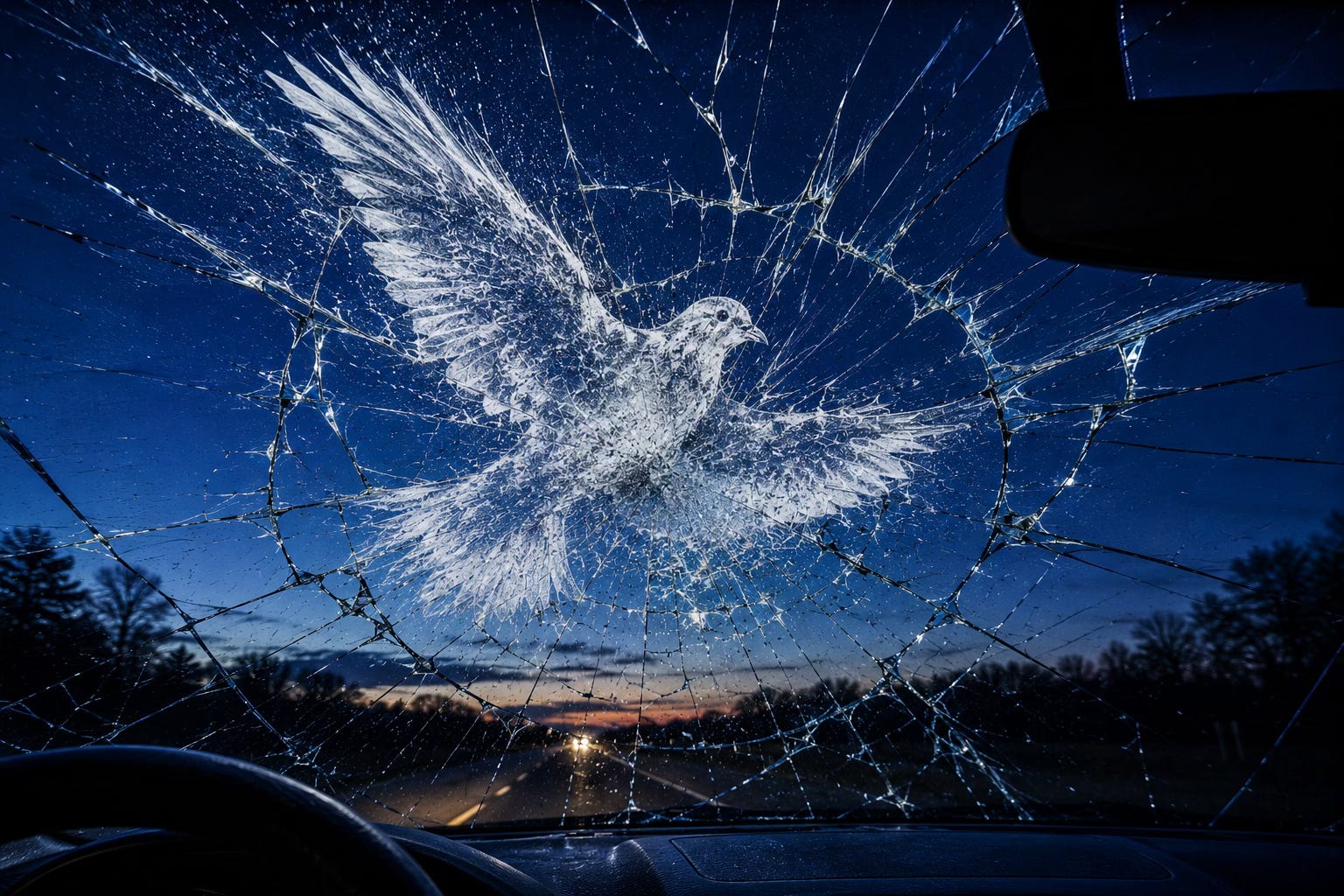
It wasn’t lost on me that doves symbolize the Holy Spirit. When John the Baptist baptized Jesus, a dove descended onto Jesus’s head. My mind spun. What would an analyst say about a dream about hitting a dove at dawn? What would a shaman or Christian mystic say? I’ve long had a thing for doves. I don’t go around talking about spirit animals, but if I had one, it would be the dove. Sometimes, on morning walks, I find myself surrounded by doves. Once, I told a girlfriend about this, and she laughed. Brad, doves are all around. When they appear, they mean something to me.
Standing over the cracked windshield, I thought about leaving the white dove-shaped film where it was, perhaps out of respect. But then I reached for the squeegee. I pressed hard, dragging the rubber across the glass. The dove outline smeared but didn’t disappear. I tried harder. I leaned into the strokes as the cold air bit my hands. Still, the wings, body, and head remained: ghostly, stubborn, and translucent. Even now, nine months later, if the light hits just right, you can still see the faint trace of its body on the glass.
I climbed back into my Kia Soul and pointed it north again. I kept thinking about how something so soft could arrive with such force. I’d been living lately with more focus and more boundaries. Good things, but maybe there was a message here: stay soft.
Why a dove? Why not a hawk or a raven or an owl? Why leave its image but no flesh or blood? Why this particular morning, on this particular drive? I suppose these experiences ask us to hold them long enough to work on us. Then maybe they can change us.
I saw the dove as one of those moments when the veil thins, and the unseen pushes its way into the visible world.
I’ve had experiences like this for as long as I can remember. As a teenager, I fell in love with the story of Jesus. Not because I imagined myself to be some kind of messiah, but because I recognized something deeply human in him. I was drawn to his longing for truth, his willingness to speak truth to power, and his refusal to live a half-hearted life. Even more than that, I felt a strange mystical kinship with him, as though I wasn’t simply reading about someone else’s story but somehow participating in it. It felt possible that Christ’s journey wasn’t only about one extraordinary life but, in some mysterious way, about all of us. Our repeated invitations to become more loving, more courageous, more fully ourselves. Even our many resurrections over a lifetime. I didn’t know how to talk about those feelings then. I only knew they felt true, and that the world seemed somehow larger and more alive than many adults around me believed.
That winter morning when I hit the dove felt like what Robert A. Johnson called a moment of the Golden World. He describes the Golden World as a brief opening when the ordinary becomes extraordinary and spirit and matter fold into one another. As I drove, I kept thinking of the bird’s image on my windshield. It reminded me of Johnson’s memoir, Balancing Heaven and Earth. In it, Johnson describes further the Golden World, those moments when the soul breaks through the surface of everyday life and shows us that the world is not random. It is alive, responsive, and speaking.
Johnson’s descriptions and insights helped me understand. He gave words to this type of experience I’d known since childhood. Reading him helped me see that the sacred isn’t somewhere else. It’s right here, hiding in plain sight, waiting for us to notice. I remember closing that book when I finished it and feeling less alone. Johnson wasn’t trying to convince me to believe in anything supernatural. He simply took the interior life seriously. He wrote about dreams, symbols, synchronicities, and meaningful coincidence with the same respect that a scientist brings to careful observation. For someone who had been trained as a journalist to verify everything with evidence, sources, and facts, that was quietly revolutionary. He was inviting me to enlarge my view of the world. Science and mystery coexist. That book changed me. It helped me trust my own way of experiencing things. I now see that the experiences and descriptions that many people would call superstition or projection are, in truth, the way our minds were built, the way they still work, despite our illusions that we have things pretty well figured out. Johnson taught me that these moments of shock and beauty are how the soul shows us it’s listening.
The more I’ve leaned into that way of living, the more the world has leaned back. I don’t mean that life has become easier. I’ve had my struggles: addiction, depression, uncertainty, heartbreak, even profound loss. But life, its texture, feels different now. I notice when a conversation seems to arrive at exactly the right moment. When a man sitting on the ground outside the cafe asks for change and then utters something in Sanskrit and bows like a temple pujari. When a book finds me when I didn’t know I was looking for it. When an animal appears just as I’m wrestling with a difficult decision.
None of these moments prove anything. That’s not really the point I’m trying to make. The point is that I now see my life as a relationship with the universe rather than as a sequence of random events. Or as the causal result of my willful actions. Whether these are movements of God, expressions of the unconscious, or simply the astonishing pattern-making capacities of the human mind matters less to me than this: when I pay attention, I feel more alive.
The day after the dove, I pulled a card from a deck that sits on my mantle. The Great Beyond Archetype Deck. I don’t often remember my dreams, so I use the cards as if they were the content of a dream. I pulled from the middle of the deck and flipped the card over. I laughed out loud.
Here’s the thing. The more I honor this kind of listening to my soul and to the soul of the world, the more people I meet who live this way too. My Substack began to grow when I stopped hiding the mystical parts of my life and started writing about how the world actually feels to me. It is strange, interactive, and full of weird, meaningful emissaries. That morning’s encounter with the dove, with the unseen, felt like I’d contacted something much older in me. I’ve spent my life chasing and being chased by moments like it. I tell this story in my memoir, Into the Soul of the World: My Journey to Healing. The book tells of my rise as a journalist and adventure writer, the years of travel and success, and the crash that followed: addiction, PTSD, depression, and the slow climb back. It’s also about learning again to live in conversation with the unseen.
For years I thought those two lives were separate. There was the skeptical journalist, gathering quotes and reporting facts, and there was the private seeker quietly paying attention to dreams, intuitions, symbols, and moments of uncanny grace. Looking back now, I don’t think they were ever separate. They were just two different approaches to the same question. What is true? In it, I write about being pulled back to India decades after my first visit, feeling uncertain of why, and yet drawn by something that felt like a teacher. That journey led me to a cave in the Himalayas, where I met a hundred-year-old yogi who had lived there for twenty-five years. I spent two afternoons with him, chanting, praying, asking questions, and listening to his answers with the help of an interpreter. The experience felt like a prophecy realized.
When I was a teenager, I read books about yogis in caves. I never forgot about those yogis. They remained lodged in my psyche as unfinished business. I never dreamed I’d sit in a cave with one. Forty years later, I did. When I finally sat across from him, I had the unmistakable feeling that I wasn’t meeting a stranger. I was arriving at a conversation that had begun decades earlier, perhaps even in that teenage boy who had sensed there was more to this world than could be measured or explained. That encounter lives inside me today. I left the Himalayan foothills more certain than ever that the world is alive. That it speaks through events and people if we learn to listen.
Later, a friend explained to me how he thinks of things like this. He told me that God shows up in emissaries. These symbols, people, and natural happenings are the ways the divine makes contact. Each one is a visitation reminding us that we’re not alone, that meaning is woven through even the most ordinary moments.
Over the years I’ve begun collecting these emissaries the way some people collect photographs. The hawks that appeared after Andrea died. Certain dreams that quietly redirect my life. Chance encounters that no longer feel entirely like chance. Individually, each one can be explained away. Together, they have become a kind of autobiography written in symbols, a parallel narrative running beneath the visible events of my life.
I think about that when life feels ordinary. When Tommy rests his head on my knee while I write. When my friend starts singing along to a favorite song as we drive the gravel roads outside Boulder, her voice rising with the dust. When a student finds the sentence that finally unlocks their story. These are emissaries too. They are reminders that the unseen keeps moving quietly through the visible world.
I’ve come to believe that a meaningful life isn’t built from extraordinary experiences alone. It’s built from learning to recognize the extraordinary hidden inside ordinary ones. The great moments are gifts. But the deeper practice is attention. It’s in moments like these that my two lives, the writer, and the teacher, feel like one. They come from the same impulse: to pay attention, to say what’s true, and to let meaning reveal itself through story.
I’ve taught and edited memoir writing for almost fifteen years. What I teach in Writing the Heart is not just craft. It’s a way of being with your story. You don’t have to be spiritual to belong here. You only have to believe that stories matter. I teach writing, but more than anything, I teach people how to listen to their own stories and to the world that keeps trying to speak through them. You don’t have to be mystical or have access to golden worlds. You only have to be yourself. You have to stop filtering your story and stop leaving parts of you out. That is where the alchemy begins.
It’s also why I wanted to begin The Seeker with the story of a dove instead of an introduction to myself. I could have started by telling you about the magazines I’ve written for, the countries I’ve traveled to, or the memoir I published. Those things are important, but they aren’t the center of my life. Paying attention is. Learning to trust the moments that interrupt us, humble us, and quietly reshape the way we see the world.
If you stay with me on this journey, we’ll certainly talk about writing, travel, psychology, relationships, spirituality, grief, healing, and the strange paths our lives take. But beneath every conversation will be the same question: How do we become the kind of people who notice when the world is trying to speak to us? I’m less interested in giving you answers than in helping you become more intimate with your own questions. Because I’ve come to believe that the questions we can’t stop living are often wiser than the answers we rush to adopt.
The imprint of that dove is still on my windshield. I’ve stopped trying to wipe it off. It reminds me that the world speaks when it wants to, that spirit and matter are never far apart, and that every story begins with a single, undeniable moment of impact. As I write these words, I find myself wondering about the invisible imprints you’re carrying. The moment you can’t explain. The conversation you never forgot. The dream that still visits you years later. The loss that quietly rearranged your life. The chance meeting that wasn’t entirely chance. My guess is that your life, too, has been speaking to you for a long time. Maybe the work isn’t becoming someone new. Maybe it’s simply learning to recognize the emissaries that have been walking beside you all along.
If you haven’t bought my memoir, Into the Soul of the World: My Journey to Healing, yet, I hope you will.
Here’s what author Hampton Sides wrote about it:
“Brad Wetzler has led the very definition of an adventurous life, but in Into the Soul of the World, he gives an unflinching account of his interior adventures. Wetzler’s soulful quest, by turns anguished and transcendent, will resonate with readers around the world who struggle to find purpose and a sense of the holy in the ambient jitter of the digital age.”

Comments
Nothing yet. Say the first thing.
Sign in to join the conversation.