
A video has been going around of a Senate Judiciary Committee hearing on March 25, 2026. The hearing is on four nominees for the federal judiciary: Sheria Akins Clarke (D.S.C.), Evan Rikhye (D.V.I.), Kathleen S. Lane (D. Mont.), and Kara Marie Westercamp (U.S. Ct. of Int’l Trade). I’m putting in their full names and future judgeships because I hope this episode follows them around for the rest of their careers.
To set the stage, you should check out Jeffrey Toobin’s article from a couple of days ago in the New York Times [gift link here]. He reports that Senator Richard Blumenthal (D-Conn.) has been asking Trump’s judicial nominees, “Who won the popular vote in 2020?” Inevitably the answer is some carefully scripted circumlocution, like “Senator, in 2020, President Biden was certified and served four years as president.” Toobin writes:
Since Mr. Blumenthal and others began asking versions of the same question, 37 and counting of President Trump’s nominees to the federal bench have recited the “certified” catechism or merely stated that Mr. Biden “served” as president, thus refusing to state or by extension acknowledge the fact of Mr. Biden’s victory in 2020.
And as he says, it’s no accident that all of the nominees recite the same script:
It’s unlikely that dozens of judicial nominees decided to use virtually the same formulations without a nudge from the top; the White House appears to be insisting that Mr. Trump’s judges stand by — or at least decline to contradict — his lies about 2020. Many of Mr. Trump’s nominees to administration jobs have given the same nonanswers.
Toobin concludes that, in contrast with Trump’s first term as president, where the Federalist Society had a central role in judge-picking, and Trump nominated fairly standard legal conservatives to the bench, in his second term, “Mr. Trump appears to be shifting from ideology to loyalty as the primary qualification for judicial service.”
In the video, Senator Sheldon Whitehouse (D-R.I.) loses his cool (or pretends to lose his cool – maybe he’s just bullshitting too – see below) over these four nominees’ attempt to placate Trump without making a false statement under oath in a Senate committee hearing:
Just to finish Senator Blumenthal’s point, I hope you realize how ridiculous the four of you look spouting these preposterous canned answers in a forum in which a you’re supposed to tell the truth and you’re supposed to demonstrate the judicial capacity to make independent factual decisions in hard cases. If you can’t even sit here and say that Joe Biden won that election or that the capital was attacked, what’s left?
What’s left if a hard case comes your way as a judge and let’s say the Trump administration is bearing down on that? Why would we ever believe that you would give the litigants a fair hearing and a fair decision if the executive branch was leaning in on you when we can’t get a reasonable answer out of any of you with the executive branch leaning in on you to give these ridiculous answers today?
Lies and Bullshit
By now I think most readers will have heard about Harry Frankfurt’s distinction between lies and bullshit. Frankfurt, who passed away in 2023, was a philosopher at Princeton who did foundational work in metaethics, including a couple of important papers on free will – “Freedom of the Will and the Concept of a Person” and “The Importance of What We Care About,” both in a collection of papers titled The Importance of What We Care About. I mention all this because, in the same collection, is a little throwaway paper Frankfurt wrote for fun, but which brought him recognition far beyond the circles of people who read papers on free will.
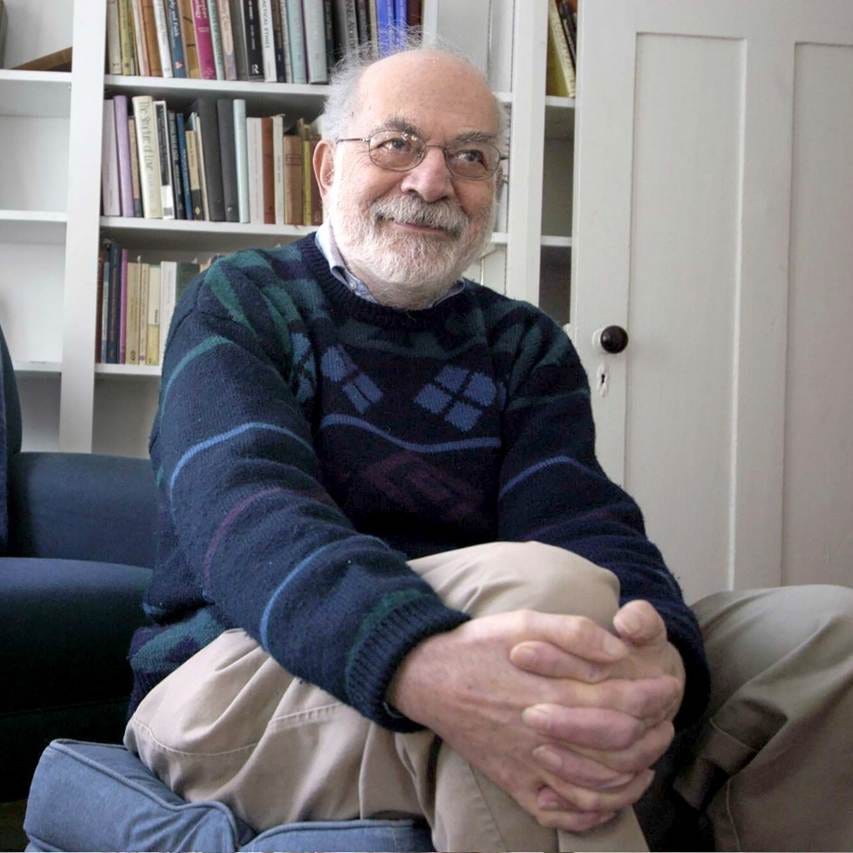
[Just about every photo of Harry Frankfurt I’ve ever seen depicts an impish grin or a little twinkle in his eye. I’m sorry I never met him.]
The paper, “On Bullshit,” which was subsequently published as a short book by Princeton University Press and became a New York Times bestseller, defines a category of statements that are truth-indifferent. A lie, by contrast, is defined as a statement made with an intention to deceive. The person making the statement must therefore have the truth in mind in order to lie. “[W]henever a person deliberately misrepresents anything, he must inevitably misrepresenting his own state of mind,” Frankfurt writes. Bullshit is different, in that it is “unconnected to a concern with the truth.” It is uttered “thoughtlessly, without conscientious attention to the relevant facts.” Frankfurtian bullshit (and yes, that is how people refer to it) purports to be a description of a state of affairs “without genuinely submitting to the constraints which the endeavor to provide an accurate representation of reality imposes.”
That last quote is the important characteristic of bullshit as applied to legal actors. The enterprise of law requires participants to submit to certain constraints. Obviously that includes no out-and-out lying or knowingly introducing false evidence. Bullshit is broader than lying, though. A bullshitter fails to attend to reality in the proper way. Frankfurt says:
is just this lack of connection to a concern with truth — this indifference to how things really are — that I regard as of the essence of bullshit.
Notice the language here: It is lack of concern with truth that characterizes bullshit. That’s fine in certain contexts, like Frankfurt’s example of a “bull session,” where “participants try out various thoughts and attitudes in order to see how it feels to hear themselves saying such things and in order to discover how others respond, without it being assumed that they are committed to what they say.” A bull session has different constraints regarding connections with reality. Bullshit is language that “does not contribute to the purpose it purports to serve.”
The critical punch of Frankfurt’s concept of bullshit is that it clearly connects the evaluation of the conduct of actors to the purpose of the endeavor they are participating in. (To be philosophical, it’s a teleological critique.) Bullshitting may be more dangerous than lying, because a liar must “submit[] to objective constraints imposed by what he takes to be the truth” in order to craft an effective lie. “[I]n in order to invent an effective lie, he must design his falsehood under the guidance of that truth.” Unlike a liar, a bullshitter has no interest in the truth-values of his statements. A liar is responding to the truth, and “is to that extent respectful of it.” The danger of bullshit – both for the bullshitter and for those subjected to bullshit – is that the habits of paying attention to the way things are may “become attenuated or lost.” Truth-tellers and liars are on opposite sides of the same game, but a bullshitter rejects the game altogether. Frankfurt therefore concludes that “bullshit is a greater enemy of the truth than lies are.”
Frankfurt’s conclusion is frequently cited, but I’m not sure that bullshit is always more dangerous than lies. In particular, defiant or baldfaced lying, without any consequences for doing so, can be a potent weapon for an authoritarian leader. Olúfẹ́mi Táíwò is a social and political philosopher at Georgetown University. He is frequently quoted on Bluesky for the maxim, “To keep functioning, society has to discourage baldfaced lying, especially by authorities.”
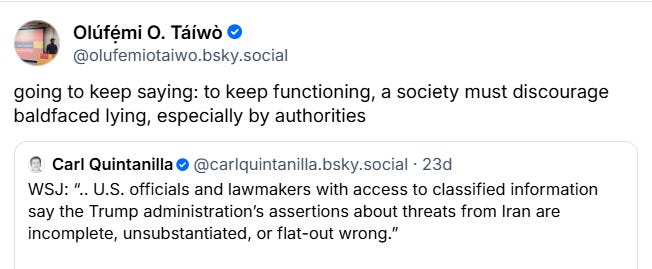
A baldfaced lie can function as a demonstration of raw power. When former DHS Secretary Kristi Noem and senior White House advisor Stephen Miller insisted that Renee Good and Alex Pretti were domestic terrorists, and subsequently when the Justice Department refused to investigate the shootings and refused to cooperate with state investigations, the effect is to deny that the government is answerable to the law for the unjustified use of force. Taiwo’s point is that the mutual commitment of members of society and the government to standards of truthfulness is a foundational condition of the rule of law.
It’s important not to make too much of the distinction between lies and bullshit. Some instances may be hard to classify as one or the other. I’m still a bit weirded out by the incident in Trump’s first term in which he predicted that a hurricane would hit the coast of Alabama, only to be rebuffed by the National Weather Service, which said no, Alabama is not at risk – to which Trump responded by holding up a map that he had obviously drawn on with a Sharpie marker purporting to show that, in fact, the Weather Service had predicted a threat to Alabama:
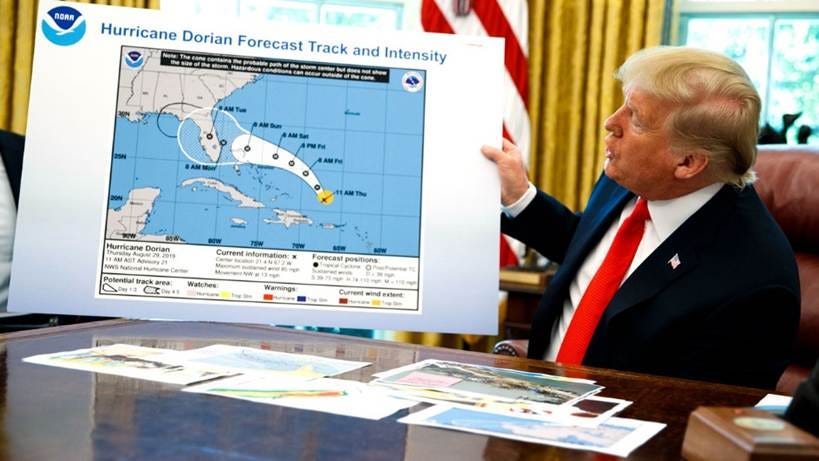
For anyone other than a world-class fabulist like Trump, it would be obvious that this was a lie. But the clumsy execution of the falsehood suggests it belongs in the bullshit bucket, as appearing to display no concern whatsoever for the truth.
I don’t think the lie/bullshit distinction matters much here, and as applied to many of Trump’s falsehoods. As Frankfurt says, near the end of his essay, both lying and bullshitting risk undermining the shared social commitment “that there is a difference between getting things wrong and getting them right, and that it is at least occasionally possible to tell the difference.”
The Politics of Bullshit
Trump’s repeated lies about the 2020 are well documented. The judicial nominees, on the other hand, weren’t lying but bullshitting. They were offering the type of lawyerly evasion that has long subjected lawyers to public ridicule. Remember when Bill Clinton testified that the truthfulness of his statement that there is “no sex of any kind in any manner, shape or form” in his relationship with Monica Lewinsky depends on what the meaning of “is” is? That’s not far off the answers given by Trump’s judicial nominees to the question, who won the 2020 election?
“Senator, under the process set out by the Constitutional, the electoral college elects the president.”
That’s infuriating in the same way that Clinton’s answer about the meaning of “is” was, but it’s not a lie. It’s classic Frankfurtian bullshit in that it manifests a lack of concern for truth. What makes lawyerly or Clintonian bullshit extra dangerous, however, is that it wears a mask of pretending to care about truth. As a really insightful recent paper (which I don’t think is on SSRN yet, so I don’t want to cite it in violation of the authors’ expectations) observes:
[B]ullshit justifications have the aesthetic trappings of their genuine counterparts—they “look and quack” like real justifications—but they perform none of the normative labor associated with reason-giving.
Lawyerly/Clintonian bullshit is particular pernicious because it comes with the aesthetic trappings of truth – the solemnity of a hearing under oath, careful attention to language, the stakes of the decision – but is in fact is unwilling to perform the normative labor normally associated with telling the truth.
The reference to Senator Whitehouse pretending to lose his cool, and my aside that he may be bullshitting too, is meant to indicate that confirmation hearings are, to a considerable extent, political theater. If they are not fully truth-functional enterprises, maybe no participant can be criticized as bullshitting, because they are not failing to submit to the constraints the enterprise imposes. I think this is too glib. The performative or theatrical aspects of a confirmation hearing may be reason to care even more about bullshit, because of its tendency to corrode shared norms of reason-giving.
Here’s an example of how the lack of commitment to the truth of a public statement doesn’t so much serve to undermine the norm of truth-telling but rather reinforces a different norm – one of quiet obedience. I’m a Cold War kid, so I often find myself thinking about Vaclav Havel’s shopkeeper:
The manager of a fruit-and-vegetable shop places in his window, among the onions and carrots, the slogan: “Workers of the world, unite!” Why does he do it? What is he trying to communicate to the world? Is he genuinely enthusiastic about the idea of unity among the workers of the world? Is his enthusiasm so great that he feels an irrepressible impulse to acquaint the public with his ideals? Has he really given more than a moment’s thought to how such a unification might occur and what it would mean?
I think it can safely be assumed that the overwhelming majority of shopkeepers never think about the slogans they put in their windows, nor do they use them to express their real opinions. That poster was delivered to our greengrocer from the enterprise headquarters along with the onions and carrots. He put them all into the window simply because it has been done that way for years, because everyone does it, and because that is the way it has to be.
Havel says “the greengrocer is indifferent to the semantic content of the slogan on exhibit.” In Frankfurt’s terms, the greengrocer is a bullshitter. The sign has no connection to the truth as he perceives it. The communication does not pertain to his attitudes about workers’ solidarity. Rather, it is a signal of grudging obedience:
The slogan is really a sign, and as such it contains a subliminal but very definite message. Verbally, it might be expressed this way: “I, the greengrocer XY, live here and I know what I must do. I behave in the manner expected of me. I can be depended upon and am beyond reproach. I am obedient and therefore I have the right to be left in peace.”
That is what I think these judicial nominees are signaling: I can be relied upon to behave in the manner expected of me . . . by Donald Trump. That is a very different signal than, I can be relied upon to behave in the manner expected of me by the citizens of the United States who trust in the impartial administration of justice. It’s Frankfurtian bullshit in that it displays a lack of concern with the truth, but it’s also Havel’s shopkeeper’s attitude of acquiescing in the exercise of power by an authoritarian government.
Of course, the votes in the Senate Judiciary Committee and in the full Senate will, predictably, be on party lines. We’ve lost any sense that the Senate confirmation process will serve as a meaningful check on the character of judicial nominees. The best we can hope for is that these future judges are ashamed of their answers to these questions and will endeavor to show that, despite the display of fealty they gave at their hearing, they can be impartial if called upon to do something that might anger Trump. Sadly, I don’t think optimism is warranted on that score.
Thanks for reading Legal Ethics Stuff! Subscriptions are always free - no paywall, no bonus content, nothing - just swear words and my off-the-cuff legal ethics analysis.
Comments
Nothing yet. Say the first thing.
Sign in to join the conversation.