
Shoot, I was planning to get some work done today, but Trump had to go ahead and allow Attorney General Pam Bondi to retire from government service and take up “a much needed and important new job in the private sector, to be announced at a date in the near future” [NYT gift link]. Man, that’s harsh. Even Kristi Noem was shifted into a made-up job with a hilarious name in the federal government, but Bondi got the “best of luck with your future endeavors” treatment. Ouch, although I’ll admit to indulging in a bit of Schadenfreude.1

But here’s the bad news: As anyone with the intelligence of, say, algae realizes, Bondi’s under-busing is not a vindication of the rule of law. Yesterday’s story in the New York Times [gift link] anticipating her firing indicates that Trump had two primary complaints about Bondi:
(1) she made a dog’s breakfast of the Epstein files scandal and created a gigantic political headache for Trump [see also WSJ gift link], including claiming Epstein’s client list was “sitting on my desk right now” and promising to release everything, but then holding a ridiculous press conference for a bunch of right-wing influencers at which she handed out binders labeled “Epstein Files: Phase 1” that contained pretty much nothing; and
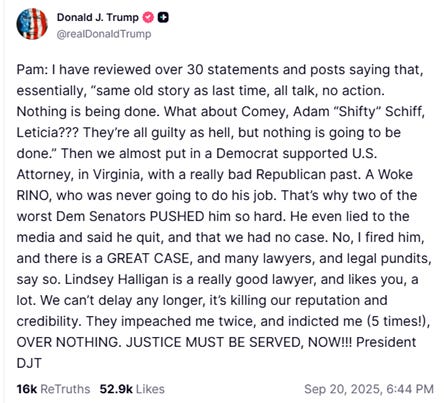
(2) far more importantly, she failed to be enough of an instrument of retribution for Trump and lock up 100% of his political enemies (what about Adam Schiff, John Brennan, Casidy Hutchinson, ActBlue [NYT gift link], John Bolton, Christopher Wray [WSJ gift link], and Jack Smith?), this despite having supervised the prosecutions of former FBI Director James Comey, NY State Attorney General Leticia James, and the six members of Congress who made a video reminding service members of the obligation to disobey unlawful orders (some of which ended in no-bills from grand juries [NYT gift link], in addition to the embarrassment of the dismissal of the Comey and James indictments for the improper appointment of Lindsey Halligan as U.S. Attorney [WSJ gift link]), and the threatened investigation of Fed chair Jerome Powell; set up a “weaponization working group” and purged DOJ attorneys and FBI agents for any suggestion of disloyalty to Trump, including work on criminal cases against Trump (Todd Blanche bragged that 200 lawyers had left the Department for working on cases involving Trump or January 6 rioters); and given attack-dog defenses of the administration on Fox News and in Congressional hearings.
Let that sink in for a minute: Pam Bondi was not sufficiently loyal for Trump. In a sense that’s not surprising, because if there’s one thing we’ve learned about Trump, it is that there are no limits to the fealty he demands, and he can turn on anyone, at any time, if he feels like they are not doing his bidding. Surely newly appointed Acting AG Todd Blanche and EPA Administrator Lee Zeldin, two frequently mentioned candidates to be Bondi’s successor, are aware of this. Given all that Bondi did to carry out Trump’s campaign of retribution, and it still wasn’t enough, what will either of these two do to avoid meeting with the same fate?
Everything I just said is obvious to everyone who’s been paying attention. So, because I try to say something new, different, contrary, or at least vaguely helpful in every Substack – otherwise, why go to the trouble of writing the thing? – I came up with some questions that should be answered by the nominee to become the next Attorney General. Some of these are a little inside-baseball, but we assume that lawyers are familiar with the rules of professional conduct and other principles of legal ethics, right? Surely someone who aspires to be the nation’s top lawyer will be able to answer the questions.
To: Senate Judiciary Members and Staff Counsel
From: A Concerned Lawyer
Re: A Few Questions You Might Want to Ask Todd Blanche or Lee Zeldin
(1) Who is the client of the Attorney General and subordinate lawyers in the Justice Department to whom fiduciary duties are owed? If it would refresh your recollection, you may refer to Model Rule 1.13(a) and Comment [9]. If you have any experience in private practice, please explain the difference between representing a corporation and the CEO.
(2) Can you imagine a case in which the interests of the president, in his personal capacity, differ from the interests of the president as head of the executive branch of government? What would you do in a case where the president asked you to do something that would benefit him personally but would not be in the interests of the United States?
(2A) The president has a constitutional obligation to ensure that the laws are faithfully executed. Please briefly explain the difference between the laws and the president’s whims, citing examples as needed.
(3) The Justice Manual limits communications between the White House and the Justice Department. Is says the following (§ 1-8.600):
The success of the Department of Justice depends upon the trust of the American people. That trust must be earned every day. And we can do so only through our adherence to the longstanding Departmental norms of independence from inappropriate influences, the principled exercise of discretion, and the treatment of like cases alike.
Over the course of more than four decades, Attorneys General have issued policies governing communications between the Justice Department and the White House. The procedural safeguards that have long guided the Department’s approach to such communications are designed to protect our criminal and civil law enforcement decisions, and our legal judgments, from partisan or other inappropriate influences, whether real or perceived, direct or indirect.
Do you agree or disagree that it is foundational to the trust of the American people that your decisions be insulated from partisan or other inappropriate influences? If so, what procedures will you implement to safeguard the independence of the Department?
(3A) Do you believe it is consistent with “the principled exercise of discretion” to consider a social media post ranting about political opponents?
(4) Please analyze the following scenario under the concurrent conflicts of interest rule, Model Rule 1.7: The president has filed a lawsuit against the IRS in his personal capacity. There are very strong – probably decisive – legal arguments for dismissal of the lawsuit. Under normal circumstances, if anyone else had filed a lawsuit with the same factual and legal claims, the Justice Department would argue vigorously for its dismissal. Does the Department have a material limitation conflict under Rule 1.7(a)(2)? If so, is it consentable under Rule 1.7(b)? Who would give consent to the conflict if it were consentable? Does that lawyer himself or herself have a conflict?
(5) Lawyers have a little motto they love to quote. Please complete it: “The fundamental ethical duty of a lawyer is to serve as a zealous advocate ____________.” Would it be a misstatement of the lawyer’s ethical duty to leave out the second part that goes “. . . within the bounds of the law”?
(5A) If a lawyer is required by law (including Model Rule 3.3(a)(1)) to correct a false statement made to a tribunal, and the lawyer takes remedial action as required by the rule, is this a failure of zealous advocacy? What about a lawyer who refuses an instruction from a supervisor to make a false statement to the court?
(6) As a matter of constitutional law, is regulation of the legal profession a matter for the federal or state governments? Actually, come to think of it, how are lawyers regulated? Is the bar self-regulating, as it sometimes claims? What does it mean when lawyers say they are officers of the court?
(7) True or false: Lawyers employed by the Justice Department are obligated to comply with the rules of professional conduct of their jurisdiction of admission? True or false: They are subject to discipline in their admitting state for violating the rules of that state or the state in which they provide legal services? If it will refresh your recollection, what does the McDade Amendment say about these issues?
(8) Speaking of the rules of professional conduct, the old saying goes that a competent prosecutor could get a grand jury to indict a ham sandwich. Should that be the standard for an ethical prosecutor, or do you agree with Model Rule 3.8(a), which says:
The prosecutor in a criminal case shall . . . refrain from prosecuting a charge that the prosecutor knows is not supported by probable cause.
Or, do you go for an even higher standard and agree with Section 9-27.220 of the Justice Manual, which says:
a prosecutor may commence or recommend federal prosecution only if he/she believes that the person will more likely than not be found guilty beyond a reasonable doubt by an unbiased trier of fact and that the conviction will be upheld on appeal.
If you went for the ham sandwich standard, do you think anything a lawyer can get away with is lawful by definition?
(9) Are there formal, written agreements with the law firms that agreed to provide hundreds of millions of dollars in so-called pro bono legal services to the administration? Do they set forth a process for deciding what representation will be in the mutual interests of the firm and the administration? Have any firms provided services pursuant to these agreements?
(10) Do you believe a law firm may be targeted for punishment by the administration for representing clients or causes the president disagrees with? Do you believe that the representation of political adversaries of the president is “harmful activity” that “threaten[s] public safety and national security”?
* * *
Look, I’ve always been pretty cynical about the Senate’s advice and consent function, but in the second Trump administration it has been even more of a party-line process than usual. Still, there were enough questions raised about Matt Gaetz’s nomination for AG that he withdrew. That shows there are limits . . . somewhere. Thom Tillis has been effective in pushing back on the investigation of Jay Powell by threatening to hold up the confirmation of any nominee to be Fed chair. And it sounds like Trump may be ready to bail on the nomination of Casey Means as Surgeon General, with her confirmation being held up over her anti-vaccine stance, among other issues.
I’m not prepared to conclude that the hearing over Trump’s nominee for Attorney General is pointless. Pam Bondi’s term in office shows the damage that a hyper-loyalist AG can do. I don’t think it’s asking too much of a purportedly independent branch of government to seek some assurances that the next AG understands the ethical obligations of a lawyer for the federal government.
Thanks for reading Legal Ethics Stuff! Most posts won’t be this quick, but the Bondi thing is big news. Please subscribe if this was useful.
Comments
Nothing yet. Say the first thing.
Sign in to join the conversation.