
[Hello Substack Readers—I’m so terribly sorry that it’s been about a month since my last confess. . . my last post. April just got away from me. I’ll do my best to get back to a weekly schedule.
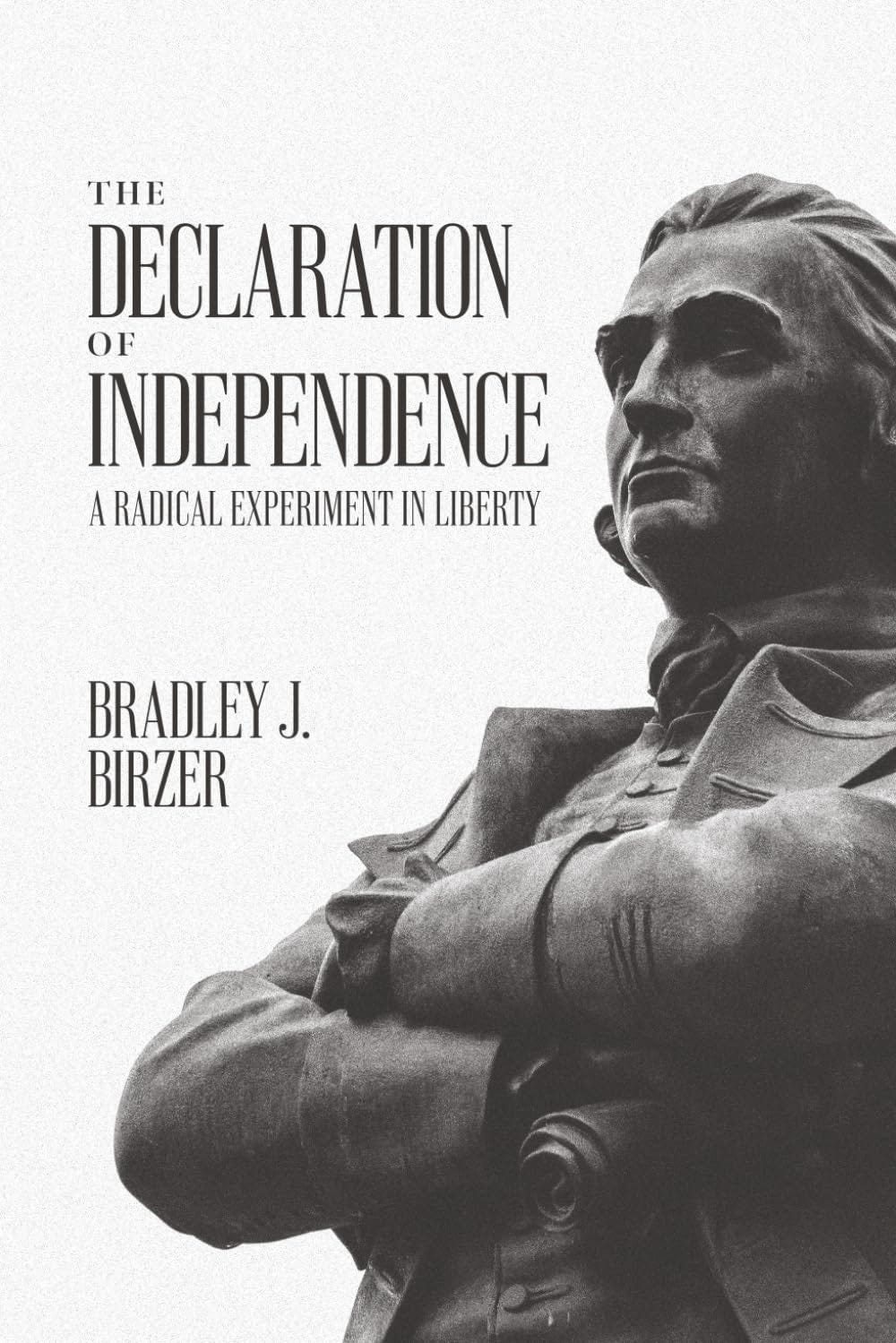
The best news is that today is the release date of The Declaration of Independence: A Radical Experiment in Liberty (Stone House Press). If you’re interested—and here’s hoping you are—you can order it now from Amazon.
To celebrate, I took an excerpt—Tacitus in the Colonies—for today’s post. Here’s hoping you enjoy it.
And, just so you know, I also have a piece on Ray Bradbury’s individualism at Modern Age and a piece condemning all ideologies at The Imaginative Conservative.
Finally, if you’ve not had enough Birzer, here are my final classes for the spring semester:
And
And
As always, a huge thanks to you each. Please know, you’re always very much in my prayers.
Yours, Brad]
+++++++++++++++
Tacitus was one of the most cited of all historians in Colonial North America. The colonists thought the world of him, preferring Locke only slightly more.[1] For example, “Josiah Quincy, Sr., was an omnivorous reader of historical literature that praised liberty, and he bequeathed to his son, ‘Algernon Sidney’s works, --John Locke’s works,--Lord Bacon’s works—Gordon’s Tacitus,--and Cato’s Letters’ as well as the hope that ‘the spirit of liberty [might] rest upon him.”[2] Historian Charles Mullett, argued persuasively, that the employment of the name and ideas of Tacitus opened many doors in terms of public debate. “Withal there was some posturing, some snobbery: to cite Tacitus was to give the password.”[3] D.L. Jacobson wrote: “Measuring the full impact of Gordon’s Tacitus would, of course, be impossible. But the popularity of that work was great enough and the reputation of Gordon himself high enough so that it ought to be remembered by any-one attempting to analyze the intellectual climate of late colonial America.”[4]
Though many colonials could not read Tacitus in the original Latin, they devoured Thomas Gordon’s translation. It’s fair to state that Thomas Gordon—the co-author of the Cato Letters and the Independent Whig—was as beloved by the colonials as was Tacitus. Gordon, a devout Whig, inserted his whiggish ideas and ideals into everything he wrote. Accompanying his translations of Tacitus was his “Discourses,” extensive Whiggish editorial comments on any thing and everything.[5] Through Gordon, Tacitus gained relevance as a Roman Whig, equally conversant in the first century AD as well as in the eighteenth century AD.[6]
Of the colonials, though, no one admired Tacitus and Thomas Gordon as much Thomas Jefferson did. Most famously, historian and biographer Gilbert Chinard proclaimed: “No greater mistake could be made than to look for his sources in Locke, Montesquieu, or Rousseau. The Jeffersonian democracy was born under the sign of Hengist and Horsa, not of the Goddess Reason.”[7] Hengist and Horsa were the Anglo-Saxons who led the invasion of England in the fifth century.
Jefferson first encountered Tacitus through the two-volume History of England by Rapin.[8] “About his favorite ancient historian, Tacitus, he wrote in 1808: ‘Tacitus I consider as the first writer in the world without a single exception. His book is a compound of history and morality of which we have no other example.’”[9] Further, as Carl Richard has argued, “Since for Jefferson the purpose of history was the prevention of tyranny, the best historian was Tacitus, the Roman moralist of the first century A.D. who scorned the emperors and glorified both republican Rome (Annals of Rome) and what he perceived to be a primitive republicanism among the Germanic tribes of his day (Germania).”[10] Additionally, it was Thomas Gordon’s translation and editorial comments about Tacitus that Jefferson so adamantly loved. “For Gordon, Jefferson’s praise was almost equally enthusiastic: the Works preserved the “spirit” of the original and Gordon’s “selection of Tacitus . . . for translation seems to have been dictated by the similar causticity of his own genius.”[11] Trevor Colbourn expressed Jefferson’s admiration best: “Jefferson certainly gave Tacitus his undying affection and attention, and as a lawyer carefully pursued Blackstone’s injunction to study feudal law with diligence.2° Both subjects of study led him more surely to the whig historical viewpoint. Tacitus became one of the books that Jefferson most widely recommended: any inquiring law student would receive Jefferson’s suggestion to look to Tacitus as “the first writer in the world without exception,” since his work was “compounded of history and morality of which we have no other exception.”21
Jefferson also took the extraordinary step of having two sets of his favorite translation collated with the Latin text—the second being a replacement for that sold to Congress in 1815.22 The translation was indeed special, being prepared by the ardent whig pamphleteer, Thomas Gordon, who adorned his text with highly moralistic “Discourses” denouncing tyranny. Gordon was probably as fascinated with the message proclaimed by Tacitus as was Jefferson, for it was a clear description of a Germanic democracy in the northern woods of Europe, of a race which elected their monarchs and which lived “in a state of chastity well secured, corrupted by no seducing shews and public diversions, by no irritations from banqueting.” The fundamental of this idealized Ger-manic existence was an allodial land tenure, holding land in fee simple without the military and Labor obligations associated with feudalism.[12]
Jefferson would go on to study, intimately, the Anglo-Saxon language and promote it at the fledgling University of Virginia, his own creation. As Jefferson wrote in an 1818 report to the college founders
It is too of common descent with the language of our Own Country, a branch of the same original Gothic stock, and furnishes Valuable illustrations for us. but in this point of View the Anglo-Saxon is of peculiar Value. We have placed it among the modern languages because it is in fact that which we speak, in the earliest form in which we have knowledge of it. it has been undergoing, with time, those gradual changes which all languages, antient and modern, have experienced: and, even now, needs only to be printed in the modern character and orthography, to be intelligible, in a considerable degree to an English reader. [13]
To study the Anglo-Saxon language, the third president thought, was to immerse oneself in the history of liberty itself. In 1825, to facilitate the learning of Anglo Saxon as a language, Jefferson wrote out an extensive essay on the language and its use.[14]
[1] Bailyn, Ideological Origins, 36
[2] Colbourn, Lamp of Experience, 95.
[3] Charles F. Mullett, “Ancient Historians and ‘Enlightened’ Reviewers,” Review of Politics 21 (July 1959): 551, 558.
[4] D.L. Jacobson, “Thomas Gordon’s Works of Tacitus in Pre-Revolutionary America,” Bulletin of the New York Public Library 69 (1965): 63.
[5] D.L. Jacobson, “Thomas Gordon’s Works of Tacitus in Pre-Revolutionary America,” Bulletin of the New York Public Library 69 (1965): 59-63.
[6] Bailyn, Ideological Origins, 42. See also Herbert W. Benario, “Gordon’s Tacitus,” The Classical Journal 72 (December 1976-January 1977): 113-114.
[7] Gilbert Chinard, Thomas Jefferson: The Apostle of Americanism (Boston: Little Brown, 1929), 87
[8] Trevor Colbourn, “Thomas Jefferson’s Use of the Past,” William and Mary Quarterly 15 (January 1958): 60.
[9] Meyer, “Thomas Jefferson and the Classical World,” 52. The original letter is dated December 8, 1808.
[10] Carl J. Richard, “A Dialogue with the Ancients: Thomas Jefferson and Classical Philosophy and History,” Journal of the Early Republic 9 (Winter 1989): 442-443. See also Carl J. Richard, The Founders and the Classics, 81-82.
[11] D.L. Jacobson, “Thomas Gordon’s Works of Tacitus in Pre-Revolutionary America,” Bulletin of the New York Public Library 69 (1965): 64.
[12] Trevor Colbourn, “Thomas Jefferson’s Use of the Past,” William and Mary Quarterly 15 (January 1958): 61-62.
[14] Thomas Jefferson, “An Essay or Introductory Lecture . . . Dialects of the English Language,” 1825.
Comments
Nothing yet. Say the first thing.
Sign in to join the conversation.