
The bond vigilantes have not pushed the button. They have, however, put a hand on it. Lines have bent upward in Paris, Berlin, London, and Tokyo all at once. That simultaneity is the clue—and it points not at country-level inflation but at the price of trusting governments with your money for three decades. In 1993 James Carville joked that he wanted to come back as the bond market, because then he could intimidate everybody. For decades now things have been on the other side of the hill: people have been desperate to, in real terms, pay governments to keep their money safe. That time is over. At least for now:
The global bond selloff since mid-2020 has been really quite remarkable!
The yield on the 30-year U.S. Treasury bond closed Monday at 5.31%, and touched 5.33% on Tuesday—its highest since the summer of 2007, back before anyone had learned to say “global financial crisis.”
Now run your eye leftward along the line to the trough. You find it in the plague-spring of 2020, at roughly 1%.
That is the whole story in a single picture: the price of long-term money has climbed more than four percentage points—not in a crash, not in a single tantrum, but in a slow, grinding, five-year march that has almost never paused to catch its breath. And widen the lens from the United States to the world, and the line bends the same way everywhere.
French thirty-year yields sit at their highest since 2008.
German since 2011.
British gilts are pushing toward 6%.
Japanese long bonds are a whisker from their all-time yield record.
Share DeLong's Grasping Reality Weblog
Whatever is happening here is happening to the entire globe’s stock of safe, long-duration debt simultaneously. Yes, the U.S. is a big player and a Stackelberg leader here. But that simultaneity is, even so, striking.
Back up: In 1993, watching how fear of rising Treasury yields had laid waste to the spending ambitions of the social-democratic wing of the Clinton Administration he had just done so much to elect, James Carville said:
I used to think that if there was reincarnation… now I would like to come back as the bond market. You can intimidate everybody.”
The line has long outlived its occasion. It names something true. And it names something permanent. Debt markets are the hardest constituency for a government or a political movement to spin, whip, or remove. They turn against you, and you learn the boundaries of your power in a hurry. Since mid-2020, they have been, very slowly, turning.
Ed Yardeni, the man who minted the phrase “bond vigilantes” back in the 1980s Reagan-deficit years thinks the posse is saddling up again. He is writing things like:
We aren’t pushing the panic button. However, we are closely monitoring whether the bond vigilantes might do so….
Get 75% off a group subscription
There is a difference between a market that is annoyed and a market that has decided a government’s fiscal trajectory is no longer credible. Yardeni has watched this movie several times. He is now telling us he is no longer sure which one we will be in come a year from now.
But what is the difference between a normal bond market and “bond vigilantes” becoming active? Interest rates are much higher than they have been for a half-generation, yes. Kenneth Rogoff, however, thinks that it the past half-generation should not in any sense be our baseline. The interest rates of the 2010s and the plague years, he insists, were ultra-low and:
a sharp deviation from historical norm and although they could come back, don’t hold your breath…
If, looking forward, the supercheap-money decade was the anomaly and not to be repeated, then we are simply living through a return to pre-2007 or even pre-2001 normality. The secular-stagnation world in which the safe real rate sat well below the growth rate was a very real thing. While it lasted. But now the growth rate of the U.S. and world economy and the interest rates on government debt are roughly equal. That means that primary fiscal balance becomes an important goal for governments, which has not been the case since 2001.
So what kind of animal is this selloff?
Bond-market panic?
Bond-market discipline based on rational judgments of an unstable and south-trending situation?
Or simply the end of a period that had seen a highly anomalous global safe-asset shortage, and thus bond market derangement on the rich-pricing side?
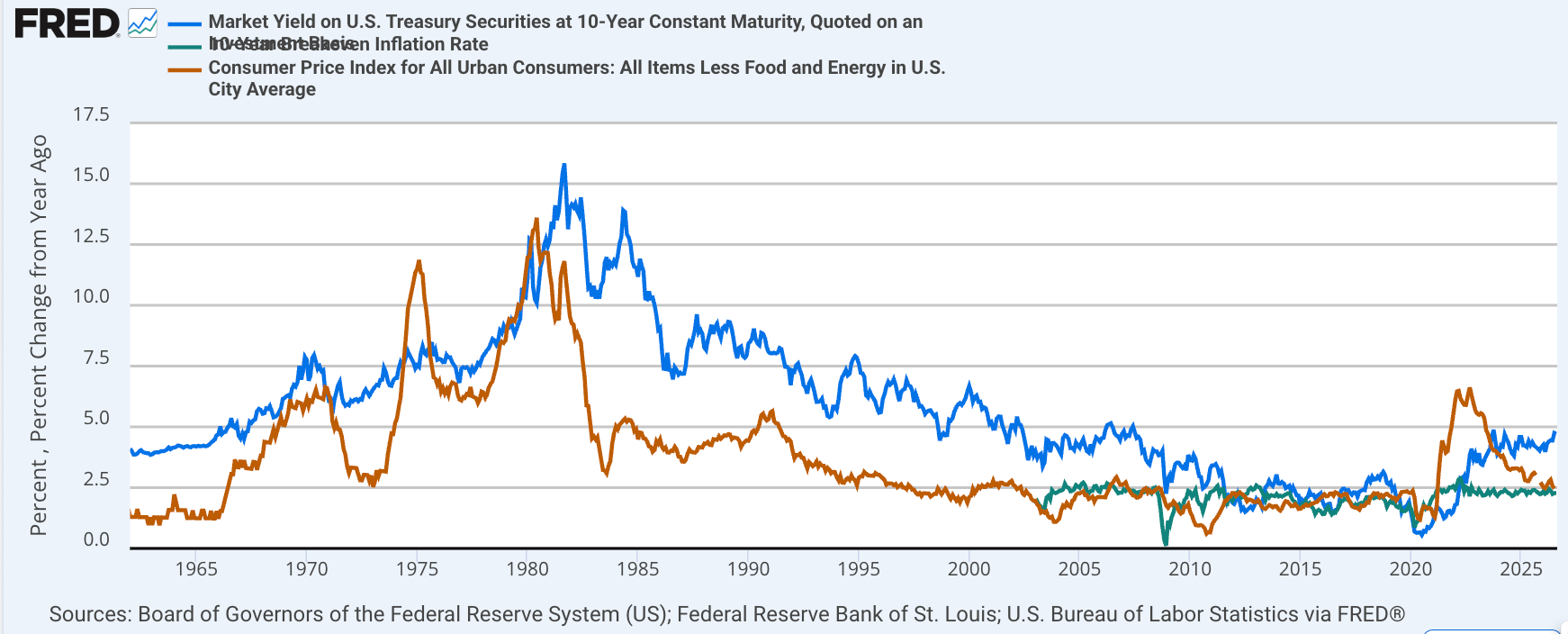
The cleanest take I have seen comes from Oxford Economics: “An increased term premium has been the main cause of the jump in US yields,” they conclude. The term premium is simply the extra yield investors demand for the risk of holding a long bond rather than rolling short ones: the price of committing your money for thirty years in a world you cannot forecast. What is crucial in the Oxford view is what is not driving the move: “not primarily an inflation-expectations story.” Inflation breakevens have stayed broadly anchored. The principal drivers of the move have not been higher expected real short rates either. The principal drivers, in their estimation, have been less trust in the dollar and a term premium reconnecting with macroeconomic volatility.
That is: What has risen is the compensation for bond-price uncertainty required for holding an asset that one does not necessarily intend to hold to maturity. In their view, it is not that expected inflation has risen. It is, rather, that not enough people are wishing the government to keep their money safe for the long term. But there is more.
There is not just demand. There is also supply. Part of this is the enormous expansion in bond supply, the result of the fifteen years of high fiscal deficits we have seen since the GFC of 2007-2009. Plus, as Goldman Sachs’s Mike Mitchell points out, the AI datacenter buildout is now a first-order force in the flow of supply into the bond market:
upwards of $250 billion this year, perhaps as much as $400 billion next year… pointing in the same direction as the heavy Treasury supply, in the same direction as the longer-term fiscal issues.” That is the whole problem in one sentence. Washington and Silicon Valley are now reaching into the same pool of savings at the same time, and the private investors who must absorb both are the ones setting the price. The term premium is what they charge for the crowding…
On top of bond supply comes policy uncertainty. Mark Cabana of Bank of America lays the blame for a chunk of the recent move at the door of Trump, the policy uncertainty he introduced, and its amplification by his appointment of Kevin Warsh to the Fed Chairship:
There is literally a price to be paid for the lack of guidance… And the price is higher interest rates and a higher cost to the taxpayer…
I want to underscore This. It is not a complaint about the level of rates. It is a complaint about a Fed Chair who manufactures uncertainty and risk because he wants to avoid alienating any of the parties—the market, and Trump—whom he has told different stories to. Thus we have a central bank that refuses to tell the market how it will react to incoming data. That forces the market to price the whole distribution of possible reactions—and that widened distribution shows up directly as term premium, and term premium shows up directly as a bigger interest bill for the Treasury. We are paying, in higher yields, for Kevin Warsh’s deliberate privilege of keeping us as much in the dark as he can with respect to what our own Fed will do.
Which brings us to the question that all of the above has been quietly building toward. Are we “nearing the tipping point of fiscal dominance—where bond markets, not policymakers, start setting the agenda?” This is the real stake.
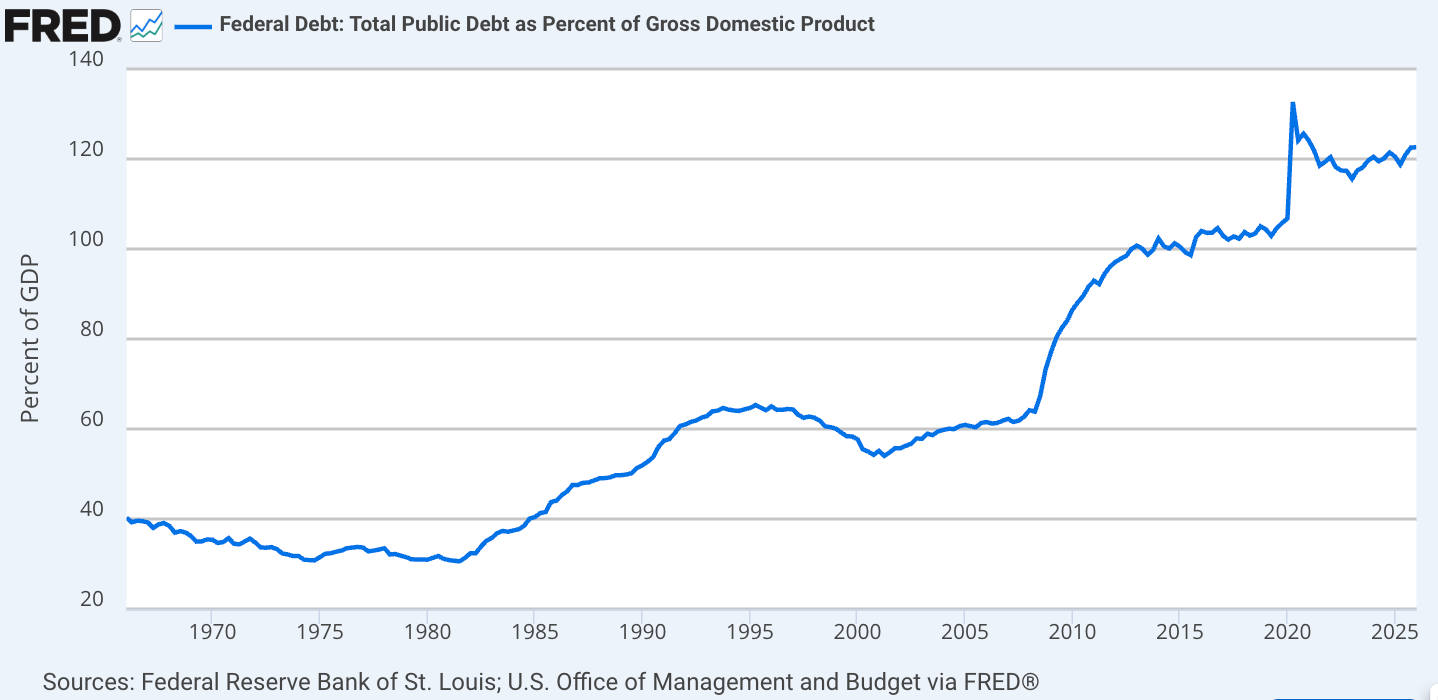
I, somewhat infamously, was confident in the winter of 1992-1993 that we were approaching the tipping point of fiscal dominance with a U.S. debt-to-annual-GDP ratio of 62%.
I was very wrong.
But at some point either the fiscal becomes dominant and the situation requires a serious policy turn and is vulnerable to a sudden stop; or enough market participants fear that the fiscal is becoming dominant that the situation requires either a serious policy turn outside rescue by someone bigger and sounder. But for the U.S. aren’t those the same thing? Who would be the someone bigger and sounder to be the lender of last resort performing an outside rescue?
Thus the Carville joke stops being funny.
Fiscal dominance is the regime in which the arithmetic of debt service, rather than the target for inflation, dictates what the central bank is allowed to do—the moment when r exceeds g by enough and stays there, interest costs compound, and every choice narrows until the government is managing its creditors’ confidence rather than its economy.
We are not there.
But the whole point of the past five years of rising long yields is that, for the first time since the early 1980s, the road to that place is visible from where we are standing. The vigilantes have not pushed the panic button. They have, however, put their hand on it—and they are watching to see whether we give them a reason.
Carson, Ruth, & Masaki Kondo. 2026. “Yardeni Warns Bond Vigilantes Stirring as US Yields Near 5%”. Bloomberg via Yahoo Finance. Aug 17. <http://nz.finance.yahoo.com/news/yardeni-warns-bond-vigilantes-stirring-015544334.html>.
Dunne, Alan. 2025. “All Roads Lead to Higher Yields”. Beyond the Cycle. May 29/<https://beyondthecycle.substack.com/p/all-roads-lead-to-higher-yields>.
Farrar, Olivia. 2026. “‘Don’t Hold Your Breath’ for the Return of Low Interest Rates”. Harvard Magazine. Apr 30. <https://www.harvardmagazine.com/five-questions/harvard-kenneth-rogoff-interest-rates-inflation-national-debt>.
Phillips, Matt. 2026. “What rising Treasury yields are telling us.” Axios. Aug 17. <https://www.axios.com/2026/08/17/treasury-yields-warsh-bonds>.
Washington, Mike, & Mike Mitchell. 2026. “How Inflation & Fiscal Policy Are Driving US Treasury Markets.” Goldman Sachs Insights. Aug 14. <https://www.goldmansachs.com/insights/the-markets/how-inflation-and-fiscal-policy-are-driving-us-treasury-markets>.
Comments
Nothing yet. Say the first thing.
Sign in to join the conversation.