
Peter Conti-Brown put this behind his paywall, which I think is the wrong judgment for him to make here, given how important it is. So I am going to pull some key paragraphs out. And I hope he will reconsider, and put the whole thing out from behind his paywall.
Of all the Governors, or the people who are likely to be confirmed by the Senate as overnors of the Federal Reserve, Lisa Cook is a (slight) outlier. She is the one who is most likely to think that the appropriate interest rate path for the economy involves lower interest rates. Her views of the long- and short-run costs of high unemployment and of the resilience of the American market system and the anchoring of inflation expectations are reasonable and reasoned, and not at all unusual for an economist. But they are are a step or two away from the core mass of the opinion cloud of central bankers, in a way that other governors’ views are not. This is the case even though she is the only Governor to have lived through a hyperinflation, and hence feels the costs of losing control of expectations (and the costs of fiscal dominance!) in her bones.
So why does Trump want to fire her, given that his successfully doing so weakens the strength of voices arguing for a slightly lower path for interest rates than the Federal Reserve typically adopts. We know why: (a) She is Black. (b) She is independent minded.
Are there any reasons for his actions that, even though they are entirely pretextual, would make her early resignation or removal from her seat as a Governor in any way appropriate? As far as I can see—no:

<https://petercontibrown.substack.com/p/trump-continues-his-war-against-fed> <https://petercontibrown.substack.com>
After a brief reprieve, Trump is back with his pretextual war against Lisa Cook, which is in fact a war against the Federal Reserve
Aug 07, 2026
Donald Trump today signaled that he would accept the Supreme Court’s invitation to try, again, to become the first President in US history to fire a sitting Fed chair.
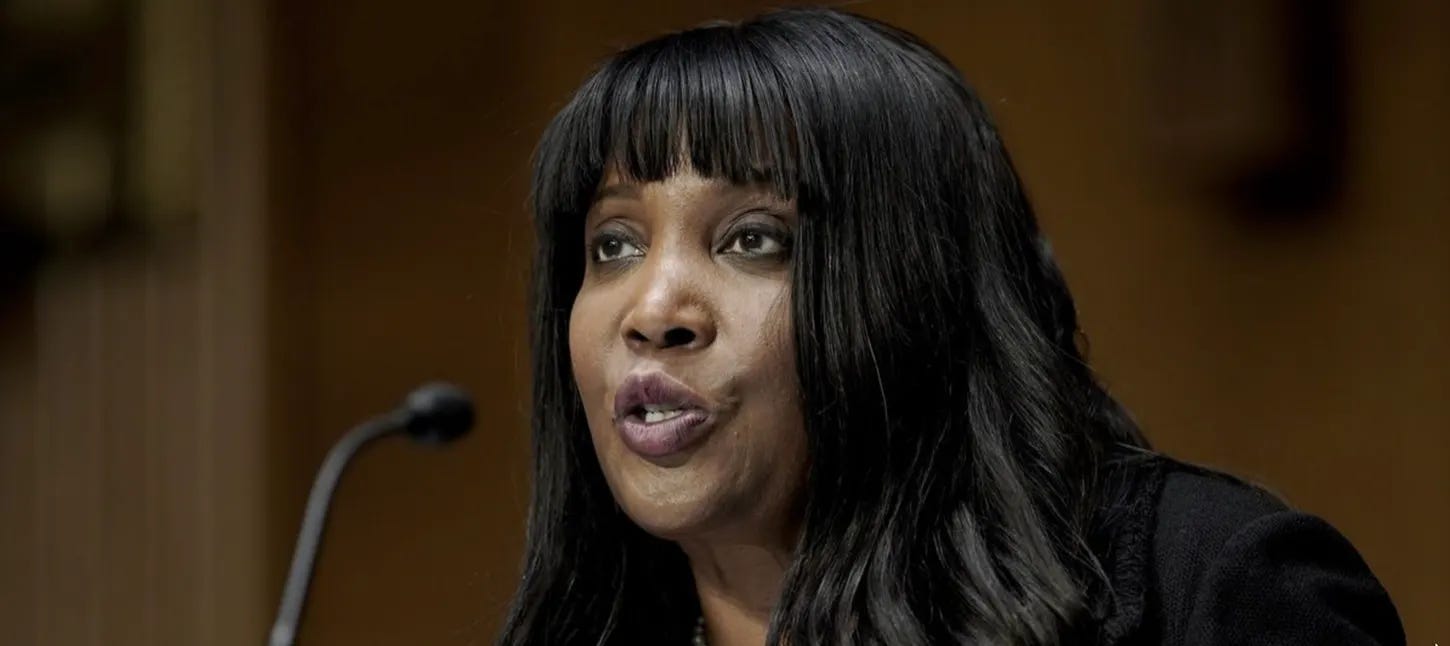
This effort, like his previous effort, will likely fail, but it’s a close call. The Fed — and with it, its hard-fought victory over inflation and economic stability more generally - are once again in peril….
The Law of Fed Independence After Trump v. Cook: Last June, the Supreme Court handed Lisa Cook a narrow legal victory… [but] “the ultimate question of whether the President can remove Cook for cause will depend in part on the underlying facts,” it said, inviting a more developed procedure for such removal than the Trump Administration followed in its first effort last summer. The Trump Administration has now accepted that invitation… giving her 21 days to respond to the allegations — since, in my view, debunked — that she committed mortgage fraud…. The problem with the Administration’s position is… [that while] the Court did make a lot out of that lack of process… that’s not the only part…. The Court wrote… “the appearance of independence is key.”… The President’s approach here is that it is fully pretextual…. Courts are likely to see through this ruse….
What the Senate should do: It’s time for Thom Tillis to make another statement. No Republican Senator who wants to be taken seriously as an inflation fighter should sit idly by…. Senators should state… that no candidate for the Fed’s Board of Governors will receive… even a hearing….
What Democrats should do: Make Fed independence a political issue. The Fed isn’t exactly the world’s most popular entity, to be sure, but voters have very strong views on inflation….
What Kevin Warsh should do…. Reporting suggesting a direct line between Warsh and Trump means that Warsh knew about, or was even party to, this effort. I sincerely hope not (and have no reason to think that it does)….
Where does Lisa Cook go from here?: Cook’s legal defense has, to date, been extraordinarily expensive, covered by gifts of labor and money…. It’s about to get a lot more expensive. I also fear the appointment of Todd Blanche as Attorney General…. I fear that Blanche will skip the niceties… and simply try to indict Cook. It’s not an indictment that will stick. I don’t even know if he could get a grand jury to cooperate. But it has never been more costly, financially or personally, to be Lisa Cook. This is a fact that we shouldn’t forget as she, once again and mostly alone, seeks to protect Fed independence for the rest of us.
<https://petercontibrown.substack.com/p/trump-continues-his-war-against-fed> <https://petercontibrown.substack.com>
Brad DeLong here: What to note:
There has long been a campaign against Lisa Cook, starting with what I regard as highly dishonest attacks against her scholarship by Harold Uhlig and company, and in Harold’s case I am highly confident he did not actually read the paper <https://braddelong.substack.com/p/have-harald-uhlig-and-company-read>. We did read the paper. And then we grilled her in person for two hours and more, largely about data construction. And we came away satisfied.
The disqualification playbook has now been run against Cook three times — her scholarship (2022) and her office (2025, 2025) — but always pretextual.
Getting Lisa Cook off the Federal Reserve Board would reduce the voices enunciating strong reasons for a relatively low interest-rate path, and so push its state of mind not toward but away from Trump’s preferences.
John Roberts’s decision letting Cook keep her job for now reached the right result through dishonest reasoning: a lot of lies, using a “quasi-private” historical story that is factually backwards.
The repeal of Humphrey’s Executor is the most destructive blow to the American governmenal order in history, creating an aggrandizement of the executive via creative delegations that were explicitly not to the president in his normal executive capacity.
Cook now faces a fresh 21-day removal process over debunked mortgage-fraud allegations, ruinous legal bills, and the risk that AG Todd Blanche tries to indict her outright.
Peter Conti-Brown closes his piece stating that it has “never been more costly, financially or personally, to be Lisa Cook”. Financially, yes, but personally? Actually, I think not:
It is true that when she wakes up in the morning she now has to deal with an awful lot of people dissing her in small and large ways.
It is also true that she needs security. There are a lot of sickos out there, and Trump is not averse to making people aware that he can point those sickos at you and put you at some physical risk.
But the dissing, the scorning, the lying, the discrimination, the physical risk— These are in this day only an extremely slight shadow of the lives that her African American ancestors lived from the moment the slavers reached their villages in Africa and ever since.
And there is one more point: In Buddhist legend, the Bodhisattva Avalokiteśvara turns aside from Nirvana and Enlightenment. Why? Because there are souls yet unredeemed. The are still trapped in the cycle of samsara and subject to suffering in this life and in Diyu, the hell of the ded ruled by Lord Yama. So she incarnates herself as the Princess Miaoshan. She lives and dies. She then descends into Diyu, so enduring the torments of the damned, when she could be in Nirvana among the Enlightened. In Diyu, she begins the work of relieving the suffering of the damned and bringing them to Enlightenment. And at that moment, as she steps into one of the flame pits of hell “there arose a beautiful large lotus-flower, up and up, from the bottom of the depth of the fiery pit, to receive her feet”. For her, Nirvana was not chanting sutras with the other Enlightened amidst the pools with the lotus flowers. For her, Nirvana was doing her job of harrowing hell.’
Overstated as an analogy for Lisa Cook’s position? Yes. It is difficult, personally, to be Lisa Cook right now. But is it costly in any true sense? I think not. I think doing the job, when the job is very much worth doing and very important, is not personally costly, but rather personally extremely remunerative. Truly, she has an opportunity to excel. And she is doing so.
What to note, at much greater length: below the paywall because I do not have time to turn sixteen long points into a coherent essay, am embarrassed t give world access to what are largely stream-of-consciousness notes, and yet I am still holding the line at not asking LLMs to summarize my own notes for me, and print it:
First, for ninety years, from 1935 until the annus horribilis of 2025, the settled law of the land was the unanimous holding of Humphrey’s Executor v. United States, 295 U.S. 602. A unanimous Court—not a bare and bitter 5–4, not a shadow-docket sneak-attack, but nine justices speaking with one voice—held that when Congress creates quasi-legislative or quasi-judicial agencies it can require them to act independently of direct executive control, and to preserve that requirement it can fix their terms in office, and “forbid their removal except for cause in the meantime.” The Court went on:
The fundamental necessity of maintaining each of the three general departments of government entirely free from the control or coercive influence, direct or indirect, of either of the others has often been stressed, and is hardly open to serious question. So much is implied in the very fact of the separation of the powers of these departments by the Constitution, and in the rule which recognizes their essential coequality…
Hardly open to serious question. That is what they said. That was 1935.
Second, that was the tradition for ninety years. It remained “hardly open to serious question” through fourteen subsequent presidencies—Democratic and Republican, imperial and hapless, Roosevelt and Eisenhower and Nixon and Reagan and both Bushes and Obama—none of whom found the arrangement so intolerable that they went to war with the structure of the government they had sworn to faithfully execute. It took Donald Trump, and a corrupt neofascist Supreme Court majority that discovered a burning constitutional imperative precisely when a Republican occupied the White House and could not locate the same imperative during the four years of Joseph Biden, to decide that a settled understanding older than almost everyone now living was in fact an intolerable affront to Article II.
That is the tell. That is always the tell. A principle that binds only your enemies and never your friends is not a principle. It is a weapon wearing a principle’s clothing.
Thus, third, the repeal of Humphrey’s Executor is the most destructive wrecking ball taken to American governance, I think, ever. Congress has delegated massive powers to administrative agencies with the understanding that these are not subject to the whim of the executive. A Supreme Court majority that overthrows that creates an executive-branch heavy legal order that no congress or series of congresses would ever have passed into law.
Fourth, we arrive at the Federal Reserve Board carve-out. It is ludicrous, and it is pathetic. The sloppiness of John Roberts’s and his clerks’ reasoning is not incidental. When you are reaching a result for reasons you cannot say out loud, the reasons you do say out loud come out mangled.
Here is John Roberts’s story:
the Federal Reserve is “a uniquely structured, quasi-private entity that follows in the distinct historical tradition of the First and Second Banks of the United States.”
Therefore it is different.
Because of that difference, the members of the Federal Reserve Board, unlike the members of the National Labor Relations Board or the Merit Systems Protection Board or the Federal Trade Commission or the Consumer Product Safety Commission, get to keep their jobs after the President says they have been fired, at least for a while.
Everyone else’s tenure is fed into the wood chipper—maybe they can get their jobs back if the “cause” for which they were fired is too obviously pretextual for even a bunch of corrupt neofascists, maybe not. But in the meantime facts on the ground are created in favor of the executive.
A competent economic historian or an honest law clerk with a library card could not have honestly written this. For the “quasi-private” is simply wrong.
Now, fifth, the Federal Reserve System is indeed a hybrid beast. The System has genuinely private-ish elements: the twelve regional Federal Reserve Banks. These are, in their legal architecture, something like member-owned cooperatives of the commercial banks in each district.
They have private boards. Their member banks hold stock. They are the descendants, structurally, of the clearinghouse associations that did quasi-central-banking in the free-banking era. They are the regionalism that Carter Glass insisted upon in 1913 when he declared that “there is no argument, either of banking theory or of expediency, which dictates the creation of a single central banking institution.” Carter Glass wanted twenty regional banks and no central board at all.
But, sixth, Woodrow Wilson insisted on a governmental capstone. And so the compromise that emerged in 1913 was exactly a hybrid: twelve regional banks, forming a consortium, supervised and coordinated by a governmental body.
That governmental body is the Federal Reserve Board.
The Board is not quasi-private. The Board is not quasi-anything. The Board is a federal executive agency, full stop. The Board has been one since the ink dried on the Federal Reserve Act. Its members are nominated by the President and confirmed by the Senate. Its members draw federal salaries.
Seventh, the Federal Reserve Board is, in the original 1913 design, so far from “quasi-private” that two of the seven seats were held ex officio by the Secretary of the Treasury and the Comptroller of the Currency—cabinet and sub-cabinet officers of the executive branch, sitting on the Board by virtue of their executive offices.
The founding Federal Reserve Board was thus , if anything, more subject to executive control than a modern independent agency, not less.
Eighth, its independence was a later graft:
The Banking Act of 1935 threw the Treasury Secretary and the Comptroller off the Board and gave the reconstituted governors their fourteen-year terms
The Treasury-Fed Accord of 1951 won the Fed its operational autonomy over monetary policy.
The “distinct historical tradition” of central banking the Court invokes to justify the Fed’s modern independence was comprehensively rejected at the founding of the Fed.
The actual tradition of the Federal Reserve Board is that its founding made it more a creature of the executive than the standard administrative agency.
Thus Roberts and his clerks have the history precisely backwards. They pretend that the Fed’s independence is an ancient and constitutionally hallowed central-banking thing, descending in an unbroken line from Hamilton’s First Bank and with Madison’s switch-in-time to support the establishment of the Second. They are wrong.
For, ninth, the truth is that the modern Fed’s independence is a twentieth-century statutory construction—built by exactly the same Congress, exercising exactly the same Article I structuring power, that built the independence of the FTC and the NLRB and every other agency the Court is now stripping bare.
If the constitutional foundation is good enough to save the Fed, it was good enough to save Gwynne Wilcox. And if it is not good enough to save Wilcox, then the Court has just told us that the Fed’s protection is not resting on any constitutional foundation at all. It is resting on the naked fact that five justices are afraid of what the bond market will do if they let the chaos monkey near the printing press.
Now, tenth, take “follows in the distinct historical tradition of the First and Second Banks of the United States.” This is the load-bearing beam of the whole carve-out, and it is rotten. The First and Second Banks were not independent central banks in any sense that helps the Court’s argument. They were chartered corporations, one-fifth owned by the federal government, in which the government—despite its ownership stake—was, by design, not permitted to manage. They made commercial loans, which the Fed does not.
And, eleventh—this is the part the Court’s clerks apparently skipped—their history is not a “tradition” of settled, respected central-bank independence. It is a history of ferocious, unresolved, generation-spanning constitutional combat.
Jefferson and Madison argued the First Bank was flatly unconstitutional.
Madison, having lost that argument as a congressman, signed the Second Bank into law as a president.
Andrew Jackson vetoed the Second Bank’s recharter, declaring it “unauthorized by the Constitution, subversive to the rights of States, and dangerous to the liberties of the people,” and then killed it by yanking the federal deposits—the most aggressive act of presidential control over a central bank in American history.
To invoke the First and Second Banks as a “tradition” supporting insulation from presidential control is to invoke Andrew Jackson in defense of central-bank independence. It is to get the moral of the story exactly inverted. The tradition of the First and Second Banks is the tradition of presidents destroying central banks they could not control.
That is the last precedent a careful judge would reach for if the goal were to protect Lisa Cook.
And this, twelfth, brings me to the small differences that do, honestly, exist between the Board and its sister agencies. I do not want to pretend the Board is identical to the FTC. Looking at the statute—12 U.S.C. §§ 241–242, which is Section 10 of the Federal Reserve Act—the differences are real, and they are these:
The terms are extraordinarily long. They started out at ten years in 1913, they were then extended to twelve in 1933.
And then, in 1935, the Treasury Secretary and the Currency Comptroller were removed from the Board of Governors, and: “The Board of Governors of the Federal Reserve System… shall be composed of seven members, to be appointed by the President, by and with the advice and consent of the Senate… for terms of fourteen years.”
Fourteen years is more than three presidential terms; it is designed so that no single president short of one serving two full terms can appoint a majority.
The terms are staggered and holdovers are protected. “Upon the expiration of their terms of office, members of the Board shall continue to serve until their successors are appointed and have qualified.” A governor whose term runs out does not vacate; she holds over. The seats are staggered so that one opens every two years.
Insulation, and more of it than the ordinary agency enjoys. A deliberate architecture of insulation. It is a stronger insulation than the seven-year FTC term at issue in Humphrey’s Executor.
But, thirteenth, as Justice Barrett, dissenting in Cook, noted: In Trump v. Slaughter the same day, Roberts announced a “categorical rule” that whenever “an agency ‘executes’ a congressional mandate against private parties, it exercises executive power” and must be subject to plenary presidential control—“no ifs, ands, or quasis about it.” And then, in Cook, it carved out a quasi. “How can history support both a categorical rule and a carveout?” she asked. “And is the Federal Reserve unique, or might history sanction other exceptions too? The Court does not say.”
She is right that Roberts does not say. Roberts cannot say. The real answer is that the independence rests on precisely the same constitutional and analytic foundation as every other independent agency—Humphrey’s Executor—and once you have set that foundation on fire to get at the NLRB, you cannot coherently claim it still holds up the Fed.
So, fourteenth, why did Lisa Cook get to keep her job for now while Gwynne Wilcox did not?
I have said this before and I will say it again, because cynicism this pure deserves to be stated plainly: it is because letting this chaos-monkey president gain control of the Federal Reserve might actually be bad for people whom the majority likes, and not merely for the libtards who weep when the New Deal state is dismembered.
The FTC and the NLRB protect workers and consumers—constituencies the majority is content to see stripped of protection. The Fed protects bondholders and the value of financial wealth—constituencies the majority is not willing to see thrown to the chaos monkey. That is the entire distinction. It is not a legal distinction. It is a class distinction wearing judicial robes.
Now, fifteenth, John Roberts got to the right answer in Cook. Lisa Cook is my friend and sometime student. Lisa Cook is eminently qualified to be a Governor of the Federal Reserve. She gets to keep her seat, for now, and that is just.
But, sixteenth, she keeps for a reason Roberts dare not write. To paper over the gap he and his clekrs had to tell a series of lies about history and doctrine:
that the Federal Reserve Board is quasi-private (it is not; the Board is a federal agency),
that the Federal Reserve Board descends from a hallowed tradition of central-bank independence (it does not: the American tradition is of term-limited private-quasi central banks then reversed by the Jacksonian destruction) of such instittuions,
that its statutory peculiarities justify a removal carve-out (they do not).
A legal order in which the outcome is right but the reasoning is a lie is not a legal order that will hold. It is an order in which the next case comes out however the strongest faction wishes, and the reasons are supplied afterward by clerks. That is not the rule of law. That is the rule of whoever currently commands five votes—and it is exactly the executive-branch-heavy order that no Congress, and no series of Congresses, would ever have chosen to enact had they been given foreknowledge an forewarning of John Roberts.
I have written about this before:
Comments
Nothing yet. Say the first thing.
Sign in to join the conversation.