
(A few weeks ago I responded to a call-out from podcast for voice notes from listeners about how they feel about Brexit, ten years on. I like this podcast for many reasons but one is that listening to it reinforces my belief that I am still European: I am still invested in these things, they are still relevant to me. I sent a voice note in, and I was so happy that they included it in the programme: you can listen at 11.45ish here. What I sent was the constrained, concise version. What follows here is not.)
Brexit has been in the news a lot recently. Again. Some of it is because it’s been ten years since the referendum. More of it is because the roll-out of the EU’s new entry/exit system has been bumpy, and people are cross about waiting in long queues at airports. Here is what I think: it is insane that we are angry about airport queues when what we should be furious about - and I am - is that the government took a really fundamental set of rights away from us.
Ten years. Ten years! In an incredibly disconcerting twist of fate, the day of the referendum was the last day of my year abroad. I had experienced the build-up from Europe, first in Germany and then in France. Well-meaning colleagues would ask me over lunch what was going to happen. Was Britain really going to leave the EU? I don’t think so, I’d reply. But I didn’t know! I didn’t know what to think! It was 2016 and Obama was still president and the UK wasn’t yet in the habit of swapping prime ministers every year, and we hadn’t slipped into the strange mirror world we live in now. But I had a bad feeling about it, a doom-tinged tingle of premonition that started the first time I heard the term ‘Brexit’ (witty, I thought), and returned, more threateningly, as June got closer. My mum, as my proxy, voted remain for me as I packed up the last of my Parisian flat and spent one final hazy evening sipping wine on a quai. In the early hours of the next morning, I sat in the departure lounge, dread pooling in my stomach as the newsreader said it looked like a leave result was likely. By the time I arrived in London a few hours later, the count was confirmed. The UK had voted out.
I was distraught and horrified. I still am, but ten years later, what I feel about my European citizenship is still something akin to grief. Brexit, for me, has nothing to do with airport queues. Hell, I would happily queue all day if it meant I could get my European passport back. What Brexit is about for me is a huge part of my identity which has been stripped away.
I feel deeply lucky and grateful to have grown up in the EU. I was, for the most part, hardly aware of it. If you’d asked me as a teenager, I’d have told you it meant a logo on our passports and a little plastic EHIC card we had to take on school trips. I don’t think I’d have realised that those trips - taking two coaches of sixty teenagers and their musical instruments to play concerts in Italy and Spain, or to learn ski in Austria, or to stay with a French family for a week, safe in the knowledge that any hospital care we needed would be covered - was really only possible because we were EU members. I’d probably have told you I was studying languages because I liked them - and I did - but looking back on it, it feels so obvious that I also felt drawn to a future in which I would use them regularly and fluently. Being a member of the EU meant that the future felt exciting and enticing and full of possibilities, even if I didn’t realise it yet. But as with all things: you don’t know what you’ve got until you’ve gone.
It is true, in theory, that I could have moved back to Europe between 2016 and 2021, and I often imagine the parallel universe in which I did. I’d be in Germany, probably, flawlessly fluent by now and living in an Altbau apartment with a balcony and hardwood floors and high ceilings and wide double doors between rooms. I could easily have been there long enough by now to become a German citizen. I had a window to make it happen and I didn’t do it, although I always thought I would. But I was young and not in the habit of thinking more than a year or so ahead. I had missed my friends and I was enjoying being in the same city as them; enjoying having family nearby. After a while, I had a job I loved and had worked hard to get, a partner I felt seriously about. Moving back to Europe was still on my radar but not pressingly so. We didn’t know yet when Brexit would happen or what it would look like: there was talk about a Norway-style deal or a Switzerland-style deal, or even Australia or Canada, both of whom have much more generous youth mobility programmes with the EU than anything the UK has now. It was early 2020 and there was no rush. And then lockdown started, and I realised I’d missed my chance.
What I am sad about is not so much that I’m not living in Europe. I actually love my life here! I love my partner and my family and my friends and my flat and my job. It’s perfectly possible that I would have tried Europe out again and come back by now, just as it’s perfectly possible that I’d still be here, saying I planned to move at some point. But without Brexit, it would have been possible to say that, to mean it, to know that I could decide to pack up and build a life in another European country, to turn up without a job or a plan and stay for as long as I liked. What I am sad about is the loss of possibility.
Something else happened to me in those first few years after we finally, actually left: I fell in love with Sweden. Does that sound contrived? I don’t think I care. It’s the best way I can explain it. It started with the language, which clicked right into place for me, that melodious lilt with its singsong rhythms and unexpected emphases coming sharply into focus. The more I understood, the more I came to admire Sweden’s patterns and principles: lagom and jantelagen, allemansrätten and friluftsliv, jul and midsommar, fika and kladdkakka. The obvious ones, but other things too: Swedish school leavers parading around cities on open buses in fancy dress; helan går and other drinking songs; the extremities of dark, snowy winters and summers where it’s light all night; the concept of a laundry room for the whole apartment block, with a rota. And when I finally went to Sweden, for the first time, I loved it in a wholly different way to any other lovely place I’d ever visited: Italy, for example, or Greece, where I admire and enjoy it for a week but with a kind of objective distance. Sweden felt like coming home.
Sweden doesn’t fit neatly into my ‘woulda-coulda-shoulda’ narrative because it all happened too late. There is no version of this story where I moved to Sweden before Brexit and claimed pre-settled status: I didn’t know I wanted to. But there is a version of this story where we didn’t leave the EU, and I’m living in Sweden now, with a personnummer and a small but stylish Stockholm apartment and a spot on the building laundry rota and, one day, eye-wateringly cheap childcare.
Freedom of movement is, obviously, not the only thing we lost when we left the EU. We know now how much of the Leave campaign was based on lies and misinformation: it still makes me feel a bit sick to think how much damage the liars caused, and how easily they got away with it. Many cleverer people than me have written brilliant things about the impact on UK trade on leaving the customs union and the single market; about the devastating impact of Brexit on industries of all sorts, from farmers to touring musicians; about how the problems in Britain today can be traced back to Brexit with total clarity; about how Brexit is, in every way, a continuing, unprecedented disaster. But freedom of the movement is the one I focus on because its loss is the thing that feels the most painful, the most unjust. It’s also the most arbitrary. Because, it seems, huge chunks of the UK have European passports - or, at least, they do now - and suddenly having an Irish granny is like winning a passport lottery.
In 1935, two women were born, a couple of months and 150 miles apart. One was born on an island off the west coast of Scotland and spoke Gaelic (Scottish) as her first language, the other in the north of Ireland and spoke Gaelic (Irish) as her first language. In the mid 1950s, both women moved to England and married English men. In the mid 1960s, both women gave birth to sons, British citizens. And in the mid 1990s, both women became grannies. My friend is the granddaughter of the Irish granny. The Scottish granny is mine. My friend and I have the same sort of relationships with our Gaelic heritage: relatives to visit on beautiful wind-swept islands with white sands and Atlantic storms; folk songs and tartans and family history and fondness. It felt similar, is what I mean, and until 2021, it was. But now my friend has the right to live and work in 28 countries, and I - even though I speak four languages - only have the right to live and work in two.
“I’ll marry you,” my friend offers, mostly joking but, I suspect, not entirely. She’d love to help. Alas, I’ve already found someone to marry and he, lovely as he is, is just as hopelessly British as I am.
In the early hours of the morning somewhere on the Danish border, a firm knock on our couchette door woke us up with a jolt. It was 2024 and we were on the sleeper train from Hamburg to Stockholm, and border guards, who seemed not to know or care that it was in the middle of the night, had decided to check the passport of everyone on the train. There were six of us in the couchette, three couples, and we sleepily rummaged for our documents.
“The two British people”, the guard barked. “Do you have visas?”
I was half asleep but I knew this was wrong. We didn’t need visas to travel in Europe. I wasn’t awake enough to articulate why.
“I don’t think we need them?” I said, followed by something incomprehensible about Schengen and how we’d already been through border control to get into Brussels. The guard wasn’t impressed.
“Remember Brexit?” he kept exclaiming, almost gleefully. “Remember something called Brexit?”
I was more alert now, outraged and also humiliated. (Of course I remembered Brexit, I wanted to scream, it ruined my life!). I was also awake enough to remember the 90-in-180 days rule. He raised his eyebrows and went off to check with his supervisor. Moments later he came back and threw the passports back at me, angry to have been proven wrong. I mumbled apologies for the scene to the others in the couchette: they were French and German and none of this affected them. But inside I was seething and humiliated, and I barely slept for the rest of the night. It was better on the way back: the German guard was friendly and I apologised to him in German while I emptied my bag onto my lap to find my passport, and again while I searched it for the page with my entry stamp. He was kind and patient and he complimented me on my German - but he still had to see the stamp. The implication was clear: I was not welcome any more.
Brexit has sown division and bad feeling, in lots of ways. I am jealous! Jealous of anyone more than a few years older than me who had a chance to settle somewhere and build a life without the pressure of losing the right to do so. Jealous of the Europeans who can waltz around Europe living wherever they like (and jealous especially of the hundreds of Germans on Instagram who have made moving to Scandinavia, and posting about how brave of them it was, their entire personality). Jealous of everyone who doesn’t feel as tormented by this as I do. I am also angry - furious! - about the fact this happened, and the way it happened, and all the disgusting lining-up of politicians’ self-interest that made it possible. I could hardly bear to watch the BBC’s Brexit documentary: it is still too raw. Even talk of rejoining is bittersweet: I hope and believe that it will happen one day, but there is no way of getting back this time and all that might have happened within it. My generation is already too old for our European youth. And beyond the envy and rage, there is a deep sadness. It shows no signs of going away.
But for me, at least, Europe lives on. It lives on in the European habits I’ve picked up and made part of my life; fikas and feirabends; apéros; al fresco. If I can’t live in Europe I can at least try to recreate it in London, and I do: I stock up on kanelbüllar and knäckebröd at ScandiKitchen and the IKEA deli, I take long walks around the Hampstead Ponds and imagine I’m on the other side of the North Sea; I wear linen in summer and proper boots in winter and drink black coffee always. Europe lives on in the WhatsApp chat with my former Leipzig line-manager and now firm friend who messages me with questions every time the UK gets a new prime minister. It’s the words and phrases I’ve collected, magpie-like, and built into my vocabulary: ‘geschafft!’, I exclaim when I finish a task; ‘pass AUF!’ when my partner nearly drops something; ‘doch’ to counter an argument; ‘det är det’ to end one. It’s the French, German and Swedish authors consumed into my alphabetically-ordered bookshelves, and the French, German and Swedish podcasts that appear in my feed. At work, I am proudly building a translated fiction list, and getting to know the literary scenes of our neighbours is one of the parts of my job I treasure the most. And more than that: I still feel European. I still love Europe. I still hope it might love me back.
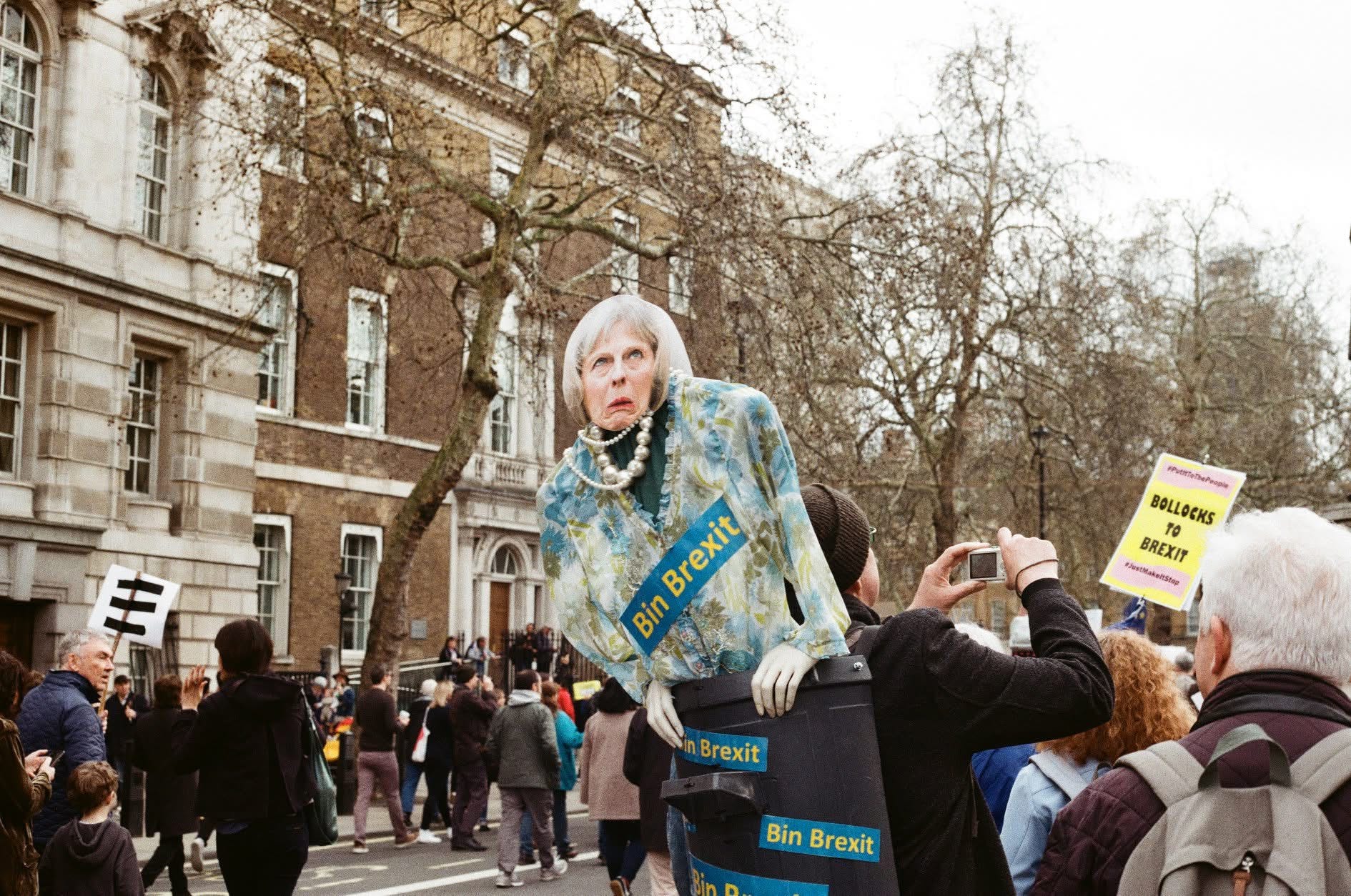
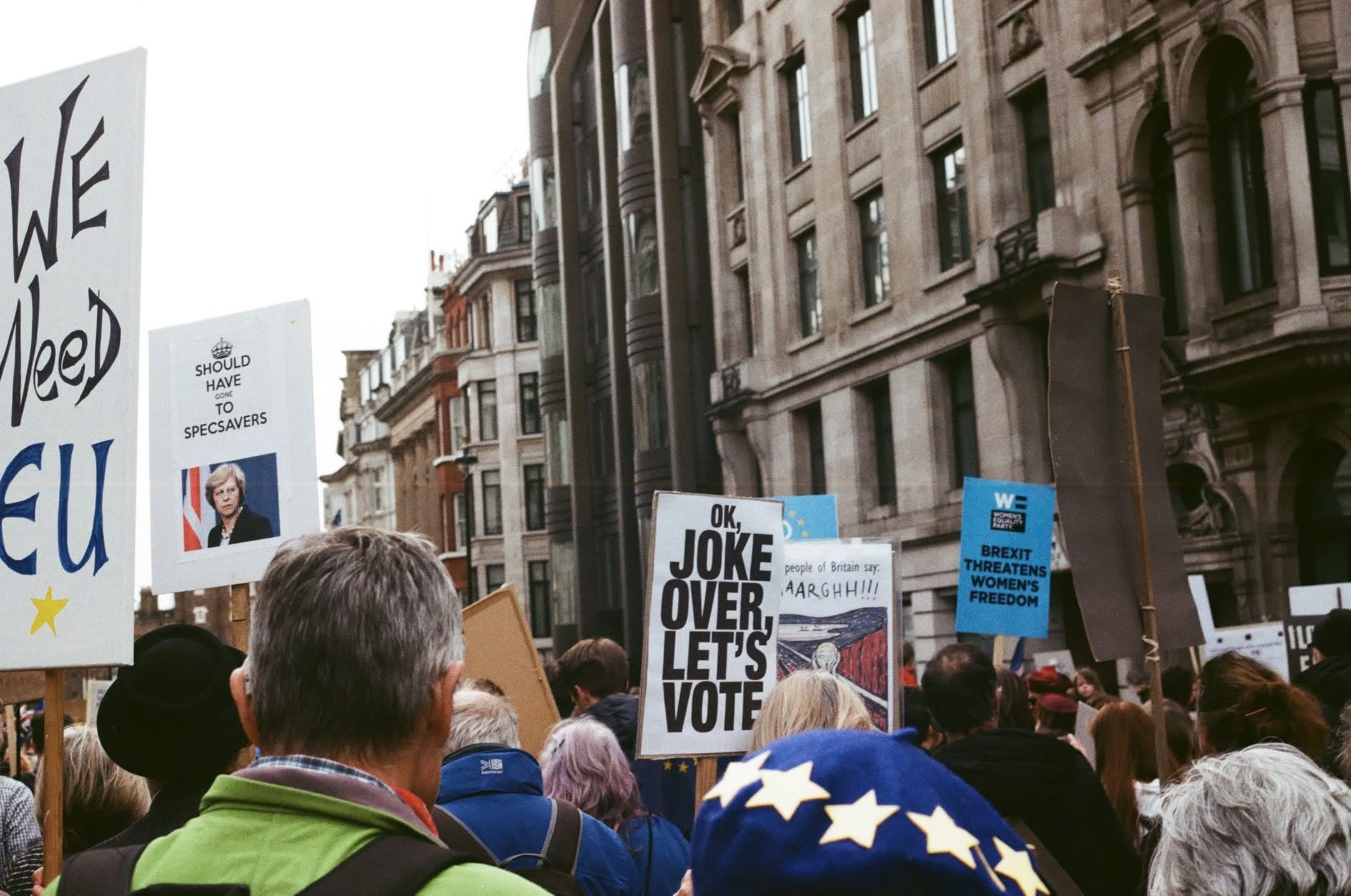
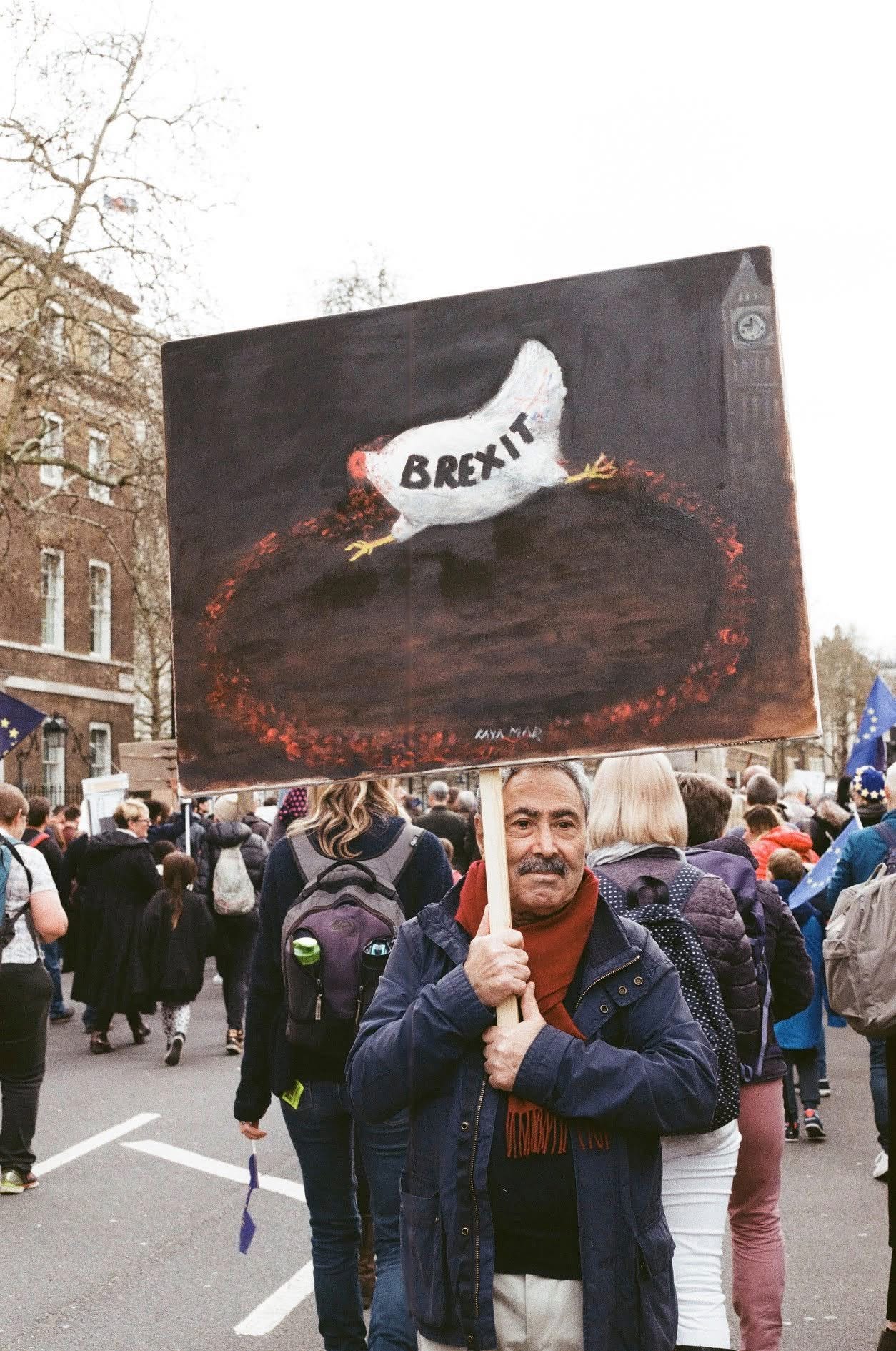
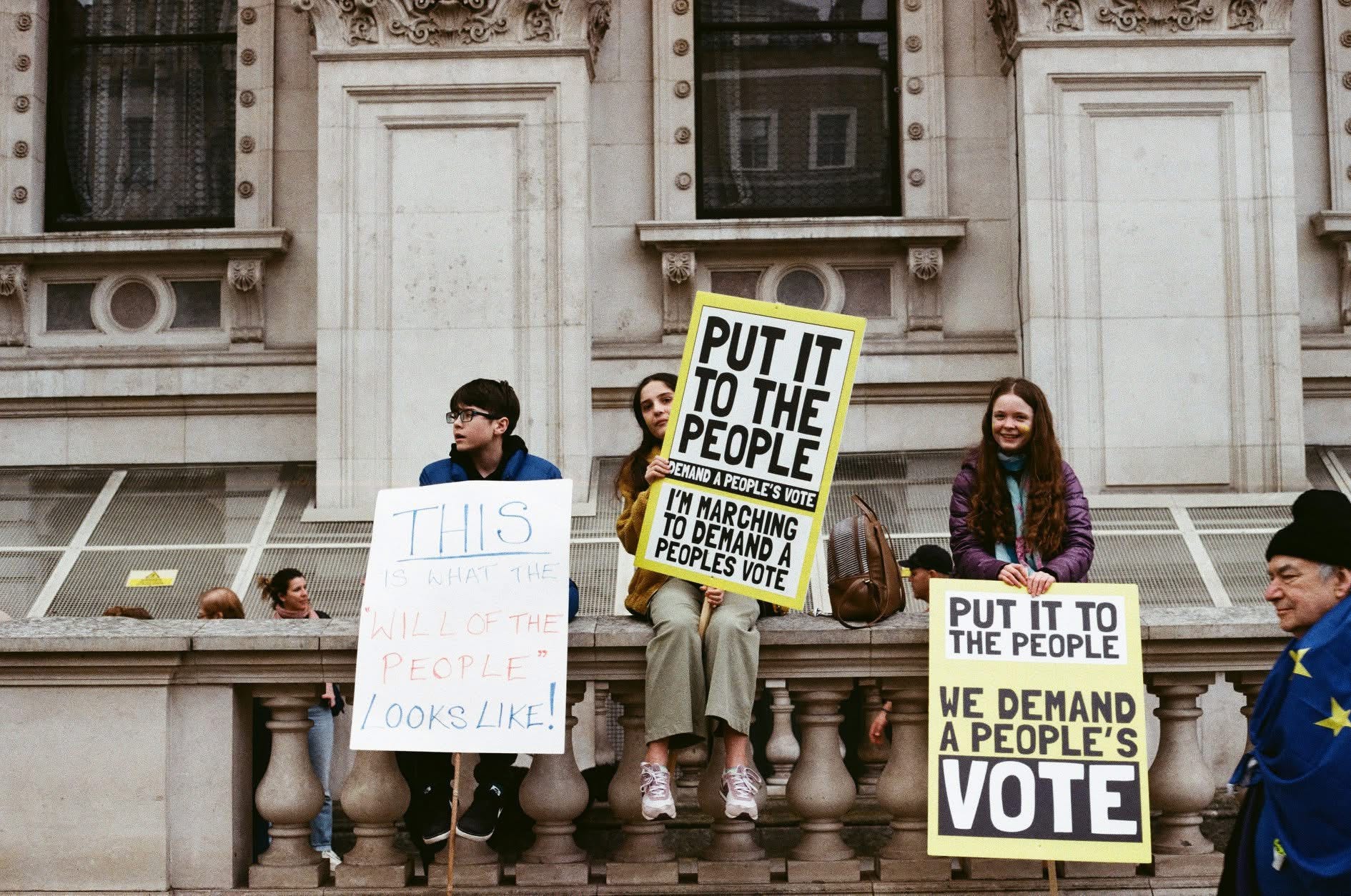
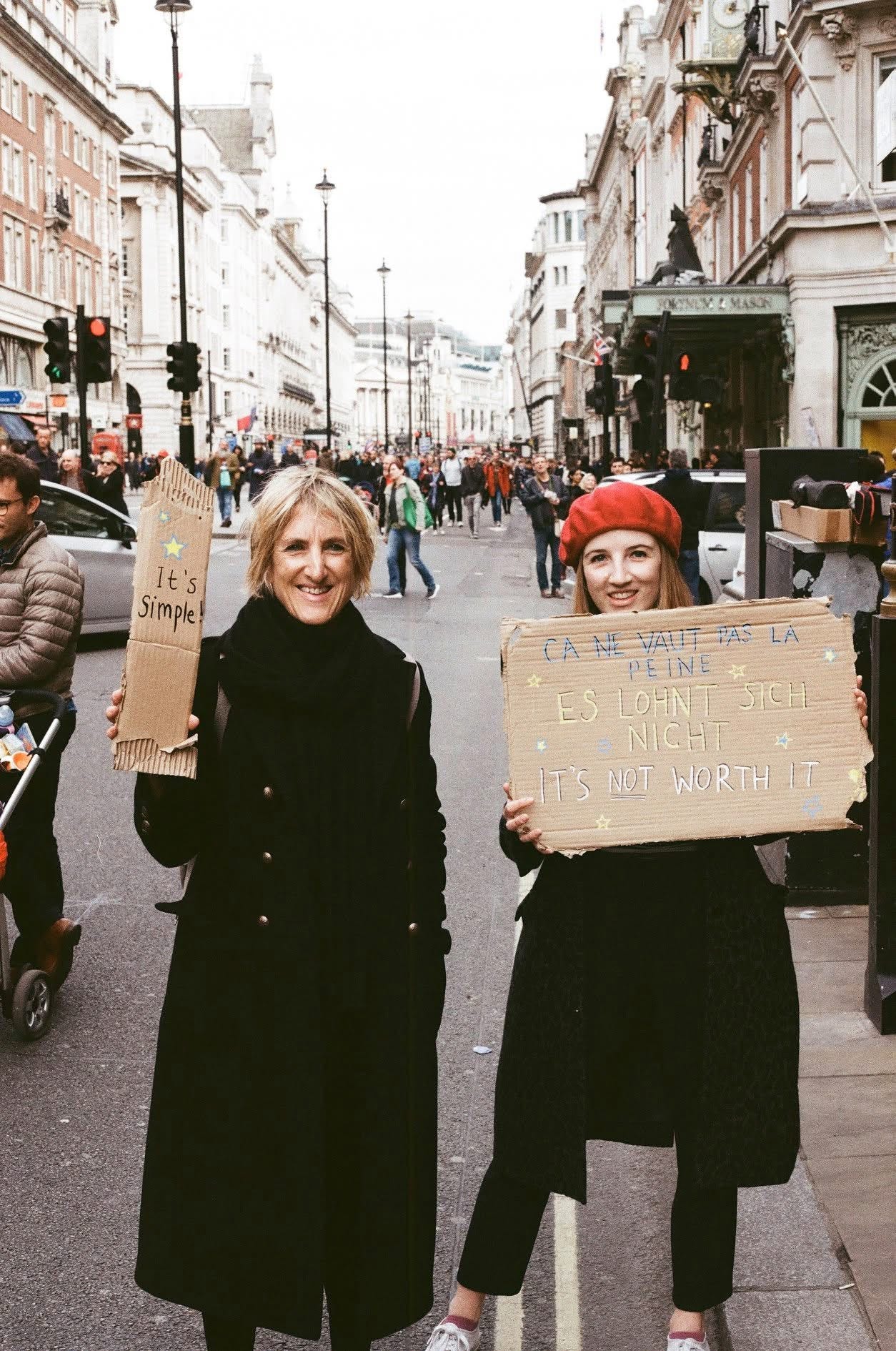
Photos from the People’s March, London, 2019.
Comments
Nothing yet. Say the first thing.
Sign in to join the conversation.