
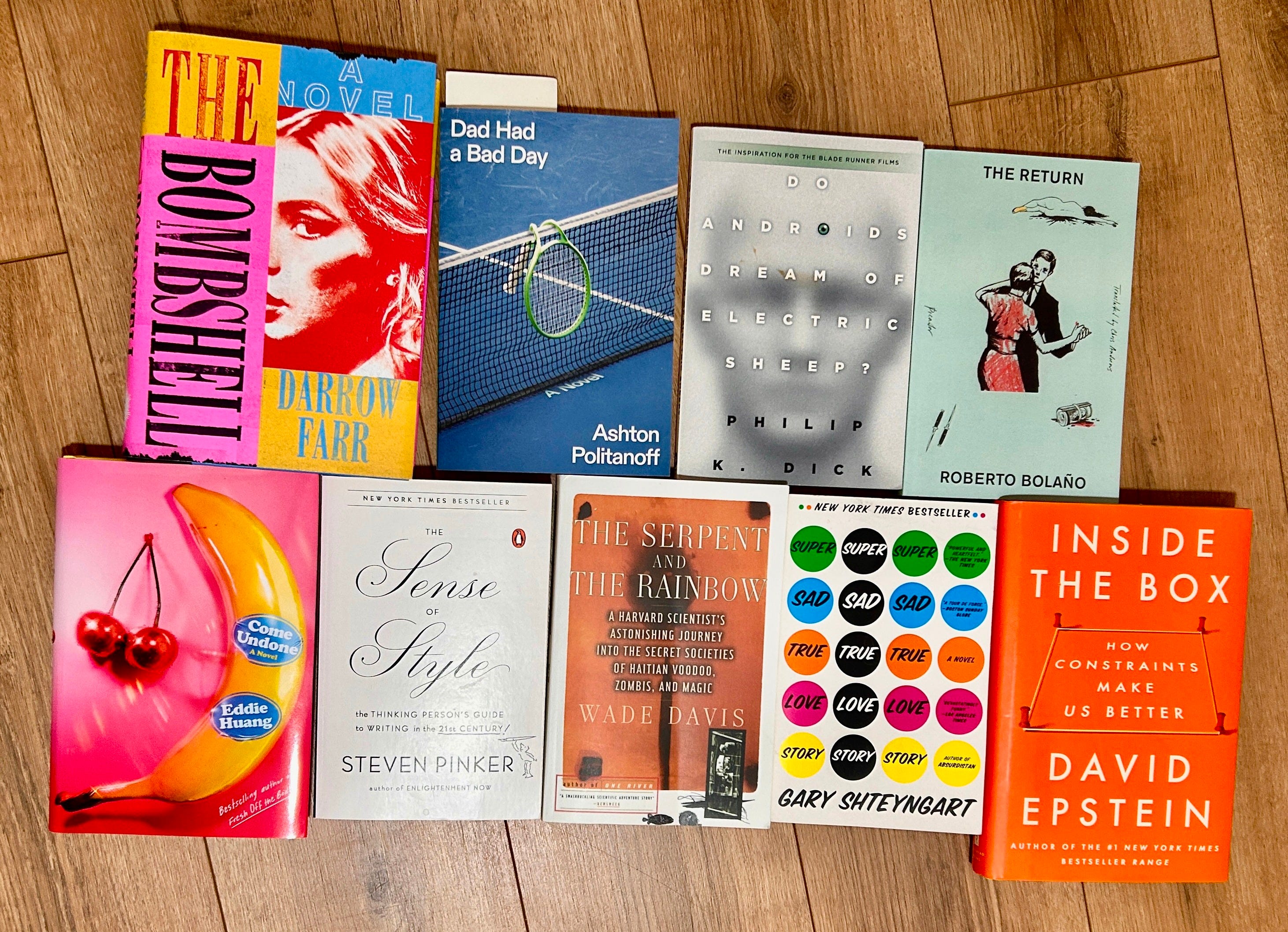
I spend more money on books than anybody I know. I’m not bragging. It’s a serious compulsion. I order two or three books a week and I can count on my hand the number of times I’ve walked into a bookstore and not walked out with a book (once).
Lately, there has been a question on the minds of many writers and publishing industry professionals: How do readers actually find out about new books these days?
Everyone, as you know, has their theory: Print reviews are dead. Short-form video on Instagram and TikTok runs the world. Influencers have us under their dexterous thumbs. Substack is where all the real ™ critics live now. We’re all fucked. Etc.
Instead of lobbing another take into the void, I decided to look inward and run a highly-scientific audit. I went back and looked at the last ten books I bought in physical bookstores or online, and tried, to the best of my ability, to contact-trace the people, posts, and platforms that led me to discovering these books.
The results of my study, grouped in loose categories, are as follows:
1. Dad Had a Bad Day by Ashton Politanoff (2026)
I saw this book on my homegirl @bookshelfbyla’s Instagram account. Her taste, which I trust, got me in the door. But what sold me was the subject matter–I’m a dad, writing a novel of my own about a dad, and there are very few modern novels out there about that experience believe it or not, so, at the very least I felt obligated to see what was what. (I’m actually more than halfway through and really enjoying it.) Also, the cover is gorgeous.
2. Save a Seat for Me: Notes on American Fatherhood by Marc Anthony Neal (2026)
I saw this exact post from @literapy_nyc another book influencer on IG I follow. This part of the caption made me buy it: “Written by a Black father, husband, scholar, and professor, this memoir reflects on raising two daughters while trying to make sense of work, marriage, identity, and the person he is becoming along the way.” It sounds just like what I’m living through at the moment. I signed up for a pre-order (book drops in early August).
Takeaway: In a world of a million influencers, find the one your ideal reader probably trusts.
3. Super Sad True Love Story by Gary Shteyngart (2010)
I have never read Shtyengart’s work but I have been meaning to. I had a copy of Absurdistan but lost it. Shteyngart has serious pull at The New York Times because he ends up in their pages for random reasons like when they tried to position him as a style icon. Well, he was in The New York Times again recently, and this time the bait worked. Ezra Klein brought him on his show to discuss Super Sad True Love Story more than a decade after it was published because Klein said the novel “predicted the strangeness of the world we live in today – and also a lot of what it feels like to live in it” more than any other book he’s read.
Grand statement! I didn’t listen to the episode to see how Klein backed it up. But it was enough to get me to say, fuck it, let me buy the paperback and see if that’s true.
Takeaway: Prestige publication reviews and write-ups may be on their last legs, but they still can get you to buy a decade-old novel just because.
4. Come Undone by Eddie Huang (2026)
Last year Eddie edited two travel pieces I wrote for The Places Review (a Substack publication) and I got to learn more about his interest and practice as a writer through our conversations. I also subscribed to his Substack and I love how real he keeps it about a lot of topics I think a ton about: masculinity, fatherhood, modern marriage, balancing ambition and trying to be a present parent and partner. Our interactions and his newsletter made this an auto-buy when it came out earlier this month.
5. Inside the Box: How Constraints Make Us Better by David Epstein (2026)
I stumbled onto David Epstein’s Substack this spring and enjoyed his posts (which were really just teasers from his book) about how writers like Isabel Allende and leaders like Ed Catmull, former head of Pixar, use constraints to enliven their work. As an author with a day job and a family and very little writing time, I’m susceptible to anything that suggests limitations might be useful. Hearing Epstein on Cal Newport’s podcast helped, too, but what got me to pre-order his book before it came out was his bonus offer: unlocked Q&As with people he interviewed. I haven’t read the Q&As yet, but the Allende and Pixar material alone made the value-add feel worth it.
Takeaway: Substacks or any outlet that gives readers sustained exposure to your voice and your project works. When you read someone long enough, and grow to trust their voice, you’ll be willing to follow them anywhere.
6. The Return by Roberto Bolaño (2010)
I ran away from my family to work out of a Starbucks in a nearby Barnes & Noble the other day and, as I previously mentioned, I cannot walk into a bookstore without leaving with a book so I picked up this one. I hadn’t read or heard of this Bolaño collection before, and I loved the cover. The fact that it was slim was appealing to me, too.
7. Do Androids Dream of Electric Sheep? By Philip K. Dick (1968)
I already read this one last year, but it was a library copy. I recently felt the urge to revisit it–and particularly the way Dick handles the future and futuristic tech with a plot that felt also quite grounded in day-to-day human concerns. I also picked this up during my Barnes & Noble getaway because I decided I needed a copy in the permanent collection.
Takeaway: The bookstore impulse buy is alive and well.
8. The Bombshell by Darrow Farr (2025)
My wife asked me to order this for her. She met Darrow at the Miami Book Fair party last year. We hung out the whole night with Darrow and her husband and ever since my wife said to herself, Darrow is so cool, I really need to read her book. She said this a few times since we hung out back in November, so we recently just ordered the book.
Takeaway: Be cool and interesting at parties.
9. The Serpent and the Rainbow by Wade Davis (1985)
This was chosen by a member of my book club and something I never would have ever read on my own. But I loved it. Also, Wade Davis is just a straight up G and I’m thrilled that now I know who he is. I’ll be buying more of his books now.
Takeaway: Don’t sleep on book clubs, even small ones. They move copies and guilt people into reading books they never would have—sometimes to surprising results.
10. The Sense of Style by Steven Pinker (2015)
I don’t remember where I came across this book. I’ve never really engaged with Pinker’s work, and I don’t think he’s an exceptionally stylish writer. All I know is I bought this purely because I’m interested in the exploration of style and what makes writing engaging from the perspective of a cognitive scientist. I’ve read many craft books before, but I can’t say I’ve read that version.
Takeaway: Sometimes the hook is not the subject of the book, but the strange or unique angle from which someone is approaching it.
I still don’t have a great sense of what sells books these days. When it comes to my own buying habits, the one through line I can see is trust in taste.
I trust the tastes of certain influencers, editors, and pundits. I trust the taste of certain newsletter writers whose work I keep up with. I trust the taste of certain podcasts. I also trust my own instinct when a cover or book description feels like something I need in the moment.
The other thing that is clear to me is that books don’t really reach me through one channel anymore. It used to be the case that I would scan book review sections each week, or pay attention to the books that won certain prizes or seemed to be “of the moment”–something like Yesteryear, for example.
But now, books are finding their way to me from a variety of places. Some flit in and out of my consciousness and require me passing a few times before I buy them like Dad Had a Bad Day but others just find me at the right moment, like Super Sad True Love Story.
I have the sense that this is the case for a lot of us. Which is why I encourage you to try my experiment for yourself. It isn’t hard. It requires a decent memory, an online order history, perhaps some receipts you have to dig out of your pockets.
Let me know how it goes, and what you learn in the process.
Peace,
Andrew
Comments
Nothing yet. Say the first thing.
Sign in to join the conversation.