
When you first start a novel, there is often a joyous high. You have this great idea, you’re excited about it, and now you’re off to the races. On the other side of the spectrum, when the end of a novel is in sight, it can often feel like you’re writing with the wind at your back. You’ve set up all the dominoes—now you just have to knock them down.
But the messy middle—which is where the real writing of a novel happens—is usually a slog.
In my case, it requires motivating myself daily to get up and get words down. It requires writing despite the fact that I’m often not sure where I’m going, or if I’m even going in the right direction. In short: There is a ton of doubt, confusion, and frustration baked into the process.
Thankfully, I’ve learned that there are some tools you can use to sustain you through this grind. Tools to remind yourself what you’re after, and that you’re actually making progress—even on those dog days where you eke out just 200 incoherent words, or spend most of your writing hour staring at a blinking cursor.
Today I’ll talk about two tools I’ve used over the last year while working on my second novel. Both are easy to use, and cheap.
For the past year and a half—ever since I moved into my house and got my first proper office—my desktop where I write has looked like this.
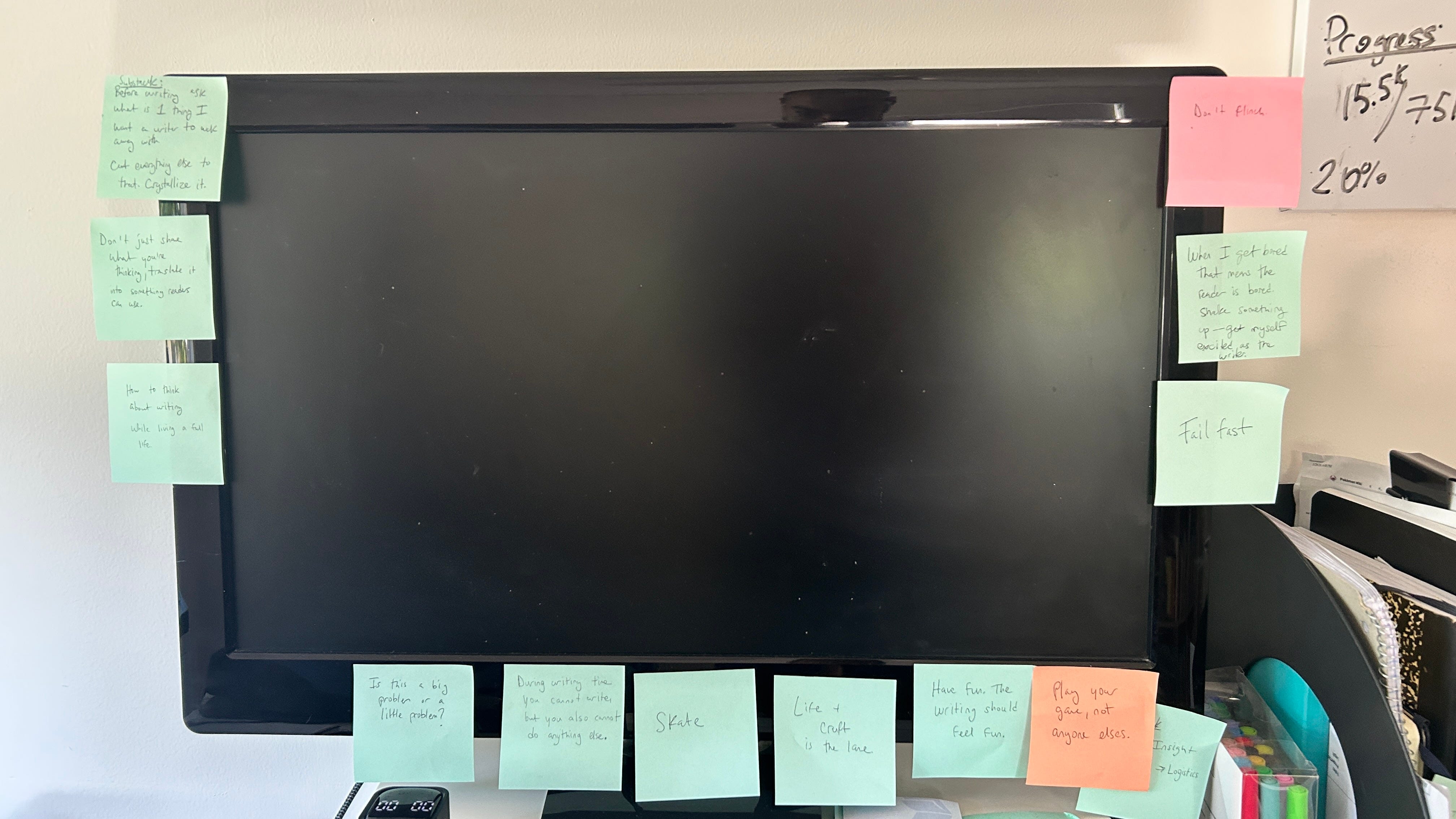
Those post-it notes decorating the screen are full of little reminders, mantras, and mostly unattributed quotes I like to glance at while I’m working.
For example, one of the ones on my screen now says “Don’t flinch,” which is something I jotted down after listening to a recent interview Jay-Z gave to GQ. The meaning for me is clear: Write my shit, lean into my voice and my perspective, and don’t flinch while doing it.
“Fail fast,” is another one I have up, which is apparently a popular saying at Pixar. For me, it is a reminder to not be precious about my words—especially in this stage I’m at, which is working on getting the shape and structure of this new thing nailed down. The time for refining and polishing will come later. In the meantime, the goal is to complete drafts, iterate, and keep pushing until it all clicks in the way I want it to.
The last one I’ll mention is just one word: “Skate.” I honestly don’t know where this comes from, but to me it is a handy, succinct description of the sort of writing I want to accomplish. The goal is to write sentences and construct a narrative that makes a reader feel like they’re just skating through the pages, without much effort.
These are just a few examples. Right now there are 13 post-it notes on my desk—all which have accumulated over the course of the past few months. I don’t have an organized method for how I get them there. They just come to me naturally, often while reading, thinking about some writing problem, or while listening to music or podcast interviews.
When the thought emerges, I stop what I’m doing, write it down, and find a space for it.
After about 15 notes or so, my screen is usually full. But funny enough, because these are post-it notes, and because my kids are often playing in my office, they tend to fall off naturally—kind of like dead leaves. Which feels right.
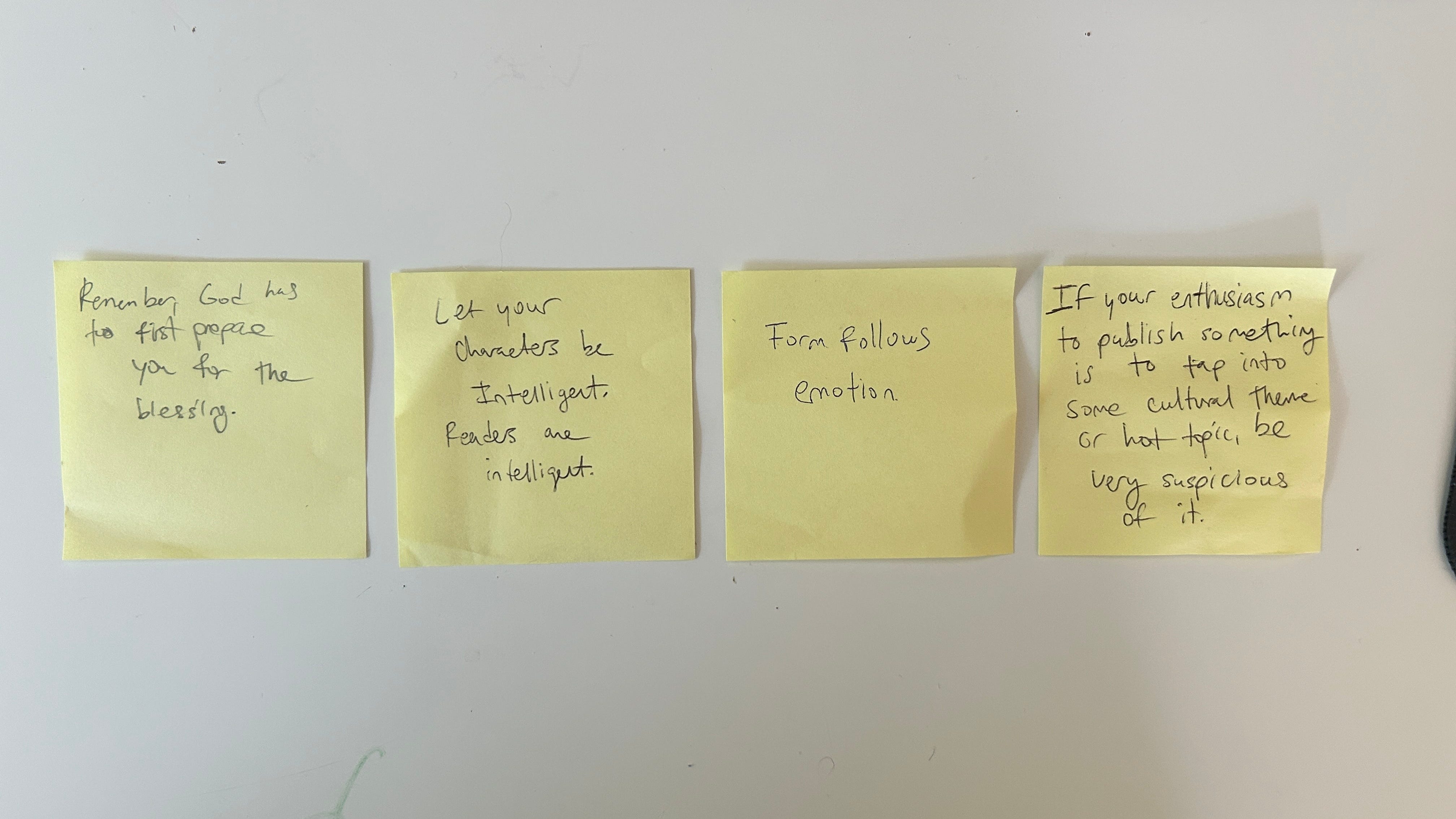
Not because the notes are dead to me, but because often the mantra I need is dependent on where I’m at in my writing process. When one falls, it tends to be around the time that I need to make space for new ones anyway. But I keep the ones that fall, and stack them all up in a space in my desk. It’s nice to look at them from time to time. To see how my ideas and needs have changed.
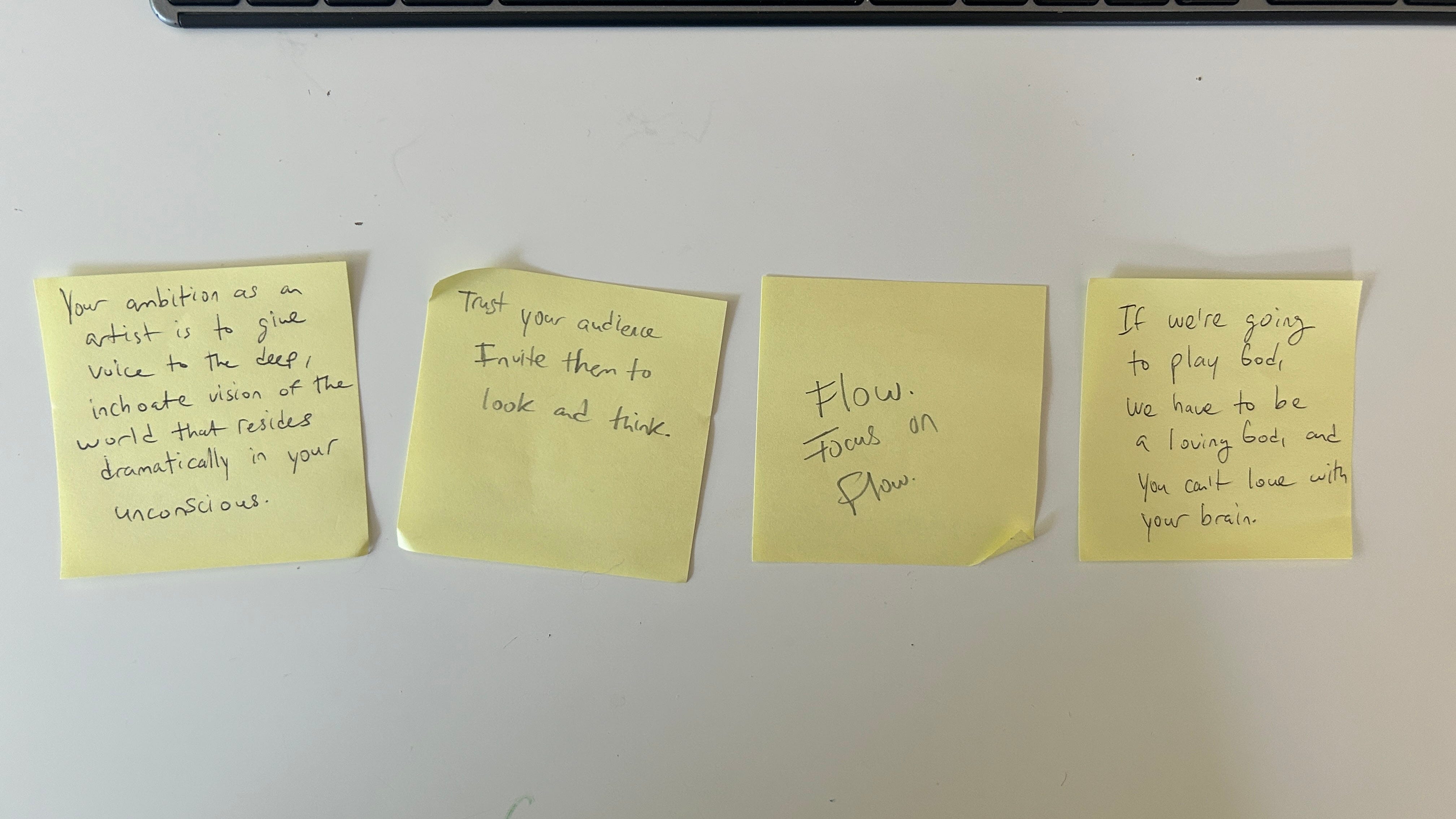
For example, I posted this note during the second draft of this new novel (I’m on draft five now): “Trust your audience. Invite them to look and think.” This was useful on my second draft in particular, because a lot of what I was doing was trying to iron out the spots from the first draft where I was being too obvious and hitting people over the head.
Another fallen note I like is: “If your enthusiasm to publish something is to tap into some cultural theme or hot topic, be very suspicious of it.” This was helpful while writing the first draft of the novel, when I knew I was interested in the relationship between AI and humans and how we’d eventually start outsourcing key human tasks to this new technology. The note reminded me not to focus on the new, shiny thing (AI) just because it was new and shiny, but to make sure my novel is actually about larger themes and ideas that have been relevant for many years and will continue to be.
Things like how to navigate fatherhood when you had a shitty dad, finding balance in a modern marriage, figuring out how to sustain ambition while raising needy toddlers, and the constant questions about whether or not you’re doing things right.
The idea with these post-it notes is that I can look up and have instant access to reminders about what I’m aiming to achieve on the page, what I want it to feel like, and some north stars that make sure I’m going in the right direction.
I don’t find myself looking at them every day. But often, my eyes will wander from the screen and land on one of these, and it will be the jolt I need.
This is the more practical, accountability tool I use. Right now, I have this bad boy hanging right next to my screen.
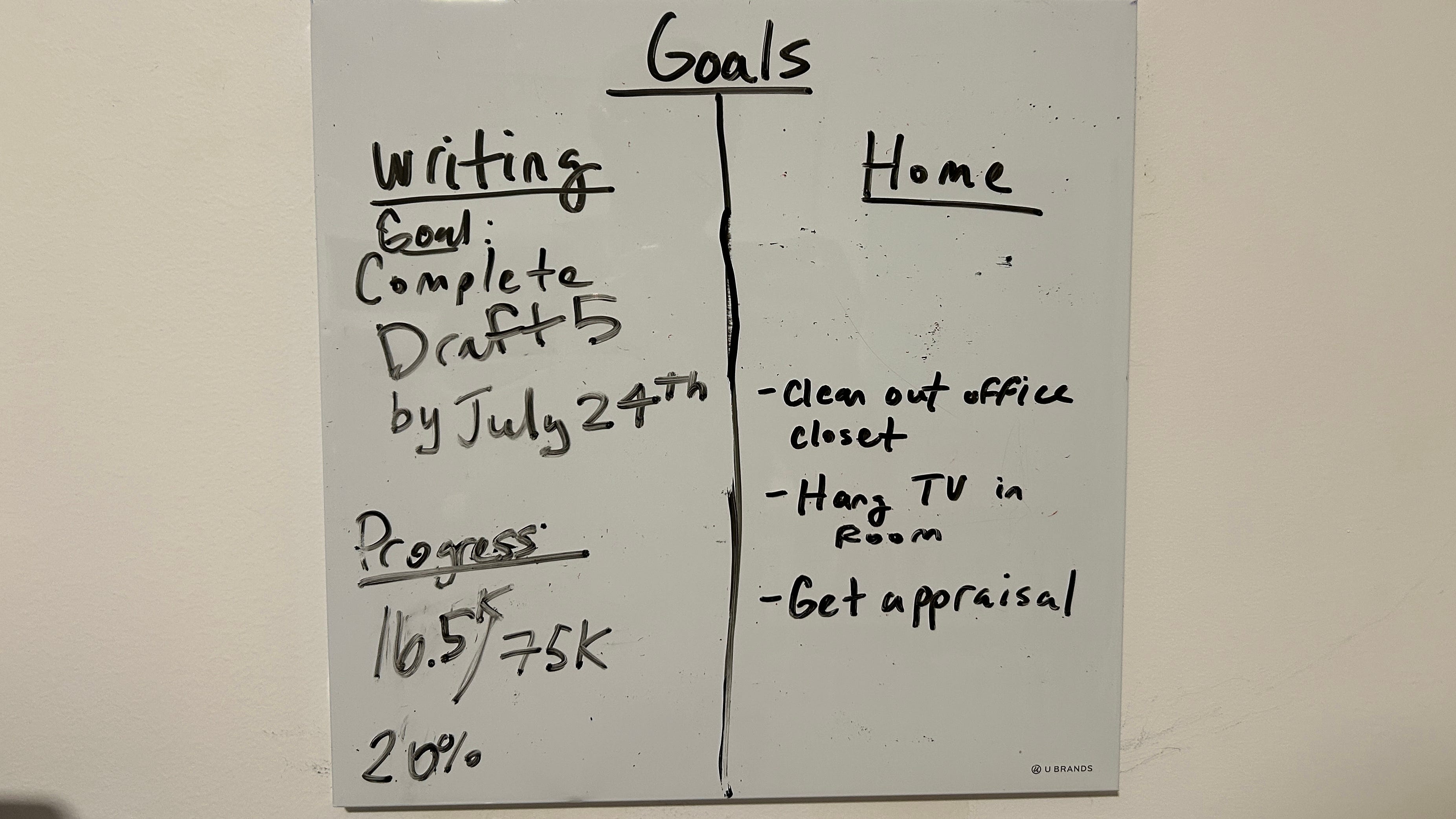
On one half, I have my writing goals, and on the other, house shit I need to get around to taking care of. The writing one is the one I update most regularly (I’ve had cleaning out that office closet on there for a solid two months now…) and I use it for two reasons: tracking progress and setting deadlines.
Day to day, after each writing session in the morning, I calculate where I’m at word wise, and update the percentage mark. It seems silly but it’s really nice to watch that percentage tick up little by little. It reminds me I’m accomplishing something and moving toward my goal, even if the day to day writing often doesn’t make me feel that way.
The deadline, meanwhile, is a useful way to motivate me to actually finish a draft. It is a theoretical deadline. I’m not under contract for anything. I choose a date that seems reasonable if I’m drafting somewhere around 1,000 words a day for five days a week. I also try to build in some buffer time to account for general life shit that often gets in the way of writing.
The idea is to choose a date that doesn’t feel ridiculous, but also will require some consistency to reach. Even though it isn’t technically real, I find it useful to keeping me accountable. Maybe it is all the journalism training I’ve gotten, but damn do I love me a deadline.
In my mind, both of these tools—my post-it note system and my white board—are broadly about motivation, yes. But they’re also about protecting my work from my own worst instincts. By that I mean the things that can often naturally creep in when you’re working on a long creative project: doubt, trend chasing, impatience, or a lack of urgency, for example.
I’ve found them to be pretty helpful to me, and perhaps they might be helpful to you, too.
I’m curious: Are there any motivation tools that you use? Anything special you do to help you get through the dog days or remind yourself of where you’re headed?
Sound off in the comments, or hit me on email by replying to this post. I’d love to know.
Peace!
Andrew
Comments
Nothing yet. Say the first thing.
Sign in to join the conversation.