
Having a sense of humor is an intangible quality that can brighten up your life, the lives of others, and, as a writer, brighten up the page in a way readers remember. It’s no secret why some of my favorite writers—people like Paul Beatty, Mat Johnson, and Dave Eggers, for example—are known for their humor and wit.
Humor—purposeful, useful humor—is also something I aim for in my own work.
This appreciation for humor stems from my family, and their ability to take even the most tragic stories and find something to laugh about within them. I’ve always admired people who make that choice.
Back in high school, for example, I worked for a nonprofit that helped disabled athletes compete in marathons. A veteran on the team had lost both his legs, part of one arm, and many fingers after stepping on a landmine in Iraq. We took a trip to Disney World, and the entire time he wore a T-shirt that read: I Went to Iraq. It Was a Blast.
That is not only hilarious to me—it’s fucking inspiring. I will always remember that man, and the choice he made to laugh about his situation, rob it of its power over his life, and bring everyone else along for the ride.
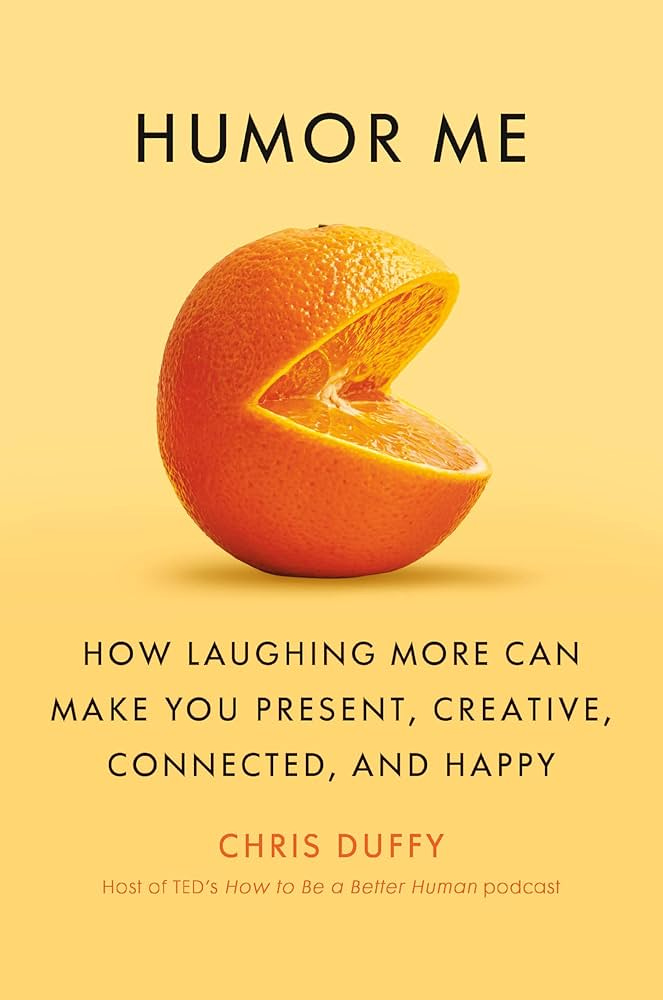
His ethos lines up with what argues in his new book Humor Me. Chris—a former fifth-grade teacher who now hosts the TED podcast How to Be a Better Human, writes for television, and helms the Substack Bright Spots—makes the case that humor isn’t just a personality trait. It’s a practice. “It’s building the muscles to see, notice, and celebrate the delightful weirdness of our world.”
Used well, he writes, humor works like a portal: it helps us notice what others miss, acknowledge and discuss difficult truths, and build community along the way.
For writers, this reframe matters. After all, isn’t that what many of us are after on the page?
I’ve known Chris for almost a decade, since we were both part of a national Pop-Up Magazine (RIP!) tour, and it was there I got to see his commitment to humor as a way of life up close. He’s not just funny, but funny in a way that puts you at ease; funny in a way that makes it easy to open up and arrive at reflections about your life or the modern world that you might not have come to otherwise.
It’s my pleasure to bring him on for a lovely conversation about humor, attention, and generosity—and how to use all three more deliberately in your life, and perhaps even on the page.
A central idea in your book is that humor isn’t just a personality trait some people are born with. It’s something you can practice. What does it mean to approach humor as a skill you cultivate? How is that different from just “being funny”?
CHRIS DUFFY: One of the biggest reasons I wanted to write this book is because I think a lot of people have it backwards when it comes to what a “good sense of humor” means. I’m much less interested in the skill of delivering a joke onstage or being the funny person at a party and much more interested in how you can walk through your everyday life and find things to laugh at. I want people to be able to laugh at their own ridiculousness and the absurdity of the world, even when times are dark. And I do really believe that’s a skill that you can practice. When you start noticing things that make you laugh and are odd and strange and delightful, you notice more and more, until you realize the world is filled with them.
That idea of noticing really stuck with me. Where does attention come into humor? Why does it matter so much?
DUFFY: I’ll give you one parallel that captures how I think about this. I’ve never been into birdwatching, but I watched this great birding documentary on YouTube once (Listers) and afterwards when I went outside I was floored by how many birds I heard and saw. They had always been there but I’d never noticed them before. I think the same is true with funny stuff. When we start noticing and seeing it, we realize it’s there and then we build the practice of paying attention to it and noticing more and more.
When you are laughing really hard with a friend, so hard that tears are rolling down your cheeks and you’re clutching your sides, you are FULLY present and in the moment with them. You are peeing your pants, you are wheezing, you are full on snorting through your nose. You’re locked in with the other person 100%. That’s part of what makes it so fun!
Humor requires our full attention so we can clock what’s off and unexpected. That’s what makes us laugh. Especially these days, when we’re so often only half there, with a big part of our brain worrying about what’s coming next or thinking about our emails/messages/texts, laughter snaps us back into the moment.
You describe having and cultivating a good sense of humor as an inherently generous act. What makes humor generous?
DUFFY: The generous part of humor comes from what we’ve been talking about with presence and attention. It’s such a gift to have someone give you their full time, presence, and attention. They’re fully there with you. And when they laugh at something you say or they make you laugh? It’s an incredible release and, again, such a gift.
Of course, humor can also be a knife that cuts and makes someone self-conscious or insults them. It’s not like laughter is only ever used for good. Bullies get people laughing a lot! To me, bad humor is the kind that’s used to self-aggrandize or demean and good humor is the kind that connects us and makes us all have a great time.
Why does that distinction between good-faith humor and bad-faith humor matter?
DUFFY: Because so many truly evil and despicable people think they are funny and say “it’s just a joke” to get away with horrible shit!
As someone who loves laughter and spends my life thinking about humor, I hate that there’s been this completely wrongheaded understanding of humor alongside the rise of comedy’s importance in pop culture and the amount that comedians are respected and listened to.
What do you think changes in a room when the goal behind a joke is connection?
DUFFY: People relax! The tension evaporates and people start having fun and being playful and feeling safe to share more vulnerable (or just unexpected and off-kilter) thoughts.
It’s way more fun.
Do you think developing this sort of sense of humor feels particularly important right now, in our current cultural moment?
DUFFY: We need way more people who are willing to laugh at themselves and say “I do not have it all figured out. I’m a little bit of a mess and a doofus.” We’re at this very weird moment in the culture where you’re supposed to know everything and have a fully-formed, nuanced opinion about every topic at every moment.
The more that we can laugh and connect in a fun way and acknowledge that we are all bozos, the more we can open up space for people to grow and change and connect rather than feel like they have to double-down on every tiny idea and never give an inch.
I’ve been thinking about Gary—your former student who wrote these hilarious reviews of his cafeteria lunches. I first encountered that story during our Pop-Up Magazine days, and it was great to see him resurface in the book. Why has he stayed with you so long?
DUFFY: Gary writing reviews of cafeteria food has stuck with me for over a decade because, first and foremost, his reviews are hilarious. The food writing is unparalleled. I mean he describes cafeteria pizza as “a dish originally from Italy” and compares its smell to “when you’ve just got out of the shower and you used your sister’s shampoo.”
That’s MacArthur level genius.
But I think the bigger reason Gary’s story has stuck with me is because he found the funny in a very mundane and boring part of the day that I’d never thought twice about before. And because Gary used humor to show that he was more than just a student who often got in trouble, he was also a creative, hilarious genius.
I think society often doesn’t value that kind of creative intelligence and I love how Gary forced me (and every reader of the school newspaper) to see it.
Reading the book, I could really hear your voice—the footnotes, the quiet asides, the small jokes throughout. How much of that tone was there from the beginning, and how much emerged through revision?
DUFFY: Thank you so much! From the start, I was like “if this book is just serious and doesn’t make people laugh, I will be a gigantic failure.” The deep irony of a book about humor not being funny was too much for me to bear. So I always knew I wanted to have my voice, my jokes, and my ability to skewer myself front and center. I personally love books where the footnotes are commenting on the text and I think it’s such a ripe place for jokes and comedy. I took full advantage of that.
A lot of the writing process was sending a draft to my editor and her telling me where she was confused or my jokes didn’t land and then me tightening, polishing, and trying to address those notes explicitly in the text by writing things like “You might not find this example relatable! My editor did not, but I refuse to change it!”
At first glance, people might think this is another memoir by a comedian. But it’s deeply researched. You spoke to experts, combed through studies, and grounded the book in psychology. What made you take that route?
DUFFY: I just don’t think I’m all that interesting! I don’t have a juicy enough life for a memoir. And I love talking to smart, funny people about their ideas.
The interviews and the research phase were a huge pleasure and took many months. But I’d also been doing interviews and thinking about this topic for years so I had a lot of my previous work and conversations that I could draw on and pull from as well.
I think it all added depth to the book and allowed for people to find themselves represented even if they are not a middle-aged podcast host / standup comedian with two young kids at home. I also know for sure that without the interviews and the research, I would never have been able to fulfill the terms of my book contract and likely would have turned in a three-page pamphlet that I xeroxed at a FedEx Kinko’s.
A big chunk of my audience are emerging writers, so I’m curious: how has your approach to humor influenced the way you think about writing, or your own writing process?
DUFFY: The biggest way that humor has shaped my writing is by teaching me to embrace the bad.
So much of good writing is about getting the bad writing down on the page! I find that I get frozen when I’m thinking about writing something good but when I embrace the idea that I might write something laughably awful then I can actually get out of my own way.
After spending so much time thinking and writing about humor, what’s next? Are you drawn to more nonfiction? Are you itching to try something different?
DUFFY: I would love to write another nonfiction book but I don’t know what it will be about yet!
I’d also love to write a scripted (fictional) TV show.
Many thanks to Chris for the chat. Now, please go out and get your copy of Humor Me.
Comments
Nothing yet. Say the first thing.
Sign in to join the conversation.