
Of all the qualities that make literature great, the most diminished in modern times is the art of the living, universal character.
Prose remains ascendant; plot has declined but retains strongholds here and there; since Dickens, characterization has declined to near-extinction.
As Georg Lukacs pointed out in Realism In Our Time, modernism reduced characters to a “shadowy blur.” Lukacs wasn’t around to see most of it, but postmodernism continued the trend with an almost manic focus on psychological realism or nihilistic paranoia, depending on the writer.
Not so the 19th century.
We remember Mr. Micawber, Elizabeth Bennet, Thomas Buddenbrooks, Oliver Twist, and Natasha Rostova effortlessly, but the miracle of 19th-century literature is that a single work often contains 5-10 universal type characters, standing for an entire swath of humanity, but also alive in word and deed.
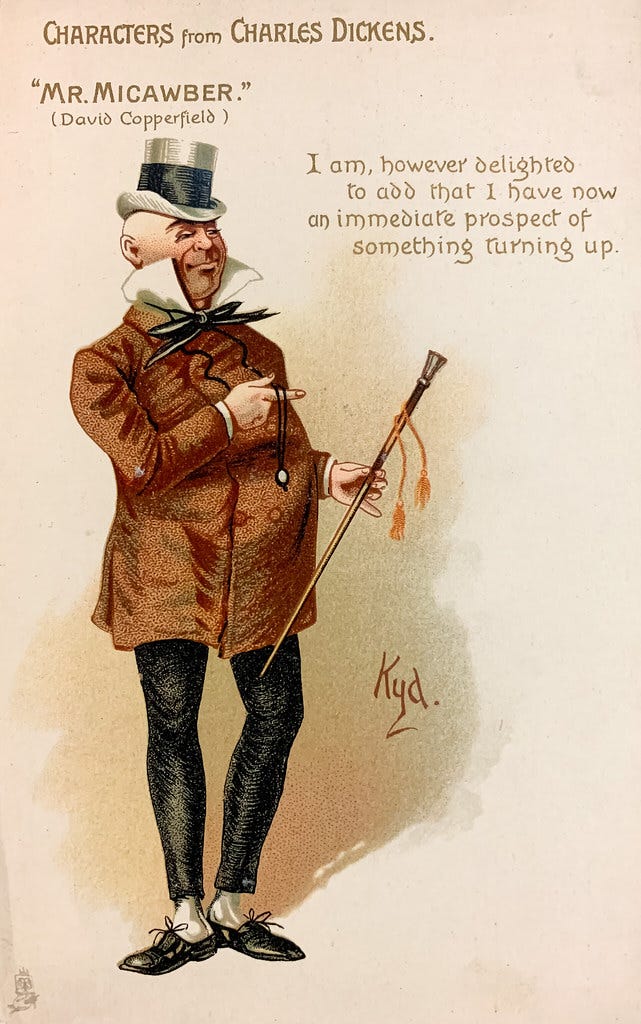
Consider Bleak House: although I haven’t read it all the way through since the early 2000’s, I can still list over a dozen of its vivid characters from memory: Lady Dedlock, Esther Summerson, John Jarndyce, Harold Skimpole, Mr. Tulkinghorn, Mrs. Jellyby, Richard Carstone, Ada Clare, Inspector Bucket, Jo, Mr. Guppy, Krook, Miss Flite.
Contrast that with modern literature, or even the great works of the modernists of the 20th century. Often the only truly realized character is the narrator, a stand-in for the author himself.
There are notable exceptions; Hemingway and Steinbeck excelled at characterization, and Virginia Woolf achieved some startlingly vivid characters in Mrs. Ramsay and Mrs. Dalloway, although critics point out that they much resemble the author.
It’s not that some modernists didn’t write characters well; it’s that the characters they wrote are fragmented, standing only for themselves, not the universal. And in general, as Lukacs points out, the modern character is often only a shadow. Speaking of Camus’ The Plague, Lukacs points out “the lives of the characters are without direction, without motivation, without development.” It’s not just Camus; the same may be said of Kafka, Dos Passos, Zola and many more.
Let’s take the vaunted postmodernist hero Thomas Pynchon for example. I recently read The Crying of Lot 49 and enjoyed it hugely. It’s short and very funny. The plot is mostly a vehicle for paranoia, which is ironically a strong point for the book, which will, I’m sure, become a proxy in my mind for an entire genre of fiction. But the characterization is sorely lacking.
Oedipa Maas is memorable as a victim of swirling forces beyond her understanding, but she’s the ultimate shadow. The reader understands little of her motivations, her values, or her as a real human being at all. This may be a feature and not a bug for the type of novel Pynchon was writing, but the point remains that with enough writers like Pynchon, literature as a whole runs the risk of losing the skills of universal typology in characterization.
The trend continues for modern writers as well; writers like Ben Lerner and Sally Rooney have, by my count, produced precisely zero universal characters that define an enduring type.
Our failure to produce universalized typology in characterization is no mystery; it’s part and parcel with the disintegration of the idea of the objective in art, the denial of human universals in favor of excruciatingly detailed subjectivity.
The modern fascination with Marcel Proust sweeping Substack in the summer of 2026 is a symptom of the disease; for all the genius of his prose, Proust only described an individual, and not the universal experience of mankind. Of course, Proust’s description of an individual was immensely skilled and psychologically insightful; yet it identifies a subjective experience with reality, thus giving a distorted picture of reality as a whole. While we can see parts of ourselves in Proust’s neurotic narrator, we cannot learn about the character of humanity in general from him.
Proust, of course, was enormously influential, both in his time and ours. He represents one of the earliest breaking points with the realism of his time. And well into the 21st century, I would wager that most writers buy into the modernist deconstruction of realism. Yet, if we view typology and characterization as a “hangover from the 19th century,” it shouldn’t surprise us that we’re getting worse at it. And it’s a huge loss.
Lukacs again:
“In realistic literature each descriptive detail is both individual and typical. Modern allegory, and modernist ideology, however, deny the typical. By destroying the coherence of the world, they reduce detail to the level of mere particularity… Modernist literature thus replaces concrete typicality with abstract particularity.”
Lukacs notes that by separating ourselves from objective reality, “the inner world of the subject is transformed into a sinister, inexplicable flux, and acquires - paradoxically it may seem - a static character.” Hence the shadow or dream-like quality of so many modern characters.
In contrast, characters that embody a universal typology, while also taking on a unique life of their own, serve as models of the typical and the individual.
Dickens’ characters in Bleak House, were, as Harold Bloom pointed out, based on real people; Skimpole was based on the Romantic essayist Leigh Hunt, Esther herself, on Dickens’ sister-in-law. They are universal types, but they also live and breathe as real humans. (And for all the brilliance of Virginia Woolf or Marcel Proust’s psychologically realistic characters, it’s a far more impressive literary feat to create a character that is both universal and living.)
I’m a firm believer that literature has the power to help us understand the world and the people around us. The novel's classic intention, as Lionel Trilling noted, is a “perpetual quest for reality… the investigation of the problem of reality in the social field.” But it can only do so if it professes to understand something about the world and the 7 billion people within it, not merely the author’s own head.
Starting with the modernists, our literature has been created by those who have a disintegrated view of reality, a firm conviction that the only truth a writer can illuminate is his own. And we’re the poorer for it.
Consider this a challenge to the novelists of the 21st century; it’s time to reclaim the lost art of characterization.
Comments
Nothing yet. Say the first thing.
Sign in to join the conversation.