
I first heard of War and Peace during a childhood game of Trivial Pursuit. (What classic novel has over 600 characters in 1000 pages?) Even to a child who read 1000-page Dickens novels for fun, Russian literature sounded intimidating.
My first toe in the water came during my teens, when I read an old copy of Alexander Solzhenitsyn’s One Day In The Life of Ivan Denisovich that was collecting dust on a shelf in the family “rumpus room.” I was struck by its seriousness, the roiling ideas so close under the surface of the plot, the terse rhythms of translated Russian. And I wanted the real thing - Tolstoy and Dostoyevsky. Within a few months, I had devoured War and Peace, The Brothers Karamazov, The Death of Ivan Ilyich, and Crime and Punishment.
See all 21 books by subscribing!
But it wasn’t until I was much older that I reapproached Russian literature in more depth, and it was thanks to 20th-century writers like Solzhenitsyn and Vladimir Nabokov, who introduced me to lesser-known Russian writers like Akhmatova, Sholokhov, Bunin, Bulgakov and more. I became aware that Russian literature was more than Dostoyevsky and Tolstoy. And despite its relative compactness - Nabokhov estimated that the Russian canon was only 23,000 pages, a fraction of English or French literature - there was something that made it different. Russian literature was concerned with truth.
As Nabokhov said (with a typical and gratuitous swipe at Dostoyevsky):
“Most Russian writers have been tremendously interested in Truth's exact whereabouts and essential properties. To Pushkin it was of marble under a noble sun ; Dostoevski, a much inferior artist, saw it as a thing of blood and tears and hysterical and topical politics and sweat; and Chekhov kept a quizzical eye upon it, while seemingly engrossed in the hazy scenery all around. Tolstoy marched straight at it, head bent and fists clenched, and found the place where the cross had once stood, or found—the image of his own self.”
Of course, Tolstoy and Dostoyevsky earned their towering reputations; War and Peace, Anna Karenina, The Karamazov Brothers, Crime and Punishment are not only some of the best books in Russian literature, but some of the best literature of all time. But Russian literature doesn’t start - or end - with them.
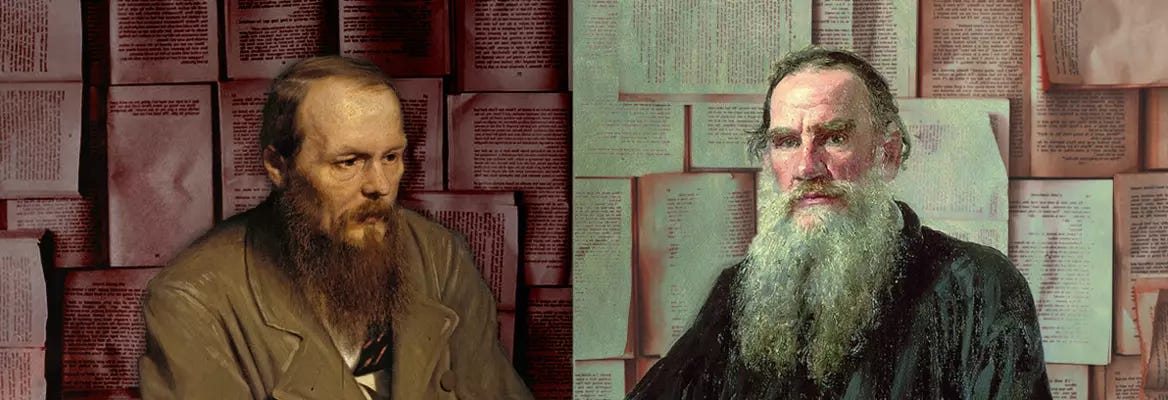
Behind them stands one of the richest literary traditions in the world: Pushkin’s elegant verses, Gogol's savage comedy, Bulgakov's supernatural satire, Sholokhov's epic Cossack world, and many others.
The following list is my attempt to point you towards some of these gems.
1) The Master and Margarita by Mikhail Bulgakov
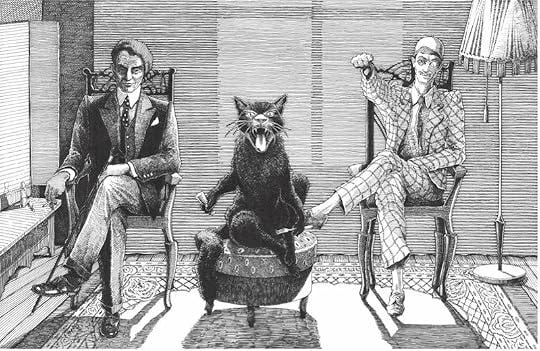
The Master and Margarita is surreal entertainment with the bite of true satire. Written in the 1920’s and 1930’s, it reads like a more modern novel, but one with deep roots. References to Goethe’s Faust, Dostoyevsky’s Grand Inquisitor, and the fables of Aesop are mixed with the farcical style of “magic realism” (the novel features a talking cat) and the frenzied motion of jazz music.
There’s also a deep-seated critique of the Stalinist nightmare Bulgakov was living during the writing of the novel - the literary bureaucracy MASSOLIT is a particularly ludicrous touch.
Above all, The Master and Margarita is a darkly playful spiritual novel, a deep achievement in an age of state-enforced atheism. Bulgakov never got to see his novel in print, but the world has recognized its genius many times over by now - among other accolades, the novel inspired the Rolling Stones' Sympathy for the Devil and was recently ranked #66 on the Guardian’s Top 100 novels list.
“Most bad," the host concluded. "If you ask me, something sinister lurks in men who avoid wine, games, the company of lovely women, and dinnertime conversation. Such people are either gravely ill or secretly detest everyone around them.”
2) Doctor Zhivago by Boris Pasternak
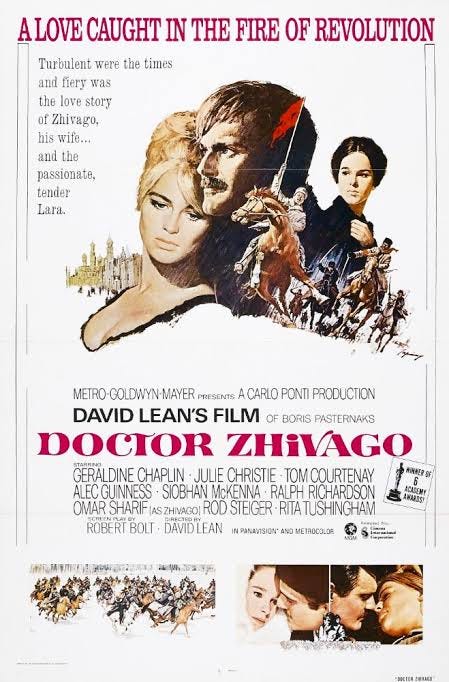
Doctor Zhivago had a tortured path to publication - banned by the Soviet authorities in the mid-1950’s, it was published in Italian before the first English edition came out in 1958. That year, Pasternak was awarded the Nobel prize for the book, a prize that the Soviet government refused to let him accept. Pasternak, born into an aristocratic family before the communist revolution, was destined for disappointment under the Soviet regime.
Doctor Zhivago is a novel of destinies, often doomed ones. It is hardly political, though it deals with historical realities. Instead, it is a great novel of love, the greatest in the Russian language, perhaps one of the greatest in any language.
Isaiah Berlin wrote of it:
In Russian literature, in Pushkin and Lermontov, love is a romantic outburst; in Dostoevsky, love is tormented, and interwoven with religious and various other psychological currents of feeling. In Turgenev, it is a melancholy description of love in the past which ends, sadly, in failure and pain…But passionate, overwhelming, all-absorbing, all-transforming mutual love, the world forgotten, vanished – this love is almost there in Tolstoy’s Anna Karenina (not in War and Peace or the other masterpieces), and then, in my experience, only in Doctor Zhivago. In this novel it is the authentic experience, as those who have ever been truly in love have always known it; not since Shakespeare has love been so fully, vividly, scrupulously and directly communicated.
As great as Doctor Zhivago is, it is not my favorite work of Russian literature - that distinction belongs to the next book on this list…
Comments
Nothing yet. Say the first thing.
Sign in to join the conversation.