
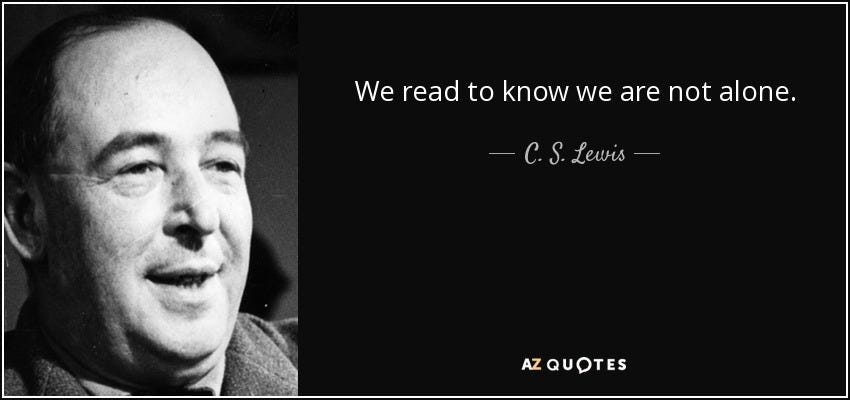
Happy Read Across America Day! 28 years ago, the National Education Association held the first Read Across America Day on March 2nd to coincide with Dr. Seuss’s birthday, as a way of celebrating and promoting literacy. This year’s theme is “Champion Kindness,” and the NEA website explains that this day is meant to, “Foster a culture of care and connection where kindness, empathy, and collaboration help everyone feel seen, valued, and included.”
The connection between reading and empathy has been much researched and well-documented by a wide variety of different fields of study. And, based on the research, there are many interesting ways that reading has been implemented to actually develop more empathy in people. An article from the BBC in 2019 explains:
“So the research shows that perhaps reading fiction does make people behave better. Certainly some institutions consider the effects of reading to be so significant that they now include modules on literature. At the University of California Irvine, for example, Johanna Shapiro from the Department of Family Medicine firmly believes that reading fiction results in better doctors and has led the establishment of a humanities program to train medical students.
It sounds as though it’s time to lose the stereotype of the shy bookworm whose nose is always in a book because they find it difficult to deal with real people. In fact, these bookworms might be better than everyone else at understanding human beings.”
The belief that “understanding human beings” is a vital pursuit seems to be coming up against some mighty headwinds of late. The desire to understand something or someone has to begin with the basic premise that the focus of study is interesting or important in some way. I worry that humans are starting to lose affection for the limited, finite, awkward, and frail human race. Perhaps we no longer want to empathize with humans because that would mean admitting our own weakness, hurt, and vulnerability. Without empathy we can’t truly be kind to ourselves or each other because we can’t accept our shared struggle with compassion.
As Artificial Intelligence has become so incredibly advanced, humans can start to look a bit like carriages at the advent of automobiles. In the same way that we used to outsource our most annoying chores, like the washing of dishes and clothes to machines, we are now asking machines to do our writing, reading, and thinking for us. It becomes easy to imagine that the pursuits, efforts, passions, and struggles that make us human are too difficult, boring, or pointless to do when they can be done for us.
For instance, my Gmail’s AI used to suggest a word or two for me to send as a response to emails that I was beginning to craft my response to, but a couple of weeks ago, an entire email popped up as a suggested response. All I had to do was accept the suggestion, and my entire email with salutations, well written content, and perfect grammar would be off my to-do list. More and more we are unsure if the person on the other end of a keyboard or phone or even drive-thru speaker is actually human. We are so impressed by what machines can do faster and with more accuracy than we can that we begin to feel silly for struggling to do it ourself. Why should I tax my slow brain for the perfect word to describe my day when this machine can think of a thousand? Why should I feel badly about my inability to construct a thoughtful analysis of a book, or even read and try to understand the basic information presented in the book, when this very nice machine wants to do that all for me? Why paint a picture, sing a song, or write a poem?
The “why” brings us back to where we began. If we take the time and effort to write and read, then we can know we are not alone. If a human being can do something beautiful, overcome something painful, experience something supernatural, than it is possible for all of us, and then none of us are alone in the living of this life. The creative works of humans, and books in particular, remind us that none of us have to figure life out, or explain it, or improve it by ourselves. Reading is uniquely suitable for making us feel empathy towards others and to feel empathy from others because it invites us to jump into another person’s world, brain, and heart.
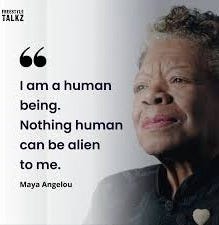
Maya Angelou was an exceptional writer and reader, and she sometimes spoke about the quote pictured above by a Roman poet named Terrance. She eloquently explained how important it is for people to read about other people so that they are wise to avoid the frailties we are all subject to and are encouraged to reach for the greatness of which we are all capable. When we read a cautionary tale about a human doing evil, we grapple with the uncomfortable truth that we might also commit that same evil. When we read a heroic tale, we are are also challenged with the truth that we are just as equipped to daring deeds. Nothing human can be alien to me.
Another way that she beautifully expressed the power of reading to create an empathetic connection between humans is in her story about growing up in the wake of terrible trauma and finding understanding from an unlikely source. She talks about reading the works of William Shakespeare as a girl growing up in poverty in the segregated south after a horrifying rape at the age of 8. As an adult, she would sometimes say in those childhood years she had thought that maybe Shakespeare was a black girl who grew up in the south because he seemed to understand her so well. The process by which she began to speak after years of living as a mute was to first voraciously read everything in her school library and then to decide that she wanted to recite the words that had healed so much of the pain that had caused her silence.
Maya Angelou is one of those humans that makes humanity seem incredibly important. Though she is no longer with us physically, her words remind us of all that we have to gain from embracing the idea of our shared humanity and the great love that God has for us as precious children. There is one particular interview where she is brought to tears thinking of how monumental it is that the same God that made all of creation, and is powerful beyond measure, loves her. It is a moment that I love to re-watch when I need to remember that humans are made in the image of God and are precious and beloved by their creator. We may fall into the trap of feeling small and clumsy compared to our created machines, but we can be reminded of our great importance by looking through the eyes of our creator.
In the bible verse Ephesians 2:10, it says, “For we are God’s workmanship, created in Christ Jesus to do good works, which God prepared in advance for us to do.” The Greek word for “workmanship” is poiema which can also be translated to “masterpiece” and is where we get the English word “poem.” So, the idea could also be that we are God’s masterful poetry created to create more good poetry. When we write, and when we read each other’s writing, we are accepting the invitation to do the good work we are created to do. This good work is for us to do, and though it is sometimes difficult and time-consuming, it is never something that should be seen as an inconvenience to outsource. When we refuse to write, and read, and think, we lose the ability to understand ourselves, each other, and our creator.
We know that God uses narratives to make sense of the supernatural and natural world for humans throughout scripture. It seems that God created us to understand and speak in stories. Madeline L’Engle called Jesus, “God who told stories” because so much of his ministry was speaking parables to explain things that were too big for people to understand in any other way. Not only does reading help us to know we are not alone, it helps us to know who we are, what we are here to do, and the one in whose image we are made.
No posts
Comments
Nothing yet. Say the first thing.
Sign in to join the conversation.