
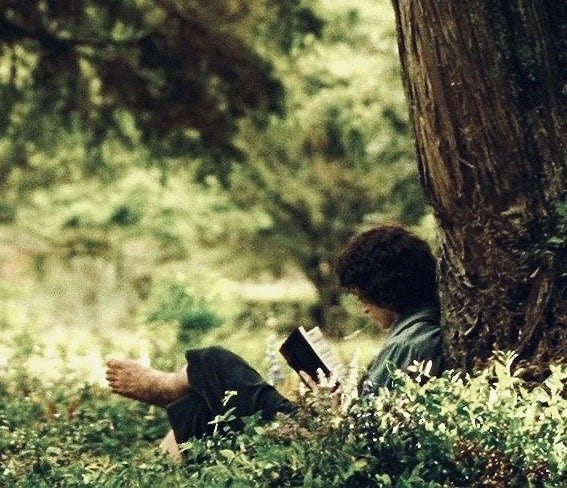
I was an undergraduate student when I first fell in love with J.R.R. Tolkien and his stories of Middle-earth. I was an English major when I first saw the films of The Lord of the Rings trilogy, and I was unsure of what to expect since I hadn’t read any of Tolkien’s works yet. I was transported by the world and transformed by the story. I have loved the trilogy of movies and re-watched them regularly over the years. In my last year of college, I jumped at the chance to take a class on J.R.R. Tolkien and C.S. Lewis. The stories of Middle-earth spoke to me as a twenty-something English student, and now, as a middle-aged English teacher, I have an even deeper appreciation of Tolkien’s work and the man himself.
One of the things that deeply inspires me about his story is that he shared my struggle and joy in teaching English Literature to young people. And, like me, he often felt overwhelmed by the burdensome task of grading piles of student papers. The story of how he began to create his incredible fantasy world of Middle-earth is that while he was grading, he wrote the first line of what would become The Hobbit: “In a hole in the ground there lived a hobbit.”
It took him approximately seven years from that first sentence to the publication of that novel. He was a husband and father in addition to being a professor, and his time was pulled in many directions. As a wife, mom, and teacher, I relate to the struggle to find moments to dedicate to writing. I often feel that my season of life is one of caregiving and helping others to grow and develop. That has been the great gift of starting to write again on this platform: I’m reminded of myself as a creative. It is a gift to have an opportunity to write my own stuff, but it is not at all easy to prioritize, and I appreciate that Tolkien also struggled with this balancing act.
Something particularly hopeful about Tolkien’s writing process is that he was ultimately helped and inspired by his family and his teaching as he created his stories. His relationship with his family was especially enriching to his imagination, as The Hobbit was originally developed as stories he told his four children, and his wife and friends were often muses for the characters he invented. This reminds me that though my family, friends, and students demand my attention, they also give me many gifts that deepen my thinking and writing.
It did not only take Tolkien seven years to write that first novel because he was busy; he was also slowed by his confirmed struggle with perfectionism, which caused him to endlessly revise, rework, and rewrite. While his dear friend C.S. Lewis flew through the writing of many books, Tolkien hesitated to commit to any finished product. He was 45 years old when The Hobbit was finally published. Now in my forties, “That is an encouraging thought,” as Gandalf told Frodo. I find such comfort in the idea that this brilliant man lived with uncertainty about his ideas and words.
The Hobbit was an immediate success, but he didn’t know that would be the outcome during the years he was writing it. He had the same lack of guarantee that we all have as we show up to write. And, even after the success of The Hobbit, and knowing that people and publishers wanted more of this world he created, it still took about twelve years to develop and write what became The Lord of the Rings trilogy. The external chaos and internal uncertainties that slow the writing process for so many of us who seek to create in these dizzying times may find a hopeful example in the endurance and resilience of Tolkien’s creative process.
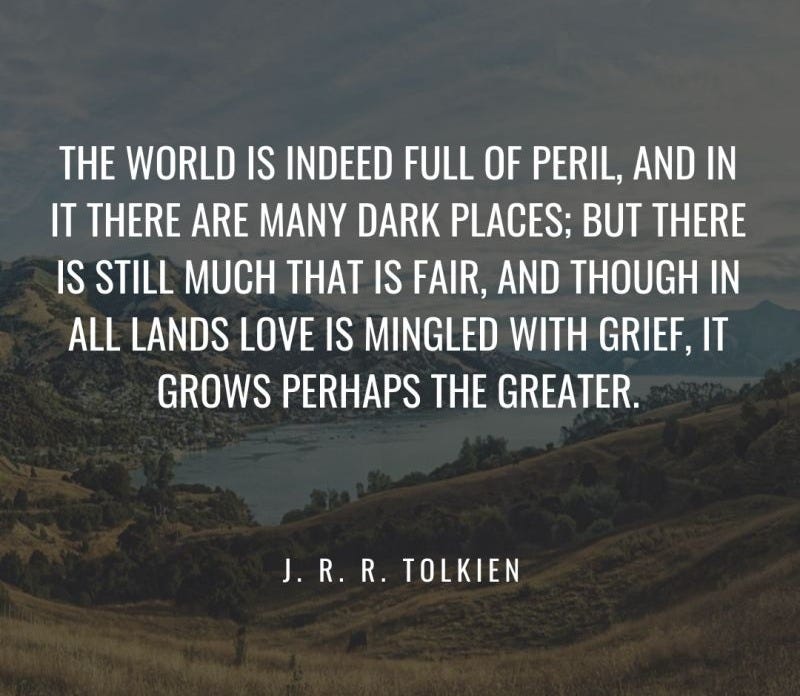
I’m so grateful that Tolkien fought to overcome everything that made his writing slow and challenging because the stories he put into the world are full of hope and help for dark times like the ones we are living in today. And, his are not simple platitudes offered from a man unacquainted with sorrow, but rather profound truths from a man of faith who lived with multiple traumas and losses.
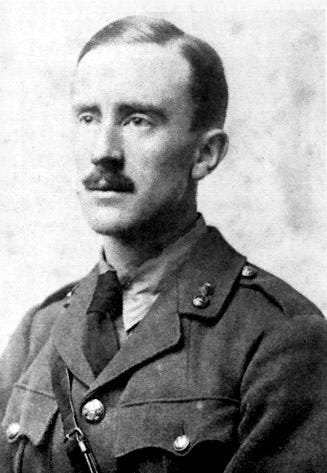
As a soldier in World War I, he experienced terror and tragedy. He said that “by 1918 all but one of my close friends were dead.” So, when he speaks of “peril,” “dark places,” and “grief,” he knows of what he speaks. Another reason that The Lord of the Rings took so long to complete and publish is that England entered the Second World War in Tolkien’s lifetime. How unfair it must have felt to believe he had experienced “The War to End All Wars,” just to see the same sides engage in another war 20 years later. He worked as an air raid warden, and two of his sons were sent into combat just as he had been at their age. By all accounts, and understandably, he was horribly worried about them after losing so many friends and becoming terribly ill from trench fever himself. And, though both sons survived, his son Michael was described as never being the same.
Reading Tolkien in the 21st century makes him seem prescient of the shadows we would experience in our time. Perhaps he simply understood that there would always be shadows and a need of light in every generation. One gift of the fantasy genre, which Tolkien did so much to expand and even create, is that it can be applied to any time and place. The shadows that cross Middle-earth can be equally relatable to people enduring World War I, World War II, or the multiple wars of today. Our own environmental destruction, greedy violence, and unfettered rise of technology are all easy to apply to the circumstances that Middle-earth faces. Though Tolkien often argued that his stories were not allegorical, they are certainly applicable. This young century has seen a global pandemic, decades-long wars, racial injustice, and terrible greed that have led to the destruction of precious resources and the death of people who are deemed unimportant.
These are not days for simple Hallmark-card sentiments about how things will work out in the end, based on some vague sentimentality. And this is why Tolkien is such a lifeline. He provides a clear-eyed argument for what is good because he had seen the encroachment of evil. This is a man who loved nature so much that he created a race of ancient trees that had the power of speech to argue for the protection of the forest. He wrote about the bonds of fellowship that were crucial for survival between races/species that had long hated and mistrusted each other. One of his characters argued that “If more of us valued food and cheer and song above hoarded gold, it would be a merrier world.”
The things that Tolkien saw as dangers were not just called out, but also given an alternative. The heroic characters are flawed and tempted by evil, but they are also given the desire and ability to overcome. These books may save us from the despair of seeing forces that feel too big to fight by giving us faith in the power of small things. As Galadriel says to Frodo, “Even the smallest person can change the course of the future.” And, again, this is not a sweet thought, but a prophecy of what Frodo and Sam would go on to do in the fires of Mordor.
When Frodo first sets out to destroy the One Ring, he says, “I will take the ring, though I do not know the way.” As a parent and teacher living in these times of rapid change, powerful weapons, and wide-spread malfeasance, I often do not know the way to react. There is intentional messaging that small people should just live with the shadows and keep trying to do the best they can with the bad hands they’re dealt. This is why hobbits are such a gift. They don’t just have a lot of heart and save people with a song and a little bit of luck like plucky Care Bears, they struggle to the point of near-death, but are victorious because of their resilience, faith, and dependence on each other.
A major source of their courage comes from the stories that they read and were told as children. Sam tells Frodo that people will one day read their story and be encouraged to fight their own battles, just as they were inspired by the stories they read as little hobbits. This is all deliciously meta, of course. This is why I love the picture of Elijah Wood as Frodo reading a book under a tree that is at the top of this post. The very first thing we see the hero do, at the start of the first film, is to read a book. Sam reminds him of these books on their journey when things are bleak and seem most hopeless.
“It’s like in the great stories, Mr. Frodo. The ones that really mattered. Full of darkness and danger they were. And sometimes you didn’t want to know the end. Because how could the end be happy? How could the world go back to the way it was when so much bad had happened? But in the end, it’s only a passing thing, this shadow. Even darkness must pass. A new day will come. And when the sun shines it will shine out the clearer. Those were the stories that stayed with you. That meant something, even if you were too small to understand why. But I think, Mr. Frodo, I do understand. I know now. Folk in those stories had lots of chances of turning back, only they didn’t. They kept going, because they were holding on to something… That there is some good in this world, and it’s worth fighting for.”
The decision to be courageous in the times that they are given is one that each heroic member of the Fellowship of the Ring must make, and is the one the audience is also encouraged to make. The word “encouragement” means to give someone courage, and that is why the reminders of the brighter sun coming after the passing shadow are so important. If we can’t imagine that things can be better, then we can never fight for that better world. If the fight is already lost, then we can all just go about our day and let powerful forces do what they will with our world.
But Tolkien also reminds us that fighting for the sake of fighting is also a trap. We are not called on to overpower with brute force, but rather to show our courage by showing heart. The word “courage” comes from the Latin word for heart, which is “cor.” It’s why we tell people to “take heart” or not to “lose heart” when they are discouraged or scared. Vulnerability expert, Brene Brown, reminds us that “Courage originally meant ‘To speak one’s mind by telling all one’s heart.’”
While the enemy in Middle-earth is creating fighting machines in the form of Uruk-hai who are bent on destruction and will fight each other as quickly as they’ll fight their enemies, the heroic side is committed to each other as friends, show each other deep love and devotion, and openly weep for each other’s pain. In one scene, Aragorn brings courage to the armies of men about to fight by giving them these words:
“Sons of Gondor, of Rohan, my brothers! I see in your eyes the same fear that would take the heart of me. A day may come when the courage of men fails, when we forsake our friends and break all bonds of fellowship, but it is not this day.
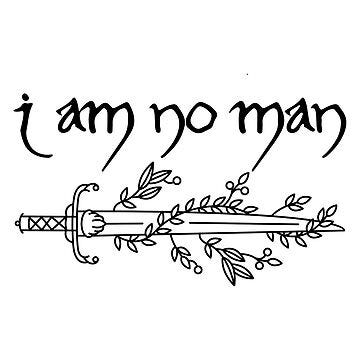
In Middle-earth, these brave humans are called the race of “Men,” and here Aragorn calls the soldiers “brothers.” This creates the context for one final (for this post) point of gratitude I have for Tolkien. As a devout Catholic with a profound reverence for Mary, a man repeatedly inspired by his wife, and a father of a beloved daughter, he creates a moment in which Lady Eowyn is revealed to be the person destined to kill the Witch King. The evil creature believes he is immortal because of a prophecy that no man can kill him. And, Eowyn can declare herself to be “no man,” as she and Merry, the Hobbit who is too small for his armor, can defeat this evil.
When my daughter read a book or watched a movie, she would sometimes ask me where the girls were. We all need to see ourselves reflected in the stories of mighty heroes. Even in writing this post, I sometimes got nervous because I know that there are Tolkien scholars here on Substack and those who take his stories very personally. But I appreciate that his work, like all great books, is for everyone. Each person who reads Tolkien may be saved from some of the fear of the shadows they face, and may be encouraged to pick up a light and carry on. And, “that is an encouraging thought” for all of us.
No posts
Comments
Nothing yet. Say the first thing.
Sign in to join the conversation.