
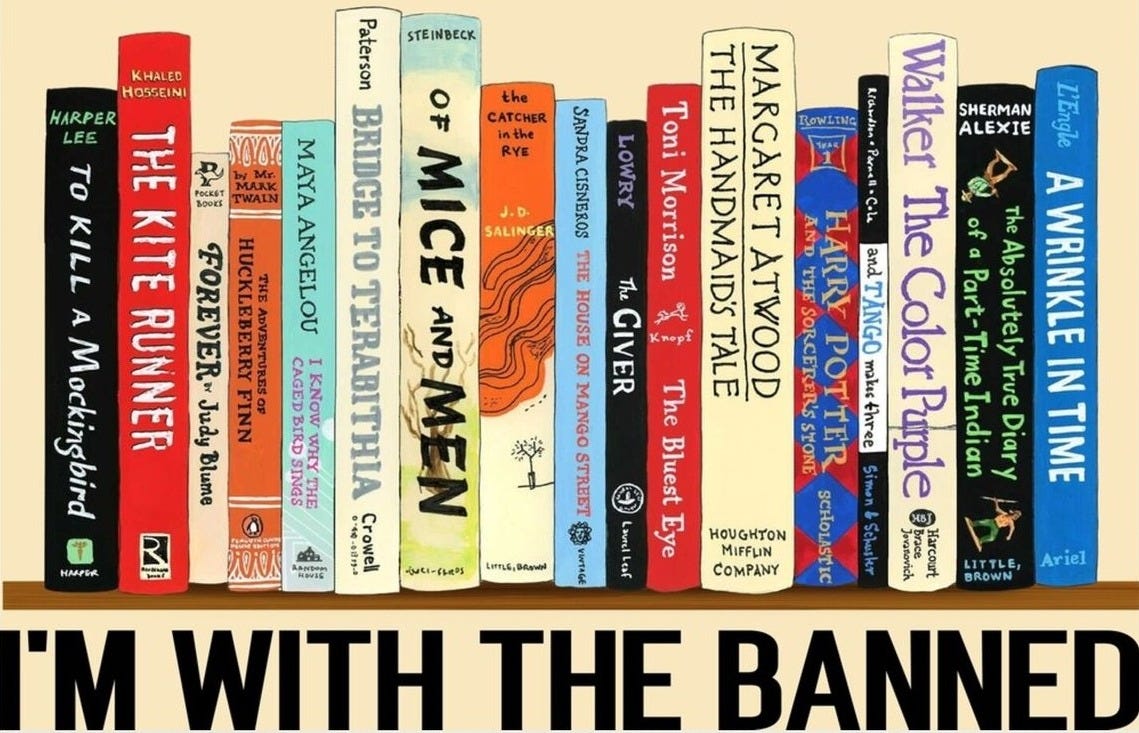
I’ve been trying to digest the mix of terrorizing and inspiring news out of Minnesota the last couple of weeks. I was trying to figure out how books may save us from the hopelessness and helplessness we feel when we see people have to take to the streets to fight for their rights. As I did some writing, I was convinced again of the power of books to help us resist oppression and fight for a better world. Because readers are so often empowered and equipped by their reading, tyrannical regimes have consistently burned and banned books when coming to power. Thus, reading is a crucial act of resistance.
That train is never late.
I remember watching comedian Chris Rock perform a particularly astute, challenging, and hilarious stand-up dealing with the repetitive nature of racist rhetoric, and he came to the observation, “That train is never late.” It stuck with me because it’s such a great way to describe the predictable patterns of history. These repetitive cycles can sometimes feel as consistent as a train schedule.
Thanks for reading! Subscribe for free to receive new posts and support my work.
One way we see these reliable patterns is that the rise of oppressive regimes often have certain shared characteristics. There is no playbook exactly, but there are certain plays that get used again and again. One of the paramount steps that tyrannical rulers consistently employ is the banning of books.
One of many examples of this happened shortly after Adolf Hitler came to power in Germany in January 1933. Holocaust Encyclopedia describes that this particlar episode of book banning came in the dramatic form of mass book burnings:
“In May 1933, book burnings took place in more than 20 university towns and cities across Nazi Germany. The Nazi government supported—but did not organize—these book burnings. They were the initiative of German university students. During these events, students threw tens of thousands of books into bonfires. The book burnings symbolized the Nazis’ desire to remake German culture in accordance with Nazi ideology.”
The books were burned because their content went against the party line, and because they were written by people who were considered enemies of the state, but they were not destroyed by the leaders of the regime. It’s particularly disturbing to think that students who were supposed to be embracing an education provided by books were the ones taking the initiative to throw books into the flames. Hitler had only been in power for three months, and yet these young people were completely sold out to the idea of their world being made in his image. The ideology was disseminated by the government, but it was enacted by the people who willingly renounced their own access to books, words, and ideas.
There are many reasons books become targets in oppressive regimes, but they can be summarized by the understanding that books are much more than they seem. Though often overlooked and ignored, they are actually the ultimate form of non-violent protest and resistance to control. If people read, then they can form their own ideas of what is right and wrong, and they have the words to voice these beliefs. Books also challenge us to see each other as equal humans with equal rights, needs, and emotions. This empathy destroys the ability of the powerful to separate us from each other. The students who were taught to destroy books in Nazi Germany were first trained to mistrust, fear, and hate the authors of ideas different than their own.
It is disturbing to think what Hitler’s propaganda machine could have done with our modern social media. In 2025, the “Oxford Word of the Year” was “rage bait.” The idea of rage-baiting is that people are exposed to constant stimuli in order to elicit rage towards whatever is being discussed. The “bait” can focus on any group, idea, or problem, and the audience is the fish waiting to be hooked. Once we take the bait and allow ourselves to be enraged by the presented information, often concerning who to blame for all our problems, then we will engage in the ecosystem of the bait’s content creator, and ultimately make them money and give them more power. If we can become angry and engaged enough, we will allow those we “follow” to tell us what we think and what we should do. We will happily burn the books written by people with the “wrong ideas” who are “ruining our world.”
The words we need to think
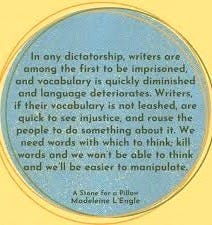
Madeleine L’Engle gave many warnings such as the one above. She had firsthand experience with being feared and hated by audiences consumed by “rage-bait.” Her much-loved book A Wrinkle in Time, has been banned and challenged many times since it was first published in 1962. Though L’Engle was a professed Christian, her work has often been criticized by religious thoughtleaders who believe it blurs the lines between good and evil. Her work has been feared because it is complex and challenging. Though she lived her life as a follower of Jesus, her faith was and continues to be questioned and condemned for looking different than the accepted dogma of powerful people like Jerry Falwell. Though this was personal for her, she often wrote about the ways that restricting books injures us all. One of her gravest concerns was about the destruction of our language that results from such book bans.
It is widely acknowledged that reading is the best way to improve vocabulary, and vocabulary enables us to understand the world around us, process our emotions, engage in critical thinking, develop imagination, and fight for the world that we want to create.
In George Orwell’s oft-banned dystopian classic, Nineteen Eighty-Four, language is reduced to remove words such as “bad” so that there will be no dissatisfaction with or rebellion against the party in charge. Without the ability to use specific, correct language to describe our lives, we cannot even fully experience them. Other regularly banned dystopian novels, Brave New World and Fahrenheit 451, also feature book bannings and burnings in the service of those in power.
These are books that we English teachers routinely assign to students to warn them of the danger of losing language, yet these students are also growing up in a culture where Dictionary.com chose “6-7” as the “2025 Word of the Year.” Two numbers that are not words and have absolutely no meaning were selected as “Word of the Year.” These same students call everyone from their mom to their teacher to their girlfriend “Bro.” If each person has the same name, how can they have distinct and important roles? If we lose the word for “jealous,” will we know that that’s what we’re feeling, or might we think we’re angry? If we don’t have a word for “angry,” might we merely believe we are hungry? If we say “it sucks” when we get a bad grade and when our grandma dies, do these things begin to feel equally painful? If we’re always “fine,” can we ever know that we’re actually struggling?
What if the pen actually is mightier than the sword?
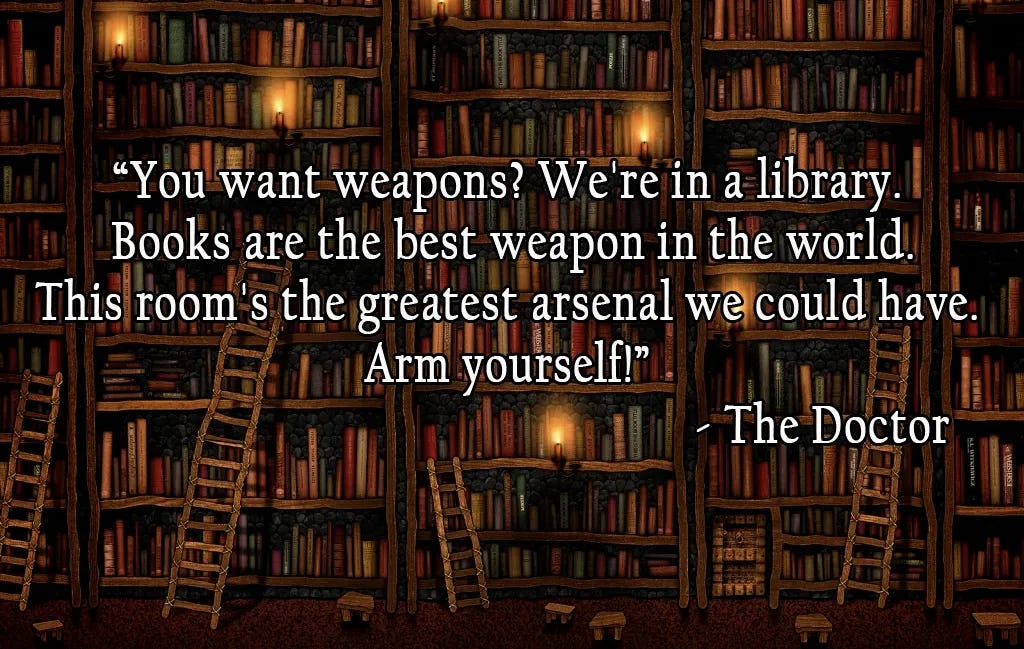
There’s a great episode of Doctor Who called “Silence in the Library,” in which a nearly invisible force is attacking a group of explorers, and they cannot figure out how to protect themselves, much less fight back. The Doctor, a brilliant alien who always helps humans out of supernatural jams with his knowledge and care, points out that they are trapped in a library, so all the help they need is at their disposal. It may seem like a quaint idea, but I think it’s actually a correct understanding of the situation we all find ourselves in now. We often feel overwhelmed and outmatched by the forces of insidious control, and we forget that we are surrounded by books that can empower us to fight for a better world.
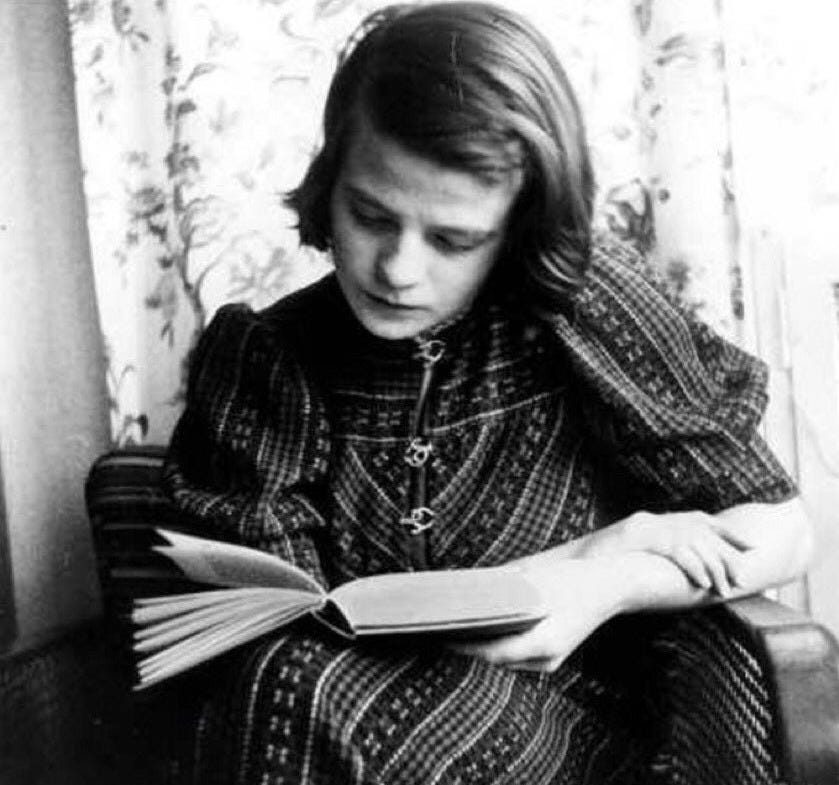
There were other university students in Nazi Germany besides the ones burning books. Pictured above is a personal hero of mine since I was a high school freshman assigned to do a life-changing history report. Her name is Sophie Scholl, and she was murdered by the Nazi’s infamous “People’s Court” who accused, tried, and executed “enemies of the state.” She was 21 when she was killed with two other members of the White Rose Resistance. They were discovered by the Gestapo after writing and publicaly distributing six leaflets that detailed the crimes committed by the Nazis. The leaflets also called for an uprising against the regime that had taken control of their country.
These university students believed in the power of writing and reading the truth to overcome the lies of the powerful. What made this group so dangerous was that they were insiders who were considered the perfect German youth. Some of them had served in the German military, been members of the Hitler Youth, and watched their neighbors disappear into camps. They could have chosen to burn or ban the information that threatened the dictator, but instead they read, studied, learned, questioned, and wrote down what they knew could bring down the regime. Ultimately, seven of this small group were killed, two years before the end of the war. It must have felt to them that they had failed. But today, there are national stamps, monuments, and movies made to commemorate them in the country they fought to save. They are considered heroes, and their names, unlike those who burned books a decade earlier, are remembered and revered.
After Sophie Scholl was killed, the Allied Forces found the final pamphlet written by the White Rose, and they dropped millions of copies of it over Germany from their bomber planes. The Allies used planes usually reserved for dropping bombs to release written manifestos from a small group of students that a recent article by the Oxford Press remembered as “voracious readers.” These forces fighting for freedom knew that no weapon could destroy oppression more completely than the written word, and no army could be stronger than a small group of bookworms willing to put their learning to work in the service of the others.
Thanks for reading! Subscribe for free to receive new posts and support my work.
Comments
Nothing yet. Say the first thing.
Sign in to join the conversation.