
Hello all,
We are very excited to be dedicating this week’s newsletter to sharing three more works by entrants into our inaugural flash fiction and poetry competition, which ran in December 2025.
Each of these works received an honorable mention from our judges, and we are thrilled to be able to share their work with our BookGo readers for the first time.
Just like our winner, whose flash fiction piece “The Envelope” was published in our last newsletter, these authors will also receive a development workshop with our team of editors, and we hope to see much more of them and their work in the future. Their pieces are printed below, along with the judges’ comments, author bios, and a short description of what inspired them to write these wonderful works.
We hope they inspire you too and want to issue a huge thank you to everyone who submitted their work as part of the competition. Keep writing, reading, and sharing your stories!
“The Disciplined Grass” by Nicolás Andrés Ferreiro-Saez
“Inanimate” by Gabrielle Sojourner
“Where Memories Lie” Itunu Taiwo

By Nicolás Andrés Ferreiro-Saez
The trimmers roar again. Their engines snarl with fury, cutting through the air that once shimmered with the songs of native birds. The chainsaws are gone, there are no more trees left to fell. They were sold, burned, or simply uprooted to “clean” the land. In their place, Brazilian grass now stretches its perfect green mantle. At first glance, it looks like a tribute to nature. A flawless garden, a uniform carpet beautifying the landscape. But it is nothing more than a mirage.
Ah, the grass—exotic, voracious, indomitable if ever left unchecked. Its ruthless growth demands discipline, at least a weekly cut. Who could imagine that this humble, ground-hugging plant becomes a threat the moment it dares to rise? The trimmer, then, becomes the guardian of this artificial order; an unrelenting tool replacing not only the extinct grazers that once roamed this soil, but also the chainsaw that stripped the trees of their place.
It’s ironic to think about the balance between the energy burned by the machine and the sunlight trapped by the grass. Who wins? Who loses? It doesn’t matter. In the end, all that energy is wasted within a closed system, unable to feed anything beyond itself. The grass absorbs the sun but never becomes forest; the machine devours fuel but creates no life. In this impoverished ecosystem, the humidity vanished with the trees. Biomass is lower, nutrients are swept away, and decomposition, the quiet engine of life, has been replaced by plastic bags full of lawn clippings. Carbon, once captured by the trees with skill and patience, now escapes into a soil too rushed to hold it. Everything is less; except the noise, and the constancy with which humans labor to preserve their illusion of beauty. Because the grass, ah, the grass, has its own revenge. It is beautiful, yes—but only when contained. At the first sign of insubordination, when it dares to lift itself more than four inches, it is swiftly disciplined. It cannot rise, cannot grow, cannot reveal its wild nature. It stands as a silent reminder of what once was, and what could still be, if only given space. The disciplined grass is the emblem of this new order: green, smooth, useless. A living carpet stretched over the emptiness left by the loss of a complex world. What did we gain through this illusion of control? What did we lose in our pursuit of perfection? Perhaps, in the end, the only thing that remains is the roar of the trimmer, echoing like the sound of our obsession to master the unmasterable.
What the judges thought…
We all knew after reading just the first line of this work of flash fiction we were on a stunning journey into the life of our front yard—the grass and its domestication. The piece is not only immediately engaging—essential in flash fiction—but also humbling. We were asked to think differently and more fully about that which we walk all over, the grass, and also imagine its future. Congratulations!
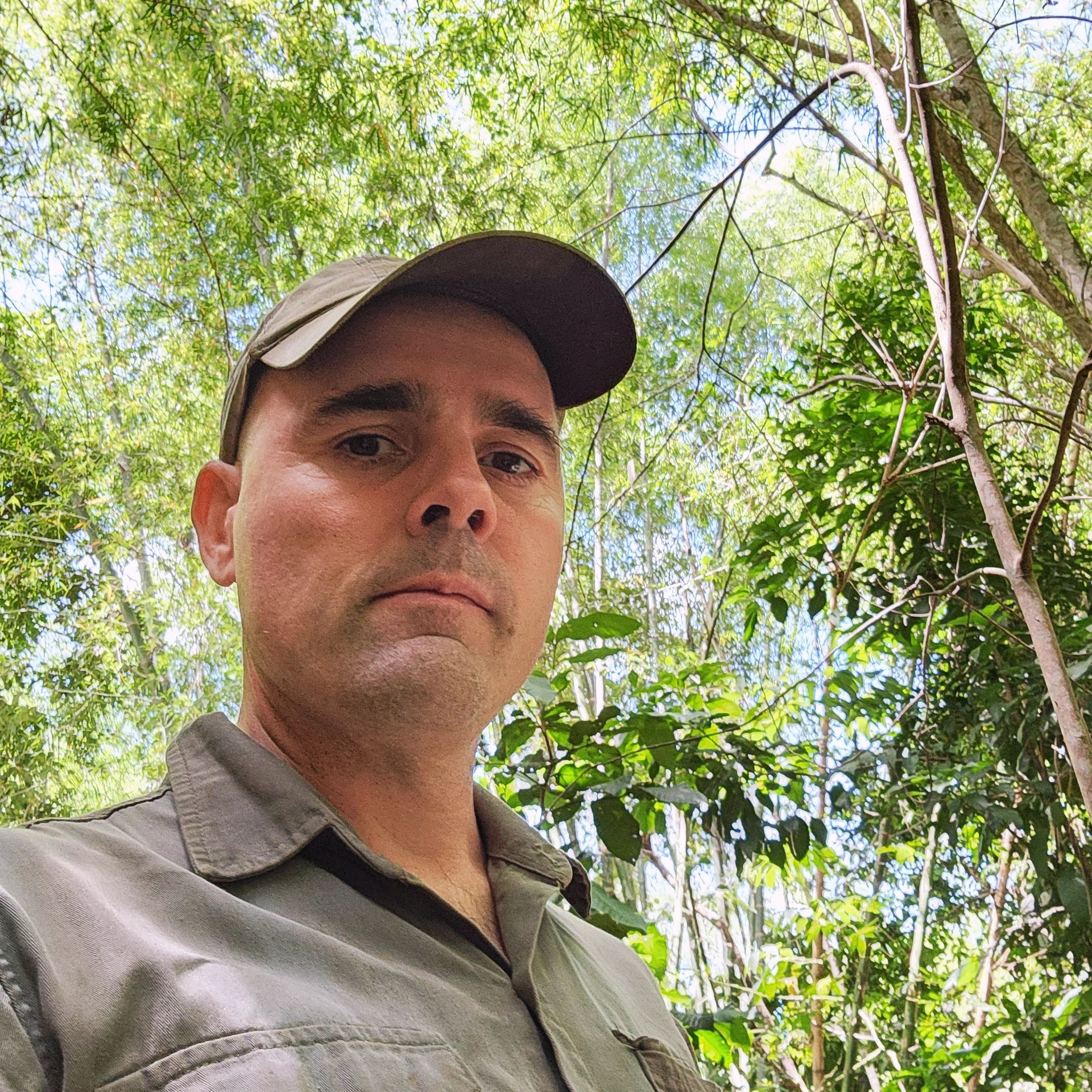
Nicolás Andrés Ferreiro-Saez is an Argentine writer and scientist whose research focuses on ecological restoration. His literary work emerges directly from his scientific perspective, particularly from long-term observation of degraded and managed ecosystems. He writes at the intersection of speculative fiction, environmental thought, and narrative essay, exploring how human systems of control transform landscapes and reduce complex ecological processes into simplified, regulated forms. His work frequently adopts non-human or systemic viewpoints to examine the cultural andmaterial consequences of treating nature as something to be optimized, disciplined, or replaced.
“The Disciplined Grass” was inspired by the ongoing deforestation associated with new residential developments in northeastern Argentina, particularly in the province of Misiones. In these areas, remnants of the Atlantic Forest are routinely cleared and replaced with Brazilian grass lawns—an exotic, invasive species in the region. These lawns are then maintained through constant cutting, chemical inputs, and labor, while residents frequently complain about the time, cost, and effort required to keep the grass under control.
What struck me was not only the ecological loss itself, but the contradiction at the core of this practice: an ecosystem that was naturally forested is forced into the form of a lawn, and then perceived as problematic for behaving as living matter rather than as a static surface. The grass becomes something that must be continuously disciplined in order to preserve the illusion of order.
The piece reflects on this paradox. The lawn appears green, clean, and “natural,” yet it is ecologically impoverished and functionally useless. It is a surface produced by erasing a complex system and then endlessly struggling against the biological tendencies of what remains. In this sense, the disciplined grass becomes a symbol of how domination over nature often disguises itself as care, aesthetics, or improvement.

By Gabrielle Sojourner
Text within this block will maintain its original spacing when published
The inky velvet box
Seemed so plush
Until he snapped it shut
To keep you
And you lost yourself
In the quiet that comes
With being inanimate
What the judges thought…
This poem is utterly gripping to the judges: it is delicate and direct, yet powerful. What is so compelling we find is that in a mere seven lines, the poem takes us into the transformation of a gorgeous, shining and vital piece of jewelry into a kind of death with its encasement in a box—as if it is no longer alive. And yet the reference to “he”, who snaps the lid shut, draws us into the poem’s world more closely and personally as the poem and the entrapment is directed at “you”. You, the jewel, are trapped and become an inanimate thing. This poem leaves us breathless with its concise beauty. Cheers!
Gabrielle Sojourner was born in Los Angeles and raised in Paris, France. She has published her short fiction and creative nonfiction in Flash Fiction Magazine and Braver Collective. She will reluctantly admit that she hoards books as much as she actually reads them.
You can find her on Substack writing her way into a life she loves in her newsletter, Sirop de Citron: Bringing Myself Back to Life.

This poem is inspired by my personal experience with domestic violence. “Inanimate” explores the suffocating nature of possessiveness in an abusive relationship.
In the beginning, you feel like a jewel—chosen, special, and cherished. However, an abuser never truly sees you as a human being. To them, you are merely a thing to be claimed. Over time, abuse robs you of your voice, your sense of self, and you end up as silent and still as an inanimate object.

By Itunu Taiwo
The market woke before the sun. Mist drifted above the zinc roofs as Eseohe arranged her jars—faintly glowing bottles of memories she could no longer carry. She began selling them after her husband died, when silence swallowed everything: his laughter, his footsteps, even the smell of his soap. Grief demanded rent. Hunger collected it.
In Ekuona’s Memory Market, people bought comfort the way they bought bread. Mama Kudi
sold laughter; Baba Onome sold first rains. Eseohe sold love.
Her first customer arrived at sunrise—a man with a trembling mouth. “How much for a memory of love?” he asked.
“Love has no fixed price,” she said. She lifted a jar whose light pulsed weakly. When she opened it, the scent of rain and clay escaped—her husband’s laughter brushing the air. She sealed it quickly and handed it to the man.
Another trade. Another ache.
By noon, heat shimmered through the square. Then came the girl—barefoot, cowries clicking in her braids, clutching a cracked phone like a toy. “Aunty,” she whispered, “do you have a memory of love to spare?”
The question pierced something inside her. “Who sent you?”
“No one. I just want to know what it feels like. Mama says love ran away before I was born.”
Eseohe looked at her jars. Her hand stopped at one she rarely touched—the memory of her
husband combing her hair after their wedding. He had whispered, Love remembers you even when you forget yourself. “You can have this one.”
“How much?”
“Pay with a song.”
The girl hummed softly, and when she ran off with the jar, Eseohe felt the familiar hollow widen.
Days blurred. Soon, only one jar remained—a large one swirling with gold. It held the day her husband built her a clay house with mud-streaked hands, telling her, Hope keeps the living alive.
A man in a frayed suit paused. “How much for that one?”
“It’s not for sale.”
He placed more money than she’d seen in years on her table. Enough for food. Enough for
Survival. Her ribs throbbed with hunger. But when she touched the jar, she felt her husband’s hand against hers—warm, insistent, alive in memory if nowhere else. She pushed the money back. “Not this one.”
That night, she opened the jar at home. Light spilled into the room, soft as dawn. For a heartbeat, her husband knelt before her again, smiling the way he used to. When the vision faded, she let the last of the light drift out her open window.
At dawn, a knock pulled her outside. The girl stood at her gate, holding a small jar glowing with quiet fire. “Aunty,” she whispered, “I dreamt of a man building a house of laughter. He said to tell you thank you. And that hope doesn’t die… it just moves.”
Eseohe’s breath trembled. Morning unfurled around her in slow gold. For the first time in years, the world felt warm enough to remember her.
What the judges thought…
In the Flash Fiction, "Where Memories Lie", we are instantly transported into a magical market where memories are sold, memories of love. The language of the piece is powerful and poetic -- a great style to use to add depth to the brief encounter that is Flash Fiction! When we read the line..."Grief demanded rent. Hunger collected it..." we all stop to inhale the beauty of the author's phrasing. Indeed, we feel the author's work shows the full command of the art of Flash Fiction, gaining power from its brevity and its beauty. Hurrah!
Itunu Taiwo is a writer, educator, and pharmacist with a Master’s degree from University College London (UCL). She writes fiction and reflective prose that explore memory, faith, longing, and the quiet tensions of becoming. Her work often sits at the intersection of the spiritual and the everyday, paying close attention to language, restraint, and emotional truth. When she is not writing, she teaches and mentors writers through BuildWithWords Academy.

“Where Memories Lie” was inspired by my fascination with how memory behaves, how it lingers, costs us something, and yet sustains us. I wanted to imagine a world where memories could be traded like goods in a market, especially memories of love, and to ask what grief would demand in such a place. Underneath the loss in the story is a quieter conviction: that hope, in its smallest and most stubborn form, keeps us alive even when everything else seems lost.
You can read the winner of BookGo’s Flash Fiction and poetry prize in last week’s issue.
The BookGo Flash Fiction and Poetry Prize ran in December 2025. Authors were asked to submit a new piece of flash fiction or poetry on any topic, fiction or non-fiction,, up to a maximum of of 500 words. Thank you to all who submitted.
Comments
Nothing yet. Say the first thing.
Sign in to join the conversation.