
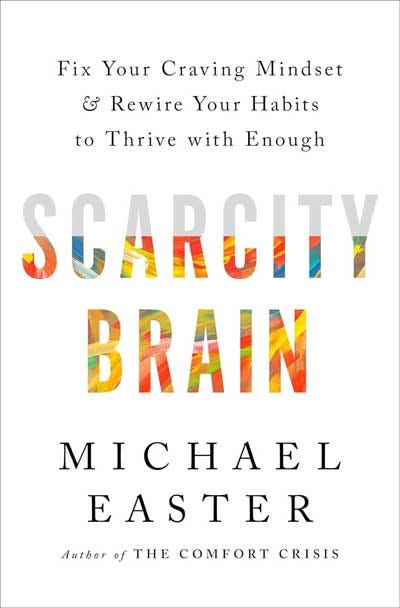
Scarcity Brain reveals why we constantly crave more food, stuff, information, and influence than we need. Understanding your evolutionary wiring can help you feel like you have enough.
Easter identifies a three-part mechanism he calls the “scarcity loop” that drives compulsive behaviors: 1) opportunity (a chance to get something valuable), 2) unpredictable rewards (you might win, you might not), and 3) quick repeatability (you can try again immediately). This loop explains the appeal of slot machines, social media scrolling, sports betting, dating apps, and overeating. Once you recognize this pattern, you see it everywhere. You can design your environment to break the cycle.
Our ancestors survived in a scarce environment because they grabbed every calorie, resource, and opportunity they could find. Today we have an abundance of everything we evolved to crave, yet we’re still wired to act as if we don’t have enough. The mismatch between our ancient brains and modern abundance shows up in obesity, shopping addiction, and doom-scrolling.
Our brains fixate on uncertainty. The possibility of a reward excites our dopamine system far more than a guaranteed one. This is why variable rewards are so addictive: the “maybe” keeps us engaged. Casinos, tech companies, and food manufacturers have all learned to exploit this quirk. Understanding this helps explain why we check our phones compulsively (maybe there’s something interesting) and why we struggle to stop eating chips (the next one might taste even better).
Easter argues that understanding why we crave more lets us shake our worst habits and appreciate what we already have. When he lived with Benedictine monks, he learned to treat happiness as a byproduct of things like helping others and activities that build self-understanding.
Identify your scarcity loops. List three behaviors you do compulsively (scrolling, snacking, shopping). For each, identify the opportunity, unpredictable reward, and quick repeatability that keep you hooked.
Add friction. Break one scarcity loop by making it harder to repeat quickly. Move apps off your home screen, keep snacks in a cabinet instead of on the counter, or add a 24-hour wait rule before purchases.
Practice “enough” awareness. Before your next meal, purchase, or scroll session, pause and ask: “Do I actually need this, or is my scarcity brain talking?” Notice the craving without immediately acting on it.
“In the human brain, less equals bad, worse, unproductive, more equals good, better, productive. Our scarcity brain defaults to more and rarely considers less. And when we do consider less, we often think it sucks.”
If you like Book Freak you might like the Book Freak Deep Cuts Reading Club, a paid-subscriber benefit where each month I dig up a forgotten, public-domain book and turn it into a clean ebook edition, with a cover, a foreword, and a discussion thread. Join the club for $5/month or $45/year.
Book Freak is published by Cool Tools Lab, a small company of three people. We also run Recomendo, the Cool Tools website, a YouTube channel and podcast, and other newsletters, including Recomendo Deals, Gar’s Tips & Tools, Nomadico, What’s in my NOW?, Tools for Possibilities, Books That Belong On Paper, and Book Freak.
Comments
Nothing yet. Say the first thing.
Sign in to join the conversation.