
This is my monthly wrap up where I talk about some of my favourite things from the last month. What I’m reading, enjoying, looking forward to—sort of anything floating my boat.

The talk will be moderated by yours truly and I would love to see you there! You’ll find my review of the book below and spoiler alert: it’s beautiful, shattering, incredible.
Below is a rundown of every book I read last month. I’ll be adding a star next to my standouts, like a starred review where a star isn’t a 1 to 5 scale, it just means good!
Before the written ramblings, here is a video version of my monthly wrap up if you’re more of a visual person:
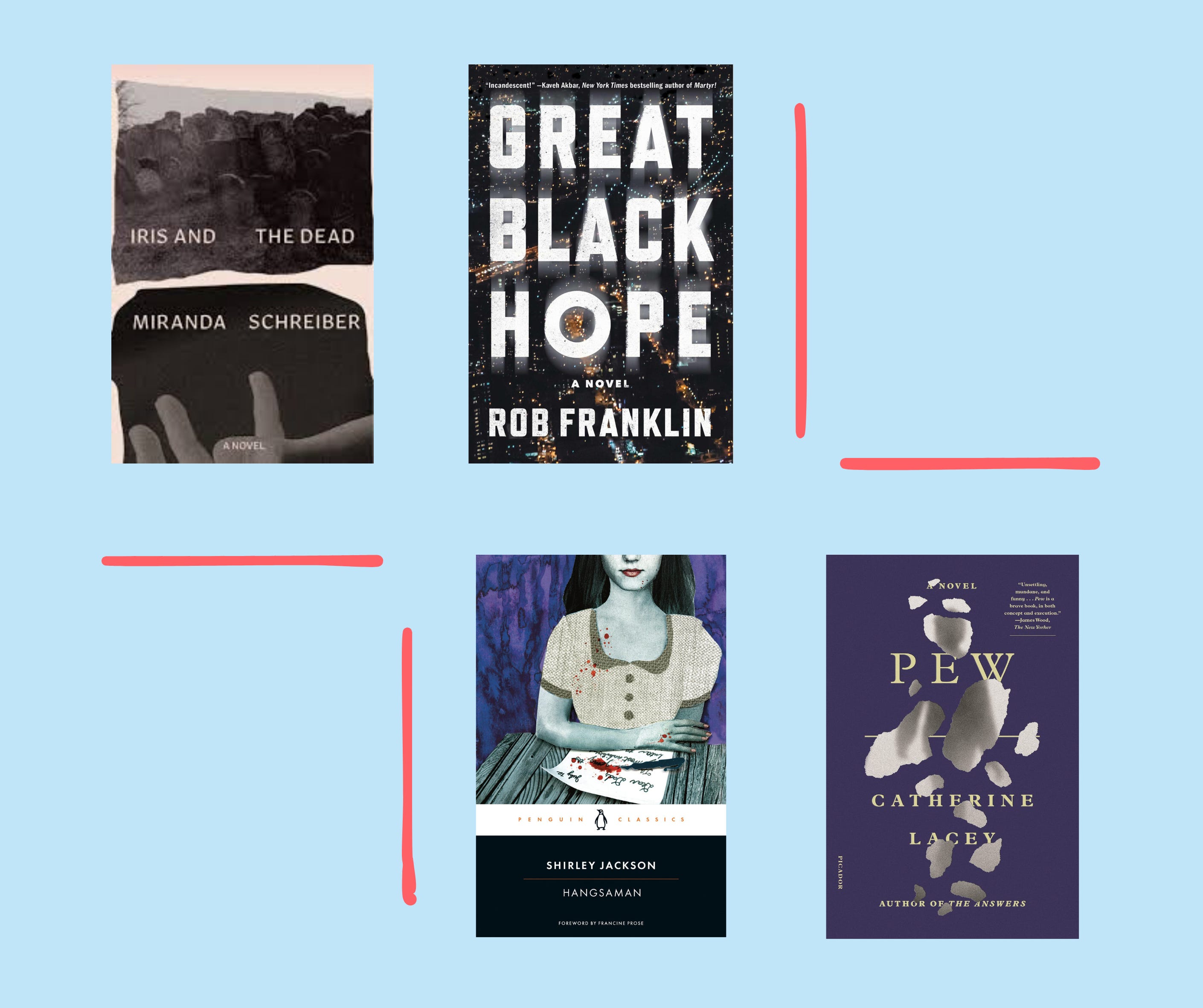
Iris and the Dead by Miranda Schreiber ★
I stumbled onto this little gem in a used bookstore, and I’m so glad it came home with me. It’s a hazy recounting of an imbalanced relationship, a coming out and a struggle with mental health.
This book is told from the perspective of a narrator looking back on her young life through vignettes. It recounts her coming out as a teen, falling for an older counsellor she’s seeing, and finding her way through the fog of depression… all at once.
There was this really palpable thirst for connection that any queer will recognize in their young selves. She feels a spark of commonality and it ignites something in her that feels so loud in contrast with the dim whisper of her world.
She writes about this first queer experience (a damaging one from the jump due to the counsellor-patient relationship dynamic) in a way that leaps off the page. To love someone so completely that you all of a sudden feel incomplete. To love someone that rides your desire like a bus, hopping on and off at their leisure. It was all so poignant.
While writing these diary entires for you, I tried to deny the feeling I had for years that I seemed to have lost my mind. Every sentence anticipates my fear that you will figure out that something is missing from me.
p.45, Iris and the Dead
There’s a rhythm to this novel that takes a second to follow, but once you do it flows really nicely. It jumps around time and place, there are diary entries and fourth wall breaks, but everything is snappy in a really satisfying way.
It reminded me of my favourite book, In the Dream House, for many reasons. I loved this.
Great Black Hope by Rob Franklin
This is a novel about many things, but my favourite part was the grief and the way it left scattered leftovers all around the narrator’s life.
We follow Smith, a young queer Black Stanford grad, who gets arrested for cocaine possession in the Hamptons. This happens just weeks after the death of his closest friend who was a New York socialite and a member of the Black elite.
The tug-of-war that ensues between race and class is fascinating. The class he’s part of gives him access and protection and privilege, but his race can strip those things away in the same breath.
The two tracks we follow are the grief and entanglements from his friend’s death, and the legal system and recovery program that throw a wrench into his life. While I found both of these things very interested, the balance was a bit off to me. It’s almost as if this could’ve been two separate novels.
Don’t get me wrong, I enjoyed this! It was thought-provoking and interesting, but I think the author had so much to chew on that it did a disservice to the brilliant writing and incisive cultural commentary.
Hangsaman by Shirley Jackson
I’ve read some Shirley Jackson in the past, but I don’t remember much about those experiences. I was pleasantly surprised by this one!
This is the story of a teenage girl over the course of a some challenging months in her young life. She has overbearing, messed up parents, and, unbeknownst to them, she goes through something traumatic right before leaving for college. Intense social dynamics and power struggles squeeze her uniformed shaped. She is at the mercy of her classmates and teachers.
”Weird Girl Lit” is a term people throw around a lot, and I think Shirley Jackson is one of the original weird girl lit stars. This protagonist is spunky, strange, interesting, and her inner monologue is a dizzying ride down a spiral.
I read the first 100 pages of this in one sitting, unable to put it down for sleep. The horror Jackson explores in this is the mundane. The real world can be so scary, she doesn’t need creaky floorboards or the crackle of nearby branch to give a goosebump or twelve. Around the 75% mark, I found this to lose steam, but that could be because of how strongly I felt it start.
I’m happily on the hunt for more Shirley Jackson as of now.
Pew by Catherine Lacey
I’ve only ever read Biography of X by Catherine Lacey. I waited a very long before reading more of her work because I knew the expectation that novel set would be impossible to meet.
Pew is about a person found sleeping in the church of a small tight-knit village in the American South. The community is faced with a person of unclear gender and race, and someone who doesn’t seem to speak. They name them Pew.
The entire village is preparing for a festival happening in a week, and they trade off caring for the narrator. Faced with this mute, nebulous presence, all who encounter them spill their guts. It’s like Pew is a mirror for the best and worst parts of all these people. Their care and the obligation they feel, but also their secrets and clear annoyance at their presence.
At first, Pew is the main point of the interest of the story, but slowly the slightly unsettling things happening in and around the village take over. This community’s layers are peeled back through Pew’s eyes.
I really loved the idea of this novel. How does one comment on race, class, religion, sexuality, when your narrator has none of those things? A fascinating exercise that’s very well executed here.
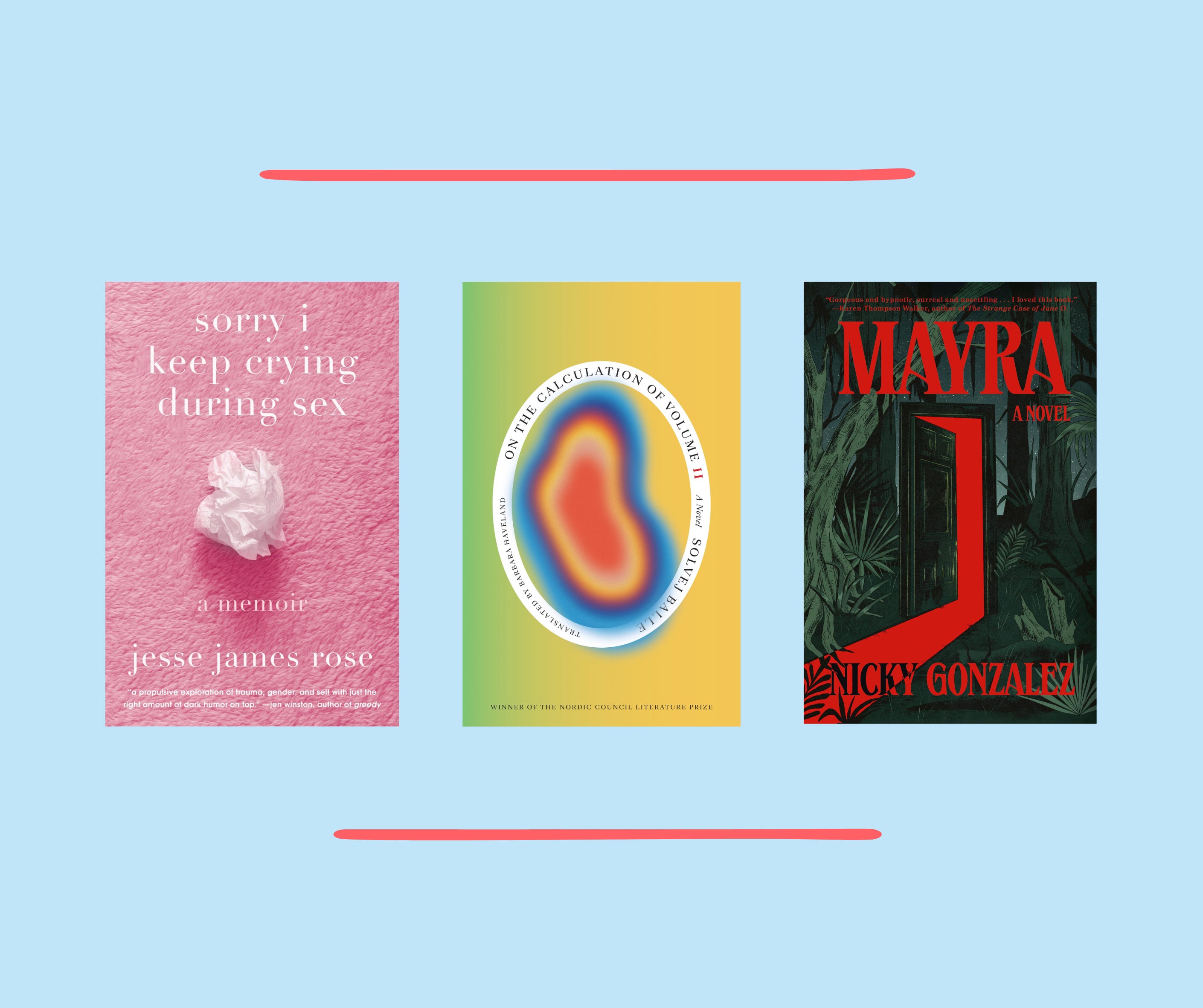
Sorry I Keep Crying During Sex by Jesse James Rose ★
Incredible, unlike anything I’ve ever read, bold, necessary… I will go on, but I have to be open about the fact that I am good friends with Jesse and witnessed her write most of this book.
Biased? Sure. Able to recognize great writing and impactful storytelling regardless of a personal connection with the writer? Hell yeah.
This is a literary memoir that breaks all the rules. It’s experimental and sharp, but the emotional through-line is so loud. Jesse braids together healing from trauma, coming into herself and losing her grandfather to illness, to create a resonant story of a person finding her way through.
From sex parties to conversations with Osama bin Laden, and a few hellish SoulCycle classes, this is a jaunt down triggering territory but you are held the entire way. The shape this story takes is unlike anything else, but the narrative arc is strong enough to follow even if you don’t love experimental books.
Do yourself a favour: pick this up and come see me talk with JJR if you’re in Montreal!
On the Calculation of Volume II by Solvej Balle (tr. by Barbara J. Haveland) ★
The second in a series of 7 books about a woman trapped in the same day, November 18th, that she lives over and over and over again.
The first instalment in this series was so internal. It was all about her struggling with her predicament and understanding how it all works. There was so much emotion and interiority and loneliness.
In this second book, all of that has an additional and external layer. Tara interacts with more people and things, and lets them shape her days. She is also chasing the seasons all over Europe to recreate the ebbs and flows of her years before being trapped in time.
This volume, unlike its predecessor, doesn’t examine love and marriage. It digs into material things and their place in her world. When she eats, what is left over? When she puts on a new dress, will it stay with her? It’s a new way to think about her place in the world as she floats around in time.
At this point, reading this feels so smooth and natural. I’m so invested in Tara and her days (well, day) that this novel zipped by. I barely took notes. I think every single one of these 7 novels will redefine the way she experiences her circumstance, making it feel new all over again. This series is a fantastic idea and the execution matches.
Mayra by Nicky Gonzalez
I read this book right before the of October in the hopes that it would keep the spirit of spooky season alive until the very end. It’s pitched as an unsettling literary horror set in a remote cottage in the swamplands of Florida. Naturally, I was interested!
We follow Ingrid, a twenty-something still living in her hometown, as she goes about her days with apathy. She’s about to go on a first date when she gets a call from her oldest friend she lost touch with. That friend, Mayra, invites her to her to a cottage just a few hours away. Ingrid goes with apprehension, and her doubts are confirmed when she arrives to find it’s actually Mayra’s boyfriend’s family cottage. She is in a secluded house, an hour from any hint of civilization, with a man she’s never met and a woman she hasn’t spoken to in years.
The setting, the premise, the scaffolding, all of it was delicious. We really feel this tight coiling from Ingrid as she find her friend completely changed and notices her boyfriend seems a bit off. This just didn’t hit it out of the park on an executional level.
I think where it lacked was the connectivity between the elements. There’s a lot of time spent in a diary Ingrid finds and also lots of flashbacks to her childhood with Mayra, but neither of these things really pay off in the end. We spend so much time with a narrator just floating through this increasingly odd situation, without adding to the eeriness or uncovering anything that actually serve the resolution.
I really wanted this to go there, but I felt myself colouring in a lot of additional elements to make it feel complete (and not in a way that I think is par for the course).
A dispatch from my bedside table and the books that litter it, hoping to be read soon.
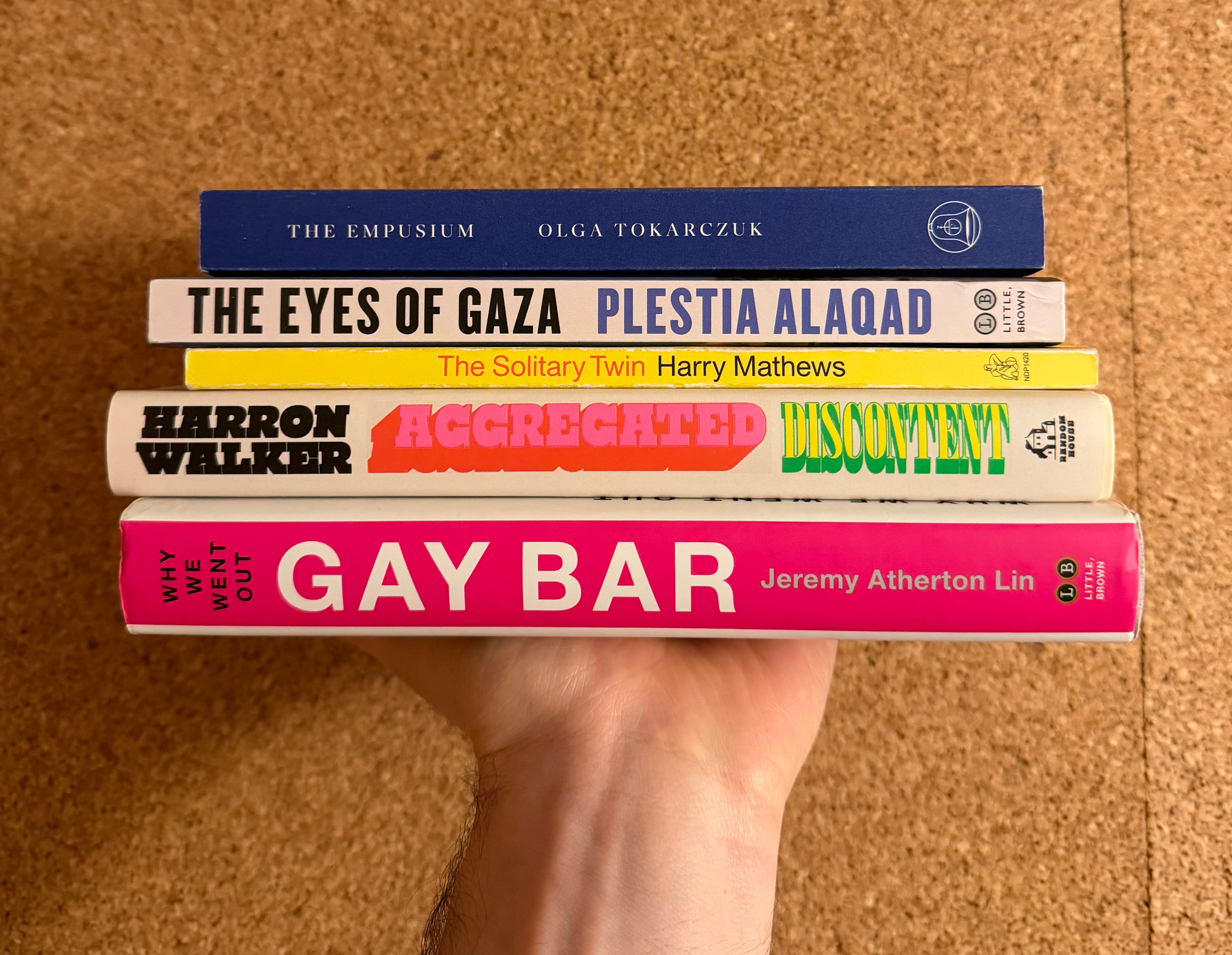
The Empusium by Olga Tokarczuk (tr. Antonia Lloyd Jones), an unsettling horror set in a remote Polish health resort.
The Eyes of Gaza by Plestia Alaqad, the diary of a journalist living in Gaza as the current genocide began.
The Solitary Twin by Harry Mathews, a mystery surrounding a set of twins in an unnamed port city.
Aggregated Discontent by Harron Walker, an essay collection at the intersection of memoir and cultural criticism that examines identity, transness, pop culture and more.
Gay Bar by Jeremy Atherton Lin, a memoir meets investigation of the history, impact, and place of gay bars on the personal and cultural level.
Have you read any of these? Are any of these non-negotiables? Are any of them skippable?
What did you read and love in October?!
Tell me what you think in the comments!
That’s been my month! Typos (if any) were made on purpose.
Until next time 🤠
No posts
Comments
Nothing yet. Say the first thing.
Sign in to join the conversation.