
Excerpts from a conversation with The Booker Prizes winner, David Szalay, about his novel Flesh.
A few months ago, I got an email telling me Dua Lipa and the Spotify team wanted to send me to New York City for a day. After picking my jaw up off the floor, I jumped on a plane.
I was only meant to be there to attend a podcast recording of Service 95’s book club conversation with Dua and David Szalay, the author of Flesh. But when I got the chance to meet with him before, I jumped on it.
Wrapped in double denim, I clacked my way across town during an early fall heat wave (there are worse places to blot your sweaty forehead than the Spotify office bathrooms). The expectations that were set for “meeting David Szalay” led me to believe it was going to be a casual conversation. Nothing more than a short exchange. No content, just me, a curious writer, getting to pick his brain about the craft. Next thing I know, I’m walking into a recording studio, cameras are on, and I’m shuffling the mic pack in my lap out of frame.
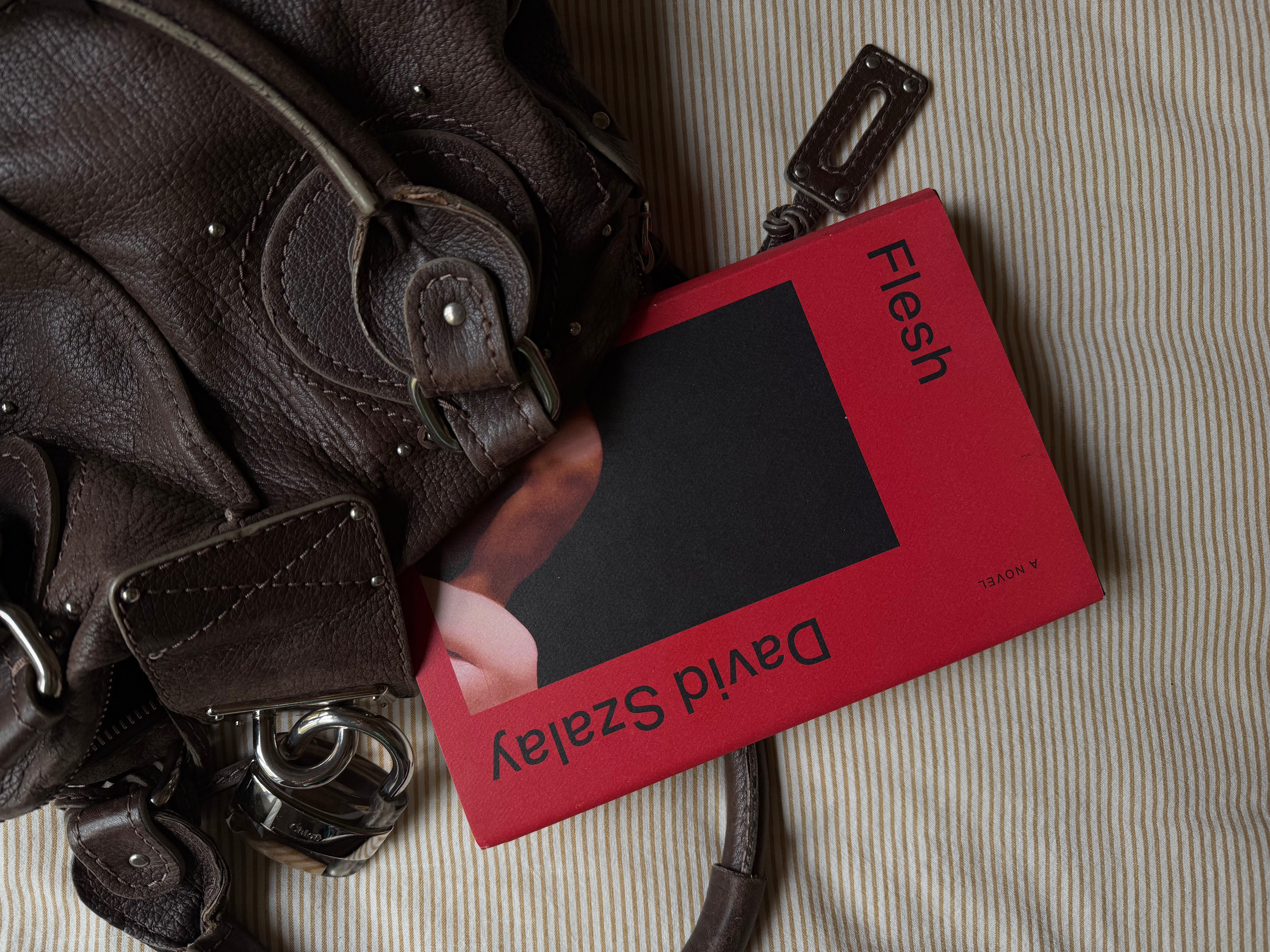
Flesh is a novel concerned about masculinity, and the different sharp angles that make up its shape in a man. The writing is spare, but the tension is dizzying. Told through long snapshots, the book flies through a man’s life from teenage-hood well into middle age. These moments are defining, but the life isn’t extraordinary. It’s meant to be mundane and it does that beautifully. Reading this felt like having wet clothes stick to you, just before your bones start to feel a chill.
We follow István, a teenager living in a Hungarian apartment complex with his mother. The novel opens with him begrudgingly engaging in an inappropriate relationship, which leads to a traumatic event. Years later, after serving in the army, he goes to London and works as security for a rich family. He becomes a husband and a father, and all of these milestones are unpacked from his distant and cold perspective.

David Szalay was born in Montreal, the city I’ve lived in my whole life. When I told him that Flesh was in a section dedicated to Québécois authors at my local library, he said it ought to be! He still claims Canada despite only having spent a few years there before his family moved to Lebanon, and then London, and several more relocations after that.
Knowing this, I was especially curious about how it has impacted his writing. Many of his works explore migration and life in different countries. His previous novels All That Man Is and Turbulence are structurally built around travel, and Flesh unfolds in Hungary, in London, and many places in between. So, why is place and journey so important to him?
“I’m drawn to stories that involve people becoming decontextualized by going to a place which is new for them. There’s a lot of tension and fascinating stuff that arises. Friction. The question of who they really are immediately comes to the forefront, both for the character and for the book.”
For Flesh specifically, the character’s migration from Hungary to London mimics the writer’s own, though in the opposite direction. This was intentional because Szalay himself felt pulled between the UK and Hungary at the time of writing it. The only choice he had was to pour that feeling of straddling two worlds into the novel.
István is a constant outsider. He feels out of place in Hungary as he grows up, and in London where he has built a new life. His choices (or his inaction when faced with choice) at every turn only make the gap between himself and others greater. Maybe the most fascinating side of this outsider is how he seems to hold himself at arm’s length. He is passive, things happen to him. It feels like the steering wheel is always just out of reach, and the reader repeatedly witnesses his inability to connect with himself.

All the moments in this novel are vignettes that stretch into chapters. Each feels like a snapshot that could stand on its own. It reminded me that Szalay has written short stories, short story collections, collections as novel, and now this novel that could almost be split into stories.
I’m always curious about writers who dabble in different forms, and how they go about deciding what shape a project will take. Emma Copley Eisenberg is releasing a series of connected fictions in April of next year as a follow-up to a novel I loved, Housemates. Brandon Taylor has fantastic examples of short story collection as novel and novel made up of connected stories.
My pull as a writer has never been to the short story, I always conceive of projects on a wider canvas. I am so impressed by writers who can do both, especially at the same time. Szalay says that for him, it’s project dependent, but that Flesh was always going to be a novel.
“Flesh is a novel, there isn’t really a question about that. But I did approach each chapter of it wanting it to be somewhat of a self-contained unit. That imposes a kind of discipline, having to contain everything. It helps to give shape to each ‘episode’ of the book, if you want to think of it like that.”
He goes on to say that he enjoys reading these kinds of stories the most. Ones where circumstances change and you constantly have to find your footing again as a reader. In Flesh, he accomplishes this brilliantly. There are cliffhangers, massive time jumps where years go unaddressed, and yet, it felt complete. The puzzle he built clicks into place by the end.

When I first read this book, I found the narrator’s hard shell difficult to crack. Admittedly, I don’t often read from the perspective of a straight cis man with troubles. It wasn’t until I unpacked it with my friend Celine that the choice started to sing: The weight of upholding standards of masculinity, the posturing, the reader being held at arms length. István’s icy disposition was affecting when contrasted with the emotional jostling in his life.
“It was partially that when writing the first chapter, [the distance to the protagonist] was very much a conscious decision. I felt it would be more powerful to tell it in this very a detached way, and that, to some extent, set the approach for the rest.”
I wanted to dig into this book shaping itself around a statement on masculinity, but we never got to that. It’s glaring to me though. There is no mention at all of István’s father and when he has to step into the shoes of a son, a husband, a father, they never quite seem to fit right. I guess even straight cis men have daddy issues!
Szalay also said that the distance was meant to make István feel real. We don’t ever get to know others completely, but in fiction this notion is sometimes pushed aside. Some of us don’t even have that much proximity to ourselves.
“I’m glad that a lot of the reaction to the book has emphasized that even though you don’t get told that much about the protagonist’s inner life, somehow by the end you feel that he’s someone you know in a slightly mysterious way.”
On November 10th, David Szalay won the Booker Prize 2025 for Flesh. It’s his second time showing on the shortlist, and his first win. In a world very concerned with the Male Loneliness Epidemic, this novel feels very timely. To say that is what the novel is depicting would be reductive, but it certainly adds to that conversation.
I can see why this book has made such an impact and is getting celebrated. István manages to be one of the most fascinating characters I’ve read all year, despite only knowing him flesh-deep.
This wasn’t a typical review, and it wasn’t meant to be. I only showed up to the Spotify offices armed with questions I selfishly wanted to ask. David was gracious, kind, inquisitive, and did not seem to mind heat-wave-induced exposed clavicles.
We parted ways just after he told me I should write The Next Great Montreal Novel. And maybe I will!
Thank you to Spotify, Dua Lipa and David Szalay for making this possible!
No posts
Comments
Nothing yet. Say the first thing.
Sign in to join the conversation.