
Excerpts from a conversation with Stacey Yu about her forthcoming novel Kitten and the booktok to debut author pipeline.

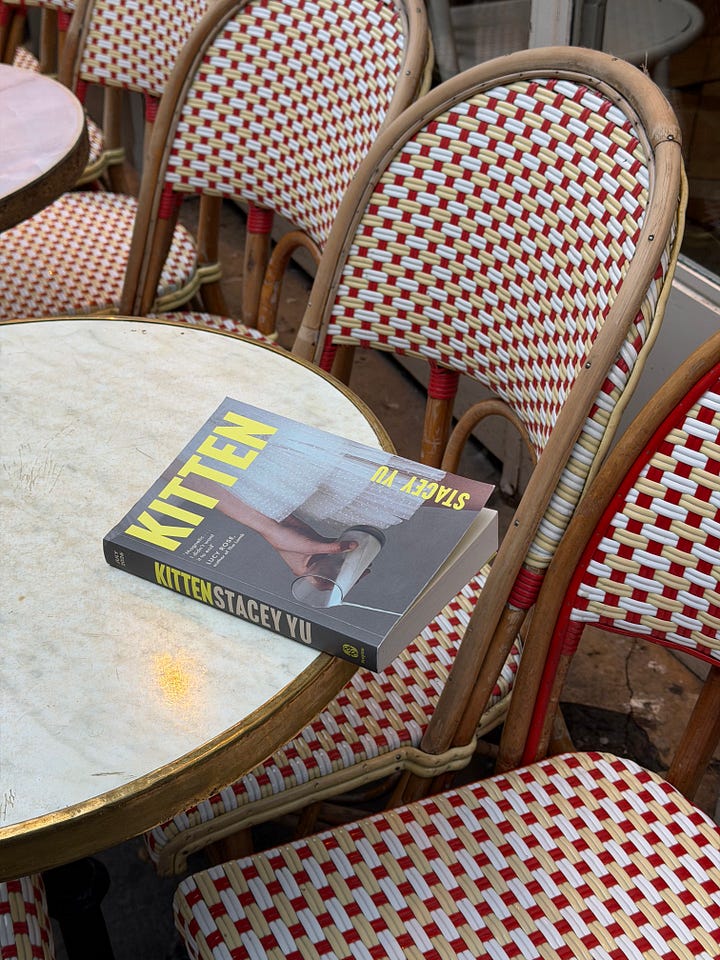
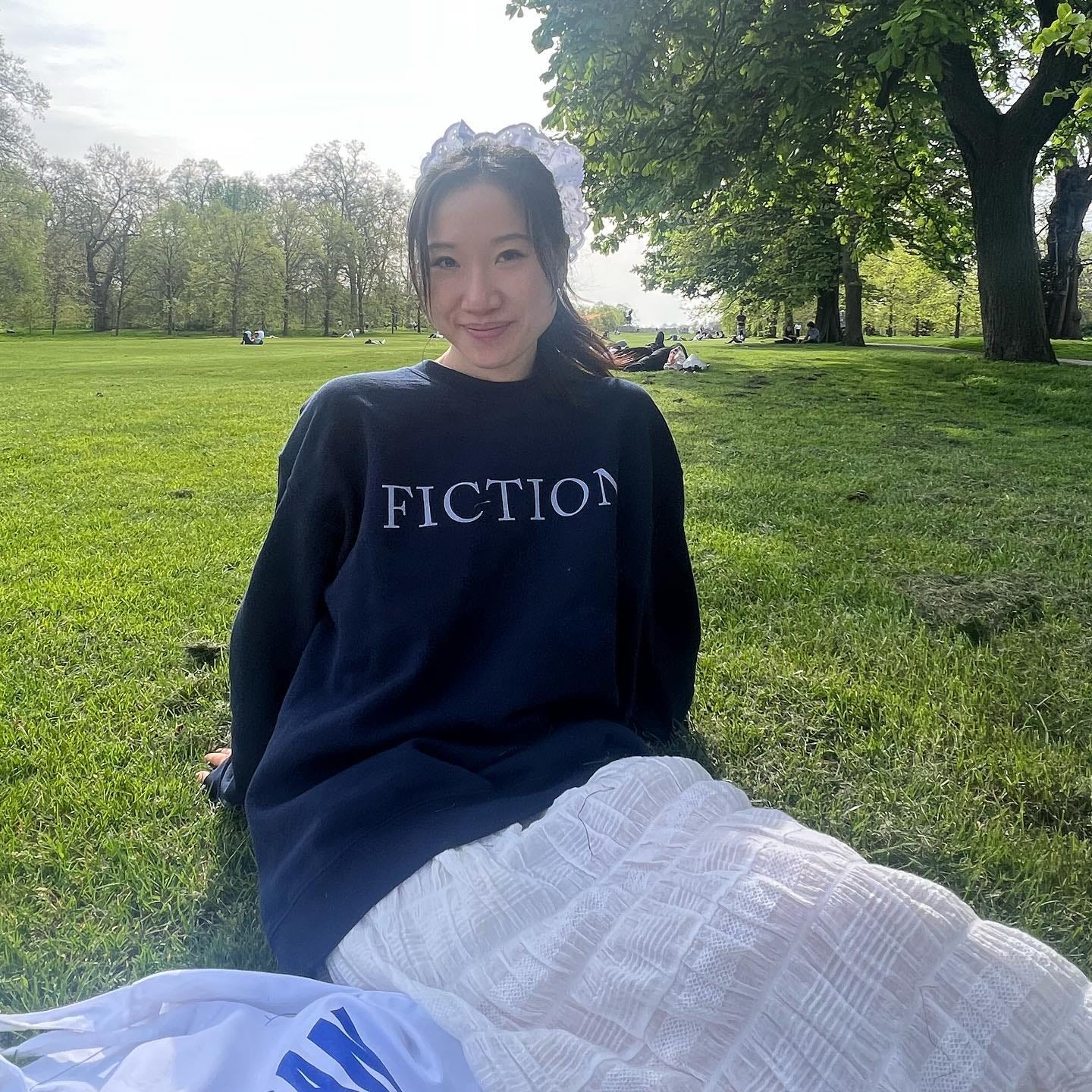
I first became aware of Stacey on TikTok years ago. She was (is) this incredibly smart girl across the pond who could slice through a novel with the precision of her reviews. Her book taste has always been impeccable and she effortlessly oozes the je ne sais quoi that many people strive to imitate.
Now knowing her, I can attest that she is everything you’d want her to be. She is both buoyant and grounding, anyone would be lucky to peek into her mind. Luckily, you can read her book and do just that.
In my conversation with Stacey, I wanted to dig into the booktok to novel pipeline, how she feels about stepping into a Published Writer’s shoes, what made her write Kitten, and so much more.
Read on to find out how she manifested a cat crawling through my apartment window.
Stacey has a very successful online platform and she has always presented as writer first, even years ahead of a novel’s publication. Claiming that title took me a long time (this isn’t going to become about my imposter syndrome, but like…) and I know many other people with similar online activities whose writing pursuits happen in the shadows.
Talking about books and reading while also wanting to push a writer’s agenda can be a tough balance to strike. There’s a lot of discussion about writers and readers, the distance that should exist between the two, the sanctity of reader spaces, etc.
Because of all this, I wanted to know how she balances the author and online book person hats.
“I think my author hat contains the online book person hat! I actually think most authors these days are online book people, too, even if that just means having an Instagram account and reposting reviews. That can feel a little sad, I know. But I think we have to question the immediate impulse to keep those identities pure and separate. Being an author is not the same thing as being a writer. Being an author necessitates engaging with your book as a commercial object, and being online is one way to do that productively. Your book is something you once sold to the publisher, and it will continue (hopefully!) to be something you, via your publisher, will sell again to readers. Of course, there’s so much more to publishing a book than the commercial side, but I think it’s important to acknowledge that side exists and create your own relationship to it.”
I have personally felt the double-edged sword of breaking into traditional publishing while having a bookish presence online. Publishing can be old school and there’s certainly a sense that we’re creeping in through the backdoor instead of getting an MFA and breezing through the front door. On the other hand, it can be seen as a huge asset that, paired with a great book, feels like an unbeatable combination.
On the eve of her debut novel’s release, I asked Stacey how she felt about having what some might call an unorthodox road to publication.
“I still feel insecure at times about not taking a traditional path to publishing, but then I zoom out and think: who cares? When I worked in publishing, on both the agent and publisher side, I remember working on books by a not insignificant amount of authors who didn’t have an MFA or those traditional buzzwords in their bio. I also think moving to the UK helped me see how much of the significance and reverence we pile onto the MFA pipeline is an American construction. You literally can just write a book. And, in some ways, my path to publishing has traditional elements. The publishing employee to published author pipeline is also very real, and I feel privileged to have broken in those many years ago. One of the editors I connected with during my time at Penguin Random House later helped me with my query letter down the line.”
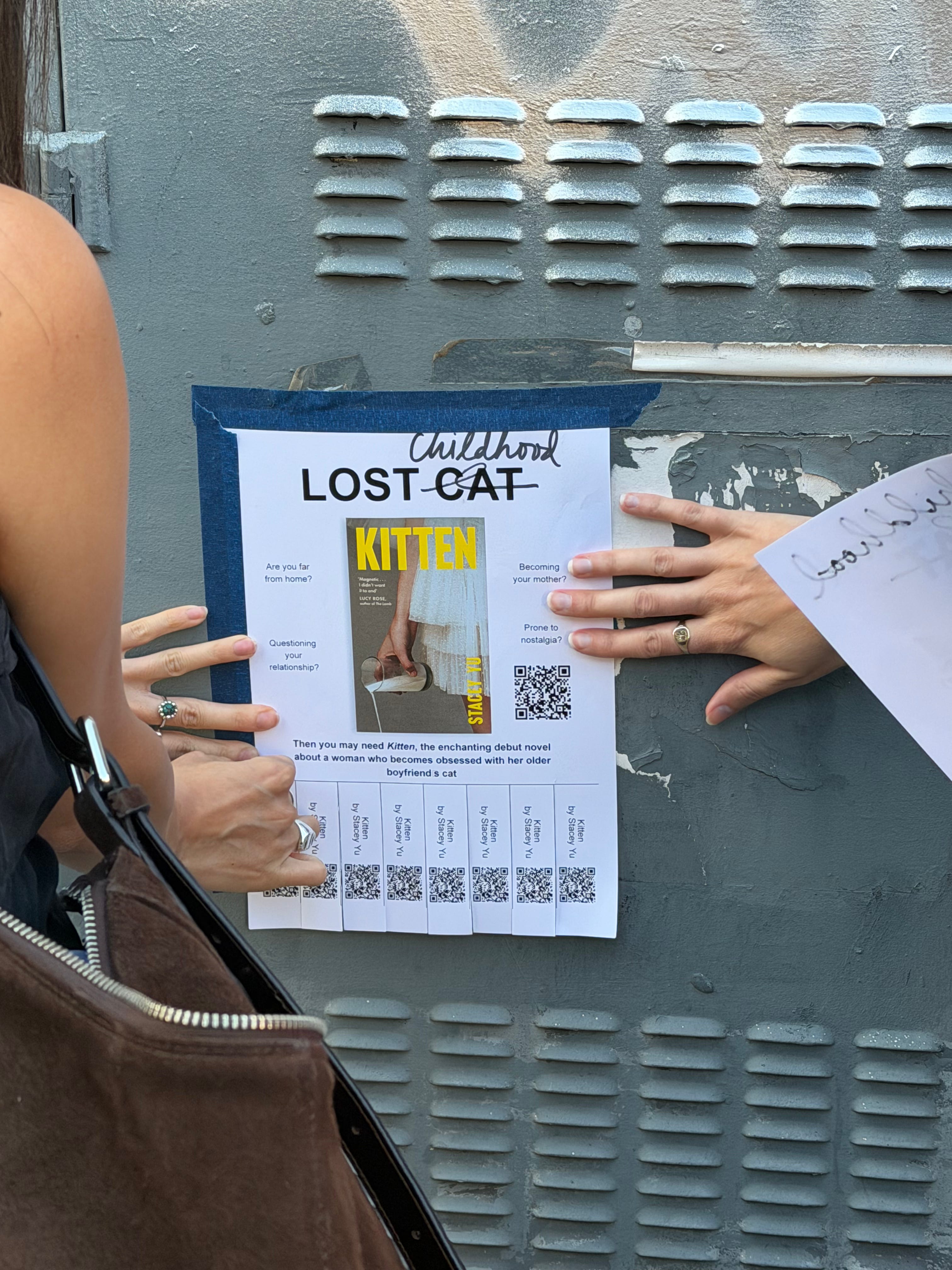
Toni Morrison once said, “If there’s a book that you want to read, but it hasn’t been written yet, then you must write it.” This rings true to me. You are your own first reader after all. In Stacey’s case I wondered why Kitten? Why is this the book that made it out of the notes app?
“Kitten is definitely the book I’ve wanted to read and to write my whole life. I’ve always known the first book I wrote would be about the death of childhood, particularly the narratives we spin about our past and how they overtake our present, because I have been spinning such narratives about my own childhood ever since I left it. There is absolutely no shortage of bildungsromans in the world, but I yearned for one that was as full of play as it was of vulnerability and reverence for the people we love and lose as we grow older. More than anything, I needed the book I wrote, because only by writing it could I really grow out of my own narratives of childhood and adulthood and simply step into my life, I think.”
Kitten is a sophisticated, delicate novel about a 22 year old girl named Katie. She is a recent college graduate who doesn’t have much figured out: her career, her friendships, her family… moving the needle on these in any direction is too much for her to bear. Meanwhile, her older boyfriend has his life pretty figured out. When he introduces Katie to his family cat, Silver, her infatuation for the animal shakes up her entire world.
Katie’s thoughts spill out onto the page with such beautiful intimacy. Her story is quiet but emotionally loud. Stacey has written a narrator I won’t soon forget.
What Yu explores here is a tiny sliver of time in a person’s life. The brief liminal space of not-a-girl-not-yet-a-woman Britney Spears sang about. Some might dismiss these months or years as shallow—as if there’s nothing to say about balking at the inevitability of adulthood—but here it’s treated with such specificity and depth. There’s reverence for this character that is stuck in the molasses of impending responsibility. It reminds us that watching simpler times slip away is not so simple.
I asked Stacey why she chose to explore this time in Katie’s life and what made it interesting to her.
“I think the further you get from your own childhood, the more you’re surprised by how much it still affects you. I started the book when I was twenty-five, so a few years older than Katie, who is twenty-two. I was finally starting to feel a sustainable sort of contentment and self-esteem within myself, my body, my life. I remember sitting in my room one afternoon, looking at my bed and my shelf and my clothes and my wall decorations, and thinking: I chose and bought all of this. I spent a lot of my life thinking for some reason that I wouldn’t be able to afford or have a life I wanted. I was so shocked at that moment, and giddy with the realization that I had a room I loved, I made the room I loved. I could never have felt that at twenty-two. I know Katie will feel that way eventually, but I needed to linger in her confusion and fear and pain, with the knowledge of what would follow, to write her story.”
A very striking part of this novel for me is its dissection of agency. Silver, the cat Katie is enamoured with, does what she pleases, when she pleases, how she pleases. She is an embodiment of agency. This is a huge contrast to Katie who is more comfortable when people tell her what to do, what to think, how to be. She is passive to a fault, leading her to not make decisions, avoid conflict, and let things happen to her.
She’s the kind of character you feel the need to care for rather than simply root for. A reader might see in her a whisper of a former self and something quite honest. Other readers might find this passivity frustrating and make Katie hard to grasp for them.
I was curious whether Yu considered this potential unlikability and how she navigated that as she was writing Katie.
“Passive characters can be a pain to read about. I always knew that would be my biggest challenge: writing a character whose passivity defined her (in order to build the novel’s thesis on passivity) while still getting the pages to turn. But what Katie lacks in action, she makes up for with belief. To me, it’s worse when a character believes nothing than when they do nothing. Katie knows exactly what she wants: to not grow up. In a way, her every non-action and non-decision is a result of one big choice she made when she was younger, to stay young - to be her mother’s daughter - forever. I hoped this clarity of belief, and the tension between it and the unfolding reality of Katie’s situation, would give the book its energy.”
Katie’s estranged relationship with her mother is something we orbit throughout the novel. My mother wasn’t human, she was my mother. She is a spectre, never on the page but always on Katie’s mind. We feel the fracture without ever being able to fully distinguish its shape. This was so affecting, and a really unique way to discuss complicated family relationships.
While this is a huge part of Katie’s character arc, I wondered why the choice to make the distance and detachment happen even for the reader.
“Katie and her mother are estranged for most of the story. How do you write about silence, the non-existence of something? How do you live around a non-existence, something that refuses to engage with you? Very early on, at the end of chapter one, Katie makes the choice to “put away thoughts of [her] mother.” She commits to this impossible task, much like she once committed to the impossible task of being with her mother forever. The absence of Katie’s mother from her life, and therefore from her thoughts, and therefore from the narrative, is the book’s core emotional set-up. Of course, for the sake of the reader (and for Katie), the mother can’t be totally absent. By only dripfeeding memories of her mother in select places in the book, scenes where Katie felt the most lost or afraid, I hoped to show the impossibility of wiping yourself clean from the things that hurt you without resorting to the pitfalls of the trauma plot. In short, I wanted Katie’s story to contain her mother, but not be contained by it.
The mother is let in only when we realize it’s impossible to keep her out. I defended this choice pretty fiercely when first editing the book. I remember being stricken by a similar choice Brandon Taylor made in his novel Real Life, where Part II is just this torrential outpouring of information about the main character’s past that throws everything about him in a new light. Sometimes it’s more interesting to not know something, to feel that missing piece grow, than it is to have it spelled out for you.”
To close out, here are some books that inspired Stacey throughout the process of writing this novel. Consider this a cool girl reading guide:
Hot Milk by Deborah Levy
The Idiot by Elif Batuman
My Baby First Birthday by Jenny Zhang
Conversations with Friends by Sally Rooney
Kitten is out tomorrow, July 30th, in the UK and August 4th in North America.
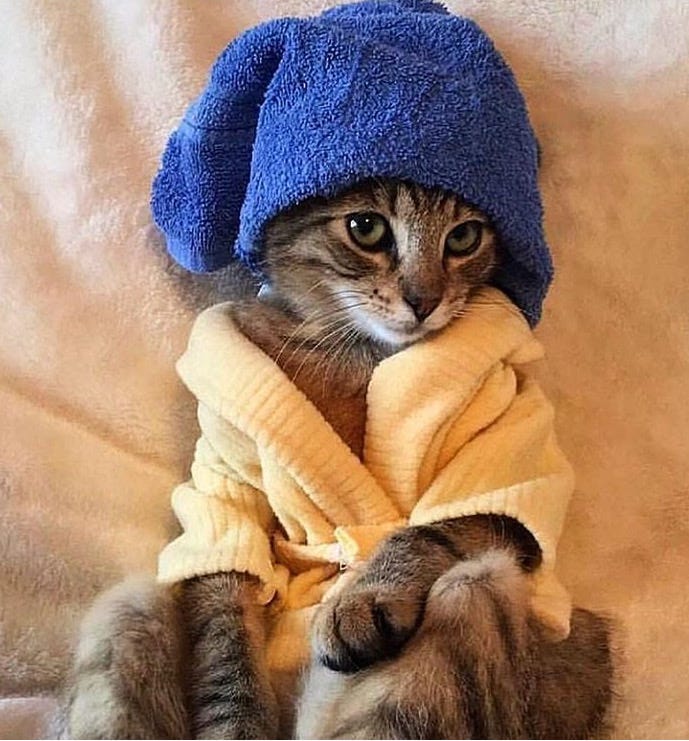
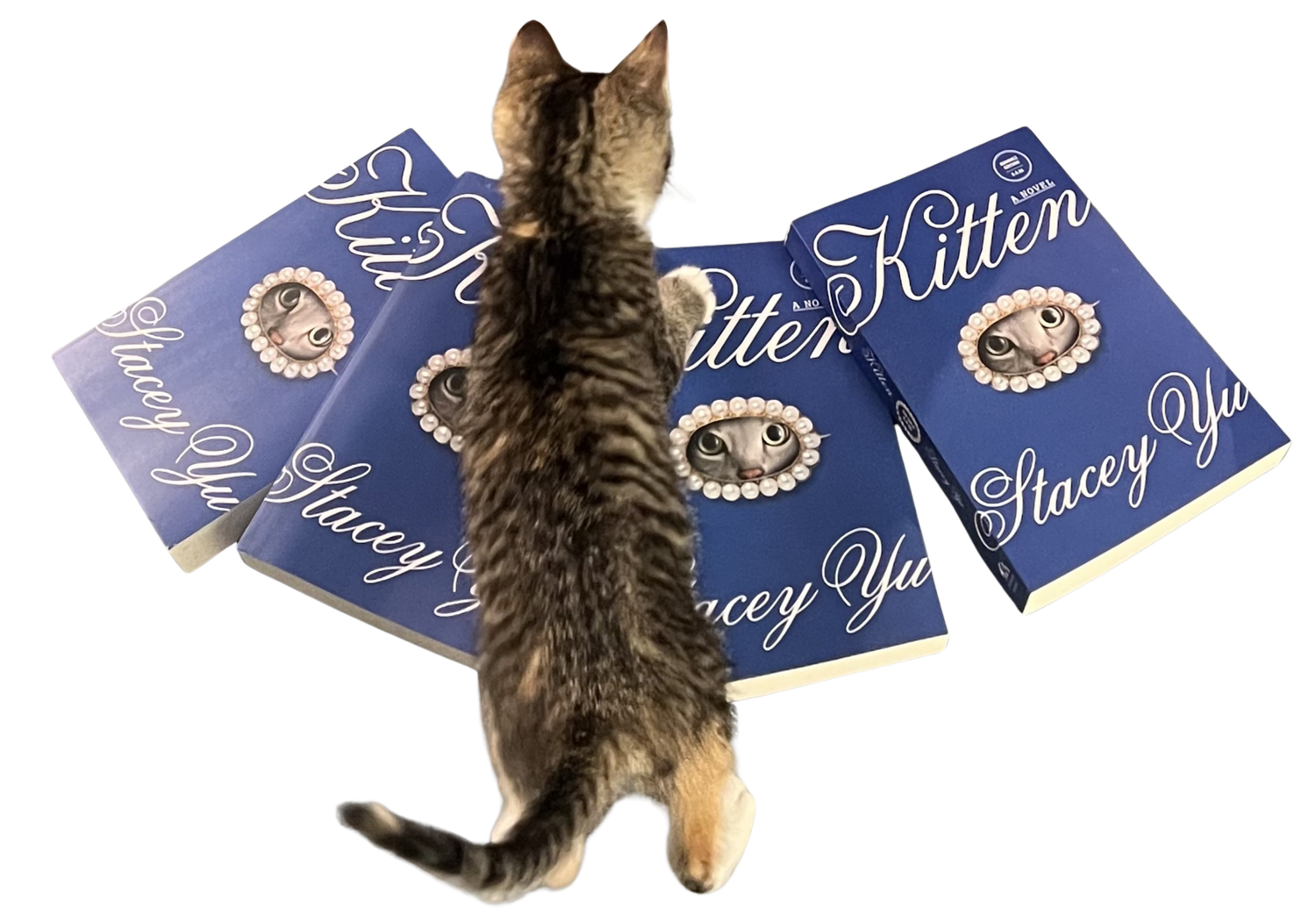
The day after Stacey and I chatted about doing this interview, I woke up to a cat crawling through my bedroom window. Not only had we been discussing Kitten, we’d been talking about how jarring it is to move to the UK from North America and have to keep screenless windows wide open.
I won’t say Stacey has the ability to manifest a cat showing up to your house, but I also won’t say she can’t do that. You’ll have to buy her book to test the theory.
Note: Minutes before pressing publish on this very thing you are reading, a second cat pawed its way through my bedroom window… Coincidence?
Thank you Stacey for taking the time to chat with me!
No posts
Comments
Nothing yet. Say the first thing.
Sign in to join the conversation.