
i heard something kinda decent recently, on spotify, and i had to do a comparatively huge quantity of research to see if it was ‘real’. it sounded real, nice artwork, but the only evidence of it online was on streaming platforms with low play counts and no bio. in this case, it was real! it was effectively library music, jazzy afrobeat with track names like hackney sunshine, composed and arranged by a session musician from leeds for a company which licenses music for film and tv. and part of me was relieved! ‘well, at least a person made it’. even though i know that two years ago i would have been like ‘ffs! a cheap (literally) imitation of the london scene. at least call it headingley sunshine!’.
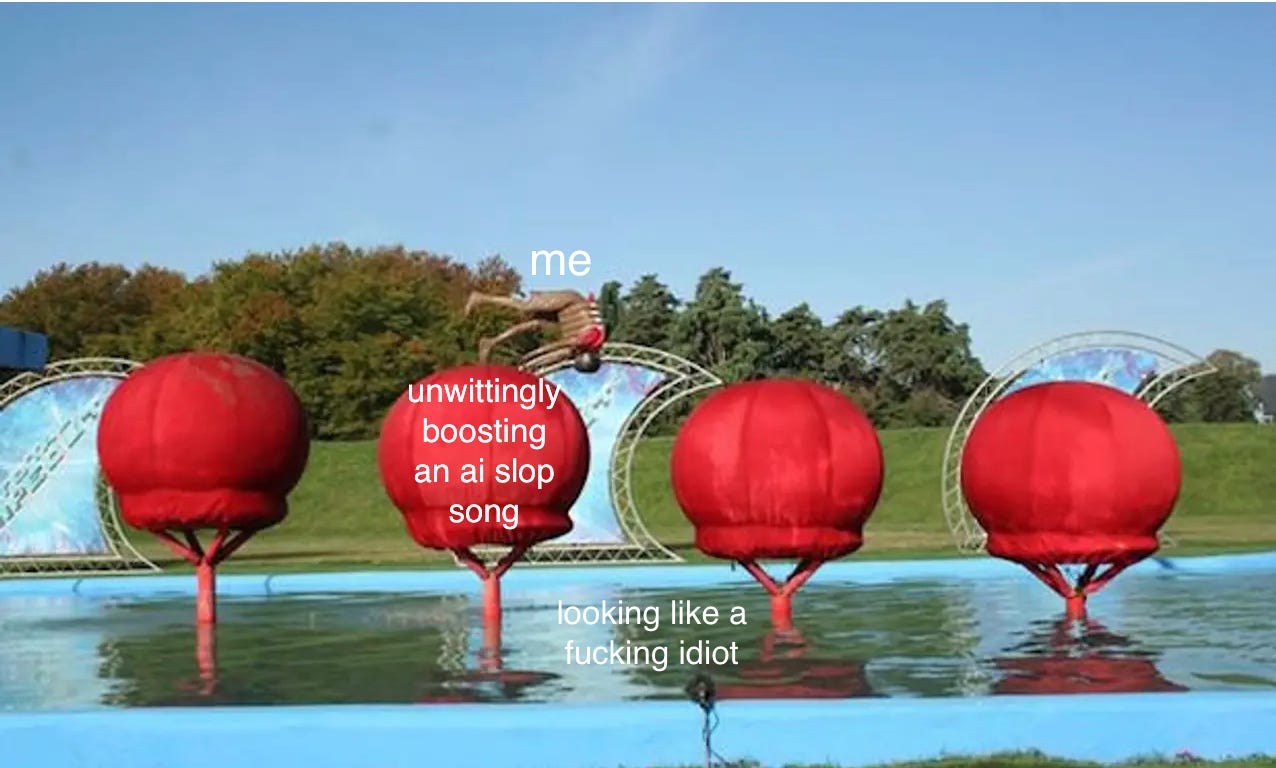
since then, i’ve seen numero group, who have been in the obscure re-releases game for 25 years, forced to put out instagram posts defending their output from the ai allegations. in my field—by which i mean devouring and then sharing scuffed up, mande-influenced jazz funk that previously never made it out of mali—i feel like i’m playing total wipeout and at any minute i’m going to slip on one of those big red balls and do a comedy prat fall into the muddied waters.
and so now i find myself writing a bonus edition of boogie nites primarily to share a podcast episode with you. i’m not planning to make bonus editions a regular occurrence, but i started writing about this for the september issue (so vogue!) and it got so unwieldy it had to stand alone.
ryan broderick sits down with prob the most famous music commentator of the youtube age, anthony fantano. whatever you feel about his reviews, i think you have to respect anyone who is really just making ‘being a critic’ their main grind in 2025.
they talk about the biggest ai generated music moment to date (the velvet sundown), and wider problems about the ethics of generating music, crediting, legislation around this, its relationship to sampling. is feeding an artist’s work into an ai model (for example, they talk about ariana grande) and using it to produce a song any different to an edm producer looping a black woman’s vocal and putting her name precisely nowhere? it’s a good discussion.
i also learned that bbl drizzy was ai generated. why didn’t anyone tell me?
i sometimes think if it was 2013, and someone presented me with ai tunes and an ai girlfriend, i would have been like ‘fuck yeah, the future is bright’.
i think i’m quite good at digging on streaming platforms, something perhaps frowned upon? although i saw another dj giving a tip to use the algorithm to your advantage when looking for new music and i was like mate!!! don’t tell people!!! lol. but the reality is it doesn’t matter if they tell people, because ultimately most people are not doing that work. no diss! it’s just not most people’s passion. i’m not slogging through elden ring or challenging polish cinema. there are always going to be shades of engagement in a hobby.
& to that end, i don’t think it is really a problem if people (as a whole) are not constantly fucking looking for new music! i don’t think it is a problem if young people are listening to fleetwood mac and not something released this year! i don’t think it’s a problem if someone discovers a song in a twelve second clip on tiktok! people will always have favourite bands and songs and genres, and i m h o The Algorithm is not necessarily a bad thing.
it seems to me there is a reasonable contradiction in the complaints that ‘it only gives you back things that sound exactly like what you’re already listening to’ and ‘no one has any sense of a ‘scene’ these days, back in my day we were punks and we only listened to punk and we wore our pins with pride’. of course, it’s different if the music being amplified to you thru the algo is only that getting promoted by big record companies, but what is the radio 1 playlist except this exact thing? the sex pistols were on emi, babes.
however. i do think the algo—and its bosom buddy, autoplay—contributes to the increasing backgroundification of music. that’s not new: muzak has been backgroundifying since the 1930s. shout out to the attention k-mart shoppers muzak collection. but absent of any tastemakers (even if that is the radio 2 playlist committee deciding what you hear in your office), i think the backgroundification 1) disconnects people from the artists they’re listening to (at least with the office radio, you get some basic info drops from the dj), which in turn makes them less likely to support the artists they like, and 2) opens the door to ai generation.
kay listens to a lot of mixes on youtube while she’s working. recently, she sent a mix of ‘rare underground 90s japanese hip hop’ to her gf, who replied and was like ‘babe, is this ai?’. she played it to me later on. because it is in japanese, and neither of us speak japanese, it was hard to tell based on the lyrics. if you speak japanese, hit me up! does it make sense? regardless, the vibes were off. the beat alone could be classic, maybe, but the vocals are like autotuned early 2000s pop*stars nonsense. it sounds nothing like scha dara parr or east end x yuri or any other actual j-rap from that period.
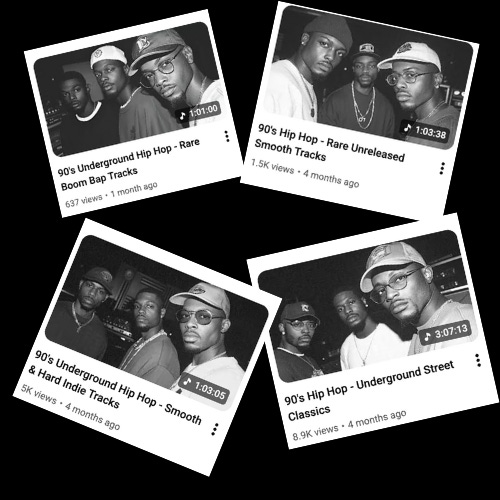
the english lyrics are, like, fine. hardly ‘spitting bars’ but it’s passable. in the background of this one, there’s some scratching and some garbled ‘words’ that sound ridiculous, but otherwise, there aren’t any like, extra thumbs sticking off a hand to tip you off.
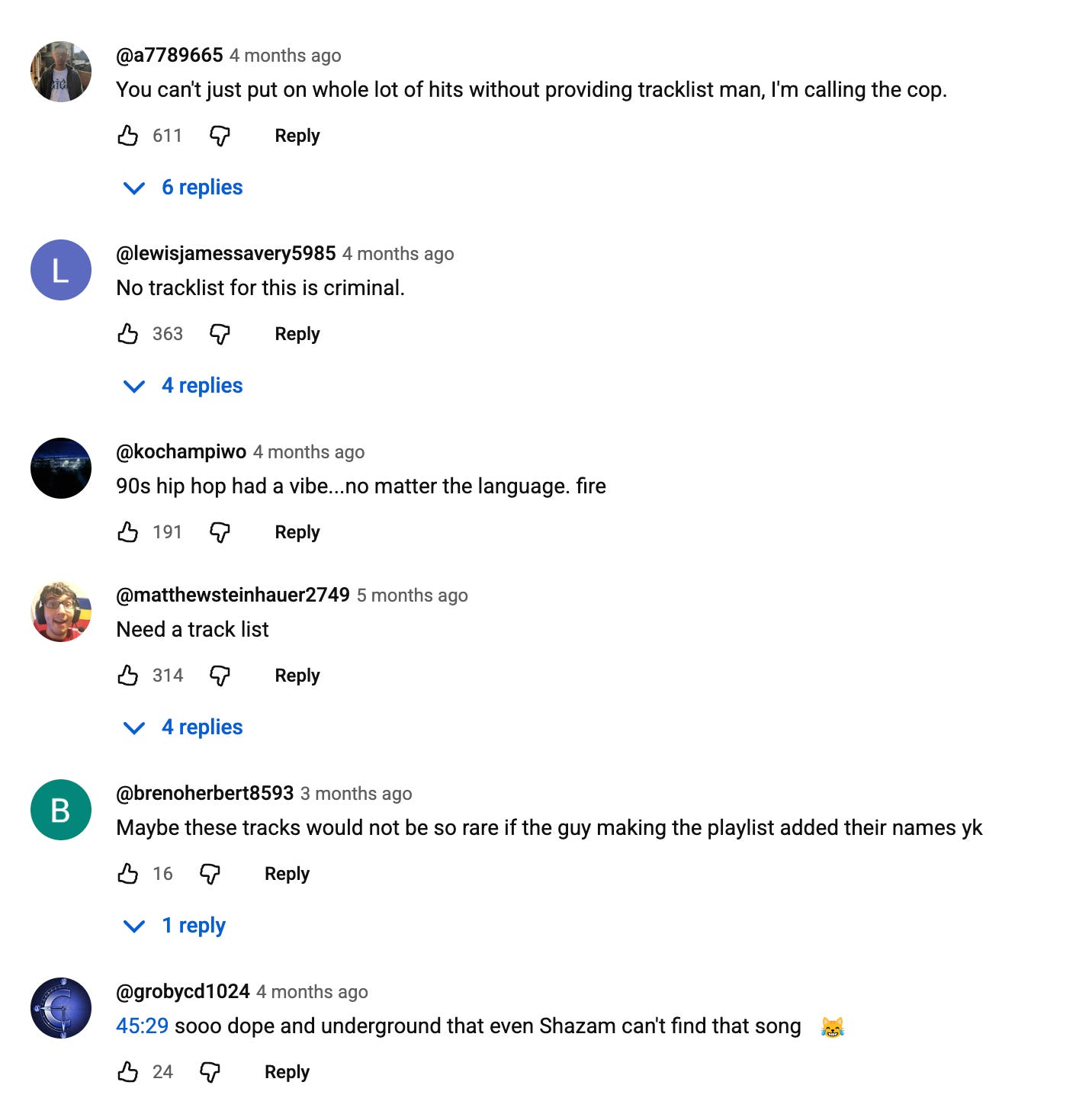
the comments are entirely bought in to these ‘rare mixes’:
it’s a whole industry. if you upload a mix which includes music created by actual artists to youtube, your mix may well be taken down or have large chunks of it silenced. if it stays up, and you hit the level that you could monteise it, that money will go to the artists instead of to you, the mix-maker. however, if you just generate that music yourself in suno or udio, there’s no artist to pay! monetise that shit all the way to the bank baby. of course, to paraphrase pitbull, youtube have said they won’t allow it, but i bet they will (timber).
this, i think, is fucked. but, if you’re just playing it in the background, do you really care? when i was v mentally unwell three years ago (time flies!), i often put on those channels where there was a nice cartoon of a coffee shop with dark winter-y vibes outside and some white man elevator jazz playing. i wanted to feel safe while i had my daily panic attacks, and i definitely didn’t want to associate any music i liked with how terrible i felt. if you’re grinding and hustling and playing lo-fi beats to motivate you through the horrors of your day: i guess, who cares. except, when it stops just being one long playlist of gentle repetitive beats (which, in effect, someone made!) and starts creating “artists”, where does that leave, y’know, artists?
i am sure in two years it will seem quaint that i wrote this! society adapts to technological change all the time, and there are always winners and losers. video killed the radio star, etc. but given the current landscape: how will artists get credited, get paid, find space to create and be respected??
in the second half of this podcast, mark henry phillips, a library music producer, compares his own commercial compositions with ai generated versions of the same song briefs. (interestingly, he plays a song the ai created that blew him away, that he couldn’t do himself without hiring an arranger, and paying for a full orchestra, and for studio time. what do you think library music used to be, my man?)
he proposes that when musicians craft a song, they are just as much guessing about what note comes next as the ai is—and that’s what makes it so ‘easy’ to replicate good music. i thought this pod might have answers, but he’s clear he’s gonna lose his job, and he’s kinda ok with it. video killed the radio star indeed.
thanks for making it this far!!! here are some interesting links.
chris dalla riva on the topic of why older music is popular with younger people these days.
a short bbc sounds series on the concept of ‘taste’, presented by zakia sewell. who shapes it and how, both at the individual and cultural levels. super interesting ty josh!
jungle slags from haaji ka halva, a special one off show on kitchen radio purely done on midi pads instead of decks. fuckin SICK.
this resident advisor interview with neffa-t, talking about the 8 track technical mix he did this summer. i loooove to hear about artists’ processes, so finding out that he spent four months prepping it *chefs kiss*
eight decks, neffa-t? eight?? that’s insane.

No posts
Comments
Nothing yet. Say the first thing.
Sign in to join the conversation.