
“The photographer is an armed version of the solitary walker reconnoitering, stalking, cruising the urban inferno, the voyeuristic stroller who discovers the city as a landscape of voluptuous extremes. Adept of the joys of watching, connoisseur of empathy, the flâneur finds the world ‘picturesque’.”
- Susan Sontag1
Armed with google maps we cruise at the altitude of satellites, flicking from restaurant to bar or gallery to cafe. We are coinesseurs of traffic jams and the nearest and furthest top rated establishments. Planning ventures abroad we script a full trajectory down to the details of each meal and photo vista. There is a poetry to this now taken for granted situation in which we can observe most surfaces of the planet from the screens in our pockets. The planetary flâneur revels in it. There is no need to attend the overcrowded, picturesque 'urban inferno'. Navigating by cartographies of desire we are guided more by taste than proximity.
I lumbered into new kind of planetary flâneurism with a native tour guide, ChatGPT, in 2023. It presented me a full day tour of the stranger sides of the Bay Area, where I was then living abroad. I simply requested a ‘weird’ itinerary, and the machine conjured one, taking me from algorithm to coordinates to place.
My day began by visiting a house shaped like a fish in west Berkeley, whose designer apparently took inspiration from the tardigrade, the Earth’s most resilient creature. It led me through a village of storybook architecture that felt like a portal to medieval France. It led me to the marina in San Fransisco where the tide blew air through tuned pipes laid on the shore, creating subtle, eerie music.
But then it instructed me to visit a ‘Flying Cottage’ in Berkeley. Allegedly, it was a house that floated magically in the air. I went to the precise coordinates described, only to find this mysterious flying cottage simply didn't exist. The most reasonable explanation I could imagine was that it flew away. When I later confronted the AI about its misguidance it apologised profusely, admitting to have made a mistake; there was never a flying cottage.
A deep investigation lead me to an archived news article from nearly two decades prior detailing a local complaint of an incomplete and abandoned construction site. The halting of construction had left the top story of the pre-existing bungalow sitting above two floors of unfinished foundation and plywood structures, making the cottage appear to float ominously above the street, earning it the nickname of the ‘flying cottage’. Certainly not a tourist attraction, and 20 years gone, it was at least in some way partially real.
As the AI and I navigated space together by strangeness of taste, we mapped a route that ventured into the surreal. But this moment of so-called 'error' revealed more about the local than any of the ‘real’ places.
The article traced a deep history of both the housing crisis and racism in the Bay Area. The controversy came from neighbours who claimed the Taiwanese developer had nefarious intentions to turn the building into a rooming-house. The developer claimed the intention was to build a home for her elderly mother above a flower shop for herself. Whether the resulting council block on construction was a ‘draconian and racist’ rejection of an outsider by the Berkeley neighbours, or a true attempt to prevent another dodgy rooming-house situation, I do not know. But this strange flying house revealed a deeply contested history of the place.
Those who chastise AI for not perfectly rendering the truth made the same mistake of photography. They make the same mistake of science. They make the same mistake of any technology; that it is supposed to act as an objective and neutral baseline, and if not then it has failed, it has broken.
Any engagement with technological objects is an engagement with culture, in the sense that they are particular, idiosyncratic products of their times. Their use and the study of them doesn’t reveal an immaculate image of what is real, but rather they create new realities, in the sense that they enact powers and influences on the present, and open possibilities for a different future.
Most mainstream AI products we are familiar with are modelled on a concept of human intelligence which has been produced by a particular western history, one which, among other things, asserts that human intelligence itself is a matter of algorithmic, abstract reason2. Naming this new thing as ‘artificial’ intelligence positions it as a mimicry of that taken for granted idea of what intelligence is3. It's not modelled on the brain as it might be connected to life in a particular human body, to being locally embedded, to having a microbiome. It is not originally modelled on a new machine kind of intelligence itself, either, as that previously didn’t exist. AI is fundаmentally different: It orders information in fundamentally different ways to how humans have historically ordered information, so it necessarily will at times do things that simply don’t make sense to us. But that is where the magic happens.
Technology is not just about efficiency and automation as current Gen-AI easily misleads one to think. It is also, even more so, about world-ordering. The way humans have shaped the internet now dictates how AI models understand the world, and has optimised for the particular kinds of content the internet priveledges. The deeper logics behind the models reveal themselves in the outputs, sometimes breaking down, opening up cracks. Sometimes in obscured ways. Sometimes through a flying cottage. This error, I suspect, would be much less likely in the newer models, which are brutalised by human feedback and fine tuning. But as the AI directed me to the magic flying cottage that didn't exist, I encountered a crack in the intended function, through which slipped unintended insights.
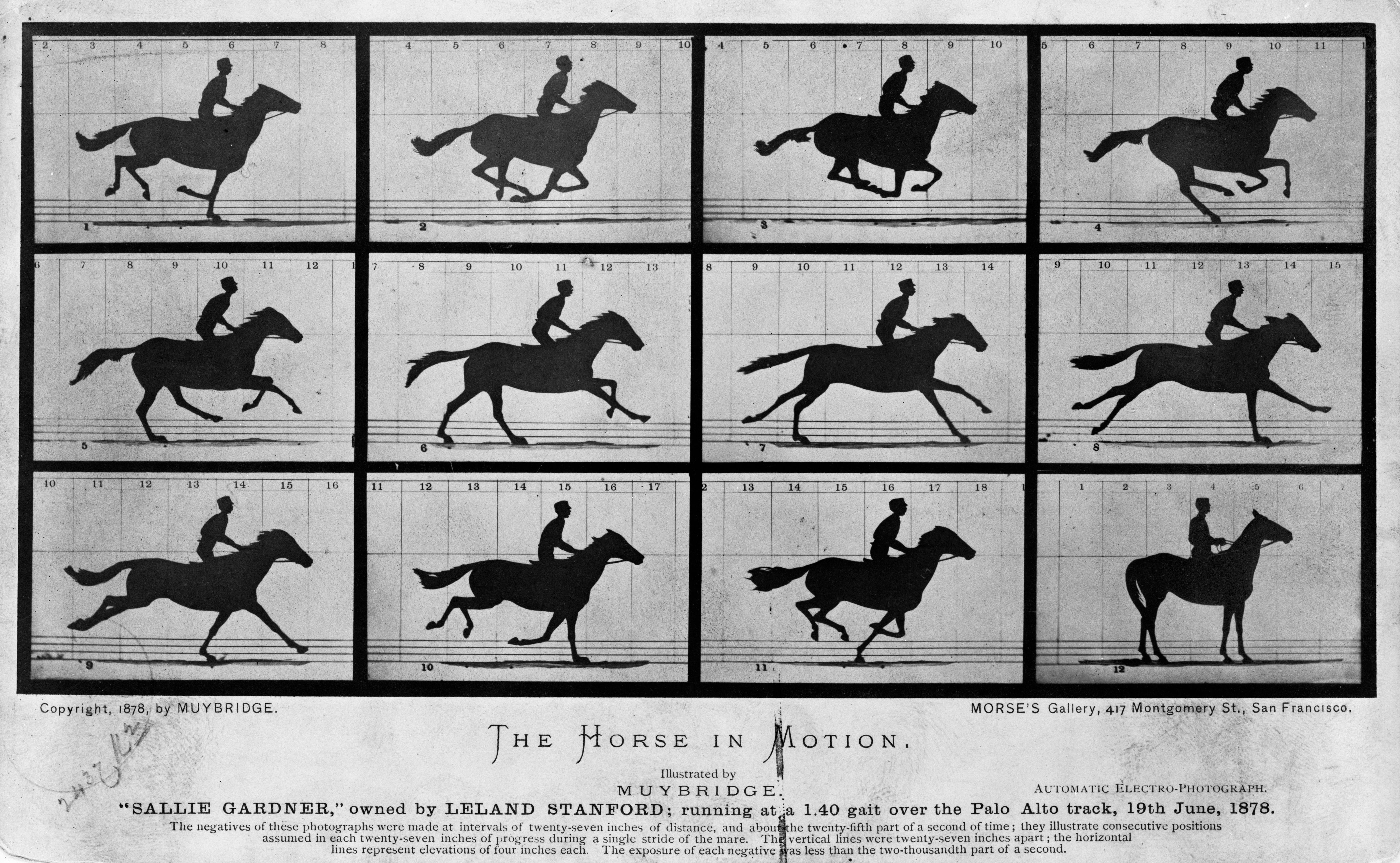
The history of technology is a history of discovering unexpected uses for things. The potential of photography, for example, to reveal new understandings of bodies in motion wasn’t its initial intention. However this capacity, latent in the first camera ever made, was realised many years later when Eadweard Muybridge used photography to capture The Horse in Motion in 1878. For the first time the mechanics of a horse galloping was revealed, previous to which nobody knew if all four hoofs left the ground at once. This revolutionary use of the camera set a path toward photographic applications in science, it created ruptures in abstract painting, and led to the development of cinema. It took very imaginitaive, creative minds and approaches of experientation and play to coax these potentials out of the original camera invention.
We are in a unique moment where a new technological tool has been invented, and we don’t have any idea what it might be able to do, what it might be able to reveal, what realities it might create. Like a bourgeois flâneur armed with a camera in the street, AI makes us a tourist of the megahertz, trawling through the transistorized lives of others, and perhaps in a way more than any other invention before, it makes us a tourist in the life of a machine. Those who will create new realities will be those who experiment, play, and coax out the potentials of it to do something wildly unexpected, something wildly new. Whether it is in image-making, literary inventions, protein folding, cartography, playing the game GO4, inventing new architectural and urban configurations, or new materials, or something else entirely, it is up to us to dream up. This time, however, we are not alone.
Thanks for reading A Planetary Flâneur! Subscribe for free to receive new posts and support my work.
Quote from Susan Sontag, ‘On Photography’.
Read this article for further exploration of the concepts of intelligence current AI is historically modelled on, and how these concepts begin to fall apart.
For the original project which models AI on particular understandings of the human brain, read: ‘A Proposal for the Dartmouth Summer Research Project on Artificial Intelligence’, John McCarthy, Marvin L. Minsky, Nathaniel Rochester, and Claude E. Shannon, August 31, 1955.
AlphaGO was a project by Google DeepMind which trained an AI to play the game GO, beating the best players in the world. The famous ‘Move 37’ marked a historical moment in which AI seemed to produce a completely novel, unexpected, and creative move, challenging and expanding the way humans play the game.
Comments
Nothing yet. Say the first thing.
Sign in to join the conversation.