
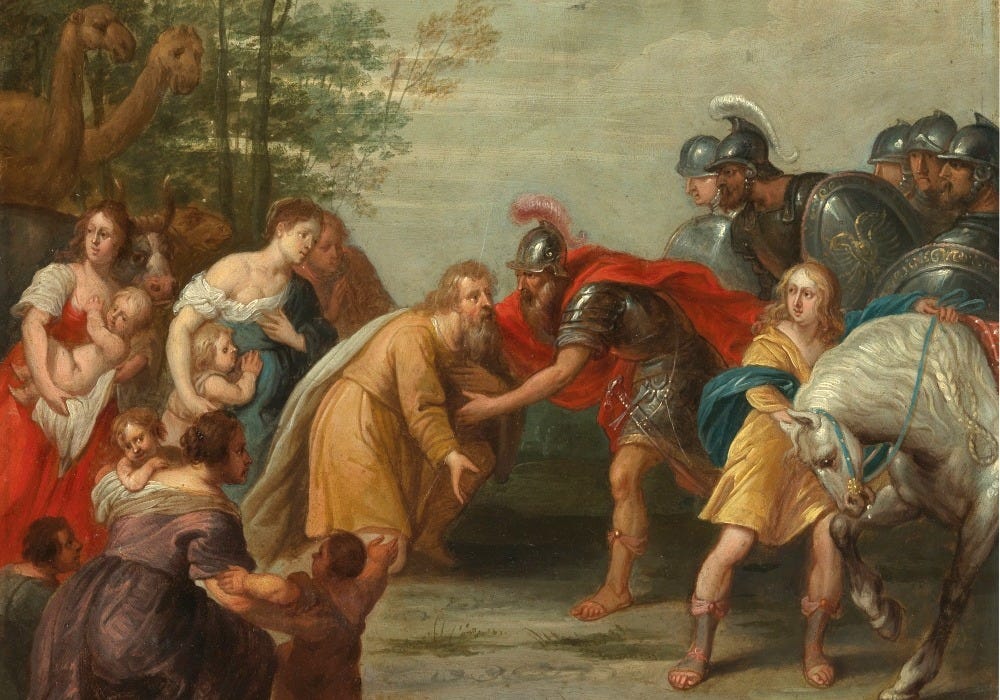
This is the thirty-sixth part in a multipart series on the Book of Genesis. You can find the others here:
What Is The Imago Dei? What is the Sin of Ham? (Genesis 9:1-29)
Who Is “I Will Bless Those Who Bless You and Curse Those Who Curse You” Actually About? (Genesis 12:1-20)
No, Abraham Did Not Lie Because He Was Scared (Genesis 20:1-18)
Why Is There So Much Bronze Age Real Estate Law In The Old Testament? (Genesis 22:20-23:20)
Isaac and Rebekah as a Type of Christ and the Church (Genesis 24:1-67)
Esau Was ALWAYS The Bad Guy And Jacob Was ALWAYS The Good Guy (Genesis 25:1-24)
Isaac Did Nothing Wrong Deceiving Abimelech (Genesis 26:1-33)
Jacob Did Nothing Wrong In Deceiving Isaac (Genesis 26:34-28:5)
Jacob’s Ladder Is Not What You Think It Is (Genesis 28:6-22)
No, Jacob Did Not “Deserve” What Laban Did To Him (Genesis 29:1-30)
The Woodchipper is a reader-supported publication. To receive new posts and support my work, consider becoming a free or paid subscriber.
Introduction
In Chapter 36 of Genesis, the narrative comes to a halt, and we get a genealogy of Esau. Esau hasn’t really been part of the story for several chapters; only at the very end of Chapter 35 does he reappear to bury Isaac with his brother Jacob. And with that last mention of Esau, we are given the full history of Esau and his descendants, the chronology of which goes right up to Israel’s conquest of Canaan. Why is Esau’s history recorded here? Why does God put this in His story? This is God’s Word. Why does He want us to know this list of names? It doesn’t seem like there is much the people of God can profit from this genealogy at first glance. But what this shows us is the history of the elder brother. Edom’s history is a Bizarro-world history of Israel. Edom is a counterfeit Israel that gets a head start. Long before Israel conquered Canaan, Edom had conquered the country of Seir. Long before Israel had a king, Edom had kings. Edom’s history is complicated; there are many wicked men descended from Esau, the great enemy of Israel, and Amalek is descended from Esau, but there are also godly, faithful men descended from him as well. Edom is a disinherited Israel with a head start that builds the city of man. Edom’s history does not end here in Genesis 36, but continues on throughout the rest of the Bible, all the way to John’s Revelation of Jesus Christ at the very end. What this passage does is lay the foundation of this conflict.
Esau’s Family
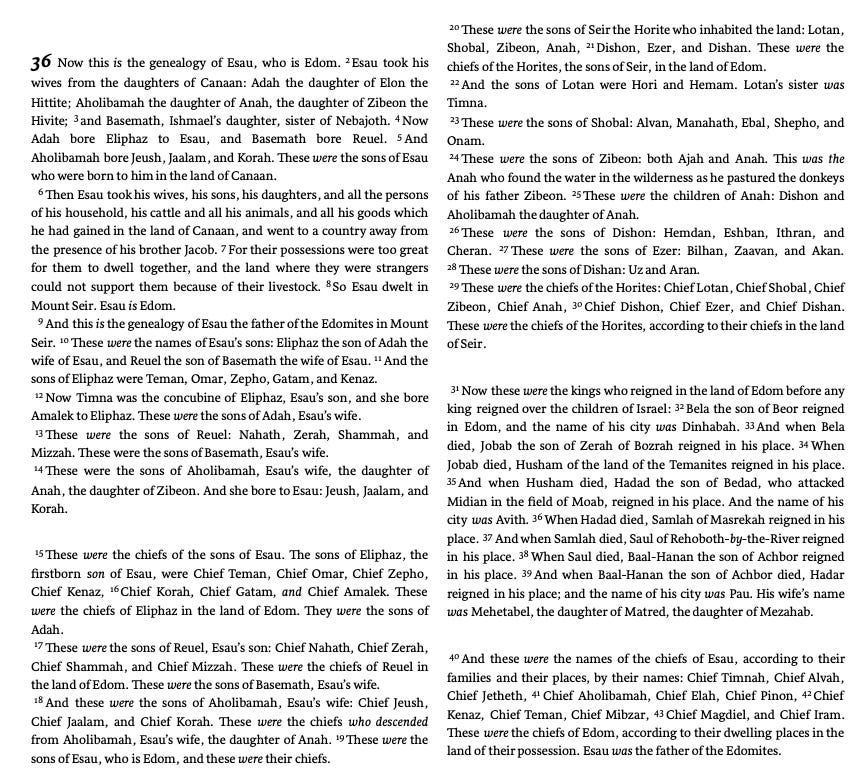
We are told once again about the wives of Esau and their children. Two Canaanite wives and one Ishmaelite wife married many years later. From these marriages, Esau had five sons. Like Jacob, Esau makes an exodus from the Land, but instead of going down to Egypt due to famine, Esau leaves like Lot left Abraham, because the Land could not support the flocks and herds of them both. So Edom goes to the land of Seir, southeast of the Land.
At Seir, Esau’s firstborn son, Eliphaz, has a son of his own named Amalek. This son is the father of the Amalekites, Israel’s great enemy during the Exodus and throughout their early time in the Land. Amalek attacked Israel in the Exodus and continued raiding Israel after they entered the land. King Saul was commanded by God to carry out the ban and wipe out the Amalekites, but rather than obey God, he took the Amalekite king, Agag, hostage along with all their animals and goods, which were to be devoted to destruction. The prophet Samuel hacked Agag to pieces, and Saul’s disobedience here and in two other instances cost him the kingdom. This Amalekite king, Agag, had posterity that survived, and centuries later, after the Babylonians carried Israel away, and the Persians conquered the Babylonians, Ahasuerus had two particular advisors, Mordecai, a Benjamite from King Saul’s house of Kish, and Haman the Agagite, a descendant of Agag whom Saul refused to execute. The great conflict of the Book of Esther was a conflict between Saul and Agag, between Israel and Edom, between Jacob and Esau. And the foundation of this conflict that runs across centuries, even millennia, begins here in Genesis 36.
The Chiefs of Edom and the Conquest of Seir
After the people of Edom began to settle in Seir, they were organized by the chiefs of their tribes. Just as Israel had twelve tribes according to the sons of Israel, Edom was organized into tribes according to the sons of Esau. These tribes eventually grew in strength and came into conflict with the people of Seir, the chiefs of which, though not related to Esau, are also listed here. Why are these unrelated chiefs of Seir listed in Esau’s genealogy? To indicate the conquest of the land of Seir, which Edom took possession of. This history is showing us (without showing us) a Bizarro-world Book of Joshua. The Seirites were to the Land of Seir as the Canaanites were to the Land of Canaan. Edom’s conquest of Seir takes place long before Israel’s conquest of Canaan. Edom’s history and Israel’s history run parallel, with Edom having a century or two head start on the progression from tribal society conquering a land and developing into a kingdom.
The Kings of Edom
The king list of the Edomites is also very interesting. The first king listed is Bela, son of Beor. What is interesting about that is that Bela is one letter off in Hebrew from the name Balaam, son of Beor, from the Book of Numbers, who attempted to curse Israel. Chronologically, this seems to fit, and whether Balaam and Bela are the same person, they are both sons of Beor. If this is the case, Balaam’s attempted attack on Israel is an Edomite attack on Israel.
The second king is just as interesting. Jobab is also one letter off in Hebrew from the name Job. The data in the Book of Job shows that Job is a king, and what are called his “friends” are actually his royal advisors. And these advisors are Edomites, like Eliphaz (same name as Esau’s firstborn), the Temanite, a tribe of Edom. It is very likely that the second king of Edom is the titular figure in the Book of Job. And unlike most of the other Edomites, Job is very much a godly, faithful man.
The list of the eight Edomite kings comes to an end at about the time of the end of the Book of Judges, when Saul becomes king of Israel. This places the final work on this book, with all the place markers (phrases like “as it is to this day”) during this period.
The final list of chiefs of Edom seems out of place. Why are different chiefs listed after the list of kings? Some speculate that these are the chiefs of Edom after they broke free from Israel. David conquered Edom, and sometime during Solomon’s reign, Edom once again became independent. If the monarchy were lost in this period, it would make sense that they would revert to a tribal system, and these are their chiefs.
Conclusion
If Edom’s history is a counterfeit of Israel’s history, what does this mean for the people of God today? It is similar to the Cainites having a head start, building cities long before the faithful sons of Seth did. Throughout the Bible, the wicked have a head start, and these particular wicked men are very closely related to the people of God. They are not some distant tribe of pagans, but Israel’s own flesh and blood. Just as we are seemingly randomly told that Abraham’s brother has twelve sons while Abraham only has one, it appears that God’s promises are late in arriving. Why do the wicked flourish while we struggle and suffer?
It is a question that Christians today often consider. Why are the wicked in power? Why do they dominate everything? Why are we left to the margins, weak, and powerless? The answer is because this is typically how God writes His story. His people must have a patient faith that faithfully plods ahead, waiting for God to establish His kingdom. We do not grasp for it ourselves. Grasping for power that has not been given to you is what Adam did in the Garden. It is the recurring temptation for the people of God. It is literally what Satan tempted Christ with in the Wilderness. We must not envy the Edomites. We must not let ourselves be tempted to grasp for what they already have. What the people of God must do today is continue living faithfully, continue worshiping and obeying their God, continue building what He has called us to, and God Himself will give His people these good things. Trust that the Lord is faithful, that His timing is always right, and that He will build His kingdom. Trust Him that the Kingdoms of this world will become the Kingdom of our God and of His Christ. In the Name of the Father, the Son, and the Holy Spirit. Amen!
The Woodchipper is a reader-supported publication. To receive new posts and support my work, consider becoming a free or paid subscriber.
Comments
Nothing yet. Say the first thing.
Sign in to join the conversation.