
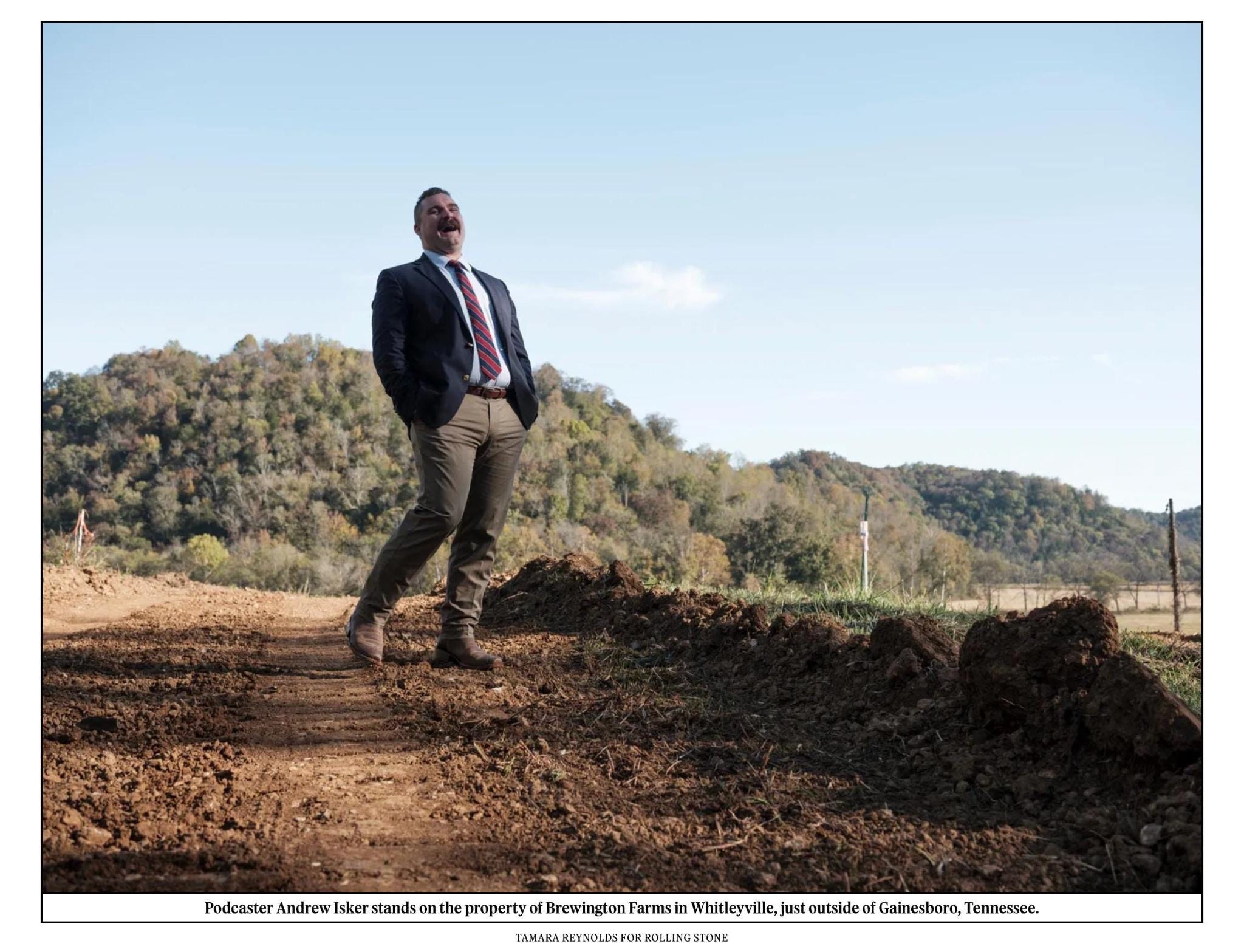
Recently, a Rolling Stone reporter came to Gainesboro, TN, to do a story on us. I don’t usually talk to reporters, especially those from far-left media outlets, but since he was going to do a story anyway and talk to the handful of libs in town who hate us, I decided I might as well speak for myself. So I agreed to answer pre-written questions via email.
The story is out now, and you can read it here. It’s behind a paywall and doesn’t really cover anything all that new, so don’t waste your money.
What I found interesting were the kinds of questions he asked. I am posting this because it is a good exercise to see how these people operate. You can see how many of these are softballs, to make you feel comfortable and drawn you in, especially the first ones. Then, however, we get to the controversial stuff. That is where they really want to get a killshot, something they can rip from context and make headlines with. The thing is, my views are fairly conventional paleoconservatism. Yeah, that’s very controversial in a world that believes cutting the testicles off little boys is normal, but to the half of the country that is still sane, nothing about what I believe is too shocking.
Anyway, he used almost none of this for the story. I wonder why?
Tell me about your background. Where did you grow up? What was your family like growing up?
I was born and raised in the small, rural, southern Minnesota town of Waseca. My father was an independent semi-truck owner-operator for nearly forty years. My mother also had a CDL and drove with him. After my sister and I started school, my mother worked at the elementary school as a special ed aide, as well as other part-time jobs. I spent my entire childhood in this town, where my great, great-grandfather had moved to shortly after it was founded. I went to college in nearby Mankato, MN.
Tell me about your own political awakening. When did you start getting interested in politics and why?
My interest in politics began when I was a child riding with my dad in the semi listening to Rush Limbaugh on the radio. I started watching Pat Buchanan on the MacLaughlin Group when I was nine or ten and always liked his commentary. What attracted me to it, even at a young age, is that these were great public questions of what is right and wrong, good and evil; these were battles worth fighting. My interest in the politics of immigration began in seventh grade when a classmate of mine was raped and murdered by an illegal alien. This interest did not have an outlet until Donald Trump arrived on the political scene in my late 20s.
How did you come to move to Jackson County. What was the impetus?
In 2018, after years of doing ministry in other states, I was finally able to return with my family to my hometown. I had intended to remain there the rest of my life. But in 2022, Tim Walz was re-elected and with him a thin majority in both legislative houses, and the first two things he did was pass legislation that allowed abortion right up until birth and also a law that allows the removal of children from the custody of parents who opposed their child’s “gender transition.” The first was something I would have stayed to fight. The second was one that threatened my family specifically. My eldest son is autistic, and in Minnesota, homeschooling him was not legally possible. Autistic children typically compartmentalize: he will not talk about school with us. Because of this, we have no idea what might be suggested to him. Someone could tell him he is actually a girl, put dresses on him, etc., and we would have no idea until it was far too late. At that point, because of Tim Walz’s new legal framework, we would lose our son. The scenario might seem implausible or alarmist until you see the percentages of “transgender children” who are on the autism spectrum. Even a 1% chance of this happening was too much.
As soon as this bill became law, my wife and I began planning how we would move. At the same time as Walz was destroying parental rights in Minnesota, Matt Walsh was leading an effort to protect parental rights over this issue in Tennessee. We knew this was a place we wanted to relocate to.
When did you first learn about Josh Abbotoy’s plans for Ridgerunner? What made you think that it would be a good situation for you and your family?
I had known Josh for a few years through mutual friends working to bolster conservatism in evangelical institutions. Around the time we were first considering leaving my hometown, I had heard about this idea. The area checked a lot of boxes for us. It is a charming small town and beautiful countryside with warm, friendly people, and a lot of potential for growth. RidgeRunner is very open about wanting to partner with church planting efforts and selling land to churches. This seemed like an ideal platform in which to plant a new church—people moving from across the country, many for reasons similar to mine, and most in need of a good church. Most church plants do not have advantages such as these, particularly not ones in rural areas.
Were you approached by Josh or Ridgerunner to move here? How did you know him?
(See previous answer)
When I met with Josh, he showed me the two developments, the one across from the high school and the other, Brewington Farms. Did you buy property in either of those spots? If not, where did you (or are you planning to) buy and build a house?
Yes, our property is in Brewington Farms.
How would you describe the general reaction to you personally since you’ve been here?
I’ve met countless folks since moving who’ve been warm and welcoming. The typical reaction I have gotten from actual people I have met in person has been extraordinarily positive. There have been some people who are somewhat cautious, not knowing what to think, especially after a biased local reporter compared me to Nazis on a local nightly broadcast. There are a handful of liberals in the county (Trump won 80% of the vote here) who are very vocal, as I’ve said many times, I’d be happy to talk with them, but no liberal has taken me up on that offer so far.
Has your family settled in well?
Yes, we have. My eldest appears to really like the school. My children are involved in sports and community ed. activities and have taken to the area well. They all like the pace of life here and living in a town where you can walk to the park or downtown to get some gelato at Ariola’s.
What do you like about the area?
I like that it is a community that has a conscious sense of its own identity. Gainesboro is an actual town with actual people who have been here for generations. It is not some transient place with hundreds of random people with no connection or bonds of social trust. Much of contemporary American life is downstream of policy intended to eradicate places like this. You are supposed to be atomized, isolated, anonymous, and alone. This place is not like that.
In what ways have you been surprised by the area? In what ways has it been different from what you expected?
I am surprised by how quickly I became accustomed to driving ten plus miles below the speed limit on the highway. The pace of life here is so vastly different than anywhere else I have ever lived. It’s honestly very refreshing.
And you’re building a church here, right? What’s your vision for the church itself? What do you want it to become?
I’ve often made the point that rural America is horribly neglected, not just by our political and cultural elites, but especially by Christian leaders as well. All of rural America is a forgotten place that has struggled economically because of decades of globalism and has suffered horrifically from opioids and fentanyl. If you want to have a giant, glitzy megachurch, it is not the place you seek out as a pastor. But if you want to truly help actual people, many of whom have had very hard lives and have suffered much, it is absolutely where you need to go. At our core, we are a church that is robustly and historically Protestant, with beautiful liturgy and preaching that takes the Bible seriously. But those are not things meant to be done in a vacuum: I want us to be a community within the community that is joyful, generous, and serious about the gospel of Jesus Christ in every part of life.
In some podcasts and other interviews that you’ve done—I’m thinking particularly about the Tucker Carlson interview you did—you spoke about Ridgerunner as a project that you seemed to be intimately involved in. You gave people a lot of info about it, you gave out the company’s website if they wanted more info. Did you or do you see yourself as something of an ambassador or a representative of Ridgerunner? Was that something you had discussed with Josh, helping to bring friends, allies, like-minded folks to Jackson County?
I would’ve loved to also promote my own books and other things to Tucker’s millions of viewers, but RidgeRunner is what he wanted to talk about most, and it is understandable why. It’s an interesting story. It’s why you are asking me about it and not my Amazon top-100 bestseller, The Boniface Option. No, I am not an official ambassador for RidgeRunner. The official ambassador is RidgeRunner’s founder and CEO, Josh Abbotoy. My role is as a church planter and pastor of a church that is building in one of their communities. Obviously, there is a common alignment of interests. I want people to move here to come to my church, and Josh wants them to buy beautiful property. These worlds overlap to some degree, but aren’t identical. People have moved to the area to come to my church, who don’t buy property, and people buy property without joining my church.
Have you worked to promote the project to friends or like-minded travelers in the online right?
Is there anything in it for you? Were you or do you get any sort of commission for bringing in new business?
I have indeed taken every opportunity to promote what I am doing online. There is obviously significant interest in it. And I am all-in on this; I moved my family here from my small town, where my family had been for six generations. I want it to succeed. What is in it for me is building a thriving, healthy church. So many people are tired of living disconnected, spread-out lives, and desire to be in a place where they can have neighbors and community again. I want that for my family. And I want to make sure that other people who want that, just like I do, know something like this exists. I do not receive commission. My reward is seeing more joyful faces worshipping on Sunday morning.
I want to ask you about some specific things you’ve written or tweeted or said on podcasts, but before I do, just generally speaking, are there things you’ve said that you regret, that you feel like you wish you could take back?
Who hasn’t wished at various points they’d said something different or phrased things a different way? When you write and speak for a particular audience, which you know understands the context of things you are saying and picks up on obvious jokes, and then an irresponsible journalist clips snippets ripped from that context to make you seem extremely radical and scary to a very different audience, of course you’d want to tailor things in a way to be as certain as you can that you will not be misunderstood.
Do you think people misunderstand the intent with which you say some of these things?
You said on a podcast about Ridgerunner, “we’re building a town, we’re building a community.” A lot of people took offense to that because they already have a town and a community that they love. Do you think that was misinterpreted? What did you mean?
I am excited about the community I am hoping to build, but I regret causing any offense to the wonderful people of Gainesboro. Obviously, I am not building a town. Gainesboro is a great town with great people who take pride in where they are from. Why would they want something else? And I decided to come here precisely because I like it the way it is! What is not as easily seen is that there are thousands of people across the country who want what Gainesboro has—a small, safe, tight-knit community. I hope that the community I am helping to build will provide this blessing to more people without changing or destroying what long-term residents love so much about the area.
Ridgerunner’s project is to build charter communities in Appalachia. What is the community that you’re hoping to be a part of building?
(See answer above re: Brewington)
You co-wrote a book with Andrew Torba about Christian Nationalism. What does the term “Christian nationalist” mean to you and is that an accurate way of describing your own ideology?
Is it an accurate way of describing this Ridgerunner project as you understand it?
“Christian Nationalist” first began to gain currency as a pejorative for evangelical Christians who supported Donald Trump sometime after the mostly peaceful protests of January 6, 2021. We wrote that book to defend evangelical Christians who love and care about their country, who we saw being slandered and vilified, especially by the leaders of evangelical institutions. In it, we gave a defense of these Christians and a biblical and historical defense for the desire to see one’s nation become self-consciously Christian. It really is just a shorthand for the idea that it is okay to be a Christian and vote for someone like Donald Trump, which is why it has diminishing returns as a pejorative.
No, I do not think it is accurate to describe RidgeRunner as “Christian Nationalist.” The company itself is a real estate business and has no position on such things. Josh Abbotoy is on record saying he isn’t a Christian Nationalist. I have many other friends who feel the same way, and that’s fine. But from my perspective, I am a Christian and an American nationalist, so I happily self-describe this way, despite knowing bad faith critics will attempt to use the phrase in insidious ways.
Obviously, Phil Williams has kind of gone after you and C.Jay in particular in his reporting about this project. What has he gotten wrong?
The fundamental problem with Phil’s reporting is that he took small snippets, ripped from context, from a conservative political theory podcast with thousands of hours of content where we discuss, in depth, any number of fraught issues in a frank and forthright manner. And Phil did in that order to paint us in a false light to create the impression that C.Jay and I are Nazis, women haters, etc., while carefully avoiding outright calling us these things – presumably because it was too risky to do so in the absence of real evidence.
I’ll give you one example. Phil took a statement of C.Jay’s commenting on the voting habits of college-educated white women (who are one of the most reliable democratic voting blocs) and used that comment to imply that C.Jay and I are opposed to women receiving an education. That’s patently absurd. Both C.Jay and I met our wives in college, and we expect our daughters to likely go to college. No reasonable person who saw the full context of the discussion around voting patterns in the 2024 election could have taken C.Jay’s comment in the way Phil tried to spin it. Phil has done this many times over, and that is, fundamentally, what’s wrong with his reporting. It’s not journalism—trying to present our views objectively—it’s left-wing activism.
If Phil had been objective and accurate in his reporting, he’d describe me as a paleo-conservative, much like Pat Buchanan, Tucker Carlson, or Matt Walsh.
Andrew, you wrote that “questioning the narrative surrounding the deaths of George Floyd, Ahmaud Arbery, and Emmett Till [is] an unforgivable sin.” What questions do you have around the historical narrative of these deaths? Are there things the historical narratives have gotten wrong?
Yes, each of these events have been and are still used to stoke racial tensions and violence. I am a Christian and a pastor, and Christians have a duty to both the truth and to bring peace. I do not want blacks hating whites and whites hating blacks. I think it is disgusting the way that the media leverages tragic deaths to push a false narrative that America needs fundamental change (like “defund the police” or George Soros DAs) to atone for its supposed original sin.
What do you think about the civil rights movement of the 1950s and 60s, in general? Was it, on average, a positive development for the country?
Have you read Age of Entitlement by Christopher Caldwell? That basically aligns with my ideas about the Civil Rights Act.
Andrew, you wrote, “Foreigners out, America is for Americans.” Who determines who is an American and who is a foreigner? Can only citizens live in the country legally? If you are a citizen by birthright, are you an American? If you are a Mexican-American whose family has lived in California since when California was part of Mexico, are you an American? If your Chinese ancestors came in the 1800s are you an American? Can Jews be Americans with all the same rights as Christians?
As a pastor and a Christian, I believe that governments have a duty to their own people first – and that comes before a duty to the entire world. But in recent years, our immigration policy has inverted this proper order. There’s been far too much illegal immigration and abuse of legal processes for entering our country. According to some estimates, nearly a third of our current population is foreign-born. No other nation in history willfully accepted this level of demographic change in such a short time. The entire last election was about this issue. Illegal immigration, the asylum system, work visas like H1B, etc., are out of control. Nearly every week, there is a story about an illegal immigrant committing a homicide or rape.
The Anglo-Protestantism that has been the core cultural, religious, and political foundation of this country has always been remarkably protective of religious minorities. Rights for Jews and other religious minorities have always been present in America since before the country became an independent nation. “A Christian nation” does not mean only Christians have political rights; it means that the cultural and political attitudes overtly reflect its Christian majority.
Andrew, you wrote, “You can have women’s liberation or civilization, not both.” Can you explain this?
Do you think women should be allowed to vote? Why or why not?
Since the women’s liberation movement and the sexual revolution, marriage rates and fertility rates have dropped off a cliff, while broken homes have skyrocketed. And almost 100 million American babies have been aborted in the last half-century. I see the wreckage from women’s so-called “liberation” every single day as a pastor. It’s been bad for people, and yes, I think it undermines our civilization. You cannot have a functioning civilization without marriage, families, and babies, and feminism is at war with marriage, families, and babies.
As to my “views on women voting,” my wife has voted for Donald Trump six times. I expect my daughters to vote when they are of age. Hopefully, my eldest daughter’s first vote will be to re-elect President J.D. Vance. My interest as a pastor, a student of historical theology, and as a social commentator is in how human society is socially and politically organized. The popular narrative, mediated through left-wing media and academia, is that all political and social thought prior to the 20th Century was patriarchal, oppressive, and misogynistic. When I read the political and social writing of my own Protestant and Reformed tradition prior to the 20th Century, I find the contrary. These men were deeply concerned about the welfare of women, families, and children. Our contemporary social and political order would never have occurred to them. Given the utter destruction of social life in America in the past hundred years, the collapse of marriage and birth rates, and the murder of 100 million babies, it is worth pursuing lines of inquiry that might be considered sacrilege to a society responsible for these ills.
How do you feel about representative democracy in general?
I think the original American Constitutional system was ingenious. It was a representative republic, comprised of a citizenry capable of self-governance. The system that we more or less have now, pure democracy, is not like that. Pure democracy is, as the founders warned, two wolves and a sheep deciding what is for dinner. Pure democracies tend to be short-term focused and struggle to address long-term problems. For example, this more than anything else is responsible for $37 trillion in sovereign debt that threatens both our nation and a fragile global order.
You also wrote “God made men to rule, period.” Do you believe women should be allowed to be in positions of political or business leadership?
All Christian social thought until the 20th century took the view that God has embedded hierarchies in nature, and that ordering the home, the church, and society in accordance with these hierarchies best promotes human flourishing. History and experience testify to this. But I do not think there should be laws or regulations prohibiting women from leadership positions any more than I think there should be laws or regulations requiring it. People should be allowed to make their own decisions freely.
Talking about Ridgerunner on The Auron MacIntyre Show, you said, “If you were able to take even a few hundred people that all think the same way and have all the same ideas about common good and politics and so forth, and you can consolidate them in the same place, you can exercise far more political power, even with a few hundred or a few thousand people, than you can on your own, widely dispersed across the entire country.” Is that still your goal in Jackson County?
Jackson County has wonderful cultural and political values that I highly align with. Over 80% of the county voted correctly in the 2024 election, for goodness’ sake! That general alignment is a big reason why I decided to move here.
If anything, I’d love to see the rest of America share more of Jackson County’s cultural, political, and economic commitments. For the last century, the cultural, political, and economic priorities of coastal and urban elites have been foisted on rural middle America, and it’s well past time to reverse this trend. Millions of Americans want exactly what places like Jackson County offer. It’s a generational opportunity for rural areas. My statement to Auron was calling young conservative guys to leave places where they are politically isolated, and put themselves in situations where they share cultural and political commitments with their neighbors, because that way they can be more effective in championing the cause of rural, middle America.
Do you feel like people who criticize a lot of your online writing or social media posts, don’t get your sense of humor, or don’t really understand the context of the online world you operate in?
Almost certainly.
When I was talking to Josh, he was talking about how there is less privacy living in a small town. Everyone knows who you are. They see you out at lunch or wherever. Does living in a small town, with the inherent visibility that you have there, change the way you think about your online persona and social media posts in any way?
Well, I am acutely aware that I am new to town and also that I was introduced by an inaccurate news story. Many of my new neighbors have met me and my family, and are getting to know my character, but others just know what the liberal media has said. Naturally, my new neighbors are a new part of my audience that I take into account now.
You and C.Jay have sort of become the poster children for this project whether you wanted to or not. Has Josh or anyone talked to you about being a little less visible and public, especially with regards to this project?
Above all else, I want to be the poster child for my church. God has blessed me with a large platform from which I can speak biblical truths to the key issues of the day to a large audience, which I will continue to do. That said, my church is taking an increasing share of my time as it rapidly grows. That’s my primary focus and calling, and my public platform is in service to that calling.
Looking back on it now, are there things you’d do differently in terms of how you’ve introduced yourself in Jackson County?
I obviously would have liked to have met people before sensationalist reporting made the first impression. But that, of course, was not up to me.
What are your personal goals in Jackson County?
I would like to have a strong, thriving church and to watch my sons play on State Championship football teams for Jackson County High School.
What do you hope Jackson County and Gainesboro look like in 10 to 15 years?
A lot like it does today. Lots of farms, pretty nature, and warm, friendly people. I do hope that RidgeRunner’s efforts bring more industry and commerce to the area and that everyone, locals and newcomers, are thriving because of it. If newcomers are all doing fine, but the rest of the county isn’t, that’s a failure. I’d like to see a full-sized grocery store come here. Selfishly, probably a golf course, too. Above all else, I want to see our church be a blessing and a place of hope for everyone.
No posts
Comments
Nothing yet. Say the first thing.
Sign in to join the conversation.