
This is the thirty-second part in a multipart series on the Book of Genesis. You can find the others here:
What Is The Imago Dei? What is the Sin of Ham? (Genesis 9:1-29)
Who Is “I Will Bless Those Who Bless You and Curse Those Who Curse You” Actually About? (Genesis 12:1-20)
No, Abraham Did Not Lie Because He Was Scared (Genesis 20:1-18)
Why Is There So Much Bronze Age Real Estate Law In The Old Testament? (Genesis 22:20-23:20)
Isaac and Rebekah as a Type of Christ and the Church (Genesis 24:1-67)
Esau Was ALWAYS The Bad Guy And Jacob Was ALWAYS The Good Guy (Genesis 25:1-24)
Isaac Did Nothing Wrong Deceiving Abimelech (Genesis 26:1-33)
Jacob Did Nothing Wrong In Deceiving Isaac (Genesis 26:34-28:5)
Jacob’s Ladder Is Not What You Think It Is (Genesis 28:6-22)
No, Jacob Did Not “Deserve” What Laban Did To Him (Genesis 29:1-30)
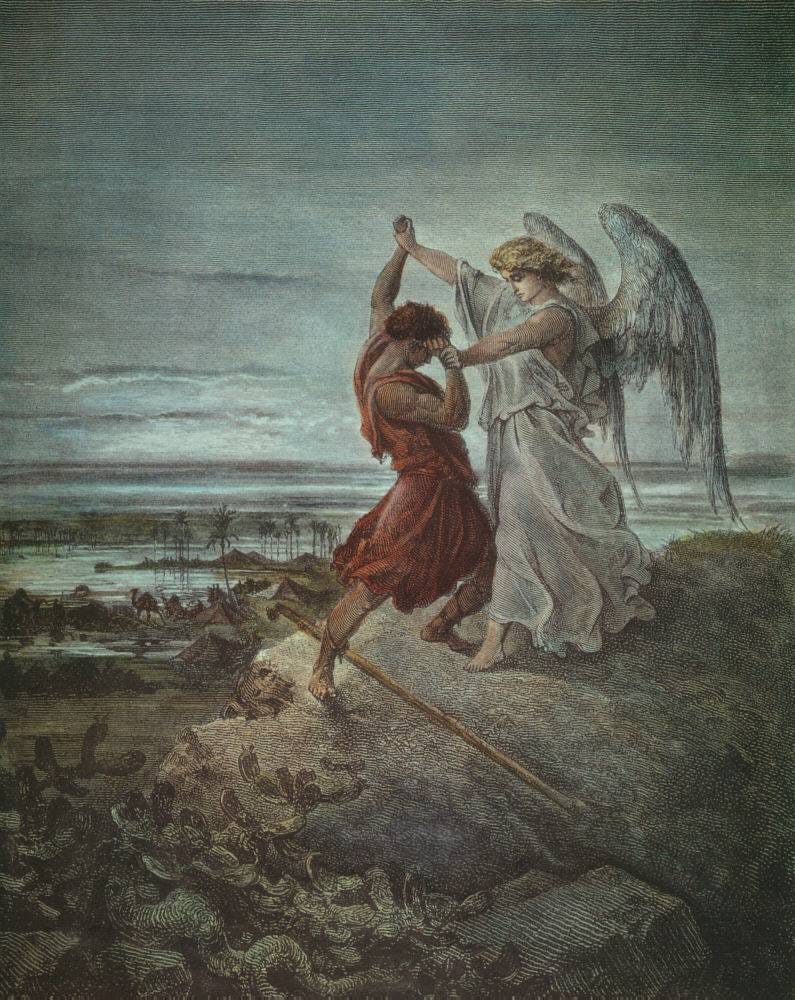
Jacob wrestling with God at Peniel is popularly treated as the moment of his conversion. But as we have been going through Genesis, we have seen that Jacob has been a believing and faithful man his entire life. The scene at Peniel is actually God revealing to Jacob what his entire life has been about. He has struggled and suffered against men his whole life, but the struggle ultimately was with God and not men. Jacob’s life is a theological illustration that faithfulness to God’s covenant requires you to fight.
As Jacob went on his way, he saw the angels of God. He saw God’s army camped out in the field, ready for war. God had promised to be with him. Jacob had, this entire time, apprehended this with eyes of faith, but here he gets to see it with his own eyes. He renamed the place after this, naming it Mahanaim, a “siege camp.”
As he re-entered the Land, he sent messengers to his brother in his territory of Edom. He tells them to tell Esau that he has become very rich in the land of Padan Aram. They come back to tell him that Esau is coming to him, with four hundred men. There is exactly one reason why Esau would gather four hundred men to go meet Jacob—for war.
Jacob understands this immediately. He was afraid and distressed. It is not a lack of faith to be fearful here. He should be alarmed at this, even if he trusts that God is still with him. He does what any faithful man should do and takes prudent action. He divides his company into two parts so that one can flee if the other is attacked. He also appeals to God, promising faithfulness if God would bring them back to the Land, and admits his own unworthiness of God’s grace to him. And he appeals to God’s covenant and promise that He has made to Jacob. Do not let your people be destroyed, Lord, you said they would make my descendants as numerous as the sand of the sea, so you cannot let them be destroyed now.
That night, they made their own war camp and prepared gifts to be sent to Esau to buy him off. He had his servants bring each drove to Esau separately, the goats, then the sheep, then the camels, then the cattle, and then the donkeys. Putting distance between the droves so they would arrive in slow succession. Why did he do this? Because he knew his brother Esau’s character. Remember, this man had no ability to delay gratification; the gifts had to be spaced out to maximize their impact. He was like a child on Christmas morning, instead of getting all his presents all at once, being forced to open each one separately, waiting for his turn. Jacob is making a bet on his brother’s own incorrigible gluttony.
That night, he took his wives, his concubines, his sons, and they crossed over the Jabbok, which is a tributary of the Jordan. They all went on ahead into the Land, while he stayed back. The geography here is important. He is not quite yet in the Land. Jacob was alone, and a man showed up and wrestled with him the entire night. Now, if you were Jacob, who would you assume this man was? You would assume that a guy showing up in the middle of the night and fighting with you would be your brother Esau. The man did not beat Jacob, and at the end, he touched his hip socket and pulled it out of joint, telling him to let Him go. Jacob refused to let him go unless he spoke a blessing. You do not allow your enemy just to leave until he makes peace with you. The Man asked Jacob his name, to which he responded. And here he renames him Israel, “He who strives with God.” He tells him that he has not been struggling with men, but also with God. And Jacob asks Him His name, but the Man refuses to give it. Why do you ask my name? (Essentially, I am the one doing the blessing and need to know your name; you don’t need to know mine.) And then the Man blessed Jacob, was at peace with him, and left.
Jacob named this place Peniel, “Face of God,” because he had seen God face to face and lived. Now he hadn’t really seen him; it was dark out. That too is theologically significant. The Old Covenant is in the dark. Only in the New Covenant do we see God’s face in the light.
At this point, Jacob crosses over the Jabbok limping. The limp, too, is theologically significant. This is a foot and leg wound. The promise of Genesis 3 is that the Seed’s foot would be crushed, whereas the Serpent’s head would be crushed. The Seed walks through life wounded and limping, but the Serpent is killed. And as a memorial of this, from this point on, the children of Jacob did not eat the muscle on the hip socket.
All of Jacob’s life, his struggles with his brother Esau, the struggles with his father Isaac in the grip of rebellion against the covenant, the struggles with his treacherous uncle Laban, and now the struggle with his brother again, all of these fights Jacob was not fighting merely with human beings. All these God ultimately raised up for Jacob. He raised them up to mature Jacob.
This is true of the whole history of God’s people. And so it is with us, as well. All the enemies that appear are there because God wanted them to be. They are there for us to deal with faithfully and to further trust Him to lead us and defend us. Even Satan and his host are this way.
The great error that is often found in the church today is the idea that Satan has a separate power and dominion apart from God. Something like Manichaeism. That good and evil have equal power, 50-50. But that is not what the Bible teaches at all. The Bible teaches that Satan is a created being who rebelled against God, and that God has 100% of the power. That Satan cannot do one single thing unless God permits him to do it. You see this in Job 1, for instance. Even this enemy, this great enemy, is one where we are ultimately struggling with God.
All of you have had conflict in life; most of you have had very serious conflicts with other people. With family, with erstwhile friends, with employers and coworkers or employees, with random violent people, or even in actual war. All the enemies that you have had to fight with, you thought, if I can just get over this conflict, if I can win, then things will be fine. But ultimately, your struggle is with God. You need to be at peace with Him before you can have peace anywhere else.
The same is true of the great conflicts for the church at large. All the enemies of the faith, the ones with very real power, are no different than Philistines or Assyrians that God has raised up. Our great challenge is not “what do we do with the people pushing utter degeneracy everywhere? How do we defeat them?” Our great challenge is how to get right with God? What have we done against God that caused Him to raise them up in the first place? That is what we give our fuller attention to.
The lesson of Jacob’s life is what Jesus says in Matthew 11:12: the kingdom of Heaven suffers violence, and the violent take it by force. The covenant is kept, is maintained, and is brought forward into the future by those who are ready to fight for it; by those who are committed to the struggle and the suffering it entails. When your life feels like a slog, like it is nothing but conflict everywhere, that is because God has put you in that exact place for a reason. He wants you to remain faithful to Him, obeying what He has commanded, and to go through everything that comes at you. The Christian life is a life of war, and not merely war against flesh and blood (which sometimes does happen), but ultimately spiritual war.
So people of God, trust Him, that He is good, that whatever He raises up He will also give you the grace to overcome. Trust Him. Trust that He will be the one who brings peace. In the Name of the Father, the Son, and the Holy Spirit. Amen!
Comments
Nothing yet. Say the first thing.
Sign in to join the conversation.